1. What is the difference between FIRPTA and the actual tax?
Two separate rules, and mixing them up is the most common error I see here.
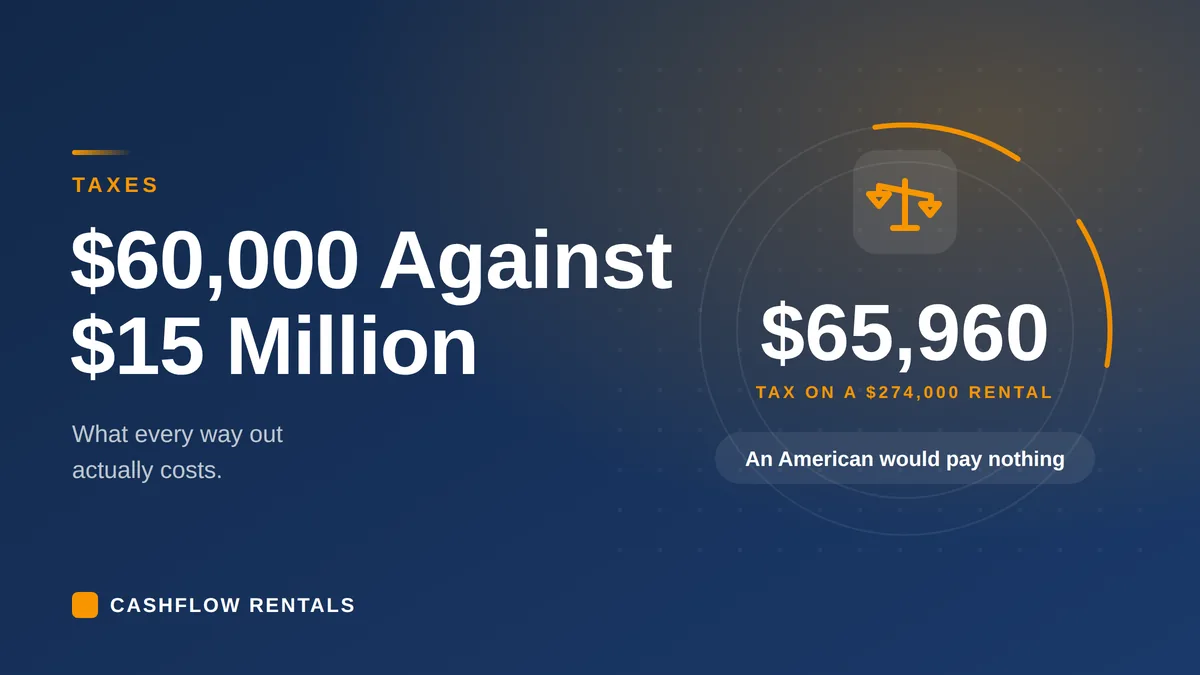
FIRPTA, under IRC 1445, makes the buyer hold back 15% of the gross sale price and send it to the IRS within 20 days. It is worked out on the price, ignores your costs, and takes no account of whether you made money.
Your actual final tax bill, under IRC 897, is worked out on your net gain and reported on Form 1040-NR. Section 897 treats gain on US real property as effectively connected income, which puts it into the graded rate system rather than the flat withholding one. It is the same mechanism that governs your rental income while you hold, set out in how to stop the 30% withholding.
On a long hold of a typical US rental property, the withholding is nearly always bigger than the tax due, which is why refunds are normal rather than rare. Getting that money back is its own process, and slower than most people expect, which I have set out in how to get your FIRPTA money back.
2. What rate will I actually pay on the gain?
Search this and you will be told non-residents pay 30% on capital gains. That rule is real, but it does not apply to your rental property.
Under section 871(a)(2), a flat 30% applies to a non-resident in the United States for 183 days or more in the year, and it aims at other assets. Real property is dealt with separately by section 897, whatever days you spent in the country.
So your US rental property is taxed at the normal long term capital gains brackets, the same ones an American uses.
Long term capital gains brackets, 2026, single filer| Taxable income, single filer | Long term rate |
|---|
| $0 to $48,350 | 0% |
| $48,351 to $533,400 | 15% |
| Above $533,400 | 20% |
Two things sit outside that table.
Depreciation recapture, formally unrecaptured section 1250 gain, is taxed at a maximum of 25%. That is a cap rather than a rate, so if your marginal rate is lower, which it often is for a foreign owner with no other US income, you pay the lower figure. That matters a great deal below.
And holding for a year or less loses you the long term rates and puts the whole gain at normal graded rates. Which is another argument for holding real estate long term. Which is another argument for holding, on top of the 11% round trip transaction cost I set out in what closing costs actually are.
One point on filing status. Form 1040-NR offers single, married filing separately, or qualifying surviving spouse. A non-resident cannot file jointly or as head of household. Where that return sits among everything else you file is in my US tax guide for foreign investors. And there is no standard deduction, so your taxable income is the gain itself.
3. How do I work out my basis?
This is where the money is, and the part that almost nobody explains properly.
Your cost basis is not what you paid. It is what you paid, plus some purchase costs, plus any qualifying capital expenditure such as a new roof, minus all the depreciation you claimed or could have claimed.
Start with the closing costs, because most of them do not count.
On a real Kansas City settlement statement I went through in what closing costs actually are, the $7,477 of buyer closing costs broke down roughly as follows.
How buyer closing costs are treated | Treatment |
|---|
| Title, escrow, recording, transfer | Capitalizable. Goes into basis. |
| Loan origination, points, desk review | Amortized over the loan. Not basis. |
| Prepaid interest, impounds, insurance premium | Deducted as expenses. Not basis. |
Points and origination are a function of how the loan itself is priced, which is in DSCR loans explained.
On that statement, the capitalizable share was about 14% of the total. So on a $150,000 purchase with $7,500 of closing costs, roughly $1,080 reaches your basis and $6,420 does not.
Why does this matter? Because the higher your basis when you sell, the smaller the gap between that basis and the sale price, and the lower your eventual capital gains tax bill.
Those other costs are deducted or spread elsewhere, so you do get relief for them. But assume the whole $7,500 lifts your basis and your gain could be wrong by thousands.
Then add qualifying capital expenditure, and note what happens next. A new roof, new windows, a kitchen, an extension. These can be added to your basis, and each one starts its own depreciation clock from the year you fit it. So it cuts your gain and raises your recapture at the same time.
Then take off the depreciation. All of it, whether or not you claimed it, because the code cuts basis by depreciation allowed or allowable, which I have written about in the depreciation advice that costs foreign investors thousands.
Canadians have a further complication, because while you can claim depreciation on your US rental on your Canadian return too, it is calculated differently, as I have set out in should Canadians claim CCA on a US rental.
One thing to make clear: repairs are not capital expenditure. The cost of fixing a leak is deductible from your taxable income. Replacing the roof is capital expenditure and goes into your basis. Getting that line wrong either way costs money.
The one thing to remember: keep every receipt for capital work for as long as you own the property. Basis is built over a decade and reconstructed on one afternoon, years later, from whatever you kept.
4. What does the tax look like on a real sale?
I will use a Kansas City rental property. Bought for $150,000 in 2016, sold for $285,000 in 2026. It is the market a lot of our clients buy in, including my Canadian client Ronald, whose purchase is in his case study. Windows and doors replaced in year five at $8,000. No other US income. Single filer.
The basis
The adjusted basis on the worked sale| Purchase price | $150,000 |
| Plus capitalizable closing costs, 14% of $7,500 | $1,080 |
| Plus windows and doors, year 5 | $8,000 |
| Less depreciation on the building, 10 years | ($43,951) |
| Less depreciation on the improvement, 5 years | ($1,455) |
| Adjusted basis | $113,675 |
The building figure is $120,864 over 27.5 years, taking 80% of the price plus qualifying costs as building and 20% as land, because land is not depreciable.
The gain
The gain on the worked sale| Sale price | $285,000 |
| Less selling costs at 7% | ($19,950) |
| Net proceeds | $265,050 |
| Less adjusted basis | ($113,675) |
| Total gain | $151,375 |
| of which unrecaptured section 1250 gain | $45,405 |
| of which long term capital gain | $105,970 |
The tax
Taxable income is the whole $151,375, because there is no standard deduction. And the recapture stacks below the capital gain, so it uses up the low brackets first.
The recapture, $45,405, taxed at the lower of 25% or the ordinary rate:
The recapture, $45,405, taxed at the lower of 25% or the ordinary rate| $11,925 at 10% | $1,192 |
| $33,480 at 12% | $4,018 |
| Subtotal | $5,210 |
That is an effective 11.5%, not 25%, because with no other US income the recapture falls into the bottom two normal brackets. The 25% cap is never reached.
The capital gain, $105,970, at long term rates:
The capital gain, $105,970, at long term rates| $2,945 at 0%, what is left of the 0% band | $0 |
| $103,025 at 15% | $15,454 |
| Subtotal | $15,454 |
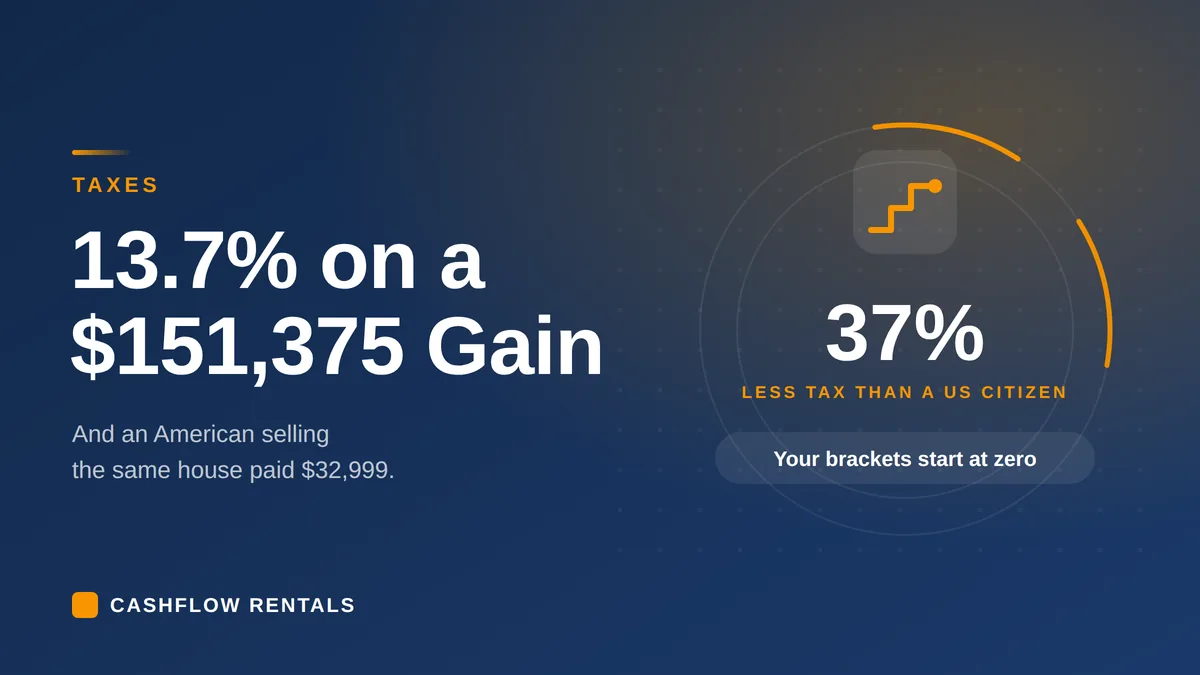
Total US federal tax: $20,664. An effective rate of 13.7% on the gain.
And because FIRPTA held back 15% of the $285,000 gross, $42,750 went to the IRS and $22,086 comes back in a refund when the seller files their next US tax return, which is its own process, set out in how to get your FIRPTA money back.
5. Why do I pay less than an American on the same house?
Now the comparison that surprised me when I built it.
Take a US citizen earning a $100,000 salary who sells the identical property on the same day.
The same house, sold on the same day, by two different owners | Foreign seller | US citizen on a salary |
|---|
| Recapture | $5,210 at 10 to 12% | $11,351 at the 25% cap |
| Capital gain | $15,454 | $15,896 |
| Net investment income tax at 3.8% | none | $5,752 |
| Total | $20,664 | $32,999 |
The foreign seller pays $12,335 less, which is 37%.
Two things drive it.
Your brackets start at zero. The American's gain stacks on top of $100,000 of salary, so their recapture hits the full 25% cap and none of their gain gets the 0% band. Yours starts at the bottom of the table.
And you do not pay the investment income tax. Non-resident aliens are excluded under section 1411(e)(1), confirmed in the IRS instructions to Form 8960. On this sale that alone is $5,752.
This is the one place in the whole system where being foreign helps, and it is worth knowing before you assume the US is punishing you. On this line, it is not.
Two warnings, and they matter. With other US income the brackets fill up and the edge shrinks, and that includes rental income from other US properties you own. And your own country will tax the same gain, with credit for what the IRS took, which for a British owner can more than reverse the position. I worked that through on a real ten year hold in selling a US rental as a UK resident.
There is a Canadian version of the same exercise in selling a US rental as a Canadian, where the withholding rate itself can change. And the rent you collected while you held the house is taxed at home too, which for a UK owner is in UK tax on US rental income.
6. What does the state take on top?
Federal is not the whole bill. Most states tax gains as income, and some run their own withholding on non-resident sales, separate from FIRPTA.
Nine states have no personal income tax and so no state tax on gains: Alaska, Florida, Nevada, New Hampshire, South Dakota, Tennessee, Texas, Washington and Wyoming. Washington taxes some long term gains above a threshold, so check.
Pennsylvania is worth a specific warning, because it gets reported wrongly all over the internet. It does not tax non-residents on gains from intangibles, which is why you will read that it does not tax non-residents at all. It does tax gains on Pennsylvania real property, at 3.07% flat, which the Department of Revenue states plainly. On this gain that is about $6,451.
Everywhere else, expect the state to tax the gain broadly as income. Rough top rates in the markets my readers buy in most:
Approximate top state rates on capital gains, indicative and changing annually| State | Approximate top rate on capital gains |
|---|
| Florida, Texas, Tennessee, Nevada | 0% |
| Pennsylvania | 3.07% flat, including for non-residents |
| Indiana | around 3% |
| Ohio | around 3.5% |
| Michigan | around 4.25% |
| Alabama | around 5% |
| Missouri | around 4.7% |
| Georgia, North Carolina | around 4.5% to 5% |
| Illinois | around 5% |
Treat those as a guide rather than exact numbers. State rates change every year, several are phasing down as states compete for business, and some cities add a local tax on top. Which states are worth buying in for other reasons is a different question, and I have answered it in the best buy-to-let markets in the USA. The state guides on this site will carry current figures market by market.
Two practical points. Some states run their own non-resident withholding, which means two lots held back from one closing. And a state return is usually needed even where no tax is due, in order to claim any of it back.
7. What would I do before selling?
Five things, and the first is worth more than the other four combined.
Keep every receipt for capital expenditure. Your basis is built over a decade and put back together in an afternoon, years later. The gap between $30,000 of works you can prove and $30,000 you cannot is about $4,500 of tax on these numbers.
Work out your basis before you list, not after you take an offer. The capital work that built that basis is in maintenance, repairs and capital. It tells you the real tax, which tells you whether a withholding certificate is worth applying for, and that takes 90 days.
Hold for more than a year. Obvious, but worth saying, because a sale at eleven months puts the whole gain at normal rates.
Check whether the state holds back its own share, because two lots from one closing catches people out. And if you decide not to sell, price the other bill instead, because your estate faces its own, set out in US estate tax for foreign property owners.
And ask about a 1031 before you decide. On a gain this size the deferral is real money, though FIRPTA makes it much harder than it is for an American, which I have covered in can a foreign investor do a 1031 exchange.
You can size the withholding and the likely liability with the FIRPTA withholding calculator, and if you would rather have the sale and the paperwork coordinated for you, that is part of what our purchase and sale support covers.
The rest of the free tools and checklists are in my investor starter kit.
The bottom line
FIRPTA takes 15% of your gross sale price. The tax is a different number, and it is usually smaller.
On a ten year hold with a $151,375 gain, the federal bill came to $20,664. An effective rate of 13.7%, and about half the withholding came back.
The two rules that make it that low are both accidents of being foreign. Your brackets start at zero because you have no US salary, and you are exempt from the 3.8% investment income tax. An American on $100,000 selling the same house pays $32,999.
Where you lose is at home, because your own country taxes the same gain and gives credit only for what the IRS took. And where you lose money for no reason is basis. Works you never claimed, receipts you never kept, and the belief that all your closing costs went into it.
Remember, investing is a game of probabilities. This is arithmetic, and the arithmetic rewards good records.
This article is general information, not legal, tax or financial advice. David Garner is a property investor and is not a tax adviser, accountant, CPA or Enrolled Agent. The worked example is modeled from published rules including Internal Revenue Code sections 871, 897, 1016, 1250, 1411 and 1445, the long term capital gains brackets as we understand them for 2026, and the ordering used in the Schedule D Tax Worksheet. The stacking of unrecaptured section 1250 gain against long term rates is involved and the figures given are our best construction rather than a filed return; have your own CPA confirm any number before relying on it. Closing cost proportions are drawn from a real Kansas City settlement statement and will vary. State rates are indicative, change annually, and exclude local income taxes. Always take advice from a CPA or Enrolled Agent experienced in cross-border property before selling.