What exactly is a DSCR loan?
A DSCR mortgage is a type of Non-Qualified Mortgage, or Non-QM. That means the lender focuses on the property's rental income rather than your personal income, which is what makes it such a natural fit for buying rental property.
Investors like me and my clients tend to choose DSCR loans over conventional loans because we do not have to prove personal income or manage a debt-to-income ratio. Most of my income comes from real estate, so after deductions my net taxable income is low. A conventional lender would see that and balk. A DSCR lender simply looks at whether the property pays for itself.
There are a few types of DSCR loan depending on what you want to do:
- DSCR purchase loans: what I use when buying rental property. Ideal for investors who cannot, or would rather not, document personal income.
- DSCR home equity loans: useful when you already own a rental and want to draw equity for improvements or for the down payment on the next purchase.
- DSCR cash-out refinance loans: something I have done more than fifty times to keep expanding a portfolio, and something I have also badly overdone. More on both in my DSCR cash-out refinance guide.
- Portfolio and blanket loans: one loan secured against several properties at once, which is how I bought four Kansas City houses in a single closing. See portfolio and blanket DSCR loans.
For a deeper explanation of DSCR financing for 2 to 4 unit small multifamily properties specifically, see DSCR loans for small multifamily.
British investors have a specific set of questions I cover in buy-to-let mortgages in the USA
What DSCR means, and how to calculate it
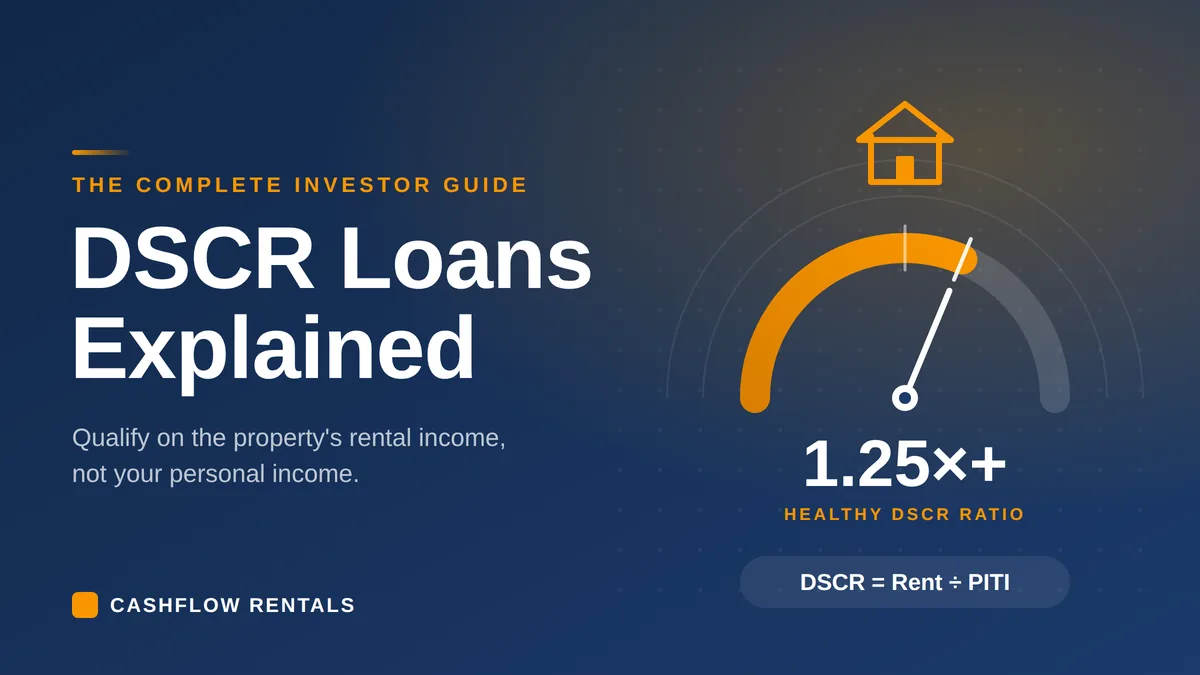
DSCR stands for Debt Service Coverage Ratio. In plain terms it is the gross rental income compared with the total mortgage payment, known as PITI: Principal, Interest, Taxes, and Insurance, plus HOA fees where they apply.
Most DSCR lenders do not factor in variable costs like vacancy, maintenance, management, or capital expenditure reserves when they calculate the ratio, though you absolutely should when you underwrite a deal for yourself. The cost of owning and maintaining rental properties in the US has increased dramatically over the past 5 years, so don't underestimate, it'll cost you!
Some lenders call these DSR or DCR loans. The correct term is DSCR, but the names are used interchangeably and refer to the same product. To work out the ratio, you divide the gross monthly rent by the monthly PITI:
- Step 1, estimate gross rent: use current rent roll data (if the property is leased) or an independent appraisal (1007). If you do not have those yet, a tool like Rentometer gives a reasonable estimate. You can also just search similar listings for available rentals in that neighborhood.
- Step 2, work out PITI: add principal and interest, monthly property taxes, insurance, and any HOA. Use pro-rated monthly figures. For example, P&I of $1,250, taxes of $250, and insurance of $100 give a PITI of $1,600.
- Step 3, divide: rent of $1,900 divided by PITI of $1,600 gives a DSCR of 1.19. Use accurate numbers, because the lender will check everything at underwriting and an over-optimistic figure can sink the approval.
That last point is not theoretical. I've watched a deal die because the borrower's rent estimate did not survive the appraiser's independent opinion, which I write about in why DSCR applications get declined.
I link to my own DSCR calculator below, so you can use that to figure it for you, and it also gives you live interest rate estimates for your deal that are updated daily, and pretty accurate.
What is a good DSCR ratio?
Most lenders agree that a good DSCR is 1.25 or above, which means there is comfortable income to cover the payment.
Plenty of lenders will still lend at 1.0, and I have seen loans written as low as 0.75. As a rule, the higher the DSCR, the better the rate you are offered.
- Poor DSCR: below 1.0
- Decent DSCR: 1.0 to 1.25
- Good DSCR: above 1.25
For a sense of what that looks like on real deals rather than in theory, here are ratios from actual loan proposals and purchases I've consulted on recently: 1.64 on the Cleveland rental below, 1.84 to 1.93 on a Kansas City single family purchase depending on which loan pricing option was taken, and 1.85 combined on a four-property Kansas City portfolio loan.
Notice they are all comfortably above the minimum 1.0. A property that only just clears 1.0 has no room for a tax reassessment, an insurance increase, or one big repair. Owning rental properties with thin margins is a recipe for disaster, and I'll talk about my own experience with that later in this article. Also, because a stronger ratio also earns better terms, it is worth knowing the levers you can pull to improve a property's DSCR.
Use my free DSCR loan calculator
Rather than run the numbers by hand, you can use my free DSCR loan calculator to work out DSCR, PITI, estimated closing costs, and reserves for any property. Enter annual figures for tax and insurance, and add numbers without dollar or percent signs. The calculator also gives you a live rate estimate based on the property and your profile.
Free DSCR Loan Calculator. Work out DSCR, PITI, closing costs, and reserves for any rental property.
Open the calculator
Case study: how a client used a DSCR loan in Cleveland
Here is a real example based on a three-bedroom single family rental I helped a client buy in Cleveland, Ohio in July 2025. It was a turnkey property with a tenant already paying $1,500 a month. The buyer was a Canadian national, and we used a DSCR product to finance the purchase.
- Purchase price: $131,000
- Down payment: $32,750
- Loan amount: $98,250 at 75% LTV
- Interest rate: 7.5%
- Monthly P&I: $686.98
- Total PITIA: $915.06 (including pro-rated taxes and insurance)
With gross rent of $1,500 against PITI of $915.06, the property came in at a DSCR of 1.64, which qualified comfortably.
The interest rate was a touch higher than other loans I've worked on because of the smaller loan size, which is a pattern worth understanding and one I come back to below. The property still throws off reasonable monthly cash flow.
I go into the real numbers in can you get a DSCR loan under $100,000.
One reminder: when you underwrite for yourself, include the costs the lender leaves out, management, plus reserves for repairs, vacancy, and capital expenditure.
DSCR loan requirements
Every lender is a little different, but most share a common core of requirements:
- An income-producing rental: usually single family or one-to-four unit properties, sometimes small commercial.
- Positive cash flow: most lenders want a DSCR of 1.0 or higher.
- Documentation: proof of identity, and LLC or trust documents if you buy through an entity.
- Credit score: U.S. borrowers generally need a score in the low 600s or higher. Non-residents are not required to have U.S. credit at all.
- Minimum loan amount: often around $100,000, though I have used loans between $75,000 and $100,000.
- Appraisal and proof of funds: an independent appraisal of value and market rent, plus evidence of liquid funds for the down payment, closing costs, and reserves.
Down payment: budget for 25% to 30%. U.S. citizens with good credit can reach 80% LTV, so 20% down. Non-residents typically put down 25% to 30%.
Credit: in practice I see DSCR loans from around 600 FICO and up, with scores above 720 earning better rates. There is a counterintuitive wrinkle here for borrowers without an established U.S. file, which I cover in whether you really need US credit.
Loan to value: U.S. citizens with decent credit can reach 80% LTV. For non-residents the ceiling in the current market is usually 75%, with many specialist lenders capping at 70%.
Closing costs: most guides give you a percentage range and leave it there, so here are real numbers from deals I have worked on.
On a $190,000 single family purchase, closing costs came to about $9,500, or 5%, made up of loan origination, admin and legal, appraisal, title fees, recording fees, and prepaid tax and insurance escrows.
On a $700,000 four-property portfolio loan, the all-in closing costs ran 5% to 6%, and that figure included the lender's reserve requirement.
Origination is often quoted in points, where one point on a $100,000 loan is $1,000, and it varies enormously between lenders. I have also seen a borrower pay over 12% of the loan balance in total costs on a cash-out refinance, which is why shopping around for the best overall deal (not just interest rate) matters.
Cash reserves: most lenders want you to hold a number of months of PITI as a cushion. A good rule of thumb is 3 to 12 months, though it varies significantly depending on the lender and the property type. Reserves are not a fee. They stay your money, you simply have to prove you hold them. I hold my reserves in an interest-bearing reserves account, so it's not completely idle capital.
Small loans under $100,000
This deserves its own section, because it is the question the lending industry mostly declines to answer.
Personally, I'm not a huge fan of leveraging cheap properties. There's typically not enough cash flow margin to accommodate the inevitable vacancy, turnover, big repair or capex cost that's always heading your way as a landlord. More on that later.
With that said, most DSCR lenders publish a minimum loan amount somewhere between $100,000 and $150,000. Below that, many simply will not quote. The reason is margin: the work to underwrite, appraise, and close a $75,000 loan is much the same as for a $400,000 loan, and the revenue is a fraction of it.
But small loans do get written. I have used DSCR loans between $75,000 and $100,000 myself, on the kind of Midwest single family homes where a solid renovated rental can be bought for under $150,000. Here is what to expect if you go looking:
- Fewer lenders. Your pool shrinks sharply below $100,000 and shrinks again below $75,000. This is exactly where a broker with whole-of-market access earns their fee.
- A higher rate. Small loans price worse for the same borrower and the same property quality. The Cleveland deal above carried a slightly higher rate for precisely that reason.
- Higher relative costs. Fixed fees like appraisal, title, and recording do not scale down with the loan, so they eat a larger percentage of a small deal. A $2,000 fixed cost is 1% of a $200,000 loan and 2.7% of a $75,000 one.
- Sometimes a bigger deposit. Some lenders offset small-loan risk with a lower LTV.
The structural point worth understanding: a slightly larger loan can sometimes unlock a better pricing tier, so it is occasionally cheaper overall to borrow a bit more. I have seen exactly that happen on a real deal, and I worked through the numbers in how to cut your cash to close.
DSCR loan rates, and a decade of real numbers
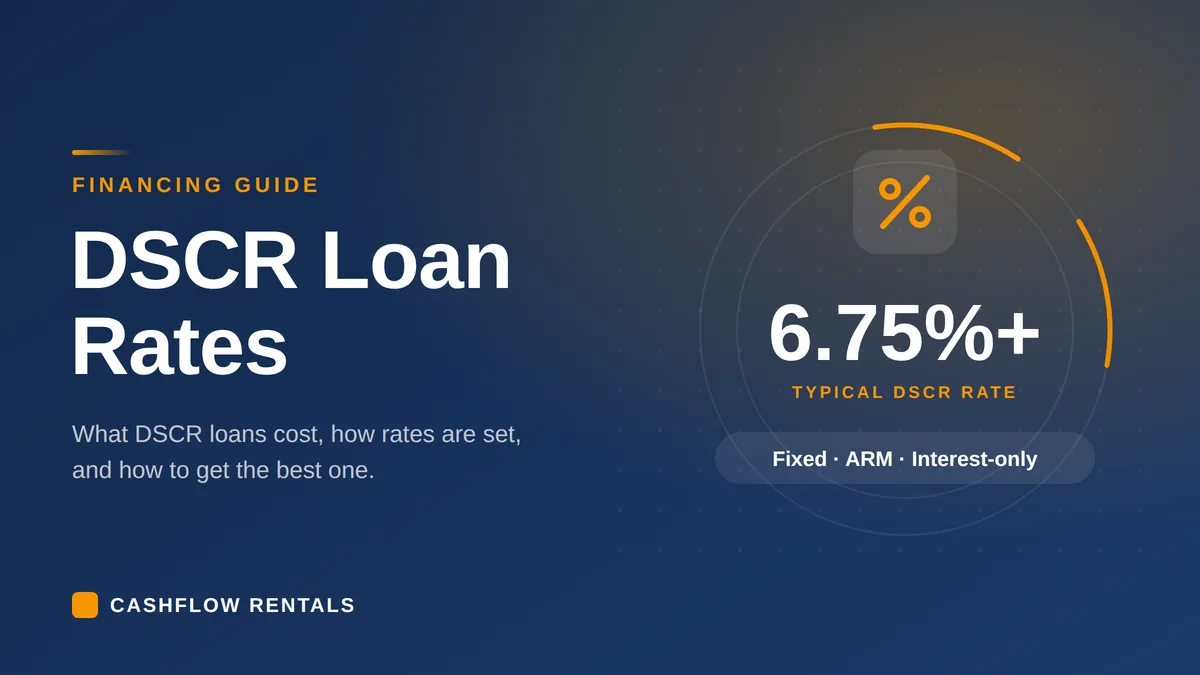
First, expect to pay a little more than on a conventional mortgage, since DSCR loans are treated as higher risk. The actual rate depends on several moving parts, including the current 5-year Treasury yield and SOFR, the loan-to-value, the loan size, your credit, your residency, the DSCR itself, and your experience as an investor.
Here is something most rate guides won't give you: what I have actually paid over ten years of borrowing. Across roughly $6 million of DSCR loans since 2016, my rates have ranged from about 8% at the top to about 6% at the best. That is the full spread of one borrower's experience through several rate cycles, and the lesson you can take from it is that the differences between lenders in any given month have mattered to me more than the movements in the market between years.
For current numbers, in mid 2026 I have seen 6.5% to 8% on a single family purchase at 70% to 75% LTV depending on points paid. That is a full 1.5% spread on the same borrower profile in the same month. Rates move constantly, so for live numbers based on real borrower profiles see my regularly updated DSCR loan rates guide.
What a real term sheet looks like
One thing I've found lacking online is actual hard data from real deals and quotes, so here is an anonymized real proposal I worked on recently: one lender, one $136,500 loan on one property, offered three different ways.
One lender, one $136,500 loan on one property, offered three ways (anonymized proposal, July 2026) | Option 1 | Option 2 | Option 3 |
|---|
| Rate | 7.125% | 6.875% | 6.625% |
| Origination and points upfront | ~$515 | ~$2,220 | ~$3,930 |
| Monthly payment (PITI) | $1,084 | $1,061 | $1,039 |
| Estimated cash to close | ~$66,776 | ~$68,483 | ~$70,189 |
That is a points ladder, and almost every lender runs one whether or not they show it to you. Points are prepaid interest: pay more at closing, get a lower rate.
The calculation almost nobody runs is the breakeven. Upfront cost divided by monthly saving equals the number of months it takes to break even.
On this ladder, buying from Option 1 down to Option 3 costs about $3,415 more at closing to save $45.60 a month, so the breakeven is roughly 75 months. Over six years. And since these loans typically carry a five-year prepayment penalty, the natural decision point arrives before the buydown has paid for itself. On this particular sheet, the worst rate on the page was arguably the best deal.
In my experience, lenders often won't walk you through that arithmetic, because it frequently argues against buying points. I decode the rest of the terms sheet fine print, including the 5-4-3-2-1 prepayment penalty structure and the rate lock, in DSCR loan terms decoded.
Fixed, ARM, and interest-only
The structure of the loan you choose affects your payment, your DSCR ratio, and your cash flow. The three main options are:
- Fixed rate: 15 or 30-year terms offering stability. I favor the 30-year fixed because it lets me project cash flow accurately without worrying about future rate moves.
- Adjustable rate (ARM): a lower initial rate that later resets periodically against the wider market.
- Interest-only: usually a 40-year loan where the first 10 years are interest only, then 30 years amortizing. The rate is typically about 0.25% higher, but the lower early payment can lift cash flow or push a thin DSCR over the line.
DSCR loan structures compared (indicative, mid 2026)| Structure | Typical LTV | Minimum DSCR | Rate range | Down payment | Best for |
|---|
| Fixed rate | Up to 75% | 1.00 to 1.25 | 6.75% to 8% | 25% to 30% | Long-term stability and predictable cash flow |
| Adjustable rate (ARM) | Up to 75% | 1.00 to 1.25 | ~6.5% to 7.75% intro, then adjusts | 25% to 30% | Shorter holds or a planned refinance |
| Interest-only | Up to 75% | 1.00 to 1.25 | ~7% to 8.25%, about 0.25% above fixed | 25% to 30% | Boosting cash flow or qualifying a thin-margin property |
One caution on interest-only DSCR loans from experience: it is a genuinely useful tool for lifting cash flow, and it is also the easiest way to make a marginal deal look like a good one. But if a property only works on interest-only terms, look hard at whether it works at all. For a deeper look at the choice, see DSCR ARM vs fixed.
The honest pros and cons
I use DSCR loans constantly, and I would not have a portfolio without them. But the cons list below is the one I would have benefited from reading in 2016, so it gets the same weight as the upside.
The upside
- Unlocks leverage: buy property without tying up all your cash, which frees capital for more acquisitions.
- Cash-flow focused: ideal if you prioritize consistent income and would rather not document personal earnings.
- Global access: removes the usual hurdles for non-U.S. citizens, like U.S. credit history and foreign income verification.
- Faster, simpler: generally quicker and less document-heavy on the borrower's side.
- No DTI ceiling: your personal debt-to-income does not cap how many loans you can hold, so the strategy scales.
The trade-offs
- Higher down payments than some conventional mortgages, typically 25% to 30%.
- Higher rates, so run the numbers carefully to be sure the property cash flows.
- The property must truly cash flow, because approval hinges on honest rent and expense figures. Optimistic numbers get caught at appraisal.
- Higher upfront fees, and they vary wildly between lenders.
- Cash reserves, usually 3 to 12 months of payments depending on the lender and property type.
- Prepayment penalties. Most carry a three to five year penalty, commonly a 5-4-3-2-1 stepdown. I have paid one twice, both times because I sold a property earlier than planned. It is a real cost, and it makes this a holder's product rather than a flipper's.
- No ceiling means no brake. This is the one nobody lists, and in my experience it is the most dangerous. A conventional lender's debt-to-income test is an annoying obstacle that also happens to stop you borrowing more than you can carry. A DSCR lender applies no such test. The discipline has to come from you.
What ten years and $6m of DSCR borrowing taught me
Here is the part no lender will publish, and the reason I think this guide is hopefully worth your time.
DSCR loans let me build fast. At my peak I held more than a hundred rental properties, financed almost entirely with this product, as a foreign national with no U.S. income beyond rent. I refinanced more than fifty times. Every time a property's value rose, I pulled the new equity out with a cash-out refinance and used it as the down payment on the next purchase. Tax-free cash, redeployed. It felt like a well-oiled machine.
I was essentially following the model the gurus and talking heads teach: pull your tax-free equity and buy again. And the reason it worked for so long is precisely the reason it eventually failed. I knew I could, but nothing in the process ever asked whether I should.
A conventional lender would have looked at my personal ratios and stopped lending years earlier. A DSCR lender only ever asked whether the individual property covered its own payment, and each one did, so the answer was always yes.
I refinanced whenever I could, rather than when I should.
The problem with pulling equity out repeatedly is that every refinance resets your loan balance upward and thins your margin. Do that enough times across a portfolio and you have a large number of properties each producing a little less cushion than before. On a spreadsheet it still works. It works right up until several things go wrong at once.
Then they did. Repairs, tenant turnovers, capital expenditure, vacancies, and evictions arrived together, and my margins were too thin to have built the reserves to absorb them. I could not cover the shortfalls. Some of those properties went to foreclosure. Others I sold at a short sale. I also paid a prepayment penalty on the way out of others that I was able to sell because I was selling earlier than I had originally planned.
That is a very honest account of the mistake I made. I am not telling you DSCR loans caused it, because they did not. I did. But I am telling you that the feature every lender advertises, that there is no personal income test and no cap on how many loans you can hold, is also the feature that removes the only external brake on over-borrowing. If you are not going to apply that brake yourself, the product will happily let you go too far.
What changed afterwards is straightforward and boring. I stopped buying the cheapest properties I could find and started buying better ones in better neighborhoods. I stopped refinancing to the maximum and started leaving equity in place. I hold significant reserves now as a matter of policy rather than as an afterthought, in an interest-bearing account so the capital is not entirely idle.
I own 30 rental properties today. Those 30 produce better returns, with far less stress, than that whole portfolio ever did. If you take one thing from this guide, take that. Quality over quantity.
The one thing to remember: a loan that does not check you also does not stop you. That is the whole appeal of a DSCR loan and it is the whole risk. Every conventional lending rule you are glad to avoid exists partly to protect the borrower from themselves. When you remove those rules, you have to supply the discipline yourself, in writing, before you start.
How to shop a DSCR loan properly
Given the spread I have seen between lenders on identical deals, this is where the real money is, and it takes an afternoon.
Always get at least three quotes. On one deal I shopped recently I got proposals on the same property from a direct specialist lender and two brokers. The direct lender won on every line: best rate, no points, and lighter reserves, coming to about $6,000 less cash to close than either broker. That will not always be the answer, which is exactly why you shop. The full side-by-side is in two real DSCR quotes compared.
Compare total cost, not the headline rate. Down payment plus fees plus reserves plus the rate, judged against how long you will actually hold. A higher LTV offer can need more total cash than a lower one, and I have a real example where it did.
Check the property assumptions on every quote. One proposal I received had been built using the wrong rent and wildly wrong property taxes, which dragged its stated DSCR down to 0.83 on a property that actually covers its mortgage nearly twice over. A quote built on wrong inputs is not a quote for your deal.
Understand that no single lender fits everyone, including mine. I work with specialist lenders I rate highly, and they are still not the right answer in every case. Some cannot go above a certain LTV. Some do not factor U.S. credit at all, which is fine if you have none, but means a borrower with a strong FICO score may get better terms somewhere that does. Anyone who tells you one lender is best for every borrower is selling, not advising. My working directory is at foreign national mortgage lenders, and the preparation side is in the DSCR pre-approval checklist.
Know the warning signs. Upfront fees before a detailed term sheet, terms that quietly worsen near closing, vague paperwork. I have catalogued them in DSCR lending red flags and scams.
If you want to work through a specific property before you speak to any lender, the free tools in my investor starter kit will let you size the deal, the cash to close, and the financing eligibility.
Why DSCR loans work so well for non-residents
For overseas investors wanting into the U.S. rental market, DSCR loans solve the exact problems that block a conventional application: no personal income verification, no green card or visa required, no U.S. credit score needed, and a lighter process as a result.
That is a substantial subject in its own right, including entity setup, source-of-funds rules, and remote closings, so rather than summarize it here I have written it up in full in my foreign national DSCR loan guide. If you are buying a second home rather than a rental, the mortgage options differ, and I cover those in U.S. mortgage options for foreign nationals.
Final thoughts
A DSCR mortgage is a genuinely powerful tool for building a rental portfolio. By shifting the focus from your personal income to the property's income, it let me grow far faster than a conventional route ever would have.
It also let me grow faster than I should have. Both of those things are true, and any guide that tells you only the first half is not being straight with you. Understand the requirements, shop the loan properly, apply your own discipline where the lender applies none, and it is usually the right first call for a rental purchase.
Remember, investing is a game of probabilities. Use the leverage, but leave yourself the margin to be wrong.
This article is general information, not legal, tax, or financial advice. Cashflow Rentals is a real estate consultancy, not a lender, mortgage broker, or tax adviser. Loan terms, rates, reserve requirements, and lender criteria vary by borrower, property, and lender, and change over time. Figures quoted are from real loan proposals and transactions and are current as of July 2026. Always confirm your own numbers with a qualified mortgage professional.