Where these figures come from. Three real settlement statements on completed client purchases, used with permission and anonymized. Every number below is a line on a document somebody actually signed. Costs vary by state, county, lender and deal, so treat these as real examples rather than a price list.
Closing costs in the US are often one of the biggest surprises for foreign investors, usually because they can be a lot higher than in your own country.
Most people budget for the deposit and treat closing costs as a rounding error. They are the first of four moments where money leaves, and I have set out all four in my US tax guide for foreign investors.
On the three deals I have in front of me, they were $7,477, $7,800 and $11,302. On a $150,000 house that last one is 7.5% of the purchase price, and it arrived on top of a $47,450 down payment.
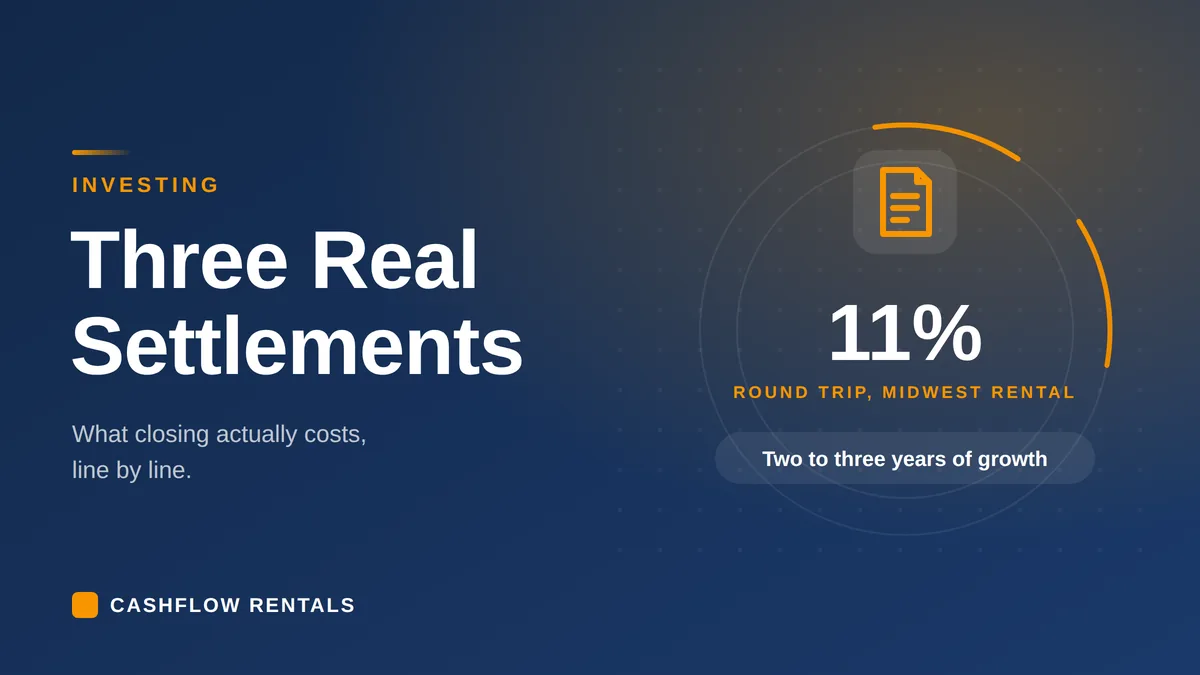
The wider point matters more. Add the buy side to the sell side and a round trip on a Kansas City rental costs roughly 11% of the property's value.
That single number explains more about US property investing than almost anything else. It is why a two year hold rarely works, and why a ten year hold usually does.
1. What did three real deals actually cost?
All of these properties were bought by overseas clients in the last twelve months, all financed, all in Midwest rental markets.
Three real client purchases, all financed, all in midwest rental markets | Price | Loan | LTV | Closing costs | As % of price |
|---|
| Kansas City, Oct 2025 | $163,000 | $114,100 | 70% | $7,800 | 4.79% |
| Kansas City, Feb 2026 | $185,000 | $129,500 | 70% | $7,477 | 4.04% |
| Cleveland, Apr 2026 | $150,000 | $102,550 | 68% | $11,302 | 7.53% |
The Cleveland buyer was a client from Germany, and his purchase is set out in full in his case study. One of the Kansas City buyers was Canadian, and his first deal is in his.
Same product, same year, same kind of house. The cheapest deal cost about half what the most expensive one did, as a share of the price. Checking a seller's figures against reality is a habit worth building, which I have set out in how to check a turnkey seller's numbers.
2. What is on the buyer's side, line by line?
Here is the Cleveland statement in full, because it is the most expensive and therefore the most instructive.
The Cleveland statement in full, April 2026| Charge | Amount |
|---|
| Loan origination | $2,051.00 |
| Rate buydown fee | $1,289.05 |
| Admin, legal and closing fee | $1,995.00 |
| Online closing convenience fee | $349.00 |
| Desk review | $95.00 |
| Flood certification | $16.00 |
| Prepaid interest, one day | $19.58 |
| Lender charges | $5,814.63 |
| Escrow and service fee | $1,037.50 |
| Owner's title insurance, buyer share | $435.00 |
| Nine separate ALTA endorsements | $1,175.00 |
| Lender's title insurance | $150.00 |
| Title and escrow | $2,787.50 |
| Property taxes, six months | $1,564.02 |
| Insurance, three months | $188.25 |
| Impounds | $1,752.27 |
| First year insurance premium | $753.00 |
| Survey | $195.00 |
| Total | $11,302.40 |
Only some of these ever reach your cost basis for accounting purposes, which matters a great deal a decade later when you are thinking of selling, and which I have set out in capital gains tax when a foreign owner sells.
Four groups, and they behave very differently. Lender charges are negotiable and vary by who you borrow from. Title is set largely by the state. Impounds are your own money held in advance. And the last group is whatever the deal happens to need.
3. Why is the range so wide?
Three things account for almost all of it.
Title, which is decided by the state
Missouri title and escrow came to about $900 on both deals. Ohio came to $2,787.50.
The difference is not the settlement fee, which was similar. It is that Ohio required nine separate ALTA endorsements, with names like usury, future advance, mechanic lien exception and environmental protection lien. Each one cost between $25 and $250.
Three times the money for the same job, decided entirely by which state the house is in. You cannot negotiate this and you cannot avoid it. You can only know about it before you commit. Whether the rest of the deal survives that difference is the prior question, and the running costs behind it are in maintenance, repairs and capital.
The lender fees, which you can control
Loan origination on the three deals:
Loan origination on the three deals | Loan | Origination | As % of loan |
|---|
| Direct with a lender | $129,500 | $1,028 | 0.79% |
| Direct with a lender, plus a buydown | $102,550 | $2,051 | 2.00% |
| Through a broker | $114,100 | $3,423 | 3.00% |
The brokered loan cost nearly four times the rate of the direct one, on a smaller loan. That single line was $2,395 of difference, and it is the most controllable cost in the whole transaction.
That is not an argument against brokers. A good one earns their fee by finding a lender you could not, or by getting a file approved that would otherwise fail. It is an argument for knowing what you are paying and why. I have set out how the loans themselves work in how to fund a US property purchase.
The buydown, which is optional
The Cleveland statement carries a rate buydown fee of $1,289.05. That is the buyer paying money up front to reduce the interest rate for the life of the loan.
It is the one closing cost that buys you something ongoing rather than paying for a service, and it needs a calculation rather than a decision. How the loan itself is priced is in DSCR loans explained. Divide the fee by the monthly saving to get your breakeven in months. If you will hold the property longer than that, it pays. If not, it does not.
Nobody will do that sum for you.
4. What does a foreign buyer pay that an American does not?
Not much, but it is worth knowing.
Remote online notary signing, $175 on both Kansas City deals. An American drives to a title office. You sign by video, and that costs money.
Overnight processing, $70. Documents moving faster than the post because you are not in the country.
Wire fees, $35 to $70. You are not writing a check.
And entity formation, where it applies. On one of these deals a $995 company formation fee appears on the statement, which was unusual: I had paid it in advance for my client and billed it back at closing. Normally it sits outside the settlement statement entirely, but you will still pay it, and it belongs in your budget.
None of these are large. Together they are a few hundred dollars, and the honest answer is that being foreign is not what makes closing expensive. The state and the lender do that.
5. What are impounds, and why do they hurt?
Impounds are not a cost. They are your own money, collected in advance and held by the lender to pay future tax and insurance bills.
They still come out of your wire.
Impounds held at closing on the three deals | Insurance held | Taxes held | Total |
|---|
| Kansas City, Oct 2025 | 4 months, $530 | 2 months, $78 | $608 |
| Kansas City, Feb 2026 | 3 months, $305 | 5 months, $885 | $1,190 |
| Cleveland, Apr 2026 | 3 months, $188 | 6 months, $1,564 | $1,752 |
The Cleveland buyer handed over $1,752 at closing for bills that had not yet arrived. That is 1.2% of the purchase price, on top of everything else, and it appears nowhere in any cash-to-close estimate I have seen a seller produce. It is one of several reasons the real cost of entry is higher than the deposit.
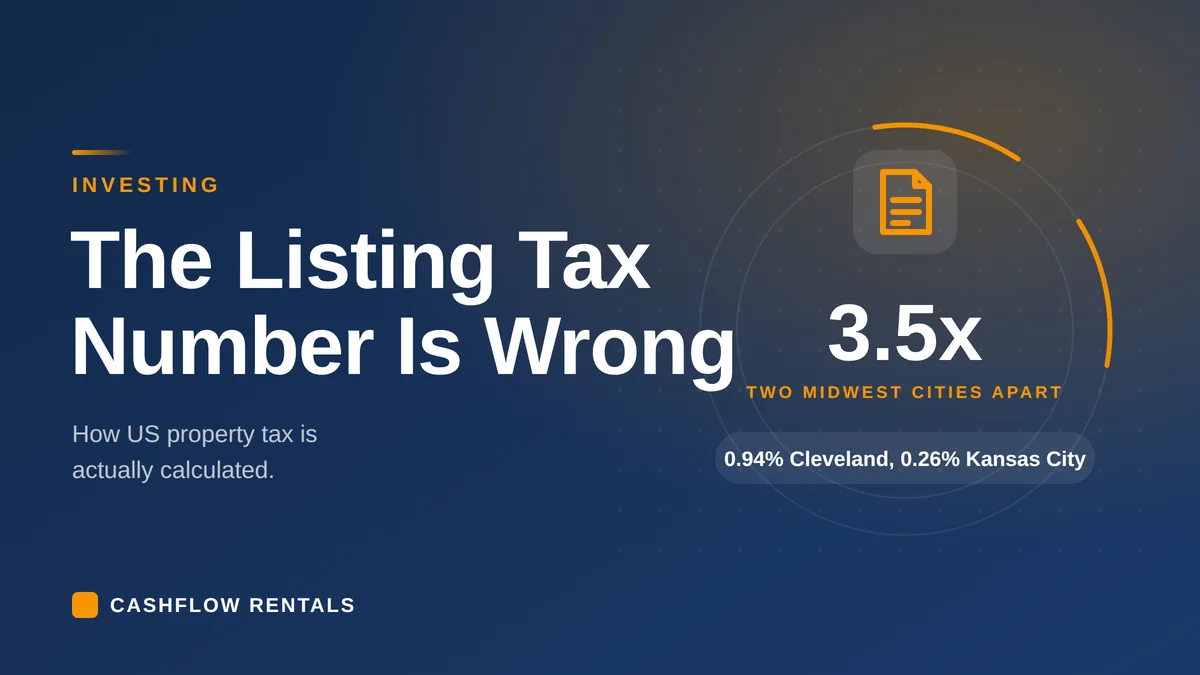
There is a useful side effect. The lender has estimated what they expect the tax and insurance to be, and they carry the risk of being wrong. If their number is well above the figure on the listing, believe the lender. I have written about why quoted tax figures are so often wrong in how US property tax works.
6. What comes off the seller's side?
The same statements show the seller's column, which is rarer to see and just as useful, because one day you will be in it. What the IRS holds back on that day is in how to get your FIRPTA money back.
On the February 2026 deal, at a $185,000 sale price:
The seller's side on the February 2026 deal, at a $185,000 sale price| Agent or marketing fee at 5% | $9,250 |
| Title, owner's policy and binder | $600 |
| Seller closing fee | $350 |
| Wire and closing protection | $60 |
| Tax proration to the buyer | $56 |
| Seller credit to the buyer | $2,500 |
| Total | $12,816 |
| As a share of price | 6.93% |
The other Kansas City deal came to 6.31% on the same basis.
One thing to explain, because anyone reading a real statement will spot it. On the October deal a second marketing fee of $8,150 went to another brokerage alongside ours. That was a one-off co-broke, unique to that transaction, and it took that seller's costs to 11.31%. It is not typical and I have excluded it from the comparison rather than pretend it was not there.
And a word on the 5%. On these deals that fee was ours, paid by the seller and itemized on the settlement statement. When you come to sell, the equivalent line is a real estate agent's commission, which lands in the same place at a similar rate.
7. What is a seller credit really worth?
Both statements carry a seller credit, and they are worth understanding because they are the most useful negotiating tool in a US purchase.
Kansas City, February 2026: a $2,500 credit. It came straight off the cash the buyer had to wire.
Cleveland, April 2026: the seller paid $8,000 of the buyer's closing costs. On $11,302 of costs, the seller covered 71% of them. Cash to close fell from $57,252 to $48,792.
Compare that with a price reduction. Take $8,000 off a $150,000 purchase and, on a 70% loan, you save $2,400 of deposit and reduce your monthly payment by perhaps $37. The credit gave the buyer $8,000 immediately.
If you are cash-constrained, and most people buying overseas are, ask for a credit rather than a discount. How you hold the property is the other decision worth making before you sign, which is in how to structure your US property investment. It is worth more and sellers often prefer it, because their headline sale price stays intact.
8. What does 11% mean for how long I hold?
Put the two sides together.
Both sides together, the round trip | Buy | Sell | Round trip |
|---|
| Kansas City, Feb 2026 | 4.04% | 6.93% | 10.97% |
| Kansas City, Oct 2025 | 4.79% | 6.31% | 11.09% |
About eleven percent of the property's value, to buy it and sell it again. On a $185,000 house that is roughly $20,350 before the property has done anything at all. Which is why the round trip belongs in the model and not in a footnote. Put your own purchase price, rent and running costs in and see what the first few years actually return once the toll at both ends is counted.
Now put that against growth. At the long run US rate of about 4.3% a year, a property takes between two and three years just to cover its own transaction costs. Everything before that point is running to stand still.
Which is the whole argument for holding. It is not that short holds are risky. It is that they are arithmetically difficult, because you pay the toll at both ends regardless of what happens in between.
I have worked a full ten year hold through, from purchase to sale with every cost included, in selling a US rental as a UK resident.
The bottom line
Budget 5% of the purchase price for closing costs in the midwest, and more in Ohio. If your deal only works at 3%, you do not have the margin you think you have.
The ongoing costs behind the transaction ones are in what US property management actually costs and what tenant turnover actually costs. Then know which parts you can move. The lender is negotiable and worth shopping. The buydown is optional and needs a breakeven calculation. The seller credit is worth asking for and often granted. Title is fixed by the state and there is nothing to be done about it.
And hold the thing. Eleven percent round trip is a toll you pay once, and it gets cheaper every year you spread it over.
Remember, investing is a game of probabilities. Transaction costs are not. They are known in advance, and you can plan for every one of them.
If you would rather somebody else priced the deal, checked the statement and told you what the real cash to close is going to be, that is what our purchase service does. Or run your own numbers first with the free tools in my investor starter kit.
This article is general information, not legal, tax or financial advice. The figures come from three real settlement statements on completed client purchases, used with permission and anonymized; individual line items have been grouped for clarity but no amounts have been changed. Closing costs vary by state, county, lender, title company and individual transaction, and change over time. Cashflow Rentals received a marketing fee on two of the transactions described, paid by the seller and itemized on the settlement statement, which is disclosed above. Always obtain your own closing disclosure and take professional advice before committing to a purchase.