1. Who does this actually apply to?
Our investor avatar is as close to you as I can make it. She lives outside the United States. No US passport, no green card, no Social Security number, and no US income other than this property.
In tax language she is a non-resident alien. That just means she is not a US citizen and does not spend enough time in America to count as resident. Two tests decide that: whether you hold a green card, and how many days a year you spend in the country.
She buys a $300,000 rental property that rents for $36,000 a year ($3,000/month). She buys the property through a US limited liability company, which is how most foreign buyers do it.
One exception, and it matters if you are Canadian. An LLC might be a bad idea. It is treated as a pass-through by the IRS and as a corporation by the CRA. That mismatch can make your filing and bookkeeping more complicated than it needs to be, and it can cost you your foreign tax credit. I generally recommend a limited partnership instead, for reasons set out in LP vs LLC for Canadians. Everything else in this article applies either way.
Here is a breakdown of her purchase.
Her purchase, and every figure in this article derives from it| Purchase price | $300,000 |
| Purchase costs at 5% | $15,000 |
| Deposit, 30% | $90,000 |
| Mortgage, 70% LTV | $210,000 |
| Interest rate, 30 year term | 7% |
| Annual rent | $36,000, or $3,000 a month |
| Building value, 80% | $240,000 |
| Land value, 20%, not depreciable | $60,000 |
| Annual depreciation over 27.5 years | $8,727 |
| Held for | 10 years |
| Owned through | A US LLC, single member |
| Her other US income | None |
I would encourage you to pay close attention to two lines in that table, because they do most of the heavy lifting on tax efficiency.
The $240,000 building gives her $8,727 of depreciation a year, which is the single largest deduction she has and the reason her US tax bill is small.
And the $210,000 mortgage matters twice. The interest is deductible while she owns it, and the outstanding balance could reduce her estate tax if she dies still owning it.
But there is something to clear up while we are at the buy stage, because I hear a great deal of misinformation about this on YouTube, on social media and in internet forums. You do not need a personal US tax number (ITIN) to buy a property in the US. You will need one to file your first US tax return, but that comes later, and you apply for it on Form W-7.
My advice is to get it early anyway. In most cases, my qualified tax partner acquires the ITIN on behalf of my clients shortly after they close on their first US rental property.
2. What does it cost to buy a US rental?
There is no national purchase tax in America. No stamp duty, no land transfer tax at federal level. What you pay instead is a collection of transaction costs. Some of those are taxes, and the single biggest variable is which state she buys in.
On three real client purchases I worked on in the last year, overall closing costs ran from 4.04% to 7.53% of the purchase price. The biggest variable was not the deal. It was the state the property was located in, because title and escrow charges in Ohio came to three times what the same job cost in Missouri.
There is more on this if you want it. I have set the whole thing out, line by line from the actual settlement statements, in what closing costs actually are on a US rental.
What transfer tax would she pay?
Britain has stamp duty. In some parts of Canada there is a land transfer tax, or property transfer tax. America has transfer tax, and it is charged by the state and sometimes the county on top. Here is what her $300,000 purchase would cost in transfer tax in each state.
State transfer tax on her $300,000 purchase| State | Rate | On her $300,000 |
|---|
| Texas, Arizona, Indiana, Missouri, Utah, Wyoming | none | $0 |
| Colorado | 0.01% | $30 |
| Ohio | 0.10% plus county | $300 |
| Georgia | 0.10% | $300 |
| Illinois | 0.10% plus local | $300 |
| California | 0.11% plus city | $330 |
| North Carolina | 0.20% | $600 |
| Wisconsin | 0.30% | $900 |
| Minnesota | 0.33% | $990 |
| Tennessee | 0.37% | $1,110 |
| Nevada | 0.51% | $1,530 |
| Florida | 0.70% | $2,100 |
| Michigan | 0.86% | $2,580 |
| Florida, Miami-Dade | 1.05% | $3,150 |
| Washington | 1.28% and up | $3,840 |
| Pennsylvania | 1% to 2% | $3,000 to $6,000 |
| Delaware | 3% to 4% | $9,000 to $12,000 |
More than a dozen states charge no state transfer tax at all, including the six in the table above. Delaware charges up to $12,000 on the same house.
Three things about that table catch people out.
Who actually pays transfer tax is more of a local custom than a law. In Florida and New York the seller pays by convention. In Tennessee the statute puts it on the buyer. In Michigan the seller usually pays, and in Pennsylvania it is often split. Miami-Dade County flips Florida's custom onto the buyer, which is worth knowing before you write an offer in Miami.
City taxes get stacked on top and are often larger than the state's. San Francisco adds up to 2.25% on top of California's 0.11%. Chicago adds a municipal tax on top of what Illinois charges. So the statewide rate rarely tells the whole story.
A state with no transfer tax may still have county or city ones, plus recording fees of $50 to $150 either way.
Is that a lot?
Only if you have nothing to compare it against, and most of my readers do.
The same purchase tax, compared internationally| Buying the same $300,000 property | Transaction tax |
|---|
| Missouri, Texas, Arizona, Indiana | $0 |
| Ohio | $300 |
| Florida | $2,100 |
| Delaware, the most expensive US state | up to $12,000 |
| Ontario, provincial land transfer tax | about $3,490 |
| Toronto, provincial and municipal together | about $6,980 |
| England, buy-to-let stamp duty | about $17,650 |
| England, buy-to-let bought by a non-resident | about $23,650 |
Every row is the tax on the same house, converted at August 2026 rates of 1.34 US dollars to the pound and 1.40 Canadian dollars to the US dollar.
A British investor pays roughly $23,650 in stamp duty to buy an equivalent buy-to-let at home. The same person pays nothing at all to buy a rental in Kansas City, Missouri.
Even Delaware, the worst state in America, is cheaper than a UK buy-to-let purchase.
Two things make the gap wider than the table suggests. America does not charge you extra for buying an investment rather than a home. England adds 5% to every band for a landlord, from the first pound, and Ontario and BC both levy a foreign buyer tax on top. There is no US equivalent of either.
So if the American figures look high to you, they are not. They are among the lowest in the developed world, and in the states most of my clients buy in they are zero.
What would her property tax be?
This is the one that matters far more, because transfer tax is paid once and property tax is paid every year for as long as she owns the house.
Property tax in America is charged on assessed value and revalued periodically. It is often the second largest line in her costs after the mortgage. Here is the same $300,000 property across the states, at typical effective rates as of 2026.
Annual property tax on the same $300,000 house, by state| State | Effective rate | Annual bill on $300,000 |
|---|
| Hawaii | 0.27% | $810 |
| Alabama | 0.37% | $1,110 |
| Arizona | 0.42% | $1,260 |
| South Carolina | 0.44% | $1,320 |
| Nevada | 0.50% | $1,500 |
| Tennessee | 0.52% | $1,560 |
| California | 0.70% | $2,100 |
| North Carolina | 0.70% | $2,100 |
| Indiana | 0.73% | $2,190 |
| Florida | 0.80% | $2,400 |
| Georgia | 0.85% | $2,550 |
| Missouri | 0.90% | $2,700 |
| Texas | 1.25% | $3,750 |
| Michigan | 1.35% | $4,050 |
| Ohio | 1.36% | $4,080 |
| New Jersey | 1.85% | $5,550 |
| Illinois | 1.88% | $5,640 |
Nearly seven times, on the same house. $810 in Hawaii against $5,640 in Illinois. That said, good luck finding a $300,000 house in Hawaii.
Put that against her rent. On $36,000 of gross rent, Indiana takes 6.1%, Ohio takes 11.3% and Illinois takes 15.7%.
Now watch what this does to her profit. Section 3 below models her investment on $3,600 of property tax. Move the same house between states and her taxable profit of $1,541 becomes:
What one line does to her taxable profit| State | Property tax | Her taxable profit |
|---|
| Indiana | $2,190 | $2,951 |
| Missouri | $2,700 | $2,441 |
| Ohio | $4,080 | $1,061 |
| Illinois | $5,640 | a loss of $499 |
One line on the schedule swings her profit by $3,450. Against a taxable profit of $1,541, that is 224% of it, which is why the same house makes a loss in Illinois. Identical property, identical rent, identical mortgage.
As an aside, this is another reason I did not jump on the Illinois and Chicago cash flow bandwagon we have seen online recently. Seemingly high rents are great, until you lift the hood and see how much you lose to real unavoidable operating costs.
Two warnings before you use that table.
Effective rates are state averages and your county will differ, often substantially. Cuyahoga County in Ohio exceeds 2% in many suburbs, against a state figure of 1.36%.
The property tax figure quoted on a listing is usually the previous owner's bill, not yours. Owner-occupier discounts do not transfer to a landlord, assessments lag sales, and caps reset when a property changes hands. This is one of the biggest mistakes I see new investors make when underwriting. Chances are the tax gets reassessed after you buy, and it is probably not going down.
That deserves its own guide, which sets out how the number is actually built and why the one you were shown is usually wrong.
When does she actually pay it?
Two things often surprise new investors here.
She pays some property tax on day one, at closing. US property tax is billed for a calendar period, so at completion it gets split between seller and buyer by the number of days each of them owns the house. If the seller has already paid for the year and she buys the house in October, she reimburses them for the rest of the year. If the bill has not yet been paid, the seller credits her their share and she settles the whole thing. That split appears as a proration line on the settlement statement, and on the real statements I used in my example above it ran from $56 to $460.
After that she pays annually or twice a year, depending on the state and county. Ohio bills in two installments. Missouri bills once, in December. Some counties offer quarterly payments.
And in practice she may not pay it herself at all. If you are buying with a mortgage, as our investor is, your lender collects it monthly as part of the payment and holds it in escrow, then pays the county when the bill falls due. That is why several months of property tax appear as an impound on the closing statement before she has owned the house for a day. It is also why your actual mortgage payment can change even though your interest rate is fixed for 30 years. It is the property tax and insurance part that moves, and it always moves up.
What will it cost to sell again?
One more cost belongs in the buying decision, even though she will not pay it for another ten years. Selling costs run to roughly 6.5% to 10%, so a round trip costs somewhere between 10% and 17% of the property's value, depending on the state at both ends. At the 30-year historical capital appreciation rate for housing in the US, that takes two to four years to earn back. Just another reason to view real estate as a long-term hold.
So that is the buy side covered from a tax perspective. Now let us look at how your US rental income is taxed.
3. How is my US rental income taxed?
This is the one most people are concerned about. It is usually one of the first questions I am asked by a new client.
First, here is the default position, and it is not great.
US rental income paid to a foreign owner is taxed at 30% of the gross by default (FDAP rate). Not the profit. The rent, before the mortgage, the taxes, the insurance, the management or a single repair.
On our investor's $36,000 of rent, that would be $10,800 a year, whether or not she made any money.
That alone would make owning a US rental unprofitable on a cash flow basis.
But wait. There is good news. There is an election that changes it entirely. Under section 871(d) she can elect to have the income treated as effectively connected with a US trade or business (ECI). That means she gets taxed on net profit after costs, at the same ordinary graduated rates as a US citizen.
Here is her first year on the election.
Year one on the section 871(d) election| Gross rent | $36,000 |
| Management at 10% | ($3,600) |
| Repairs and maintenance | ($2,500) |
| Property tax | ($3,600) |
| Insurance | ($1,400) |
| Mortgage interest | ($14,632) |
| Depreciation | ($8,727) |
| Taxable profit | $1,541 |
| US tax | about $154 |
$10,800 against $154. That is an effective rate of 10% on her taxable profit, or 0.43% of her gross rent, and it makes this single election worth more than every other decision in this article combined.
The depreciation deduction is doing much of the work here, and you may remember it from section 1. America lets you write off part of the building's value every year over 27 and a half years, even though you have spent nothing. On a $300,000 house with a $240,000 building (land is not deductible), that is $8,727 a year.
That $8,727 matters again in section 6, because it is not free money. Every dollar of it comes back when she sells, so it is a deferral rather than a discount. And the clawback happens whether or not she claimed it, which is a trap I have written about in the depreciation advice that costs foreign investors thousands.
In order to make the ECI election, two things have to happen. You give a Form W-8ECI to your property manager, which stops the withholding (the 30% FDAP tax). And you also attach a statement to your first Form 1040-NR making the ECI election, which changes the tax. You need to do both.
I wrote about this in more detail in how to stop the 30% withholding on your US rent. It also covers what to do when your property manager asks you for the wrong form, which happened to one of my clients recently.
And the state wants a return too
That $154 is the federal bill. Most states tax rental income as well, and she files a state return in the state where the property sits.
On a profit this small the state number is trivial. In Indiana it is about $45. In Ohio it is nothing at all, because the first $26,050 of income is taxed at zero. In Missouri it is about $72. And it is nothing in Texas, Florida, Tennessee, Nevada or Washington, which have no personal income tax.
But it is a second return you have to file, with its own deadline, and it falls due whether or not the federal figure is nil. It matters far more when she sells, which is section 6.
And one more thing worth saying, because it is simply good advice. The costs in that table are not all fixed. The repairs line is the one most people underestimate. What it really takes to keep a rental running is set out in what tenant turnover actually costs.
4. What annual filing does my LLC have?
Almost every guide tells you to form an LLC to buy property in the US. Mine does. Very few mention what tax filing responsibilities come with it. In fact, most guides tell you that an LLC is a pass-through entity, so it does not have to file anything. That is only partially correct and getting it wrong could cost you dearly.
A foreign-owned single-member LLC must file Form 5472 every year, attached to a mostly blank Form 1120. It reports no income and creates no tax. It just has to be filed.
The penalty for not filing starts at $25,000. There is no cap. It applies per form, per year, and a further $25,000 lands for every 30 days the failure continues after the IRS gives notice.
And the trigger is a transaction, not income. When you wire your deposit from your own account into your LLC's account, that is a reportable transaction. There is no minimum amount. So an LLC that bought a property and lost money all year still has to file.
And one filing you may have been told about no longer applies. From 2024, foreign owners were warned that forming a US LLC meant a federal beneficial ownership report to FinCEN. A final rule published on 14 August 2026 exempted domestic reporting companies, so a US LLC owned by a foreign national now has no BOI filing. A foreign-formed entity registered to do business in a US state is treated differently and may still report. i worte about that here.
Do not take that as clearance to file nothing. Form 5472 is unaffected and it is the one with the $25,000 penalty. That rule is also the newest thing in this article and it is still being litigated in the US, so check the current position before you rely on it.
This is the most expensive thing in this article to get wrong, and the one most likely to be missed by an accountant who does not do cross-border work. I have set out the filing, the penalty math and what to do if you have missed years in the $25,000 form nobody mentions.
5. Will my own country tax it as well?
America is only half the story. Your own country usually taxes the same income again, though if there is a tax treaty in place it will normally give you credit for what you paid the IRS.
Every treaty is a little different. If there is no tax treaty, chances are you will pay tax locally on your worldwide income, with a few exceptions. But make sure to research the tax treaty if there is one, and your own country's tax code if there is not.
Either way, this means the US bill and your real bill are potentially different numbers. If your home country charges more than America did, you may have to pay the difference at home. Tax credits where available stop you being taxed twice on the same money. They do not stop you being taxed at the higher of the two rates.
And the math is very different depending on where you live.
A British owner cannot deduct mortgage interest from rental profit at home. They get a 20% credit instead, under the rule usually called Section 24, and it applies to overseas property too. On a real ten year model, HMRC took £15,924 while America took $983. The detail is in UK tax on US rental income, and the full exit is worked through in selling a US rental as a UK resident.
A Canadian owner deducts the interest in full, which is worth thousands over a decade. That is in the US tax guide for Canadian investors, and the equivalent exit in selling a US rental as a Canadian.
Daniel buys from Germany, which is a third position again. He is not taxed in Germany on his US income. But it is added to his overall income when his German tax rates are worked out, so it can push him into a higher bracket. His purchase is written up in his case study.
Work out your home country position before you buy, not after. It is the number that decides whether the rent is worth having.
6. What happens to my money when I sell?
Ten years on, our investor sells her property. At the historical long term US capital growth rate for real estate, her $300,000 house is now worth about $457,000.
Here is what happens to the money.
First, the buyer holds back up to 15% of the gross price, not of the profit. On a $457,000 sale that is $68,550 sent to the IRS before she sees a penny.
It is not a tax. It is a deposit against your eventual capital gains bill, and on a property held for years the withholding is usually far larger than the tax that falls due.
And 15% is not automatic. The rate depends entirely on who is buying and what they intend to do with the house.
The FIRPTA rate depends on the buyer, not on you| Sale price | Buyer will live in it | Everyone else, including investors |
|---|
| $300,000 or less | 0% | 15% |
| $300,001 to $1,000,000 | 10% | 15% |
| Above $1,000,000 | 15% | 15% |
Which gives you a decision at the point of sale that most sellers never realize they have.
Second, the actual tax gets calculated, and it is a different number.
Adjusted basis and total gain on the sale| Purchase price | $300,000 |
| Plus capitalizable closing costs | $2,160 |
| Less ten years of depreciation | ($87,270) |
| Adjusted basis | $214,890 |
| Sale price | $457,000 |
| Less selling costs at 7% | ($31,990) |
| Net proceeds | $425,010 |
| Total gain | $210,120 |
Note what depreciation did. It saved her tax every year she owned the property, and it has now cut her basis by $87,270, which increases her gain by exactly the same amount. That portion comes back as depreciation recapture, taxed separately at up to 25%. In simple terms, she avoided income tax on $8,727 every year. Now all those deductions are added together and the total is taxed.
How the gain splits| Depreciation recapture | $87,270 |
| Long term capital gain | $122,850 |
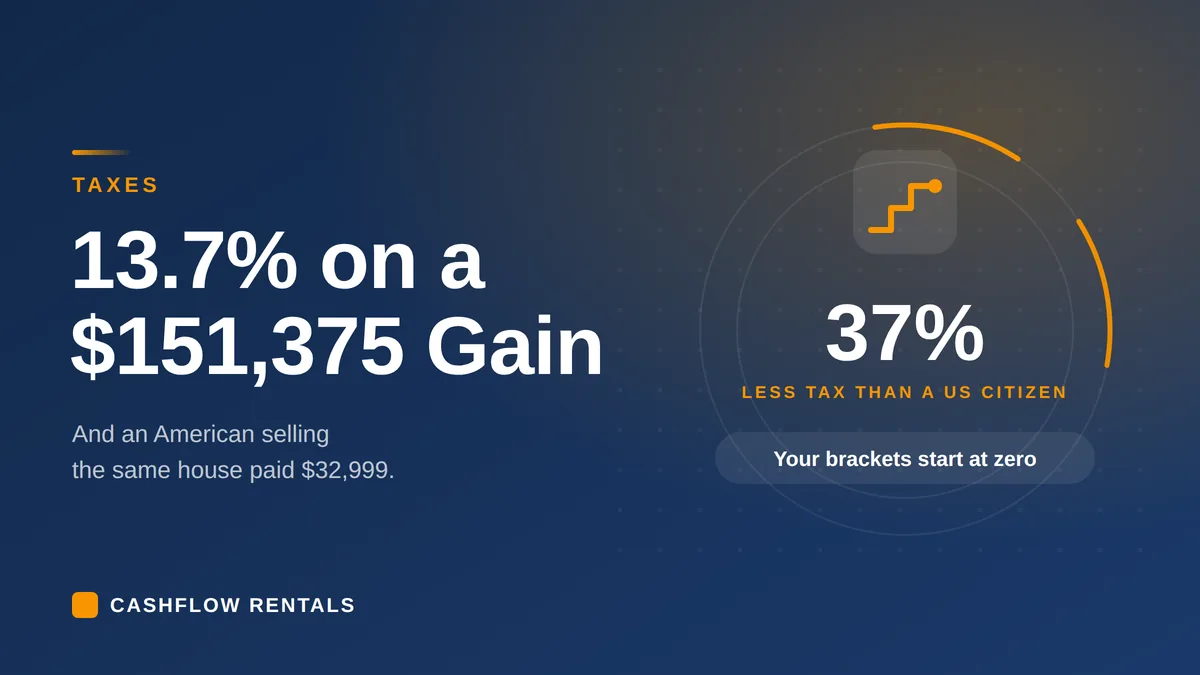
And here is where being foreign actually helps. With no other US income, her tax brackets start at zero. The recapture is taxed at the lower of 25% or her ordinary rate, which works out at 16.2%.
The federal tax on the sale| Recapture, at 10% to 22% | $14,113 |
| Capital gain, at 15% | $18,428 |
| Total US federal tax | $32,541 |
So $68,550 was withheld against a real bill of $32,541, and $36,009 comes back later, once she files a return with the accurate calculation.
And then the state takes its share
The $32,541 above is federal. Most states tax the gain as well, and on a sale this size that is not nothing.
State tax on the gain, on top of the federal bill| Where the property is | State tax on her $210,120 gain |
|---|
| Texas, Florida, Tennessee, Nevada | $0 |
| Ohio, at 2.75% above a zero band | $5,062 |
| Indiana, at 2.95% | $6,199 |
| Pennsylvania, at 3.07% | $6,451 |
| Michigan, at 4.25% | $8,930 |
| Missouri, at about 4.7% | $9,876 |
| Illinois, at 4.95% | $10,401 |
So her real bill is somewhere between $32,541 and about $42,900, depending entirely on which state she bought in. That is a 32% swing on the same sale. It also lets us put a real effective rate on it: on her $210,120 gain the total tax runs from 15.5% federal only to 20.4% in Illinois.
Do not assume a state gives non-residents a pass. Pennsylvania is the one that catches people, because it has no separate capital gains rate and no exemption for out-of-state sellers. A non-resident pays the same 3.07% on a Pennsylvania property as a Pennsylvanian does.
Some states also operate their own withholding on non-resident sales, separate from FIRPTA, which means two deductions from one closing and two refunds to chase.
But the refund is not quick, and the delay is mostly not the IRS. Getting it back is four stages, three of which happen before you can file anything. I go into much more detail on that in how to get your FIRPTA money back. Every step of the tax calculation above, on a different property, is shown in capital gains tax when a foreign owner sells.
She could defer all of it by reinvesting. FIRPTA makes that much harder than it is for an American, which I have set out in can a foreign investor do a 1031 exchange.
7. Is there anything that works in my favor?
There is exactly one part of this system that favors you as a foreigner, and on this sale it is worth real money.
Foreign investors are exempt from the 3.8% net investment income tax.
Non-resident aliens are excluded under section 1411(e)(1), and the IRS confirms it in the instructions to Form 8960. A US citizen selling the same property on the same day pays it.
On her $210,120 gain that exemption is worth $7,984.
And it compounds with the bracket point above. An American with a salary would see their recapture hit the full 25% cap and their gain taxed on top of their earnings. Our investor's brackets start at zero. Between them, those two rules save her about $12,000 on the same house.
It is the only line in this article where being foreign is an advantage, so enjoy it.
8. What happens to the property when I die?
Now, I do get asked about this, but not as often as I should be, because it matters. In an article about taxes it seems only right to use the old line that the only two certainties in life are death and taxes. That is especially true here.
Let us say she dies in year ten still owning the house.
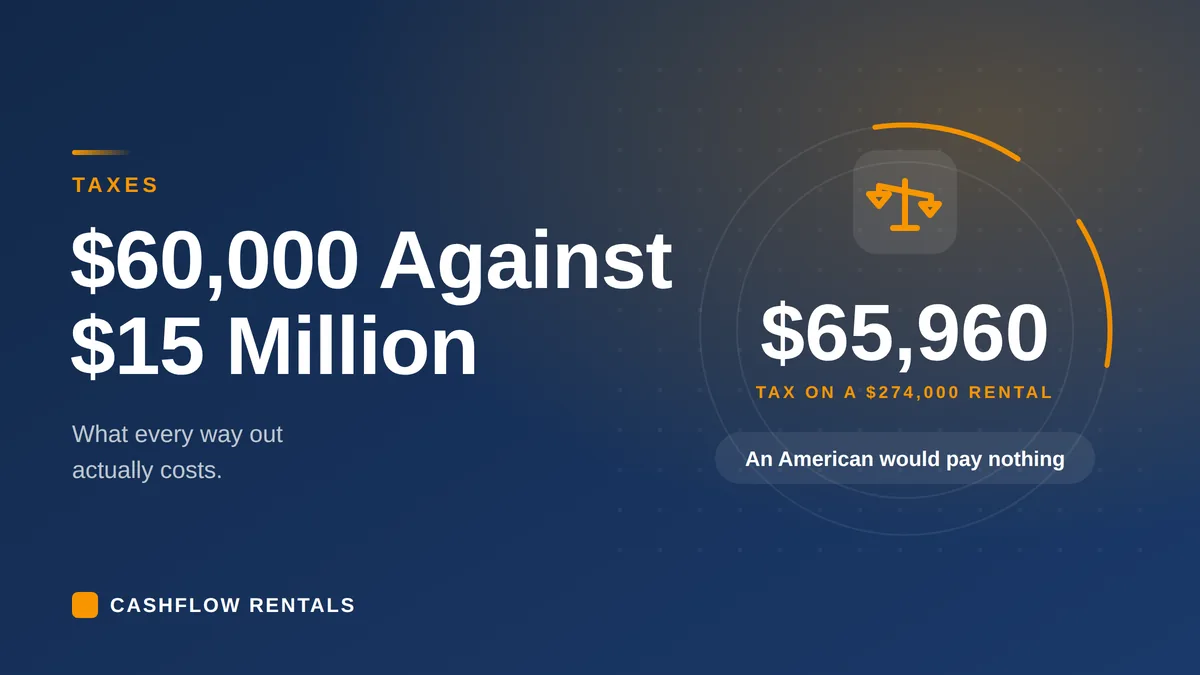
A non-resident gets a US estate tax exemption of $60,000. A US citizen gets roughly $15 million. Tax rates start at 18% and climb to 40%.
Same asset, same country, same tax, and a gap of two hundred and fifty times. The $60,000 was set in 1976 and has never been raised. In the current political climate, I would say it probably will not be.
One quick point before the calculation. The US taxes the estate, not the beneficiary. That matters, because your heirs may have to sell assets to settle the bill if liquid funds are not available.
Here is what that does to her estate. She borrowed $210,000 to buy the house, and after ten years the balance is about $180,206.
US estate tax if she dies owning the property| US-situs value at death | $457,000 |
| Less the non-recourse mortgage | ($180,206) |
| Net US estate | $276,794 |
| Tax on that, on the graduated schedule | $79,910 |
| Less the credit a non-resident gets | ($13,000) |
| US estate tax | $66,910 |
Two things about that calculation, because most of what you will read online gets them wrong.
The $60,000 is not really an exemption. It is a credit of $13,000, which happens to be exactly the tax on the first $60,000, so everybody calls it a $60,000 exemption and the answer comes out the same. But the tax is worked out on the whole estate first, and the credit comes off at the end.
And 40% is the top rate, not the rate. The schedule is graduated, and 40% does not start until $1,000,000 of taxable estate. Hers is nowhere near it, so her top band is 34% and the bill works out at 24% of her net US estate. If you have seen 40% quoted flat on a property this size, that is where the number came from and it is too high.
Compare that with the $32,541 she would have paid selling in life. Dying owning the property costs her family about twice as much.
And look at what the mortgage is doing. If she had diligently paid the loan off, her net US estate would be the full $457,000, and the bill would be $128,180. The mortgage is worth $61,270 of estate tax.
That is the single most useful fact in this section. The borrowing that makes the returns work also shrinks the estate tax, because non-recourse debt comes off the US estate value in full.
But check what kind of loan you actually have. Recourse debt does not work this way. It is apportioned against your worldwide estate rather than deducted in full, which is far less useful. Most DSCR loans are written as non-recourse, but many carry a personal guarantee, and whether that makes them recourse for estate tax purposes is a legal question about your specific documents. Do not assume the $61,270 above applies to you. Ask your attorney to read the loan paperwork.
But it is not all bad news. Your nationality matters enormously too. The US has estate tax treaties with a limited group of countries including the UK, Germany, France and Japan, and Canada is covered through a provision in the income tax treaty. If your country has one, your position may be far better. If it does not, and I live in Brazil which does not, you are on the $60,000. For Canadians specifically the position is in do Canadians pay US estate tax.
And US shares and US-domiciled funds count too, which catches out people who thought they had a property problem and actually have a wider portfolio problem.
There are structuring options that mitigate US estate tax. But as with everything, there are trade-offs, and every structure that solves this has a price.
Owning through a foreign company removes the exposure, but costs you the preferential capital gains rates and adds branch profits tax.
Using a trust may stop you financing the property at all.
And moving a property into either structure after you buy is treated as a sale, which triggers a taxable event. I have priced each option in US estate tax for foreign property owners, including the one that works for most people and costs almost nothing.
9. What do I have to file, and when?
What you file, and when| Filing | Who | When |
|---|
| Form W-7, for an ITIN | You, once | Before you need it, not at tax time |
| Form W-8ECI | To your property manager | Before the first rent, valid three years |
| Form 1040-NR | You, annually | 15 June, extension to 15 October |
| Section 871(d) election | Attached to your first 1040-NR | Once. It then stands |
| Form 5472 with pro forma 1120 | Your foreign-owned LLC, annually | 15 April, extension on Form 7004 |
| Form 8288-B | Optional, before a sale | Before closing, or not at all |
| State income tax return | You, annually, in the property's state | Usually the same as the federal deadline |
| Form 706-NA | Your estate | Nine months after death |
10. What would I do?
For what it is worth, I have purchased, financed, owned and managed over 120 US rental properties of my own, and helped dozens of non-resident clients build their own portfolios. So I have been through all of these stages except dying, so far. Here are five things I have learned along the way.
Make the ECI election immediately. It is the difference between being taxed on rent and being taxed on profit. In our example, $10,800 a year against about $154.
Ask your accountant about Form 5472 by name. Do not assume they have it covered because your LLC is disregarded. That is exactly the assumption that produces the penalty.
Get the ITIN before you need it. It is the gate that the withholding, the filing and any FIRPTA refund all wait behind. Where the number and the entity sit in the wider decision is in how to structure your US property investment.
Find out what your own country charges, on the income and on death, before you buy. Not after. A US pension wrapper will not help, and nor will a British one, which I covered in can you hold US property in a SIPP.
Before any of that, check the seller's figures yourself, especially the property tax. I go into much more detail in how to check a turnkey seller's numbers.
And hire somebody who does this specifically. Not a good local accountant. Somebody who files for foreign owners of US property, every year, as a normal part of their practice. The difference in cost is a few hundred dollars. The difference in outcome can be $25,000. Some things are worth paying a premium for, otherwise you find yourself stepping over hundred dollar bills to pick up pennies.
The bottom line
US real estate is one of the most tax efficient assets to own inside the US tax code, and the system is not hostile to foreign investors. It is indifferent to them, which is worse, because it means nobody tells you the rules and the defaults are all set against you.
The defaults are 30% of gross rent, 15% of your gross sale price, and a $60,000 exemption on death. Every one of those can be improved, most of them substantially, but all of the improvements require you to do something in advance rather than react afterwards.
Follow our investor through this article and the pattern is clear. The election took her annual bill from $10,800 to about $154. Selling cost her $32,541 against $68,550 withheld. Dying owning the same house would cost her family $66,910, and paying off her mortgage first would have made that $128,180.
The tax itself is manageable at every stage. The cost comes from not knowing a rule existed until after the moment it applied.
Which is the whole reason I wrote this. Not because the math is hard, but because nobody handed me a list when I started out, and asking ten different experts will give you ten different answers, most of which do not account for your own situation.
Remember, investing is a game of probabilities. Tax is not. It is written down, and you can read it before you commit.
If you want help getting the structure and the filings right from the start, that is part of what our purchase service covers. You can size your own position first with the FIRPTA withholding calculator, the rental income tax calculator and the estate tax calculator, or start with the free tools in my investor starter kit.
This article is general information, not legal, tax or financial advice. David Garner is a property investor and is not a tax adviser, accountant, CPA or Enrolled Agent. Cashflow Rentals is a real estate consultancy, not a tax practice or law firm. The worked example follows a single illustrative property and assumes no other US income, a single filer, a ten year hold at the long run US house price growth rate, and no capital improvements; your own rates and circumstances will differ and the stacking of depreciation recapture against long term rates is involved enough to warrant your own CPA confirming any figure. Closing cost and property tax figures come from real settlement statements on completed client purchases, used with permission and anonymised. The estate tax figures apply the graduated rate schedule and the non-resident unified credit, and assume no applicable estate tax treaty. The BOI position described reflects a final rule published in August 2026 and is subject to ongoing litigation; verify the current position before relying on it. State income tax rates are indicative, change annually and exclude local income taxes. International figures are converted at August 2026 exchange rates and move with them. Tax rules, rates, thresholds and forms change, and treaty positions vary by country. Always take advice from a CPA or Enrolled Agent experienced in cross-border property, and where estate planning is involved, a cross-border attorney.