The difference is simple: a DSCR loan looks at the property, a bank statement loan looks at you. Both are non-qualified mortgages (non-QM), meaning they sit outside conventional guidelines, and both are built for self-employed investors whose tax returns understate their real income. Which one fits depends on whether the strength of your application is the property's rent or your business's deposits.
I use DSCR loans for all of my own rentals, because most of my income is from real estate and my taxable income is deliberately low. For some of my clients who are self-employed business owners, a bank statement loan is the better tool. Here is how to tell them apart.
What is a DSCR loan?
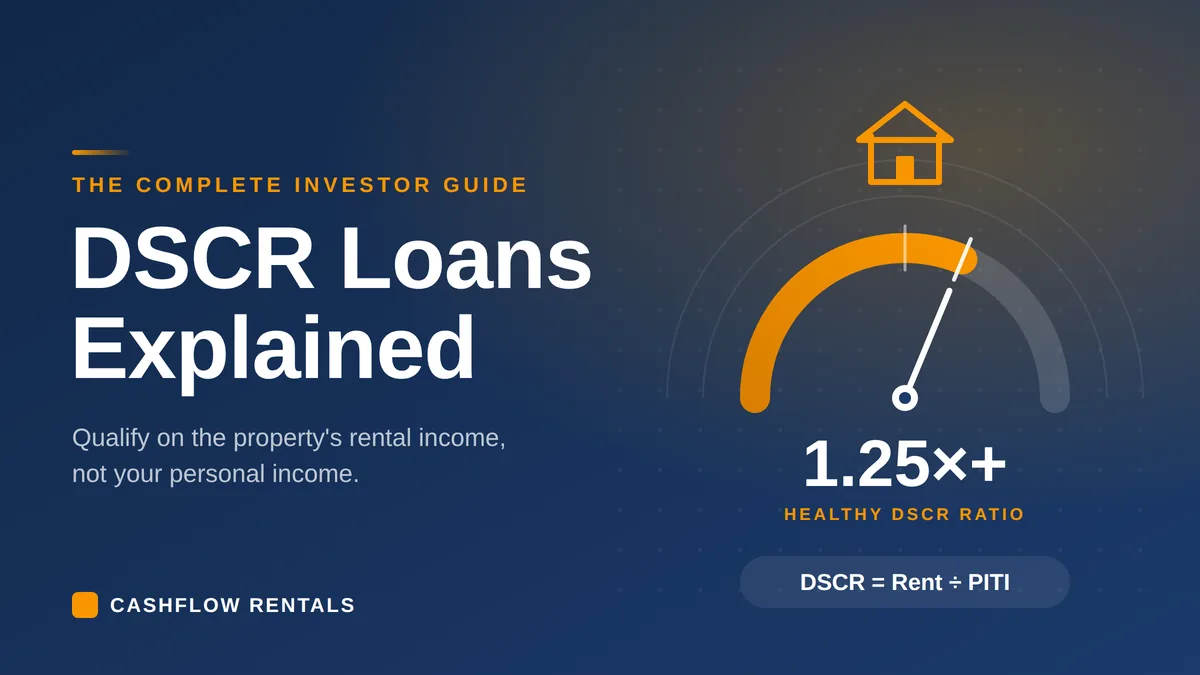
A DSCR loan is a non-QM mortgage built for investors, approved on the property's cash flow rather than your personal income. The Debt Service Coverage Ratio is gross rent divided by the monthly payment (principal, interest, taxes, and insurance). A property renting for $2,500 against an $1,800 payment has a DSCR of 1.38. Lenders typically want 1.25 or higher, though it varies. No personal income verification is required, which is what makes it ideal for buying rentals; run any property through my DSCR calculator and see my list of the best DSCR lenders.
What is a bank statement loan?
A bank statement loan is another non-QM product, but it qualifies you, the borrower, not the property. Instead of tax returns, the lender uses 12 to 24 months of business or personal bank statements to establish an average monthly cash flow, then applies an expense factor to derive a qualifying income and a debt-to-income ratio (DTI). It is designed for business owners and entrepreneurs who show healthy cash flow through their accounts but write off significant expenses on their returns.
Side-by-side comparison
Both are strong non-QM options for self-employed borrowers. The best choice depends on your finances, the property, and your strategy.
DSCR loan vs bank statement loan, investment property| Feature | DSCR loan | Bank statement loan |
|---|
| Suitable for | Investors qualifying by property cash flow rather than personal income | Self-employed investors and owners with strong deposits but hard-to-document taxable income |
| Income verification | None used; qualification by DSCR (rent divided by PITIA) | 12 to 24 months of personal or business statements with a lender expense factor |
| Documentation | Lease or market rent (1007), appraisal, ID, credit, reserves, insurance | Bank statements, ID, credit, reserves, appraisal, insurance, sometimes a CPA letter |
| Key qualification factor | Minimum DSCR, commonly ~1.10 to 1.25+ | Average eligible deposits times an expense factor, giving income and DTI |
| Loan purpose | Purchase, rate-and-term, cash-out (investment only) | Purchase, rate-and-term, cash-out (investment) |
| Credit score | Minimums ~620 to 680+; priced by score, LTV, DSCR, prepay | Minimums ~620 to 680+; priced by score, LTV, months of statements |
| Max LTV | ~80% to 85% purchase, ~70% to 80% cash-out | ~80% purchase, ~70% to 75% cash-out |
| Property types | 1 to 4 units standard, many offer STR and 5+ programs | 1 to 4 units, condos, some allow 5+ and STRs |
| Structures | Fixed and ARM, interest-only common | Fixed and ARM, interest-only often 5 to 10 years |
Quick decision guide: choose DSCR when the property's ratio is about 1.10 to 1.25 or higher and you want minimal personal income documents. Choose a bank statement loan when the DSCR is thin but your 12 to 24 months of deposits are strong and steady. For short-term rentals, condos, or 5+ units, compare overlays closely, since programs vary widely. It is also worth comparing both against a conventional loan.
When to choose a DSCR loan
A DSCR loan is often the better choice for income-producing rentals. Consider it when you are a portfolio investor expanding without touching your personal DTI, when your tax returns show low income after deductions, when you value speed and simpler paperwork, or when the property has strong cash flow that comfortably covers the payment. You can also pick the structure (fixed, ARM, or interest-only) to fit your hold.
When to choose a bank statement loan
A bank statement loan bridges the gap for self-employed people with hard-to-prove income. Consider it when you are a self-employed professional (agent, doctor, lawyer, or business owner) with reliable deposits, when your tax returns do not reflect your true income because of write-offs, or when you are a first-time or single-property investor who needs to use your own income to qualify.
Getting started
Choosing the right financing is a critical step. Assess your goals first, since DSCR loans suit income-producing rentals while bank statement loans often suit a second home or a first single purchase. Gather your documents early (statements and property details), then consult a specialist, because the non-QM world has real nuance. When you want to compare live pricing, see my DSCR rates guide, and you can book a call to talk it through.