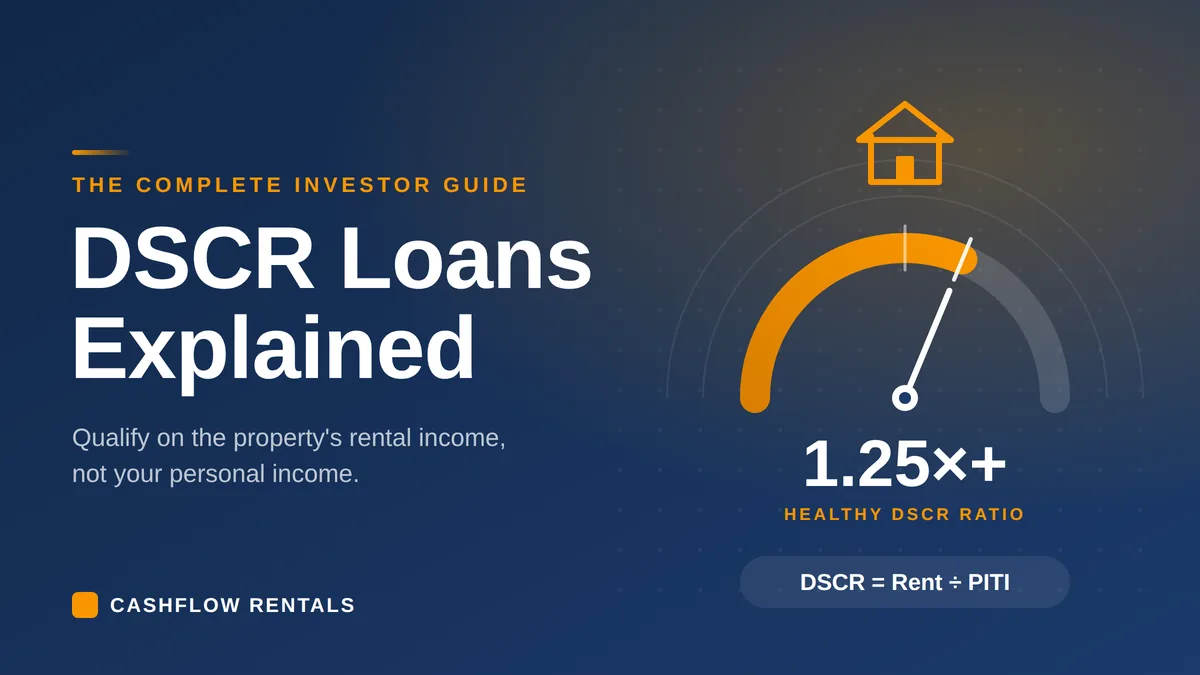
I have built a 120+ door U.S. rental portfolio using both fixed-rate DSCR loans and ARMs (5/6, 7/6, 10/6). Which way you lean depends partly on where rates go from here, which I look at in my US mortgage rate forecast. The structure you choose changes your monthly payment, your cash flow, the rate you are offered, and sometimes whether the deal qualifies at all. This guide shows where an ARM shines, where a 30-year fixed wins, and how caps, margins, and prepayment terms drive your real cost over the first 3 to 10 years.
The short version: an ARM usually starts lower, which can lift cash flow and DSCR early on, but it carries reset risk. A fixed rate costs a little more up front and buys certainty. The right answer depends entirely on your hold plan.
Key terms: index, margin, caps, floor
A few definitions make everything else clear. The index is the reference rate most DSCR ARMs use, based on SOFR; after the fixed period it updates every 6 months. The margin is a fixed spread added to the index (say 3.00%), so a 4.50% index plus a 3.00% margin gives a 7.00% rate. Caps limit how much the rate can rise: an initial cap at the first reset, a periodic cap at each later reset, and a lifetime cap overall. The floor is the lowest allowed rate, often equal to the margin. The qualifying rate is the rate the lender uses to test your DSCR, often the higher of the note rate or the fully indexed rate. And interest-only lowers the payment for 5 to 10 years, which can lift the DSCR to help a property qualify.
SOFR ARM anatomy: what to ask your lender for| Factor | What it means | Typical / example |
|---|
| Index | Reference rate used at each reset | SOFR-based, varies by program |
| Margin | Fixed spread added to the index | ~2.75% to 3.50% |
| Cap structure | Initial / periodic / lifetime movement limits | e.g. 2 / 1 / 5 (illustrative) |
| Floor | Minimum allowed note rate | Often equal to the margin |
| Reset frequency | How often the rate can change after the fixed period | Every 6 months (5/6, 7/6, 10/6) |
| Interest-only option | Interest-only period before amortization | 5 to 10 years on many programs |
When you request quotes, ask for all of it: index, margin, the full cap table, floor, prepayment terms, and the qualifying rate. Model the options in my DSCR calculator, and see also how to improve your DSCR and my pre-approval checklist.
Payment scenarios: fixed vs 5/6 ARM
Here is an apples-to-apples look at how structure changes your payment and DSCR at closing. These are illustrative numbers to show the relative effect; model your own deal in the calculator.
Payment and DSCR at closing (illustrative: $250,000 loan, rent $2,200, T&I+HOA $350)| Structure | Start rate | Monthly P&I or IO | PITIA | Resulting DSCR |
|---|
| 30-year fixed (amortizing) | ~7.25% | $1,705.44 | $2,055.44 | 1.07x |
| 5/6 ARM (amortizing) | ~6.75% | $1,621.50 | $1,971.50 | 1.12x |
| 5/6 ARM (interest-only) | ~6.75% | $1,406.25 | $1,756.25 | 1.25x |
Lower payments can push a borderline deal over the DSCR line and improve pricing, but ARMs and interest-only add reset risk and later payment jumps. On a $250,000 loan, your payment would rise by about $170 a month if the rate reset just 1% higher, so always stress test for future rate rises.
How caps and margins change payments
On a SOFR ARM your fully indexed rate at reset is index plus margin, and caps limit how fast it climbs. Here is a setup you can sanity-check.
Reset scenarios (illustrative: $300,000 loan, 30-yr amort, T&I $350, rent $2,300, margin 3.00%, caps 2/1/5)| When | Rate applied | Monthly P&I | PITIA | Resulting DSCR |
|---|
| During fixed period | 6.75% | $1,945.79 | $2,295.79 | 1.00x |
| 1st reset (after 5 yrs) | 7.75% (within +2% initial cap) | $2,149.24 | $2,499.24 | 0.92x |
| 2nd reset (6 mos later) | 8.75% (within +1% periodic cap) | $2,360.10 | $2,710.10 | 0.85x |
Caps slow the speed of increases, not the direction. If your payment rises, it can decimate cash flow, so model the start rate, the fully indexed rate, and the cap table against your rent and PITIA. Do not rely on being able to refinance later, since you cannot know what rates will be.
Prepayment and exit planning
The prepayment clause is the most expensive line most investors never read. DSCR loans often use a step-down penalty (like 5-4-3-2-1) that applies to both a sale and a refinance in the early years. Some programs offer shorter step-downs, a no-prepay option at a rate premium, or a make-whole variant. Match the prepay to your hold plan so you are not paying to exit early. Note that a step-down usually allows around 20% annual paydown (a partial early payment) without penalty.
Common DSCR prepayment structures (illustrative)| Structure | Typical pattern | Pros | Watch-outs | Best for |
|---|
| Step-down (long) | 5-4-3-2-1 (years 1 to 5) | Usually best rate, ~20% annual paydown allowed | Expensive to exit in years 1 to 3, applies to sale and refi | Long holds, 7 to 10+ years |
| Step-down (short) | 3-2-1 or 2-1 | More freedom to refi or sell earlier | Slightly higher rate | Medium holds, 2 to 5 years |
| No-prepay | 0% from day one | Maximum flexibility, no exit fee | Rate premium, not always offered | Uncertain hold, likely refi under 24 months |
| Minimum-interest / make-whole | Fixed months of interest if you exit early | Sometimes cheaper than a big step-down on a very early exit | Complex, costly if rates drop and you refi mid-term | Bridge-style needs, planned quick refi |
To compare, calculate the penalty in dollars at your likely exit date, then run a break-even against the higher rate of a no-prepay option. Choose the lower total-cost path that still gets your deal approved today.
How lenders qualify ARMs vs fixed
Your approval and your cash-out proceeds depend on which qualifying rate the lender uses. A 30-year fixed is qualified at the note rate. An ARM is often qualified at the higher of the note rate, the fully indexed rate (SOFR plus margin), or a program floor. For example, a 6.75% ARM with a 3.00% margin over a 4.0% SOFR proxy has a fully indexed rate of 7.00%, and if the program qualifies at the higher of the two, the underwriter uses 7.00% to compute the payment for DSCR, which can reduce your maximum loan or cash-out. Interest-only loans are usually qualified on the amortizing payment, not the interest-only payment, so interest-only helps your actual cash flow more than your approval DSCR. Always ask explicitly which qualifying rate the lender will use.
Decision matrix: when fixed vs ARM vs interest-only
Match your hold plan, cash-flow needs, and rate view to a structure, then sanity-check the prepayment against your likely exit. Do not just grab the lowest rate.
Choosing a DSCR structure by scenario (illustrative)| Scenario | What you value | Typical best fit | Prepay to target |
|---|
| Long-term hold (10+ yrs) | Payment certainty, minimal reset risk | 30-year fixed (amortizing) | 5-4-3-2-1 |
| Medium hold (3 to 7 yrs) | Lower start rate, better early cash flow | 5/6 or 7/6 ARM (amortizing) | 3-2-1 or priced no-prepay |
| Tight DSCR at acquisition | Maximize DSCR and approval odds | ARM plus interest-only (5 to 10 yrs) | 3-year step-down or no-prepay |
| Expect rates to fall | Lower start today, refi optionality | 5/6 ARM with a clear cap table | Shorter step-down or no-prepay |
| Expect rates to rise | Hedge against increases | 30-year fixed | Any (less relevant on a long hold) |
| Foreign national | Approval plus a manageable payment | 30-year fixed foreign national DSCR | 3 to 5-year step-down |
| Cash flow first 5 yrs (value-add) | Lowest early payment | Interest-only (5 to 10 yrs) on fixed or ARM | Match to project timeline |
Rule of thumb: request two same-day quotes, fixed and ARM, with the cap table, margin, floor, and prepay disclosed, then model both in the DSCR calculator.
Foreign-national overlays
Most of my clients are non-residents. You can absolutely use DSCR loans as a foreign borrower, but expect extra KYC and OFAC checks, higher reserves, and modest pricing and LTV overlays. A foreign national DSCR loan usually has a lower LTV cap and a slightly higher rate, and lenders will not consider your home-country credit.
Typical foreign-national DSCR overlays (illustrative)| Factor | Foreign national (typical) | Notes |
|---|
| Max LTV | ~70% purchase, ~65% to 70% cash-out | STRs and condos may price tighter |
| DSCR floor | ~1.00 to 1.25x | Higher tiers improve pricing and proceeds |
| Reserves | ~6 to 12 months PITIA | Higher for jumbo, STRs, or 5+ units |
| Pricing uplift | ~+0.25% to +1.00% | Varies by profile, loan size, LTV, and DSCR |
| Credit | U.S. credit not required | Fine with many DSCR lenders |
| Entity vesting | LLC or LP allowed | Personal guarantee and KYC disclosures standard |
The quote checklist
Do not compare one quote on one loan type from one lender. Get fully itemized quotes on the same day so you can compare fixed against a 5/6 ARM on equal footing. Ask for everything below in one email and keep the term sheet.
Your DSCR quote request, required line items| Category | Details to request |
|---|
| Loan types | Both 30-year fixed and 5/6 ARM (amortizing and interest-only), same property and lock day |
| Rate and points | Note rate, total points including buydown, lender fee, lock length and extension cost |
| ARM mechanics | Index (usually SOFR), margin, full cap table, floor, and rounding rule |
| Qualifying rate | Whether DSCR is qualified at the note rate, fully indexed rate, or program floor |
| Max LTV / DSCR tiers | Maximum LTV by DSCR band, and any pricing hit for a weaker ratio |
| Prepayment | Step-down schedule, free paydown allowance, and any make-whole language |
| Reserves and docs | Months of PITIA in reserve, KYC documents, lease or 1007 requirements |
Collect at least two quotes the same day and drop the numbers into the DSCR calculator to compare payment, DSCR, and the break-even on any points. When you want a second opinion, you can book a call.