The standard I apply
Like my investment strategy, this isn't complicated. In fact, just like the houses I own, it's boring. Boring is good. Boring, in my experience, wins the race. This is what I would ask of any applicant at any rent level.
Income. Enough to cover their portion of the rent comfortably, with the voucher counted as part of total income. I want to see the actual voucher award letter, not an assumption. I use an income multiple of 3. For a market tenant that means three times the rent in net income every month. For a voucher tenant, apply it to the part they are actually responsible for.
So if their share of the rent is $500, I want to see at least $1,500 in net income.
Employment references. Where there is employment. Where there is not, I want to understand what the household's income actually consists of. Often, applicants with a housing choice voucher are also in receipt of subsidies from a bunch of other programs, including childcare, food stamps, and others.
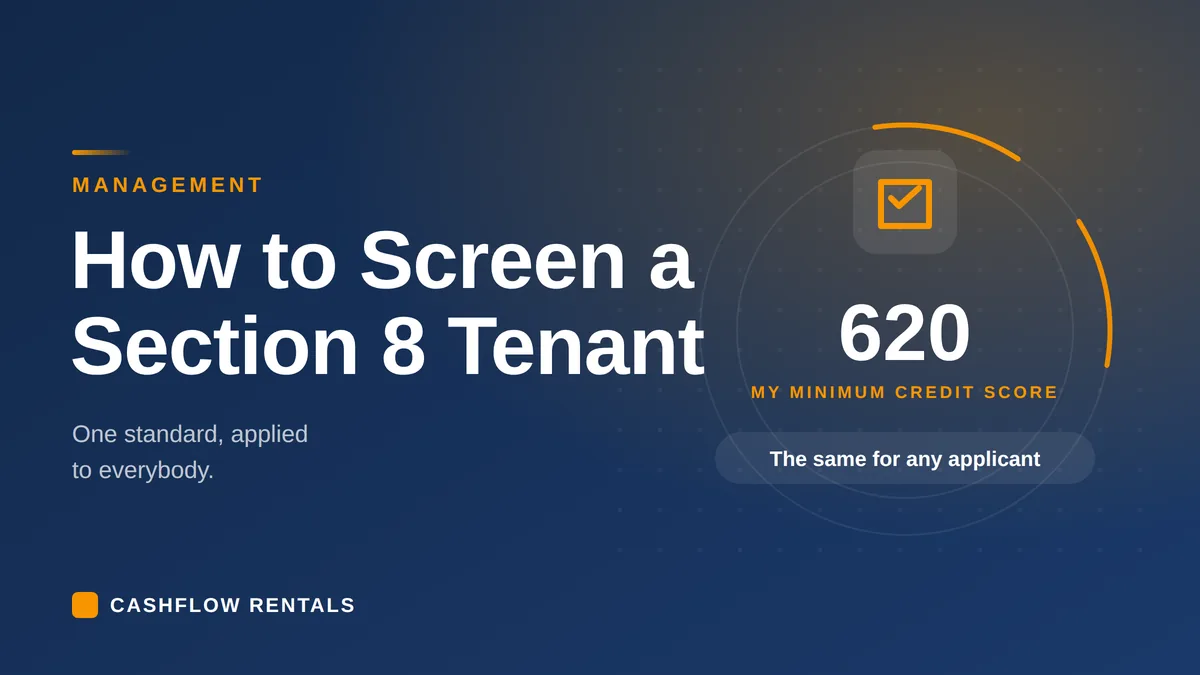
Credit check against my normal minimum of 620. I am less interested in the headline score than in the pattern: amounts sitting in collections, defaults, whether obligations get met. I want to know whether this household manages money, because that is what predicts whether their portion of the rent arrives.
Evictions check. A prior eviction is not automatically disqualifying, but it is something I want to know about and discuss rather than discover later.
Criminal background check, applied to the same criteria I would use for anyone.
The standard, and how each criterion applies to a voucher applicant. Note the income test: the multiple applies to the portion the tenant is actually responsible for, not the contract rent.| Criterion | Market applicant | Voucher applicant |
|---|
| Income | Three times the rent in net income | Three times the portion they are responsible for. A $500 share means $1,500 of net income |
| Employment references | Where there is employment | The same, plus understanding what the household's income actually consists of |
| Credit | Minimum 620, with the pattern mattering more than the score | Identical |
| Evictions | Not automatically disqualifying, but disclosed and discussed | Identical |
| Criminal background | The same criteria used for anyone | Identical |
One thing worth understanding about the income test on a voucher tenancy: the housing authority has already done a version of it. It sets the tenant's contribution at roughly 30% of their adjusted income, and at initial lease it will not let that share exceed 40%. So affordability has been partly pre-tested before the application reaches you. That is a large part of why, in my experience, voucher applications fail on credit, evictions and background rather than on income.
That is it. There is no Section 8 version of this list and no adjustment for the fact that a government agency is paying part of the rent.
Why the voucher counts as income
This is worth being clear about, because it is where the two camps talk past each other.
A housing voucher is income. It is reliable income while the tenancy complies, it arrives on time, and it would be irrational to ignore it when assessing whether a household can afford a property. Anyone who tells you to discount it entirely is not thinking clearly.
But it is part of the income, not the whole of it, and the part that is not covered by the voucher (if any) is the part that will determine whether you get paid in full. That portion also grows over time as the household's income rises, which is a mechanism most landlords have not thought about and which I have set out in when your tenant does better, you do worse.
So the practical question is not "can the voucher cover the rent" but "can this household reliably cover the part the voucher does not, and could they carry more of it if the subsidy shrinks?"
What happens when you actually apply it
Here is the uncomfortable part. In my experience, a large majority of voucher applicants will not pass a screening standard that an ordinary market applicant would pass. Credit, prior evictions, background check, and verifiable income are where it usually falls down.
That observation gets misused, so let me be precise about what it does and does not mean when I'm the one who's saying it.
It does not mean voucher holders are bad tenants. It reflects the fact that the program exists to serve households with very low incomes, and very low income correlates with the things a credit file measures. Households arrive in the program because their circumstances are difficult, and difficult circumstances leave a record.
What it does mean is that if you apply a proper standard, you will decline a lot of applicants, and you need to be comfortable with that. My answer to anyone uneasy about it is a question: why would I rent to somebody who fails my standard, regardless of how the rent is paid? The alternative is not a kinder policy, it is a worse tenancy for both of us.
It also means something about the properties themselves. If a property can only be let to applicants who fail a reasonable standard, that is information about the property and the neighborhood, not just about the applicants. I have written about what that told me in is Section 8 a good investment.
What the law says, federally
Now the legal position, because it is widely misunderstood in both directions and getting it wrong is expensive.
Under federal law, participation in the Housing Choice Voucher program is voluntary for landlords. 42 U.S.C. §1437f(d)(1)(A) provides that "the selection of tenants shall be the function of the owner". You are not federally required to accept vouchers.
Source of income is not a protected class under the Fair Housing Act. The federal protected classes are race, color, religion, sex, national origin, disability and familial status. Holding a housing voucher is not among them.
So as a matter of federal law, a landlord may decline to participate. That is the default, and anybody telling you otherwise is mistaken.
But federal law is not the whole picture, and this is where most of the confusion sits.
Where source of income is protected
A substantial number of states and cities have legislated their own protection, making it unlawful to refuse an applicant solely because they hold a voucher.
Estimates of the number of states vary between roughly 19 and 23 depending on the source and the date, plus the District of Columbia, Guam and a long list of municipalities. The number has been rising. Colorado removed its remaining small-landlord exemptions in 2026, which had previously allowed owners of a handful of units to opt out.
The picture is not uniformly one-directional. Some states have gone the other way and prohibited their own cities from mandating acceptance, including Indiana and Idaho. And in March 2026 a New York appellate panel struck down that state's source-of-income law on Fourth Amendment grounds, holding that compelling a landlord into a program requiring mandatory inspections amounted to an unconstitutional condition. That ruling applies to one appellate department, the Attorney General appealed it to the New York Court of Appeals on 1 April 2026, and reporting indicates it is stayed pending that decision, so its wider effect is unsettled. But it is a live area of law. The inspection issue behind it is covered in the Section 8 inspection problem.
The practical instruction: find out what applies where your property is, and do not rely on general advice, including mine. This varies by state, by city, and sometimes by number of units owned.
Where protection does apply, here is the key point: you may still reject an applicant for criminal history, prior evictions, poor references, insufficient income or lease violations. What you may not do is reject them solely because they hold a voucher. Colorado's guidance puts it well: the standard must be applied consistently to all applicants.
Which is exactly the approach I would recommend anyway.
What you may and may not do, depending on where the property is. This is a summary of the article, not legal advice: confirm the position for your own jurisdiction. | Where source of income is not protected | Where it is protected |
|---|
| Decline solely because the applicant holds a voucher | Lawful under federal law | Unlawful |
| Decline for criminal history, prior evictions, poor references, insufficient income or lease violations | Lawful | Lawful, provided the standard is applied consistently |
| Advertise "no Section 8" | Lawful, but the clearest possible material for a disparate impact claim | Unlawful, and direct evidence against you |
| Operate a blanket no-vouchers policy | Carries disparate impact exposure under the Fair Housing Act | Unlawful |
Why a blanket refusal is risky even where it is legal
Here is the part that surprises people, and it applies everywhere in the country regardless of state law.
Voucher holders are not demographically representative. HUD's own data puts the program at roughly 48% Black households against about 13% of the general population.
That creates disparate impact exposure under the Fair Housing Act. A policy that is neutral on its face can still be unlawful if it produces a significantly discriminatory effect without a substantial legitimate justification, following the Supreme Court's decision in Inclusive Communities in 2015. A flat "no Section 8" policy is exactly the kind of neutral rule that can be challenged on those grounds, and the challenge does not require anyone to prove you intended to discriminate.
HUD proposed rescinding its disparate impact regulation in January 2026, which if finalized would narrow this exposure. As at the time of writing that is not settled, and the statutory basis in case law would not disappear with the regulation. Treat the exposure as live until your own lawyer tells you otherwise.
So even in a state with no source-of-income protection, a blanket refusal is the riskiest of the available positions. A consistently applied standard is not.
The one thing to remember: the safe position is not exclusion and it is not indulgence. It is one written standard, applied identically to every applicant, with a record of how each was assessed. That is lawful everywhere, it is defensible if challenged, and it happens to produce better tenancies.
How to decline properly
If an applicant fails your standard, how you decline matters as much as whether you decline. Four practical points.
Never advertise "no Section 8" or "no vouchers." In a protected jurisdiction that is direct evidence against you. In an unprotected one it is still the clearest possible material for a disparate impact claim. There is no version of this that helps you.
Have your standard in writing before you advertise, and make sure it is the same document you use for every applicant. A standard you wrote after receiving an application looks like what it is.
Record how each applicant was assessed against it. Which criterion they failed, and the evidence. Not a note saying you had a bad feeling.
Give the actual reason. If someone failed on prior evictions, say so. Vagueness looks like concealment, and in a protected jurisdiction a refusal without a stated non-voucher reason invites the obvious inference.
I have spoken to landlords who advertised a property, received an enquiry asking whether they accepted vouchers, declined informally, and then found themselves dealing with a legal claim. Whether those claims had merit is beside the point. The process itself is expensive, and it is avoidable by doing the above.
Why consistency is the only defense that works everywhere
Step back and look at the whole picture.
A blanket refusal is unlawful in perhaps twenty states and many cities, and carries disparate impact exposure everywhere else. Accepting vouchers without proper screening produces exactly the tenancies that make landlords swear off the program. A consistent standard applied to everybody is lawful in every jurisdiction, defensible if challenged, produces better tenancies, and requires no judgment about who deserves a chance.
It also solves a problem that has nothing to do with law. If the subsidy portion of your rent may shrink over the life of a tenancy, and it may, then you need a tenant who could plausibly carry more of the rent themselves. Screening properly is not just a compliance exercise. It is the thing that protects you when the payment split moves.
If you want to model what happens to a deal when the subsidy share falls, the free tools in my investor starter kit will let you run it on different payment splits.
The bottom line
Screening a voucher applicant is the same job as screening any applicant. Income, references, credit, evictions, background. Count the voucher, because it is real income. Do not let it excuse you from the rest.
You will decline a lot of applicants that way, and that is the correct outcome rather than an unfortunate side effect. If a property can only be filled by applicants who fail a reasonable standard, the property is telling you something.
And get the legal position right for your specific location, because the general rule is that there is no general rule.
Remember, investing is a game of probabilities. One consistent standard, written down, applied to everybody, documented. It is the least glamorous thing in this business and it prevents more losses than anything else I do.
This article is general information, not legal advice, and it is not a substitute for advice from a lawyer qualified in your jurisdiction. Cashflow Rentals is a real estate consultancy, not a law firm. Source-of-income protection varies by state, city and sometimes by the number of units owned, and the law in this area is changing. The number of protected states cited is an estimate that differs between sources. Always confirm the position that applies to your specific property before adopting any screening or advertising practice.