What the inspection actually is
Every unit under the Housing Choice Voucher program must meet HUD's housing quality standards before an assistance payment begins, and must continue to meet them throughout the tenancy. Authorities inspect at the start and then periodically.
The standards themselves are not unreasonable. They cover the things you would want in a rental anyway: working heating, safe electrics, no exposed wiring, functioning plumbing, sound windows and doors, working smoke detectors, no peeling paint in older properties, secure handrails, adequate ventilation.
Nothing in that list is objectionable. The issue is not the standard, it is the enforcement mechanism attached to it.
I'll also go into a bit more detail further down about what "renovated to Section 8 standards" actually means. And it isn't quite the badge of quality one might think.
What happens when it fails
When a unit fails inspection, the authority notifies you and sets a deadline for remedy. The sequence from there is usually this.
- The authority notifies you of the failure and sets a deadline to put it right.
- Life-threatening items typically require correction within 24 hours. Other items get a longer window, commonly 30 days.
- If the fault is not corrected in time, the housing assistance payment is suspended.
- In some circumstances the authority may abate the payment retroactively to the date of the failed inspection.
- If the fault remains unresolved, the contract can be terminated altogether.
Note what does not happen. Your obligations to the tenant continue. The tenant remains in occupation. And in principle the tenant remains liable for their own portion of the rent, since the abatement applies to the authority's payment rather than theirs. In practice, a tenant who has just triggered an inspection failure is rarely paying you either.
I had a tenant, not Section 8 in this case, who failed to pay any rent after living in the house for just one month. I still had to have my property manager respond to maintenance requests (of which there were many), while we worked through the eviction process. I still had to pay my insurance, property taxes, and mortgage payments. It's not just lack of income, it's unfunded expenses. That's a very real, tangible financial loss every month.
The lever
Here is where it becomes a structural problem rather than an administrative one.
Suppose your contract rent is $1,600, the voucher covers $1,000, and your tenant owes $600 a month. Suppose further that the tenant is struggling, or simply decides they would rather not pay.
They can complain to the housing authority about a repair (which they may or may not have created). The authority is obliged to investigate. If the complaint has substance, the unit fails, and your $1,000 stops until you have remedied it. If the complaint concerns damage the tenant themselves caused, the payment stops anyway while you deal with it.
So a tenant who wants to avoid paying $600 can, with a phone call, put the other $1,000 at risk as well. They still owe you their share on paper. You are collecting none of it.
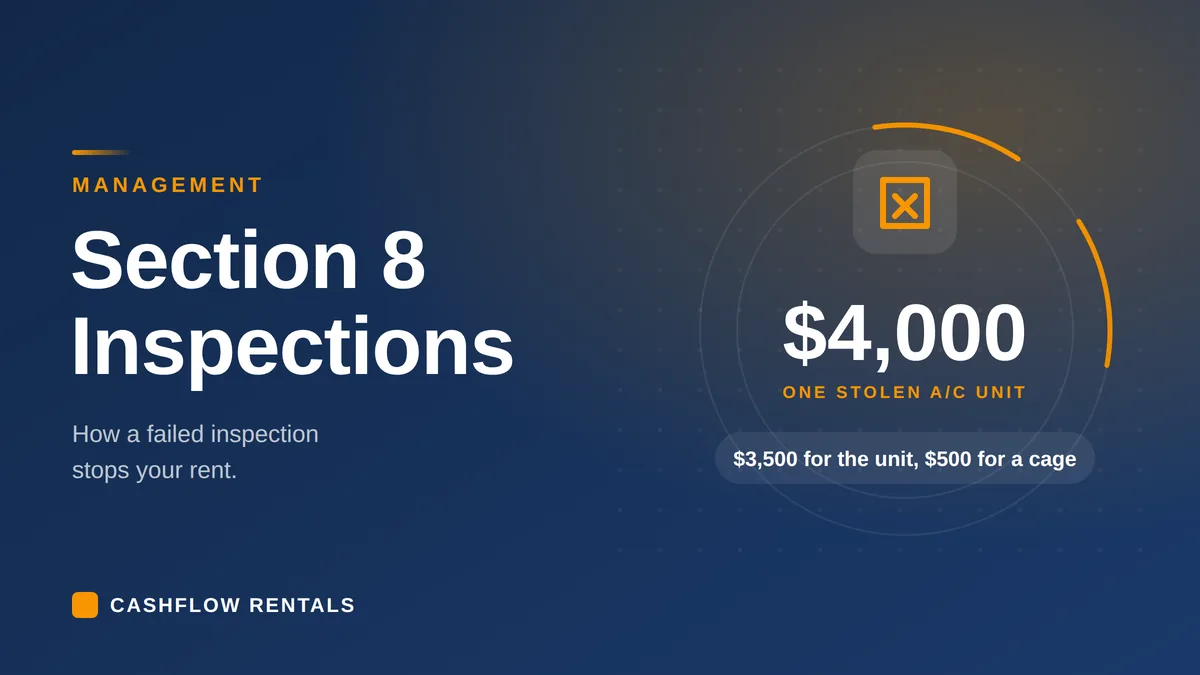
I had a Section 8 tenant who removed and sold the A/C unit from the house. I know it was them because they advertised it on their Facebook page (not smart). They then reported the house for having no A/C, and it cost me more than $3,500 to get a new unit installed, plus another $500 for a metal cage so they couldn't do the same thing again.
I want to be careful about how I put this, because most voucher tenants never do anything of the kind. But some do, and they are not amateurs about it. There are Facebook groups where voucher holders share advice on avoiding their portion of the rent. Over the years I came to think of a certain type as professional tenants, because they understood the process considerably better than most landlords do.
The four-way squeeze
When it goes wrong, it goes wrong from four directions at once.
No tenant payment, because that is what started it.
No subsidy, because the unit has failed and the payment is suspended.
A repair bill, which you must pay promptly and which may be for damage the tenant caused.
A slow enforcement process, because you are now pursuing arrears through the authority and potentially the courts, while the tenant remains in the property.
There is no equivalent of that in ordinary letting. A market tenant who stops paying is a collection problem. A voucher tenant who stops paying and complains about a repair is a collection problem, a compliance problem and a cash flow problem simultaneously.
What happens when a tenant stops paying, in an ordinary tenancy and under a voucher. | Market tenancy | Voucher tenancy |
|---|
| Rent from the tenant | Stops | Stops |
| Rent from the housing authority | Not applicable | Suspended if the unit fails inspection |
| Repair timetable | Your own schedule | The authority's deadline, 24 hours to around 30 days |
| Route to resolution | Collection, then possession | Authority process, then possession |
| Tenant's access to legal help | Usually unrepresented | Often funded representation |
The one thing to remember: the inspection regime converts a rent dispute into a suspension of your government income. The size of that risk is proportional to the tenant's share of the rent, which is why matching the rent to the voucher is not just an affordability question. It removes the lever.
Why eviction is slower
If it reaches the point of possession proceedings, expect it to take longer than a market tenancy.
Two reasons. First, voucher tenants frequently have access to legal representation funded by charities or government programs, and they know how to use it. In my experience you are not dealing with an unrepresented individual, you are dealing with somebody who has advice.
Second, the housing authority is a party to the arrangement. Terminating a tenancy under the program involves notifying and coordinating with the authority, which adds process and time regardless of the merits.
None of that means you cannot regain possession. It means the timeline you assumed when you underwrote the deal is probably optimistic, and a longer void plus legal costs plus unpaid rent is a materially worse outcome than the projection allowed for.
The court that agreed the inspections are a problem
There is a legal development here worth knowing, because it validates the concern from an unexpected direction.
In March 2026, a five-judge panel of the New York Appellate Division, Third Department, struck down that state's source-of-income discrimination law on Fourth Amendment grounds. The case was brought by a landlord in Ithaca who argued that compelling participation in a program requiring mandatory government inspections of his property amounted to an unconstitutional condition, effectively a warrantless search.
The court agreed. It described the state's objective as laudable but concluded that the method could not survive the constitutional objection.
Two important qualifications, because this is easy to misread. The ruling came from one appellate department rather than nationally, and New York City sits in a different department with its own local law, so the practical effect is limited. And the New York Attorney General filed a notice of appeal on 1 April 2026, taking the case to the New York Court of Appeals, the state's highest court. Reporting at the time indicated the decision is stayed pending that appeal, and no hearing date had been set. So this is an unsettled position, not a change in the law you can rely on. Take local legal advice before acting on it.
Even with those qualifications, a court has accepted that the inspection requirement is a genuine intrusion rather than a formality, which is a notable finding given how routinely the inspections are presented as a landlord benefit.
"Renovated to Section 8 standard" is not a selling point
I mentioned this above, and it's worth going into a little more detail. This is something to watch out for when property is marketed to you.
I regularly see listings describing a property as renovated to Section 8 standard, as though that were a quality claim. It is not. Housing quality standards are a minimum, and a property finished to that minimum is barely functional. It will not attract a good open market tenant, which means the voucher pool is your only pool, which means the subsidy is not a bonus on top of your investment case, it is the whole of it.
That matters when you come to sell, and it matters if the program changes. The wider marketing problem, including this specific claim, is covered in what British investors get sold in the USA.
How to remove the lever
Four things, in order of effectiveness.
Match the rent to the voucher. If the tenant's portion is small, the amount they can withhold is small, and the incentive to engineer a suspension largely disappears. This is the single highest-value decision in voucher letting and it also addresses the risk covered in when your tenant does better, you do worse.
Inspect proactively, every few months. The objective is that the authority never finds anything you did not already know about. A defect you have already scheduled is an administrative note. The same defect discovered at inspection is a suspension risk. I pay my property manager to walk all my properties every 3 months. It's worth every penny.
Buy a property that is genuinely above the standard, not at it. Systems replaced rather than patched, so the routine items that fail inspections are not sitting there waiting. The financing consequences of buying at the cheap end are set out in DSCR loans under $100,000.
Hold reserves specifically for this. Repairs under the program are not deferrable. You cannot decide to deal with something next quarter, because the deadline is set by the authority and the penalty is your income. A maintenance reserve on a voucher property is doing a different job from one on a market rental.
And document everything. Photograph the property at move-in and at every inspection. Where a defect is tenant-caused, you will need evidence for both the authority and any subsequent claim.
If you want to work out whether a specific property carries enough margin to absorb non-deferrable repairs, the free tools in my investor starter kit will size the deal and the reserves it needs.
The bottom line
Inspections are the part of Section 8 that looks like a benefit and functions as a risk. Somebody does check your property, which is genuinely useful. But the enforcement mechanism attached to that check hands your tenant a means of interrupting your income, and the size of that risk scales with how much of the rent they owe.
You cannot remove the inspection regime. You can remove most of the leverage it creates, by keeping the tenant's portion small, staying ahead of the maintenance, and buying property that clears the standard comfortably rather than scraping it. Plenty of landlords decide the mechanism is not worth managing at all, and the inspection regime is one of the reasons most often given by those who leave the program.
If you are weighing the program as a whole rather than this one mechanism, I have set out the full picture in is Section 8 a good investment.
Remember, investing is a game of probabilities. Assume at some point an inspection will fail, and structure the deal so that when it does, it is an inconvenience rather than a crisis.
This article is general information, not legal, tax, or financial advice. Cashflow Rentals is a real estate consultancy, not a lender, mortgage broker, tax adviser, or law firm. Inspection standards, remedy deadlines, abatement practice and eviction procedure vary by housing authority and jurisdiction and change over time. The March 2026 New York ruling described applies to one appellate department, is under appeal to the New York Court of Appeals, and its wider effect is unsettled. Always verify the current position with the relevant housing authority and take local legal advice.