The pitch, stated fairly
Here is the case for Section 8, made properly. Without the hype. Without the Rolls Royce. Just actual operational truth.
A large part of your rent arrives from a government agency by direct deposit, on time, every month, regardless of whether your tenant has had a good month. In weak rental markets that is materially better than relying on the tenant alone.
Section 8 (and other subsidized tenants) often stay for years, because moving means finding another landlord who accepts vouchers, and in much of the country that is hard.
Vacancy periods can be shorter, because housing authorities maintain lists of people actively looking. And the unit gets inspected, which at least means somebody other than you is checking the condition.
Those are real advantages. Plenty of investors run voucher-tenanted portfolios successfully and profitably, and the better commentators in this space say honestly that Section 8 suits a long-term wealth strategy rather than a quick income play. I agree with that.
What I take issue with is the specific claim that it is guaranteed passive income, because that's just untrue. Wildly untrue in fact.
Fair Market Rent is not your rent
This is the misconception that costs people the most, and it is an almost universal claim by the Section 8 investment property sellers.
You will be shown a HUD Fair Market Rent table. It is public, it looks official, and the number is usually higher than the property would fetch on the open market. A seller quotes it as your rent, applies it to the purchase price, and produces a yield that looks excellent.
Fair Market Rent is not a rent. It is an input to a subsidy calculation, and there are six separate steps between that number and money in your account.
- HUD publishes the Fair Market Rent.
- Your local housing authority then chooses where to sit within 90% to 110% of it, and one under budget pressure can sit at the bottom. That figure is a cap on the subsidy, not on the rent.
- If your tenant pays their own utilities (which most do), a utility allowance is deducted before you get to your maximum achievable rent.
- Separately, a rent reasonableness test ties what you can charge to comparable unassisted properties nearby, which means you cannot obtain above-market rent through the program at all.
- Rent increases are not automatic, you have to request them in writing before the lease anniversary, and the authority can approve them, approve a lower figure, or refuse.
- And any change applies at your tenant's next annual recertification, not when HUD publishes.
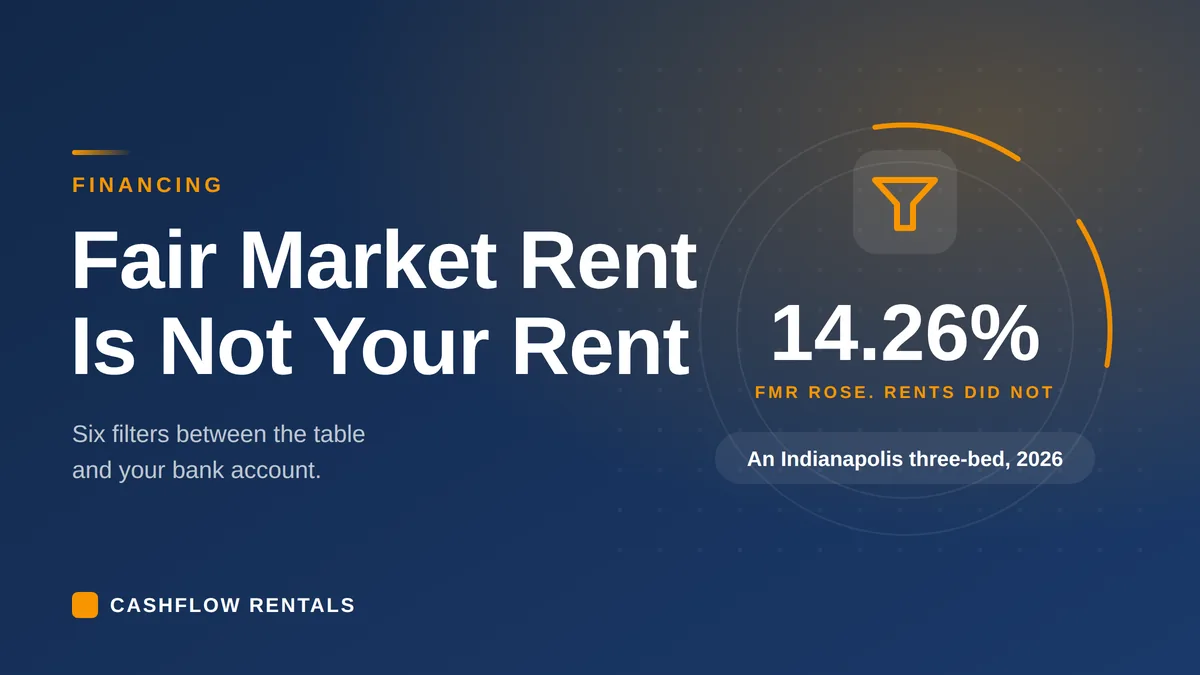
To put a number on it: Indianapolis three-bedroom Fair Market Rent rose 14.26% for the 2026 fiscal year. That does not mean a single Indianapolis landlord received a 14.26% rent increase. It means the ceiling on a ceiling moved. That's it.
The one thing to remember: ask for the actual voucher amount for the actual tenant, on the actual property. Never accept a Fair Market Rent table as evidence of what something will earn. If a seller cannot give you the voucher figure, they are quoting you a government statistic and calling it income.
I go through the whole chain, with the regulations, in why Fair Market Rent is not your rent.
What "guaranteed" actually covers
One widely read landlord site states that "at least 70% of your rental income is assured every month" under Section 8. Read that again, because it is an admission rather than a selling point.
If 70% is assured, up to 30% is not. And the unassured portion is the part owed by your tenant, who is by definition on subsidized housing. They are typically very financially strained, and they're only one small life event away from being unable to pay their share. A car breakdown. A sick kid. Unpaid sick leave from work. An unexpected cost of childcare. All these things happen to all of us all the time. When that life event sucks up the only $3,000 you had, you're not making rent, even if your share was only $300.
The tenant/voucher split depends entirely on that household's income. The authority pays the difference between the payment standard and roughly 30% of the tenant's adjusted income. So a very low-income tenant might contribute almost nothing, and your rent is nearly all government-paid. A tenant with more income contributes more, and your government-paid share shrinks.
That leads to the single most important practical rule I can give you, and I will come back to why it matters most: match the rent to the voucher. Do not rely on a tenant top-up. I have seen landlords accept a $1,000 voucher on a property let at $2,300, leaving $1,300 a month owed by a household that often has no employment income at all. That $1,300 is the part that fails.
The inspection lever
This is another part of the sales script that Section 8 sellers lean on.
Section 8 units must pass an inspection, and if the property fails, the housing assistance payment is suspended until the fault is fixed. Repairs must be dealt with immediately. Often, I see properties marketed explicitly as "renovated to Section 8 standards". Trust me, that's not a benefit. It means barely functional, and that level of finish doesn't fly for good quality open market tenants.
Now combine that with a large tenant top-up. A tenant who does not want to pay their share has a lever available: complain about repairs. Including for damage they caused, or for faults that are marginal. The property fails inspection, your subsidy stops, and you are simultaneously paying for the repair, receiving nothing from the tenant, and pursuing enforcement through the housing authority and the courts.
That is a four-way squeeze that exists nowhere else in residential letting. And it is not hypothetical. There are Facebook groups where voucher holders share advice on avoiding their portion. I have also come to think of a certain type as professional tenants, because they know the process better than most landlords do.
There is a legal footnote here that is also worth knowing. In March 2026 a New York appellate panel struck down the state's source-of-income law on Fourth Amendment grounds, on the basis that compelling a landlord into a program with mandatory inspections amounts to an unconstitutional condition. A court has effectively validated the concern.
This is also the real reason to match rent to voucher. Keep the tenant's portion small and the lever largely disappears, because there is little to withhold. The full mechanics are in the Section 8 inspection problem.
Why damage and underreporting are more common
My experience, and I will be plain about it, is that voucher-tenanted properties suffered more damage, more unreported maintenance and more failed inspections than the rest of my portfolio.
I want to explain some of that structurally rather than blame the tenants entirely. But that said, the pattern in my own portfolio was consistent and I am not going to pretend otherwise. That's important because receiving rent on time is just one piece of the puzzle. You're also relying on tenants to look after your property and report maintenance items before they become big, expensive problems.
First, consider that Section 8 tenants typically have little or no deposit at risk, so the ordinary financial deterrent doesn't apply. Their monthly stake is also small, if anything. A household under financial stress may avoid reporting a defect, fearing a rent increase or losing the unit, so small problems become large ones. They don't want to be a nuisance.
Also, and I'll say it bluntly, some of the tenants I housed had never been taught what needs reporting and what doesn't, or the do's and don'ts that can cost a landlord thousands of dollars. Flushing wipes and other sanitary products down the toilet. Pouring cooking grease down the sink. Both of those can run into thousands in remediation by the time they surface as a problem, and neither is obvious if nobody has ever told you.
I'm not saying these issues are exclusive to Section 8 tenants. They are not. But it was very noticeable how much more often these things occurred when compared with higher-priced open market tenancies I managed.
The inspection regime also creates a withholding lever that does not exist in ordinary letting. And in a low income neighborhood, the applicant pool available to a voucher is shaped by the fact that stronger applicants have better options elsewhere.
Each of those has something you can do about it, which is why I prefer them to a character judgment on the tenant. Inspect your properties proactively every few months rather than waiting to be told. Keep the tenant portion low. Give every new tenant a plain-English guide to what to report and what not to put down the drains, because most problems are cheaper to prevent than to explain afterwards.
And above all, be careful about the neighborhood. Viable Section 8 properties tend to cluster in the weakest neighborhoods. Why? Because good private market tenants have options, and they don't want to live there. So over time, Section 8 becomes the dominant tenant pool. The constraint is the neighborhood, not the voucher.
The risk that gets worse when your tenant does better
This is perhaps the most important part about Section 8 investing that no one talks about. Most sellers make it a feature that you're a social housing provider. An ethical investor if you will. In practical reality, the housing voucher program can be a poverty trap. Here's how.
In ordinary letting, a tenant getting a better job is generally good news. Under Section 8, it transfers more risk to you.
Because the housing authority pays the difference between the payment standard and 30% of your tenant's income, every dollar your tenant earns moves 30 cents of your rent from a government payer to a household payer. Using the Indianapolis 2026 three-bed payment standard of $1,907:
How the payment split moves with tenant income, using the Indianapolis FY2026 three-bedroom payment standard of $1,907. Illustrative: real calculations use adjusted income and vary by authority and household.| Tenant monthly income | Tenant pays | Authority pays | Your rent that is government-paid |
|---|
| $1,200 | $360 | $1,547 | 81% |
| $2,000 | $600 | $1,307 | 69% |
| $2,800 | $840 | $1,067 | 56% |
| $3,600 | $1,080 | $827 | 43% |
Your tenant gets a $400 a month pay rise, which is a good thing for them and for the world. Your guaranteed income falls by $120 a month and your at-risk income rises 20%.
Keep going and the voucher reaches zero at about $6,350 a month of income, at which point you are relying entirely on a tenant you never screened to the standard you would have applied to a market tenant at that rent.
To be accurate, because it matters: the tenant is not losing the whole raise. The housing taper takes 30% of it, so a $400 rise costs them $120 and they keep $280. The genuine poverty-trap effect comes from stacking that with food, medical and childcare tapers, where the combined rate becomes punishing. But from your side of the ledger the direction is unambiguous. Full analysis in when your tenant does better, you do worse.
Now look at that from the tenant's point of view. Maybe they worked hard to get that raise, or put in a lot of extra hours. Now 30% of it is going in your pocket, not theirs. How do you think that pans out for the all-important landlord-tenant relationship?
Also, and this is just my personal opinion, what this does is turn the housing voucher program, which was supposed to be a safety net, into a hammock. That's bad for the tenant, and bad for society as a whole. But let's not get political, because I don't know what the solution is. Maybe what we have is already the best version. I'm not smart enough to answer that question. Anyway, back to the questions at hand.
What is happening to the funding
If your investment case rests on a government counterparty, the government's intentions and future plans should be part of your due diligence.
The Emergency Housing Voucher program is being wound up, with HUD having stopped issuing new ones in April 2026, affecting roughly 57,000 families. New York City's housing authority has around 5,200 participants it cannot move onto regular Section 8 because it lacks the funding, sought a federal waiver, and was refused. It is formally in shortfall status.
More significantly, the FY2026 federal budget proposes eliminating the Housing Choice Voucher program entirely and replacing it with block grants to states, alongside proposed two-year time limits and a proposed rule permitting work requirements. None of that is settled. But the direction is worth noting.
And there is one detail that should concern any investor directly: HUD's own guidance to authorities facing funding shortfalls includes reducing payment standards. So the ceiling on your rent can be cut by administrative decision, with no change in the rental market at all.
The detail, with sources and dates, is in is Section 8 rent actually guaranteed.
What the long-run record shows
I analyzed HUD's complete Fair Market Rent dataset, every area in the country from 1983 to 2026, because I could not find anyone who had.
The headline is not that rents are falling. For the 2026 fiscal year they mostly rose, with a median increase of about 5%. Anyone telling you Section 8 rents are collapsing is wrong.
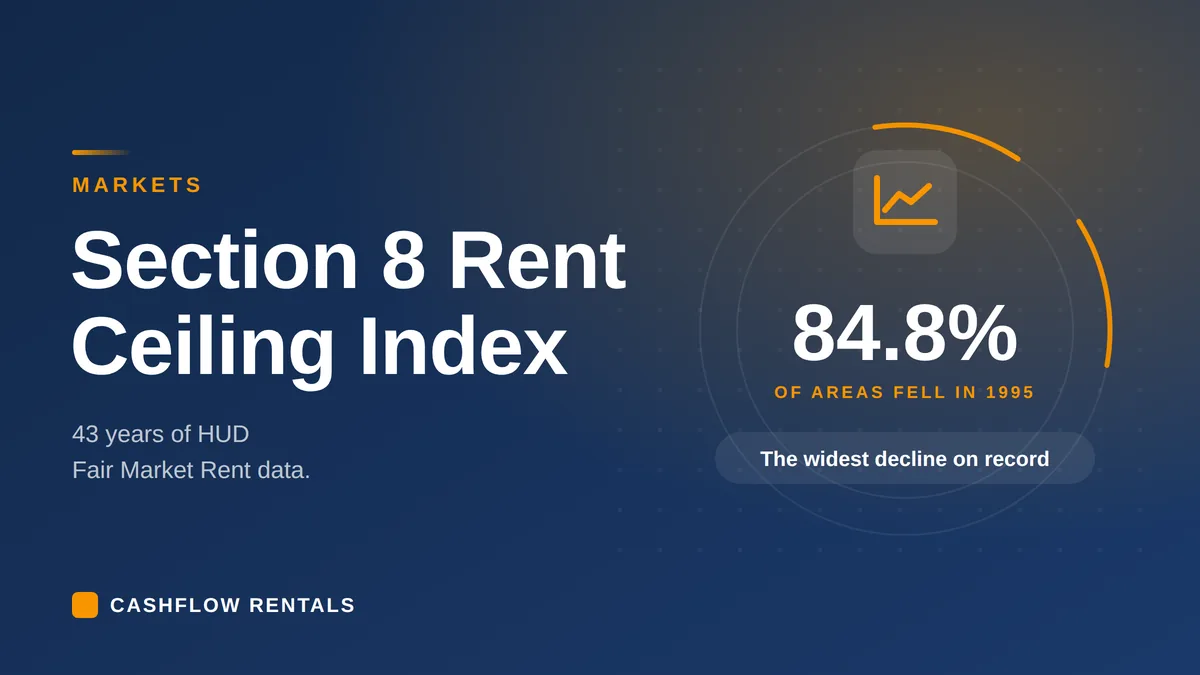
The finding is that the ceiling falls regularly, and nobody mentions it. Across 2,615 areas with more than twenty years of data, the median area saw its three-bedroom ceiling fall in 5 of the last 25 years. Only 4 areas out of 2,615 never had a fall. And in the 2012 fiscal year, the ceiling fell in roughly seven markets out of ten across America. That's the reality.
The risk also rises with unit size, which matters because larger units are what investors like me buy. In 2026, ceilings fell in 15.5% of areas for two-bedrooms and 20.3% for four-bedrooms.
One genuinely reassuring finding: HUD caps annual decreases at 10%, and no area in the dataset fell further than that.
So a Section 8 investment is not a fixed-income asset with a government counterparty. It is an asset whose revenue ceiling is reset annually by a federal agency under budget pressure, and which has moved downward in about one year in five. The full dataset, market by market, is in the Section 8 Rent Ceiling Index.
What I learned in Mississippi
My own Section 8 experience was a portfolio of cheap houses in Mississippi, and it went badly. Not at first though. At first, everything went pretty well. But eventually, the reality of housing low-income families in bad neighborhoods started to manifest on my financial statements.
The properties were exactly what gets marketed to overseas investors now: low purchase prices, strong-looking yields on paper, voucher tenants, objectively undesirable neighborhoods.
Over time, the projected yields failed to show up in net operating income. Turnover was frequent and expensive. Damage was routine. Capital expenditure on hundred-year-old houses arrived constantly and I had factored none of this into my shiny looking spreadsheets. You just don't know what you don't know, I guess.
And the property management was worse than the properties. One of my managers withheld roughly $50,000 of rent and had to be pursued legally to recover it. Another placed tenants who had not been properly screened and who did significant damage to the houses. Another claimed to have paid me rents which they had actually withheld, and it took months of back and forth, and eventually legal threats to get paid.
That portfolio ended in foreclosures and short sales. I am not going to blame Section 8 for it, because I bought the wrong properties in the wrong areas and I over-leveraged. That's all on me. But the program did not protect me from any of it, and the guaranteed-income framing was part of what made the numbers look survivable when they were not. The full account of this disaster is in how I nearly went bankrupt buying US rentals.
I am also not unusual in leaving the program. HUD's own figures show thousands of landlords exiting the voucher program every year, and the research on why they go matches most of what I set out above. That is covered in why 5,000 landlords a year quit Section 8.
The financing penalty at this price point
One practical thing that the Section 8 pitch never mentions: the stock is overwhelmingly cheap, and cheap property finances badly.
From real term sheets I obtained for clients, a $78,000 loan came in at 8.075% interest with 3.25% in upfront fees, and it was capped at 65% loan to value rather than the 70% to 75% a foreign national would normally get. Total lender fees reached 5.8% of the loan, because closing and underwriting costs are fixed amounts that do not shrink with your loan. The total cash the lender wanted to see came to 47.6% of the purchase price. That's not leverage. That's a lender pricing in extreme risk. That should tell you something.
So the cheap house is not the cheap entry it appears to be, and the financing eats a chunk of the yield the voucher was supposed to guarantee. I have published the actual term sheets in DSCR loans under $100,000.
How I would screen a voucher applicant
Here is the constructive part, and it is where I part company with both sides of this argument.
I have no objection to voucher tenants. What I object to is lowering the screening bar because a voucher is involved. So I apply exactly the same standard I would apply to anybody: income, counting the voucher as part of it; employment references; a credit check against my normal minimum, including amounts in collections and defaults, because I want to know whether they manage money; an evictions check; and a criminal background check.
What you find in practice is that a large majority of voucher applicants will not pass screening that an ordinary applicant would pass. My response to that is a question: why would I rent to somebody who fails my standard, regardless of how the rent is paid?
One legal point worth getting right, because it is widely misunderstood in both directions. Under federal law Section 8 participation is voluntary for landlords, and source of income is not a protected class under the Fair Housing Act. But somewhere between nineteen and twenty-three states, plus many cities, have made it unlawful to refuse a tenant solely because they hold a voucher. In those places you may still reject an applicant for criminal history, prior evictions, poor references or lease violations. What you may not do is refuse them purely for having a voucher.
Which is another reason a consistently applied standard is the right approach: it is defensible everywhere, and a blanket refusal is not. Anywhere in the country, a flat no-vouchers policy also carries fair housing risk, because voucher holders are disproportionately from protected groups. The detail is in how to screen a Section 8 tenant.
One more practical point on this. I have spoken to landlords who advertised properties, received enquiries asking whether they would accept vouchers, declined, and then found themselves facing a legal claim. Whether or not those claims had merit, the lesson is the same: in a state or city with source-of-income protection, how you decline matters as much as whether you decline. Apply one written standard to every applicant, keep a record of how each was assessed, and never put "no Section 8" in an advertisement.
When Section 8 genuinely works
I would not tell you never to rent to a Section 8 tenant. Some of the ones I worked with were great. They paid their co-pay on time every month, and really looked after the properties. But they were the exceptions, not the rule. What I would do is tell you the conditions that have to hold in order to consider Section 8.
The rent needs to be matched to the voucher, so there is little or no tenant top-up to withhold.
The property needs to be at inspection standard before you complete, not promised afterwards.
The neighborhood needs to stand up on its own, with genuine homeowner demand, because if the area only works because of the subsidy then the subsidy is your entire investment case.
You need reserves, because the inspection regime means repairs are not optional or deferrable.
You need a manager you have actually verified rather than one the seller recommended.
And you need a long hold, because the entry costs at this price point are heavy.
If all of that is true, Section 8 can be a perfectly reasonable long-term holding. If several are not, the guarantee will not save you, and I can tell you that from experience rather than theory.
If you want to pressure-test a specific property before you commit to anything, the free tools in my investor starter kit will size the deal, work out the real cash to close, and check the financing.
And if you are buying from 4,000 miles away, every one of those conditions is harder to verify and harder to enforce. That deserves its own treatment, which it gets in Section 8 for overseas investors.
The bottom line
Section 8 is not guaranteed passive income. It is a subsidy program with a ceiling that moves, a payment split that shifts as your tenant's circumstances change, an inspection regime that can suspend your income, and a funding position that is looking less attractive as time goes on.
None of that makes it a bad investment. It just means there are specific risks to underwrite for, which is precisely what most of the marketing denies. The investors I see get hurt (and there are lots) are the ones who accepted the words "guaranteed and passive" on face value, and didn't appreciate the operational realities of owning this kind of real estate.
Ask for the voucher amount, not the Fair Market Rent. Match the rent to the voucher. Screen the tenant the way you would screen anybody else. Buy in an area that works without the subsidy. And treat the government portion as reliable income rather than as a substitute for good judgment.
Remember, investing is not about certainties, it is a game of probabilities. A guarantee that covers part of the rent, some of the time, subject to inspection, is not a guarantee. It is just a tenant with a co-signer who can walk away. And it doesn't account for the additional operational risk of becoming the housing provider to low-income families in the US.
This article is general information, not legal, tax, or financial advice. Cashflow Rentals is a real estate consultancy, not a lender, mortgage broker, tax adviser, or law firm. Housing Choice Voucher rules, payment standards, funding levels and state source-of-income laws vary by jurisdiction and change over time; several federal proposals described here were unresolved as of August 2026. Figures from HUD data are as published. Always verify the current position with the relevant housing authority and take your own professional advice before buying rental property.