What you actually get instead of a buy-to-let mortgage
A UK buy-to-let mortgage looks at you and the rent. Your income, your credit file, a stress-tested rent calculation, and increasingly your whole portfolio.
A DSCR loan looks at the property in isolation. If the rent comfortably covers the mortgage payment, the taxes and the insurance, you can borrow. That's more or less it. No US credit history, no US income, no social security number.
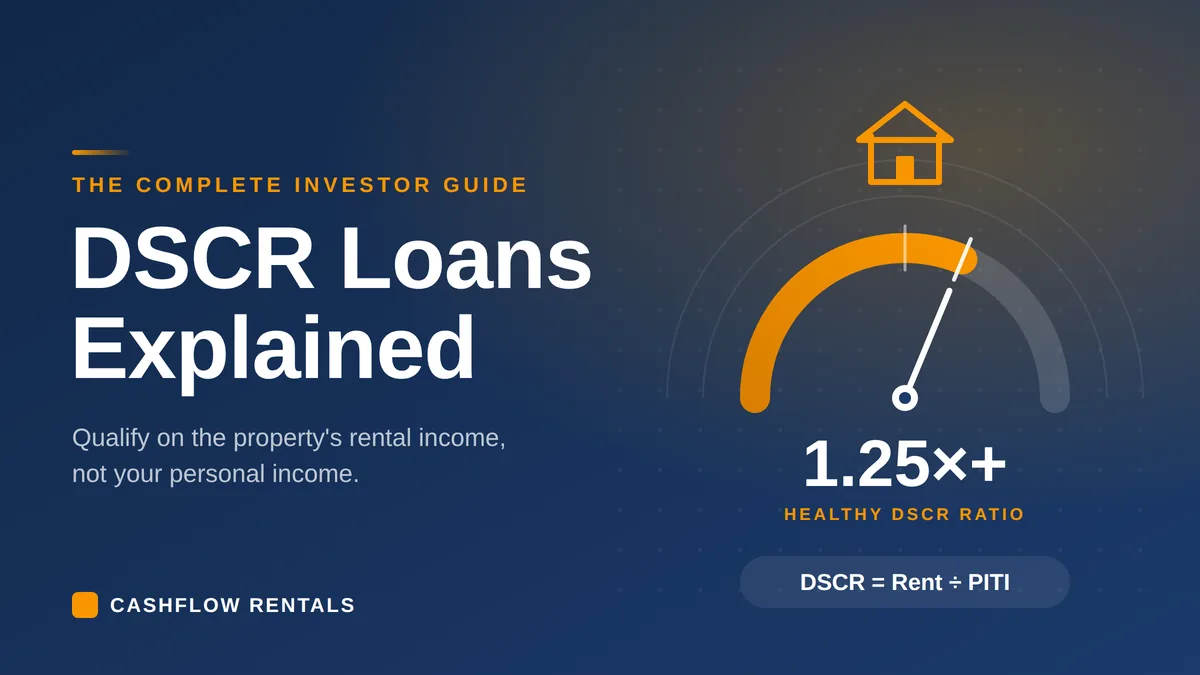
DSCR stands for debt service coverage ratio, which is just the rent divided by the monthly payment. If the rent is 1,800 dollars and the payment is 1,200, your ratio is 1.5 and the lender is happy. Most want at least 1.0, and better ratios get better rates. I explain the whole product in my guide to DSCR loans.
The reason this matters to a British investor buying US rental properties is simple. At home, the number of properties you can own is eventually capped by your own income, credit, and debt ratios. In America it isn't. Each property stands on its own rent. That's one of the most common reasons the UK landlords I work with end up looking across the Atlantic.
How you qualify
Short version: the property qualifies, and you just have to be documentable.
Expect a deposit of 25 to 30%, so you're borrowing 70 to 75%. Closing costs run 3 to 5% of the purchase price. And you'll need cash reserves, usually between three and twelve months of the mortgage payments, sitting in an account you can prove. Reserves aren't a fee, they stay your money, you just have to show them. I break the full cash requirement down in how much cash you actually need.
You'll borrow through an American company (that you own) normally an LLC, with you personally guaranteeing the loan. This catches British investors out more than other nationalities I work with, because you're used to holding property in a UK limited company. You can't use it for your US portfolio. Most US lenders won't accept a foreign company anywhere in the ownership structure. So if you want a mortgage, you're setting up an American entity. There's a step-by-step in what you need in place before you borrow.
One more thing worth knowing early: your down payment money needs a clean paper trail, and if you're borrowing your deposit it needs to be secured borrowing. A remortgage or a further advance against your own home is fine. Savings are fine. The proceeds from asset sales are fine. Even a gift is fine. An unsecured personal loan is not, and I've watched that single detail kill a deal after the buyer had already paid for an inspection and an appraisal. That story is in why applications get declined.
The two differences that matter most
Forget the interest rate for a moment. I know that's where we all focus, but it really isn't the most important factor. Two structural things separate these products, and both of them matter more than the headline number.
The American loan pays itself off. A standard DSCR loan is a thirty-year repayment mortgage. Every payment chips away at the debt. UK buy-to-let is usually interest-only, which means in year ten you owe exactly what you owed on day one.
That compounds over time. On the comparison below, the American tenant repaid about 17,700 dollars of the mortgage over ten years. The British tenant repaid nothing. Not because the British property was worse, in fact they generated roughly the same amount of net income, but because interest-only loans don't pay down your debt.
It also matters if and when markets fall. Which they do from time to time. If you've been in property long enough, you already know it works in cycles. That's not a good or a bad thing, there's opportunity in every part of a cycle, but you do need to be aware of it and plan accordingly. If values drop 10%, the interest-only landlord absorbs the whole hit from their equity. The repayment landlord in the US has a cushion, because the debt has been shrinking the whole time.
None of this makes interest-only wrong. It's a deliberate strategy: keep the payments low, take more cash flow now, and rely on the property going up in value. In a market with a long record of capital growth, that has worked very well. It just means your equity depends on the market rather than on the mortgage.
The one thing to remember: in the UK you're mostly betting on the property going up. In America the tenant is buying it for you. Both can work. But if the market goes sideways for a decade, only one of them still builds you equity.
Your rate runs out. Theirs doesn't
This is the one I most want my British clients to understand. It was a total game-changer for me personally.
I spoke to a UK broker I know while writing this. A decent buy-to-let mortgage today, in July 2026: 75% loan to value, 5% interest, interest-only. That's a good deal, and it's cheaper than anything I've seen on a US DSCR loan this year, where rates have run from about 6.5% to 8%.
But the 5% is a two or five-year fix in the UK. When it ends, you drop onto the lender's follow-on rate, and those are sitting between about 6.5% and 8.6% as at July 2026. So of course, you remortgage. That costs somewhere between 1,500 and 3,000 pounds each time once you add the product fee, valuation, legal work and possibly a broker fee. And you're back in the market at whatever rates happen to be doing that month. That could be 5% again. It could also be higher, or lower.
The American loan is fixed for thirty years. Not five. Thirty. The full term. There is no remortgage, no renewal, no fee, and no moment where you find out that fiscal policy just cost you half your net cash flow.
Over a comparable hold period, a UK investor on five-year fixes does that roughly five times. Call it 10,000 pounds of fees and five separate rolls of the dice. The American borrower does it, well, never. Unless of course rates fall, in which case you can refinance for a better one. Bonus.
So when you compare 5% against 7%, you're not comparing like with like. You're comparing a rate that expires, and the costs and risk that come with that, against a rate that never changes unless you choose to.
The early repayment charge you already have
People warn British investors that American loans have prepayment penalties, as though it's some kind of trap unique to the US.
It isn't. And if you're already a UK landlord, you know this. A DSCR loan typically charges 5% of the balance if you repay in year one, 4% in year two, then 3%, 2% and 1%, and nothing after five years. It's called a 5-year step-down penalty.
Now look at a five-year UK buy-to-let fix. The early repayment charge is very often 5%, 4%, 3%, 2%, 1%. The exact same thing. It just has a different name.
The practical point on both sides of the Atlantic is the same. These are loans for people who intend to hold. If you're planning to sell inside a couple of years, you'll pay for it either way. The full detail on the American version is in DSCR loan terms decoded.
Another area where the financing tools are similar is with overpayments. On my DSCR loan, I can repay up to 10% of the loan balance in extra payments every year that are applied towards the principal balance. I do that regularly as my goal is to have everything paid off in the next 10 years. As I understand it, that's mostly the same in the UK.
A real British property against a real American one
Here's the part I actually wanted to write. Two real properties at the same price, run for ten years on identical assumptions. I will also contend they are in similar quality markets. It's not Beverly Hills or Prime London. It's common, working-class areas. They're the exact kind of local markets where you find good cash flow in both countries.
The British one. A three-bedroom terraced house in Liverpool, listed at £130,000, which is about 175,000 dollars.
Three-bed terraces on those streets currently let for between £795 and £975, so I've used £900 a month. That's an 8.3% gross yield, and I want to be clear that's a perfectly good British buy-to-let. Anyone telling you UK yields are 3% is quoting a national average that London has dragged down.
The American one. A single-family house in Kansas City at 175,000 dollars, renting for 1,800 dollars a month. That's a 12.3% gross yield.
Both are modelled with 5% vacancy reserve, 5% set aside for maintenance, 8% management, and 3% annual increases on rents, costs and capital appreciation. For all intents and purposes, these are as comparable as you'll get.
The UK loan is 75% interest-only at 5%, reverting to 7.49% when the fix ends. The US loan is 70% repayment at 6.875%, fixed for the full term. Those are real terms I was quoted for both.
A real Kansas City rental against a real Liverpool terrace, ten years, identical assumptions. Converted at 1.334 dollars to the pound, the rate on 30 July 2026. | American property | British property |
|---|
| Cash to get in | $61,250 (£45,915) | £42,100 ($56,161) |
| Gross yield | 12.3% | 8.3% |
| Median cash-on-cash return | 11.0% | 8.9% |
| Cash flow over ten years | $67,794 (£50,820) | £36,889 ($49,210) |
| Mortgage paydown | $17,691 (£13,262) | £0 |
| Equity after ten years | $130,376 (£97,733) | £77,209 ($102,997) |
| Total return on cash invested | 223% | 171% |
I converted at 1.334 dollars to the pound, which was the rate on 30 July 2026, the day I wrote this. That rate moving is itself one of the risks of owning abroad. It doesn't tend to move much, but it does move.
And here's the part most comparisons leave out: the British property is ahead for the first five years. Its cash-on-cash return starts at 8.7% against the American 7.6%, because interest-only payments are so much cheaper than repayment ones. It only loses the ten-year contest in year six, when the fix ends and the payment jumps.
Most British landlords wouldn't just sit on the follow-on rate, of course. They'd remortgage. But that costs money and it isn't guaranteed. If our investor remortgages back to 5%, they draw level with the American property. If the best they can get is 6.5%, they don't. If rates have risen to 8%, their cash flow in year six is essentially nothing. I modelled the follow-on rate because the American loan has no equivalent decision to make.
Two things this comparison does not include. Neither side assumes a sale, so there's no capital gains tax and no selling costs on either. And the American figures exclude one real advantage I do have: I tend to buy below appraised value. The property above was actually bought for 175,000 dollars with an appraisal of 185,000. I've left that out because the British property is priced at market and it wouldn't be a fair fight. For what it's worth, that 10,000 dollar discount would have been worth about 13,400 dollars of extra equity by year ten.
What the tax does to all this
Now the bit where I'm going to be less detailed than you might expect, on purpose. But this is also one of two parts that really defines which market might be best for you.
UK tax on rental income is complicated, the rules interact with American tax in ways that surprise people, and the right answer genuinely depends on your own circumstances. So I'm going to tell you the outcomes and then tell you to go and get proper advice. I'm a property consultant, not a tax adviser.
Outcome one. The rule that restricts mortgage interest relief for UK landlords, the one that pushed a lot of people out of buy-to-let, also applies to your American property owned by British taxpayers. Buying abroad does not get your interest deduction back. Every article that implies otherwise, including an earlier version of one of mine, is wrong.
Outcome two. America lets you deduct mortgage interest and depreciation on your US tax return, which often wipes out your American tax bill entirely. It certainly does for me. That sounds wonderful, but for a British resident it's next to useless, because what you save in America you pay in the UK instead.
Conclusion one. If you're buying for income you can live off, and you're a higher-rate UK taxpayer, British buy-to-let held in a limited company is likely to leave you with substantially more money in your pocket.
On our figures, it's several times more. You can't use a limited company for the American property, so the income lands on you personally and gets taxed accordingly. So while the net income from each property is very similar, the post-tax cash in your bank account is far less from your American property.
Conclusion two. If your goal is not to take income distributions, but to build long term wealth over ten or twenty years, the American property looks far better, because the mortgage is being repaid for you and you aren't relying on the market to build your equity.
This section describes outcomes, not mechanisms, on purpose. UK and US tax rules interact in ways that depend entirely on your own circumstances, and nothing here is legal or tax advice. Before you buy, take advice from an accountant qualified in both the UK and the US.
So the question isn't really "which country is better". It's "what's your goal". Which is a question for you to answer.
What happens if you never take the income out
Here's a scenario worth running, because it's what several of my clients are actually doing, and I'm also doing myself.
Say you set your US rental up from the start with no intention of taking money out. The company holds its reserves, keeps enough back for repairs and vacancies, and anything above that goes straight onto the mortgage as an extra payment at the end of each year.
On the Kansas City property above, that pays the mortgage off somewhere between year eleven and year nineteen.
The reason for the range is simply where you find the money for your UK tax bill. If you fund it from elsewhere and put the property's whole surplus onto the loan, you own the house outright in about year eleven, and you'll have saved roughly $110,000 of interest along the way. If the property has to pay your UK tax bill as well as the mortgage, it takes until about year nineteen and saves around $65,000 of interest.
Either way, you paid $61,250 to get in, never added another penny of your own money, and ended up owning a house free and clear with about $30,000 a year of rent coming in. Compare that to the same loan left alone, which runs the full thirty years and costs $167,000 in interest.
The effect snowballs, which is why it works so fast. Every dollar you knock off the balance means less interest next year, which means more surplus, which knocks off more. The extra payment starts at about $4,700 and is over $9,000 by year ten.
One thing to be clear about, because it catches people out: you will probably owe UK tax on the rental profit whether or not you bring the money home. Leaving it in America doesn't defer the bill. That's exactly the sort of thing to put to an accountant who works in both countries before you structure anything.
And the reason I'm including this at all: you can't do it on a UK interest-only mortgage. There's no principal to attack. A British landlord with surplus rent either overpays within their annual allowance on a repayment mortgage, or stockpiles it. The American structure lets you point every spare pound or dollar at the debt and be done with it in half the time.
Which one suits you
Buy in Britain if you want income to live on now, especially if you're a higher-rate taxpayer, you'd rather have one tax return than two, you don't want currency risk, you value being able to drive to your own property, and you want more post-tax cash in your bank account.
Look at America if you're building for the long term, you'd rather use the income to build reserves and more down payments rather than take immediate cash distributions, you've hit your borrowing ceiling at home, you want a rate that's fixed for thirty years rather than five, and you'd rather the tenant bought the house for you than hope the market does it.
And do neither if someone is offering you an 80,000 dollar American house with a promised refurbishment and a yield on a spreadsheet rather than a signed lease. That's the most common way British investors lose money in the States, and it has nothing to do with the mortgage.
For what it's worth, I own American rentals and I think the long-term case is strong. I also nearly lost everything doing it badly, which I've written about in how I nearly went bankrupt buying US rentals. The market didn't decide which of those happened. What I bought did.
If you want to run your own numbers before you speak to anyone, the free tools in my investor starter kit will size a deal and tell you what it really costs to get in.
The bottom line
There's no American buy-to-let mortgage, but there is a loan that qualifies your property instead of you, doesn't cap how many you can own, pays itself off over thirty years, and never asks you to remortgage.
Against that, a good British buy-to-let is cheaper to borrow against today, simpler to own, cheaper to sell, and much better for income after tax.
They're different tools for different jobs, and the honest answer to which is better is another question: what do you want the money to do?
Remember, investing is a game of probabilities. Whichever side of the Atlantic you choose, buy a decent property in a decent area and leave yourself room to be wrong.
Cashflow Rentals is a real estate consultancy. We are not a lender, mortgage broker, tax adviser, or law firm. This article is general information, not legal, tax, or financial advice. The comparison uses real properties and real loan terms, modelled on stated assumptions, and is illustrative rather than a forecast. Neither side includes tax on a sale. UK and US tax rules interact in complex ways and depend entirely on your circumstances. Figures are current as of July 2026. Always take advice from an accountant qualified in both the UK and the US before buying US property.