In the US, foreign buyers were just 1.7% of the US market last year. I am a British investor, and since 2016 I have purchased, renovated, financed, refinanced, and managed more than 120 rental properties across the United States, all while living overseas. But in 2023 my portfolio collapsed, I nearly went bankrupt, and I had to start pretty much from scratch. This is the honest story of what happened and how I fixed it, because the lesson inside it is the most valuable thing I can give a new foreign investor.
Buying

U.S. Property Investment for Foreigners: My Strategy After 120+ Properties
I'm a British investor who has purchased 120+ U.S. rentals from overseas since 2016. This is the honest story of how I scaled fast, nearly lost everything in 2023, and rebuilt around a strict quality-first buy box.
David Garner · Co-Founder
Key takeaways
- The purchase price tells you almost nothing about the true cost of owning a rental.
- Quality assets in stable neighborhoods attract tenants who pay and stay.
- Chasing the cheapest, highest-projected-yield houses nearly bankrupted me.
- My buy box now: $150k+ value, 1,000+ sq ft, 3 bed 2 bath, renovated systems, real cash flow.
- I analyze neighborhood first, then the property, then the numbers.
From one rental to 120+ houses
I bought my first U.S. rental in 2016, while living in Europe, at the age of 36. I was not a real estate expert. I had brokered some defaulted U.S. mortgages between institutional and private investors, and I knew you could buy U.S. houses cheap and where to find them. I was just looking to build some financial security.
That first property was an ordinary three-bed, two-bath house of around 1,000 square feet in Jackson, Mississippi. Remember the location, it matters later. We bought from a wholesaler, did a light renovation, placed a tenant, then refinanced with a long-term DSCR loan. The whole thing took under 90 days. We were all in for about $73,000, and the appraisal came back at exactly $107,000, so a $75,000 loan pulled all our money back out tax free to recycle into the next deal.
That was my introduction to the BRRRR strategy: Buy, Renovate, Rent, Refinance, Repeat. It worked remarkably well, even from overseas. We bought another, then another. We built relationships with private lenders, and that capital was like throwing gasoline on the fire. Over a few years we expanded into multiple cities and states and built a portfolio of more than 120 rental properties, earning about $30,000 a month in free cash flow. From the outside it looked like a huge success. But the foundation was far weaker than I realized.
The mistake that nearly cost me everything
The problem was not the strategy. It was the properties I was buying with it. I was focused purely on the cheapest houses, most of my portfolio finished in the $80,000 to $100,000 range (more like $100,000 to $130,000 today). The cheaper the house, the better the rent-to-price ratio, and the better the projected cash flow looked. Every forum, podcast, and guru preached it: buy cheap, add value, rent high, refinance, repeat. On paper, they were not wrong. And if you are still asking the prior question, whether US buy to let is worth doing at all, start with is buy to let in the USA a good investment.
The trouble is that the cheapest houses sit in the worst neighborhoods, and those neighborhoods come with a far more challenging tenant pool. Instead of tenants who pay and stay, you get late payments, frequent moves, damage, and evictions. Then the maintenance starts, and these tenants do not report small problems, so a water stain becomes a $20,000 collapsed ceiling or a $50,000 mold remediation. My typical turnover cost was $5,000 to $20,000. The portfolio was not failing because I had too many properties. It was failing because I owned too many bad properties housing bad tenants. The voucher-tenanted (Seection 8) version of that experience, and what managing from a distance can do to it, is in Section 8 for overseas investors.
You do not see it right away. Everything works for a year or two, because the first tenant in a freshly rehabbed home often pays and stays. You think you have the perfect tenant because you never hear from them. But silence is not golden. When they leave or get evicted, the real economics reveal themselves. Around March 2023 I noticed a sharp spike in repairs and vacancies, and over about four months we went from $30,000 a month in positive cash flow to hemorrhaging $60,000 a month. We burned through our reserves, and we were cooked. We had to sell most of the portfolio, much of it at a loss. What shocked me was that the handful of properties that survived and performed all shared remarkably similar characteristics.
Why cheap properties are the most expensive
The biggest lesson I learned is that the purchase price tells you almost nothing about the true cost of owning a rental. Most investors ask "how much does it cost to buy?" Today I ask a very different question: "how much will it cost to own?" Those are not the same thing.
| Property A | Property B | |
|---|---|---|
| Purchase price | $100,000 | $180,000 |
| Monthly rent | $1,200 | $1,700 |
| Rent-to-price ratio | Looks better | Looks worse |
| Who actually lives there | The spreadsheet won't tell you | The spreadsheet won't tell you |
| Turnover, repairs, vacancy | Usually higher | Usually lower |
| Real cash flow over 10 years | Often negative | Usually positive |
Most of us gravitate to Property A because the ratio looks better. But the spreadsheet does not tell you who lives there, the turnover rate, how many maintenance calls you will get, or when you will replace the roof, furnace, sewer line, and HVAC. When a good tenant stays five years instead of one, that is a $25,000-plus difference to your bottom line, and each turnover easily costs $5,000 or more. It does not take many before you are underwater on a $100,000 house. Better properties in better neighborhoods attract better tenants who pay on time, stay longer, and look after the place. That is what I mean by real cash flow, not spreadsheet cash flow.
The buy box I use today
When it all hit the fan, I went through every property I had ever owned, looking at values, size, layout, condition, neighborhood, rent rolls, maintenance, vacancy, turnover, and evictions. A clear pattern emerged: I did not have a financing, management, or scaling problem. I had an asset quality and neighborhood problem. So I built a buy box, and I rarely buy anything that misses most of it.
| Criterion | What I want | Why |
|---|---|---|
| Finished value | $150,000+, ideally $175,000+ | Value is a proxy for neighborhood and tenant quality |
| Size | 1,000 sq ft minimum | Larger homes mean lower vacancy and better tenants |
| Layout | 3 bed, 2 bath | Appeals to the largest slice of the rental market, especially families |
| Neighborhood | Stable, improving, working-class | Better neighborhoods attract tenants who pay and stay |
| Major systems | Roof, electrical, plumbing, sewer, HVAC all done | A failed system wipes out years of cash flow |
| Cash flow | Positive from day one | Real income, not projected, is the only kind that matters |
A few of these deserve emphasis. On neighborhood, I learned that I was never really buying houses, I was buying neighborhoods, and neighborhoods come with their tenants attached. As a mentor told me, "you can renovate the house, but you can't renovate the neighborhood." In many markets it is even more local than that, it is street by street: one street full of twenty-year homeowners, the next a place I would not touch.
On renovations, I used to renovate for looks and cost. Now I treat renovation as risk management: I want the roof, electrical, plumbing, sewer line, HVAC, furnace, and water heater updated before a tenant moves in. Tenants do not call because the paint is peeling, they call because the furnace died in winter, and every remote repair becomes a $500 invoice. Spending more upfront usually means spending less overall.
I do not buy properties hoping they will become profitable. I buy properties that are already proven and profitable, with real cash flow that actually turns up in the bank account.
How I analyze a property today
Analyzing a rental is about much more than running the numbers, and that is the biggest blind spot in the courses you see online. A beautiful spreadsheet cannot save a bad property in a bad neighborhood with a bad tenant. So I work in the same order every time.
First, the neighborhood. Before I look at the house, I look at the location: is it attractive to working families, close to jobs, near schools, with an improving crime trend and rising rental demand? A client recently had a duplex under contract in Mount Pleasant, Cleveland. On paper it looked fantastic: cheap, value-add, strong projected rents. But I know that area, and it would have attracted some of the most challenging tenants in the city. We steered her instead into a renovated single-family home in a nicer, improving Kansas City neighborhood. The projected returns were lower, the actual returns will almost certainly be higher.
Then, the property. Does it fit the buy box: value, size, layout, condition, age of major systems, yard, parking? A house can look great in photos and still be a terrible investment. I want to know the future maintenance risk, because every repair is future cash flow leaving your account, and I want features families value, like off-street parking and a yard.
Finally, the numbers. Market rent, current and future property taxes, insurance, management, DSCR mortgage payment, vacancy, maintenance and capital-expenditure reserves. Two mistakes turn a money-maker into a money-pit: underestimating reserves and guessing at hard costs. Watch property taxes especially: a sale often triggers a reassessment. One Colombian client bought in Cleveland underwriting $1,400 a year in tax; the reassessment took it to about $3,800, roughly $200 a month, which wiped out most of the free cash flow. Today only about 1 in 50 deals I look at passes.
The markets I like for foreign investors
I have owned in five U.S. states across the South, Midwest, and Northeast, and I keep coming back to the Midwest, mostly for affordability. When local people can afford to rent and buy, you get a stable market without the booms and busts you saw in Florida, Texas, and California between 2020 and 2023.
Kansas City is high on my list, and I am biased because I own there with a great local team. It has a diverse economy, strong logistics, growing healthcare employment, and, crucially, you can still buy a fully renovated rental that actually cash flows. Cleveland I also know well, but neighborhood selection is everything: I only buy on the West side and avoid the East side entirely. Because the East side is cheap, it is the most heavily marketed to foreign investors, and it is exactly where the trouble lies. Indianapolis, St. Louis, and Memphis all have good and bad neighborhoods too. The common theme is never the city, it is the fundamentals: affordable housing, stable jobs, strong rental demand, and neighborhoods where people genuinely want to live. See the markets I like for more.
How I use financing to build a portfolio
I still use leverage, but differently. In the early days I was obsessed with growth: buy, renovate, refinance, pull everything out, roll into the next deal. The financing was not the problem, the assets were, and leverage amplified every vacancy and repair. That is a big reason the portfolio collapsed. Today I am happy to put a substantial down payment into a higher-quality asset, let the cash flow pay the mortgage, let the mortgage build equity, and let time do the heavy lifting. It is slower and far less exciting, but boring tends to outperform exciting.
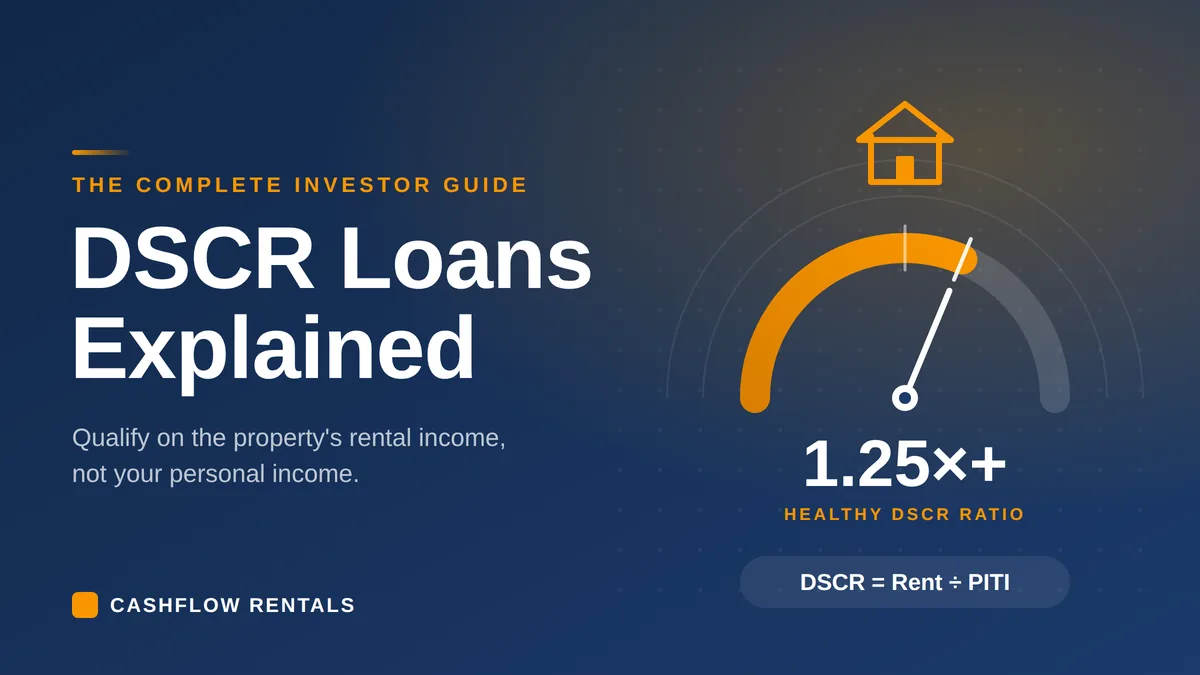
The product I use is a DSCR (Debt Service Coverage Ratio) loan, which qualifies on the property's rent rather than my personal income. That means no U.S. credit history, no Social Security Number, and no U.S. income required, with up to 75% loan-to-value on a 30-year fixed rate. I pay slightly more than a U.S. citizen, but I get long-term fixed debt on an income-producing asset. The lesson: leverage does not fix bad investments, it amplifies them. On quality assets it builds wealth; on poor assets it accelerates bankruptcy. I have experienced both. See the foreign national mortgage guide.
What I would do starting over
If I were starting from scratch today, it is the opposite of what most gurus preach. I would not chase the cheapest house, do a no-money-down deal, try to build 100 properties fast, or manage a major renovation remotely from the other side of the world. Instead I would buy one high-quality asset: already renovated properly, in a stable working-class neighborhood, with a tenant in place and real cash flow from day one, and with the expensive systems already sorted so it can quietly do its job for a decade.
Buy a good property, in a good neighborhood, at a sensible price, with sensible financing, then hold it. Let the tenant pay down the mortgage, let it appreciate, build reserves, and let time work. That is how most real estate wealth is actually created, not through exotic strategies. When I bought my first house I thought success was cheap houses and fast scale. I built 120+ properties, then lost almost everything. If I could tell my younger self one thing: stop chasing cheap, start buying quality. That single lesson would have saved me millions and a lot of sleepless nights. Hopefully now you will not have to learn it the hard way.
If you want help finding that kind of property and financing it, that is exactly what we do. You can book a call with my team, or start with the full step-by-step buying guide.
Free Investor Resources
The Foreign Investor Starter Kit
Everything you'll ever need to buy and manage U.S. rental property from overseas safely and with confidence.
Open the Starter Kit
Free to browse. No jargon, no sales pitch.
Frequently asked questions
Can a foreigner really buy rental property in the United States?
Yes. Foreign nationals can legally purchase residential and commercial real estate throughout most of the United States. Many foreign investors own U.S. rentals without ever visiting the country. The key is having the right team, ownership structure, financing, and property management in place.
How much money do I need to buy a rental property in the U.S. as a foreign investor?
It depends on the property and financing. Most of my clients invest between $50,000 and $150,000 of their own capital per property, including the down payment, closing costs, reserves, and any initial repairs. Foreign national DSCR lenders typically require 25% to 30% down.
What is the biggest mistake foreign investors make?
Focusing on projected returns instead of asset quality. Many buy cheap properties in challenging neighborhoods because the spreadsheet shows high cash flow, but those properties often carry higher vacancy, turnover, maintenance, and management costs that destroy the projected returns.
Is the BRRRR strategy a good idea for foreign investors?
It can be. I used the Buy, Renovate, Rent, Refinance, Repeat strategy to build a portfolio of more than 120 rentals. But it is much harder to execute from overseas, because you rely on contractors and local teams you cannot supervise personally. For most foreign investors, buying high-quality, cash-flowing assets is lower risk.
Which U.S. cities are best for foreign real estate investors?
There is no single best city. I generally prefer affordable Midwestern markets such as Kansas City, Cleveland, Indianapolis, and selected St. Louis neighborhoods for their mix of affordability, rental demand, and positive cash flow. The neighborhood is often far more important than the city itself.
Can foreigners get a mortgage in the United States?
Yes. Many foreign investors use foreign national DSCR loans. These typically do not require a U.S. credit history, Social Security Number, or U.S. income, because qualification is based mainly on the property's rental income.
Are property taxes likely to increase after I buy a rental property?
In many markets, yes. A sale can trigger a reassessment based on the new purchase price. This is one of the most common underwriting mistakes I see foreign investors make, so always analyze the likely future tax bill, not just the current one.
If you were starting over today, what type of property would you buy?
A fully renovated three-bedroom, two-bathroom house of at least 1,000 square feet in a stable working-class neighborhood, with strong rental demand, positive cash flow from day one, and long remaining life on the major systems.
Written by
David Garner
David is co-founder of Cashflow Rentals and a British investor who has personally purchased more than 120 U.S. rental properties as a foreign national since 2016. He helps overseas investors build U.S. rental portfolios remotely, from his base in Brazil.