When one of my foreign national clients asks me about financing their US rental property, the first question is almost always about the interest rate.
After financing over 120 of my own properties and helping dozens of other non-residents finance their US rentals, I can tell you with some certainty that it's the wrong first question.
Sure, the rate matters over the life of the loan, but what actually moves the needle when it comes to getting the best possible return on your investment is how much cash you need to bring to the closing table, and that number moves around a lot more than the rate does.
Let me explain what I wish I'd understood when I first started out back in 2016.
Your cash to close falls into three buckets: your down payment, your closing costs, and your reserves. I'll walk through each with real numbers, then show you something that surprised even me, a like-for-like comparison of three real quotes on the same property, where the best option probably wasn't what you'd expect.
Why the rate is the wrong first question
The rate decides a big chunk of your monthly payment, and how much interest you'll pay over the term of the loan, and of course it's worth getting a good deal. But it doesn't decide how much cash you have to bring to the closing table in the first place. Fees, points, and cash reserves do. And those are the levers you can pull to buy the same property with way less cash, which is ultimately going to improve your ROI more than a small rate reduction.
Let's go through all three buckets one by one.
On a multi-property package the same buckets scale up, see portfolio and blanket DSCR loans.
Bucket one: the down payment
Foreign national DSCR loans are typically written at 25 to 30% down, meaning 70 to 75% loan to value.
That's a little more than a US resident might put down, because the lender is pricing in a borrower it can't underwrite in the usual ways (income, credit, experience, and so on), and your bigger down payment compensates for that risk, as I explain in my foreign national DSCR loan guide.
On a $190,000 property at 70% loan to value, the down payment is $57,000. That's the biggest of the three buckets, and the one people expect. Simple so far, right?
Bucket two: reserves
Reserves are the bucket people forget, and then panic about when they find out later.
A lender wants to see that after you've paid your down payment and closing costs, you still hold a cushion of liquid cash, usually 3 to 12 months of the full monthly mortgage payment, depending on the lender and how they view the loan. A higher-risk file means more months. In reality, this varies wildly between lenders, especially for foreign national loans.
Here's the reassuring part: reserves aren't a fee you pay to the lender. They stay your money, sitting in your own account, and in many cases that account can be back in your home country. You simply have to prove the funds are there, and liquid-ish, which is a documentation exercise I cover in my foreign national mortgage documents checklist. So while reserves are cash you need to have, they're not cash you spend. The full picture on documenting and seasoning those reserve funds is in my guide to proving your money.
Bucket three: closing costs, and the broker versus direct decision
Closing costs usually run around 3 to 5% of the price and cover things like title, the appraisal, loan origination, prepaid insurance and taxes, and per-diem interest. The CFPB has flagged how these fees have crept up, so they're worth scrutinizing rather than waving through.
I spoke to a British doctor last year who secured a DSCR cash-out refinance loan for a small multifamily rental he had in upstate New York. When we added it all up, his closing costs were over 12% of the loan balance. That's crazy to me, when most of our closings right now come in at around 5% of the property purchase price including cash reserves.
This is also where working direct with a lender, or through a broker, makes a difference. It's a decision with pros and cons on both sides, so when I'm shopping for deals for my clients, I work both sides. Here's the trade-off.
A broker gives you whole-of-market access, and a good one will find you the best lender and current offer. But they charge for it, typically around 2 to 2.5% of the loan in points and fees, paid upfront. That fee can instead be absorbed by the lender in exchange for a higher interest rate, so you either pay it now or pay it slowly through the rate. Going direct to a lender avoids the broker fee, but you only see that one lender's products.
The honest point, and it's one the CFPB makes too: points don't automatically buy you a lower rate (unless it's a specific rate buydown). A broker's genuine value is access, matching, and managing the underwriting process for you. It's not a magic discount. So you always compare the total cost, rate plus points plus reserves plus cash to close, not the headline rate on its own. And if the broker gives great service and you're time or experience limited, you should factor in that value too.
A real like-for-like lender shop
Here's the proof, from a real deal I shopped for a client recently that I'll keep anonymous: a $190,000 Midwest rental, a foreign-national borrower with no US credit, at 70% loan to value.
I got quotes on the exact same property from a direct specialist lender and from two brokers. Rent is $2,000 a month, taxes and insurance run about $161 a month combined, and these are 30-year fixed quotes. Cash flow is shown before management, vacancy, and maintenance.
Three real quotes on the same $190,000 Midwest rental (30-year fixed, no US credit)| Quote | Rate | Extra points | Reserves | Monthly payment (PITIA) | Monthly cash flow | Cash to close | Cash-on-cash |
|---|
| Direct specialist | 6.875% | none | 3 months | ~$1,035 | ~$965 | ~$69,600 | ~16.6% |
| Broker B | 7.25% | +2 points (~$2,660) | 6 months | ~$1,068 | ~$932 | ~$75,600 | ~14.8% |
| Broker A | 8.0% | +2 points (~$2,660) | 6 months | ~$1,137 | ~$863 | ~$76,000 | ~13.6% |
In this case, the direct specialist won on every single line: the best rate, no points, and lighter reserves, which together came to about $6,000 less cash to close than either broker, and a meaningfully better cash-on-cash return.
The one thing to remember: a broker's value is whole-of-market access and finding you the best lender when you don't know it yourself. But their points don't automatically buy a better rate. Always compare the total cost, rate plus points plus reserves plus cash to close, not just the rate. On this real deal, the direct lender won on all of it.
Now, that won't always be how it falls. Sometimes a broker digs up a lender you'd never have found on your own, and that is exactly what you're paying them for. The lesson isn't "always go direct," it's "always shop, and compare the whole cost." For a second real head-to-head, including why higher LTV isn't automatically better, see two real DSCR quotes compared.
Putting it together: the real cash to close
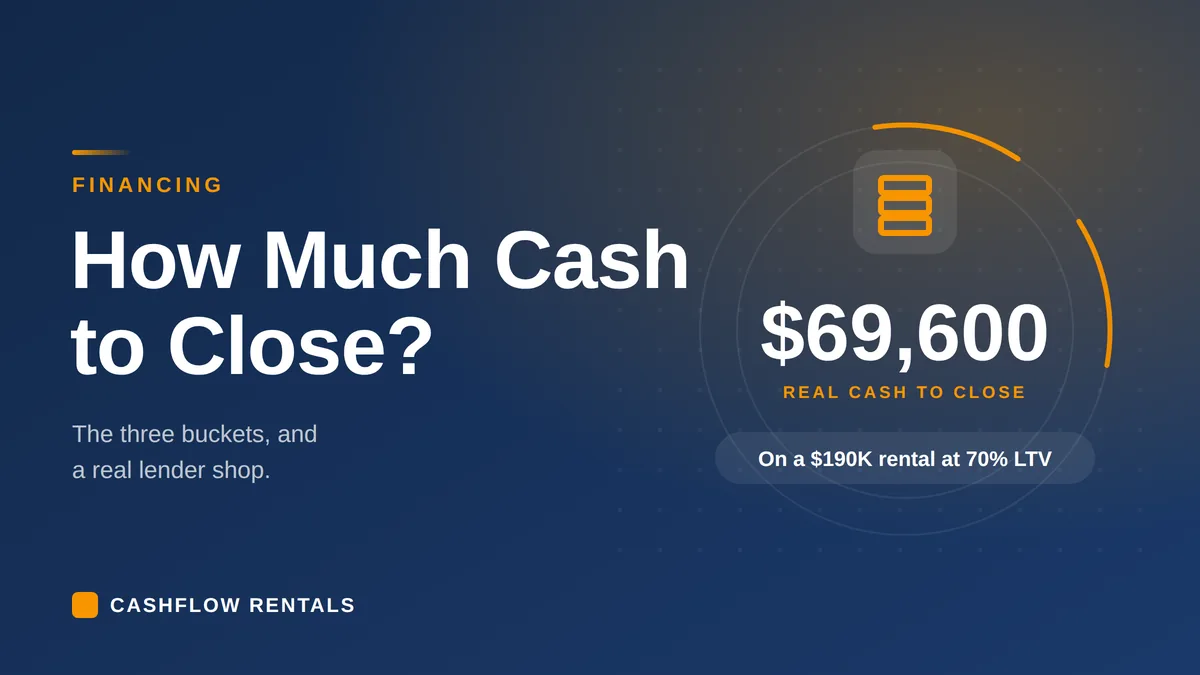
On the winning quote, that roughly $69,600 breaks down into the three buckets like this: a $57,000 down payment, about $9,500 in closing costs at 5%, and about $3,100 in reserves for three months of payments.
Change the property price, loan size, fees, or the lender's reserve requirement and the total moves, but the three buckets always remain. The same buckets apply to 2 to 4 unit buildings, with slightly tighter dials, see DSCR loans for small multifamily. You can run these numbers on any property with my free DSCR loan calculator.
Small loans behave differently, see DSCR loans under $100,000.
How to plan for it
My advice is to get a real pre-approval early, so you know your actual numbers before you fall for a specific property, and so you can line up the right lender rather than the first one you find.
Set your US entity up ahead of time so it doesn't hold up a closing. And know that there are ways to restructure a deal to cut the cash to close without over-borrowing, which is a topic in its own right and one I'll cover separately. When you're ready to size a specific deal, the free tools in my foreign investor starter kit are the place to start.
The bottom line
The interest rate isn't the number that decides your deal. The cash to close is, and it comes in three buckets: down payment, closing costs, and reserves. Budget for all three, and shop the whole cost rather than the headline rate, because as this real deal showed, the cheapest financing isn't always where you'd expect to find it.
Remember, investing is a game of probabilities, not certainties. Know your real cash numbers before you commit, keep a genuine reserve cushion, and you give yourself enough margin so that a good property translates into a durable long-term investment that can support itself.
This article is general information, not legal, tax, or financial advice. Loan terms, rates, reserve requirements, and closing costs vary by lender, borrower, and property, and change over time. The figures here are from a real deal and are illustrative, current as of July 2026. Always confirm your own numbers with a qualified mortgage professional.