Why lenders do not want your small loan
In short, it is mostly because those smaller loans are more risky, less profitable, and the underlying properties themselves tend to be problematic.
The work involved in underwriting, appraising, processing and closing a $75,000 loan is essentially identical to the work involved in a $400,000 loan. Same appraisal, same title search, same underwriter hours, same closing. But the lender and broker's revenue scales with the loan size, so on the small deal they do the same work and charge the same fee, which relative to the purchase is much higher.
There is also the issue of what happens if you default. If a lender has to foreclose, they may have to sell the property at foreclosure to recoup their money. On a low value property, that might mean significant losses, because those cheap houses do not sell well at auction. In some cases their cost of foreclosure might actually be higher than any money they net at sale.
Faced with all that, most lenders have a minimum loan size they will consider.
Three real term sheets
Here are three actual pricing sheets I obtained for clients, all foreign national borrowers with no US credit score, all 30-year fixed, all on Ohio rentals. The broker is anonymized and the addresses are withheld.
Two real single-asset DSCR term sheets, foreign national borrowers, 30-year fixed, Ohio rentals, priced July 2025 (Deal A) and November 2025 (Deal B) | Deal A | Deal B |
|---|
| Purchase price | $120,000 | $135,000 |
| Loan amount | $78,000 | $94,500 |
| LTV achieved | 65% | 70% |
| Down payment | $42,000 (35%) | $40,500 (30%) |
| Interest rate | 8.075% | 7.300% |
| Origination points | 3.25% ($2,535) | 3.00% ($2,835) |
| Other fixed lender fees | $2,020 | $2,270 |
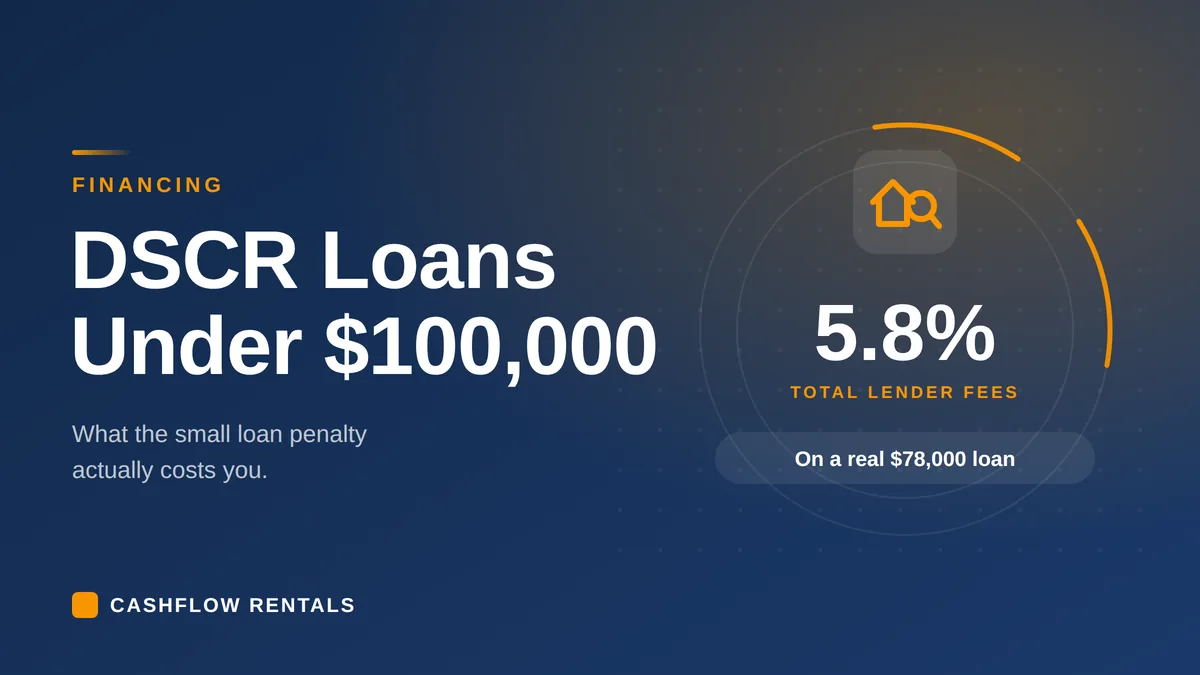
| Total lender fees | $4,555 (5.8% of loan) | $5,105 (5.4% of loan) |
| Monthly rent | $1,200 | $1,450 |
| Total monthly payment | $707.67 | $875.11 |
| DSCR | 1.70 | 1.66 |
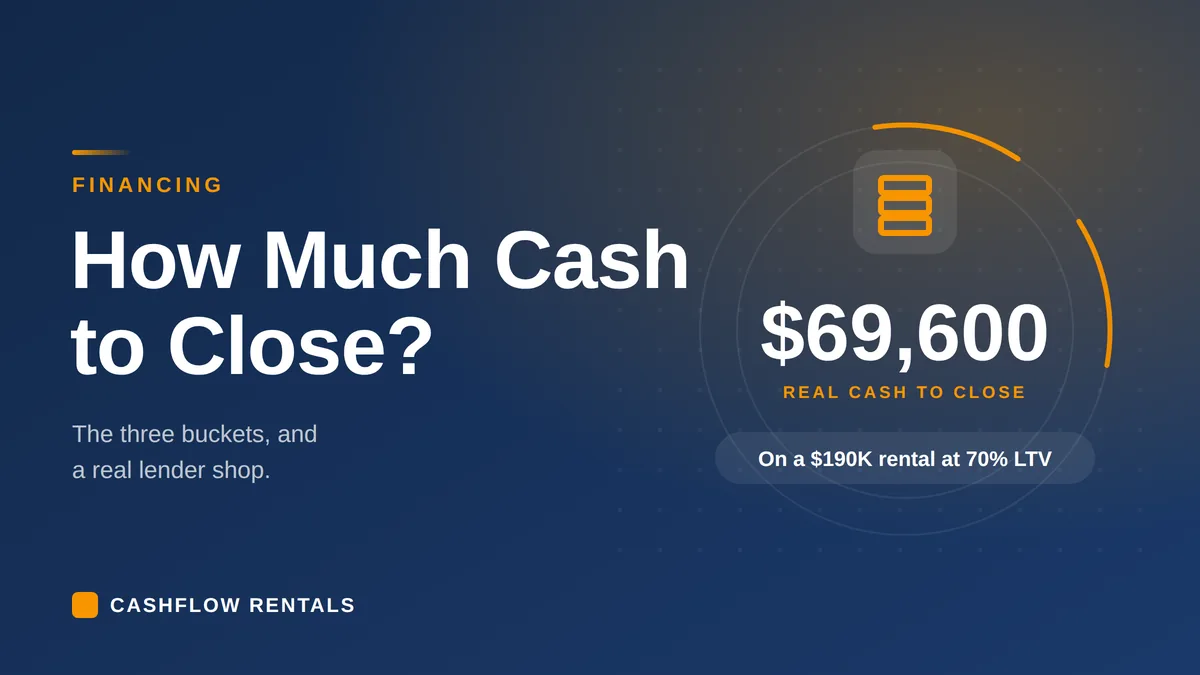
| Total liquidity required | $57,166 | $59,369 |
An honest caveat before anyone reads too much into the rate gap: Deal A was priced in July 2025 and Deal B in November 2025, four months apart, so some of that 0.775% difference is the market moving rather than the loan size. That is exactly why the third sheet below matters, because it was produced nine days after Deal B, so it is a better like-for-like comparison.
Notice the last row. On a $120,000 house, the total liquidity the lender wanted to see was $57,166, or 47.6% of the purchase price. On the $135,000 house it was 44%.
Cheap properties do not mean a small cheque. That liquidity figure is the down payment, the closing costs and the reserves combined, and I break those three buckets down in how much cash you really need.
UK buyers get marketed this stock particularly heavily, which I cover in what British investors get sold in the USA.
The four ways a small loan costs you more
Fewer lenders will quote. Below $100,000 your options thin out. This is precisely the situation where a broker with genuine whole-of-market access earns their fee, because the lender who will do your deal is usually not the one advertising the best rates.
A higher rate. Small loans price worse for the same borrower on the same quality of property. Deal A at $78,000 came in at 8.075% when the market for larger loans was well below that. I recall a client I was helping buy a rental property in Kansas City at around the same time, in July 2025. We got a rate of 6.5% at 70% LTV. Different property and different market, so it is not a controlled comparison, but the gap is instructive.
A capped LTV. Look again at Deal A. It came back at 65% loan to value, not the 70% a foreign national would normally expect. That is an extra 5% of the purchase price out of your pocket, $6,000 on that deal. If you are pricing a small loan, ask about the LTV cap before you assume anything.
Fees that do not scale down. Closing, underwriting and processing fees are broadly the same dollar amount whatever you borrow. On Deal A those fixed fees came to $2,020, which is 2.6% of a $78,000 loan. The same $2,020 on a $300,000 loan would be 0.7%. Add origination points and the total lender fees hit 5.8% of the loan on Deal A. The CFPB has been vocal about closing costs creeping up generally, and on a small loan those fixed charges bite hardest.
It is the fees, not mainly the rate
This is the part I would want you to take away, and it only becomes visible when you compare sheets priced in the same market conditions.
Deal B, a $94,500 single-property loan, was priced on 3 November 2025. A portfolio sheet I will come to next was priced on 12 November 2025, nine days later, on the same kind of Ohio houses. The rate difference between them is tiny: 7.300% against 7.204%, less than a tenth of a percent.
The fee difference is not tiny at all. Deal B carried 3.00% in origination points and $2,270 of fixed fees. The portfolio structure carried 2.75% in points and, spread across its properties, about $648 of fixed fees each.
So the small loan penalty is real, but it lives mostly in the fee column rather than the rate column. That matters, because a borrower comparing two quotes on rate alone will conclude the deals are near-identical when one is materially more expensive.
The one thing to remember: on a small loan, the fixed fees are the tax, not the rate. Price closing costs, underwriting, and processing fees as a percentage of your loan amount rather than glancing at the dollar figures, and ask about the LTV cap before you assume 70%. Two quotes a tenth of a percent apart on rate can be thousands apart on cost to close.
A DSCR portfolio loan on cheaper houses
Here is the term sheet that gives a slightly wider context to these smaller loans. These were twelve Ohio single family rentals, priced as one portfolio loan in November 2025.
The total purchase price was $1,485,300, which works out at an average of $123,775 per property, the same price bracket as the two single-asset deals above. Average loan per property was about $86,642. So this is genuinely the same kind of cheap house, financed as a portfolio rather than individually.
The same class of Ohio house priced two ways, per property, November 2025| Per property | As a single-asset loan | Inside a portfolio loan |
|---|
| Interest rate | 8.075% | 7.204% |
| Origination points | 3.25% | 2.75% |
| LTV achieved | 65% | 70% |
| Fixed lender fees | $2,020 | About $648 |
On an identical $86,642 loan, that rate difference is about $52 a month, roughly $623 a year, and a little under $18,700 across a 30-year term.
Add the half point saved on origination, about $433, and the $1,372 saved on fixed fees, and you are roughly $1,806 better off at closing per property, with 5% more leverage on top. That is a saving of about 2% of the loan balance in fees. That is significant.
The mechanism is simple: the lender does one underwrite, one closing and one set of documents for twelve properties instead of twelve of each, so the fixed costs are spread and the loan itself is large enough to price properly.
It is the same logic that makes your small loan expensive, running in your favor. I have written up how these structures work, including the cross-collateralization risk that comes with them, in my guide to portfolio and blanket DSCR loans.
The obvious limitation: this only helps if you are buying several properties at once, or refinancing several you already own. If you are buying your first cheap rental, you are taking the single-asset pricing. But it is worth knowing that the penalty you are paying is structural rather than permanent, and that it disappears at scale.
The hidden cost
Now the part that has nothing to do with financing terms, and that I think matters more.
Look at the DSCR ratios on those small deals: 1.70 and 1.66. Both are strong. A lender sees those and is happy, and on the ratio alone so should you be. But it is the operational margins outside of financing that carry the real risk, something I know quite a bit about.
Deal A rents at $1,200 against a total payment of $707.67, so roughly $492 a month of margin before management, vacancy, repairs and capital expenditure. That is an exceptionally thin margin.
A $190,000 property renting at $2,000 against a $1,035 payment produces about $965 of margin on a very similar ratio. Same apparent health, half the actual cushion.
Now put one $5,000 furnace through both. It consumes about ten months of margin on the cheap house and five on the higher priced one. A tenant turnover costing $3,000 plus a month vacant does comparable damage. The DSCR ratio told you the property covers its mortgage. It did not tell you how many months of bad luck the property can absorb, and that second number is what actually determines whether you are buying an asset or an expensive headache.
I will be straight about my own position here: I am not a fan of leveraging cheap properties, and it is not a theoretical objection. My earlier portfolio was built on the cheapest houses I could find, and thin margins are precisely what took it apart when repairs, turnovers, vacancies and evictions arrived together. Most of it was voucher-tenanted, which I have written about in is Section 8 a good investment. I also write about that story in more detail in DSCR loans explained. That is just my lived experience, and plenty of investors do well at this price point with proper reserves. Just do not let a comfortable ratio persuade you that a thin dollar margin is safe. It is not.
A state law detail worth knowing
One genuinely useful thing surfaced on all three of these Ohio sheets: the prepayment penalty was written as 1/1/1/1/1, a flat 1% for each of five years, not the 5-4-3-2-1 stepdown that is typical elsewhere and that I describe in DSCR loan terms decoded.
That is not a quirk of one lender. Ohio Revised Code 1343.011 provides that residential mortgage obligations may be prepaid without penalty after five years, and that before then any penalty may not exceed 1% of the original principal. The sheets match the state cap exactly.
Whether those provisions bind a business-purpose DSCR loan made to an LLC rather than a consumer mortgage is a question for a lawyer, not for me, and the same statute contains a further exemption for smaller obligations whose threshold is adjusted annually. If you are borrowing a small amount in Ohio, it is worth asking your broker or attorney directly which rules apply to your loan.
The transferable lesson is simpler: prepayment penalty structures vary by state. Do not assume the 5-4-3-2-1 you read about in a national guide is what you will be offered. Read your own term sheet carefully.
When a small loan makes sense, and when to walk
It makes sense when the property genuinely stands up on its fundamentals rather than on price alone: a decent size property in a neighborhood with real homeowner and renter demand, where the rent is verifiable rather than hoped for, and where you are holding long enough for the prepayment penalty and the heavy upfront fees to be absorbed. It also makes more sense when you are bundling properties in a portfolio loan, for all the reasons above.
Walk when the only argument for the property is that it was cheap, when the dollar margin cannot survive two bad events in a year, when the fees push your real cost of entry toward half the purchase price without you noticing, or when the rent estimate is the seller's rather than an appraiser's. On that last point, I have seen a deal collapse because the appraiser's market rent came in well under the buyer's assumption, which I cover in why DSCR applications get declined.
What to actually do
Use a broker with genuine whole-of-market access, because on a sub-$100,000 loan the lender who will actually do it is rarely the one advertising.
Ask about the LTV cap explicitly and early, since a drop from 70% to 65% is real money and it will not be volunteered.
Convert every fixed fee into a percentage of your own loan before you compare quotes. Ask whether the lender can bundle, now or on a future refinance.
And budget for the full liquidity requirement rather than the down payment, because on these sheets that came to 44% to 48% of the purchase price.
You can run any property's ratio, payment and cash requirement on my free DSCR loan calculator, and the free tools in my investor starter kit will help you pressure-test the deal before you pay for anything.
The bottom line
Yes, you can get a DSCR loan under $100,000. Fewer lenders will quote it, the rate will be a little worse, the fixed fees will be a lot worse as a percentage, and your leverage may be quietly capped below what you expected.
On the real DSCR term sheets here, total lender fees ran 5.4% to 5.8% of the loan, and total liquidity required approached half the purchase price.
The structural fix is scale: the same houses bundled into one portfolio loan priced better on every line. The judgment call is whether cheap property deserves your leverage at all, and on that I would rather you had the numbers than my opinion.
Remember, investing is a game of probabilities. A strong ratio on a thin margin is not the same as a safe deal.
Cashflow Rentals is a real estate consultancy. We are not a lender, mortgage broker, or law firm. This article is general information, not legal, tax, or financial advice. The term sheets described are real pricing sheets obtained for clients, anonymized, and were preliminary and non-binding. Loan terms, rates, fees, LTV caps and state prepayment rules vary by lender, borrower, property and jurisdiction, and change over time. Figures are current as of the dates given. Always confirm your own numbers with a qualified mortgage professional, and take legal advice on state-specific loan terms.