The ceiling that doesn't exist in the US
If you own rentals in Canada, the UK, or most of Europe, you'll know the wall. Every mortgage you add loads up your personal debt-service ratios, and after a handful of properties the bank simply stops saying yes, regardless of how well those properties perform.
I've seen that recently with clients from Germany, Canada, and the UK who all had reasonable portfolios, but had hit the limit of borrowing without a significant and costly restructure.
A US DSCR loan doesn't work that way, because it qualifies the property rather than the borrower, as I explain in my foreign national DSCR loan guide. A portfolio allows you to consolidate and scale. The operational side of scaling at a distance is a separate skill, and I cover it in my guide to building an out of state rental portfolio. That's how I got to 120+ rentals at my peak as a foreign national with no US income (other than rents), and it's the mechanism behind almost every overseas investor I know who has built past a handful of doors.
What a portfolio or blanket loan actually is
A portfolio loan, or blanket loan, is a single loan secured against several properties at once. One application, one appraisal process, one closing, one monthly payment, one set of loan terms covering the group.
The defining feature, and the thing to understand before you sign, is cross-collateralization: every property in the pack secures the whole loan. That has pros and cons, and I'll come back to it in the risks section.
The alternative is four separate DSCR loans on four properties. Both approaches work. The portfolio route trades some flexibility for efficiency and, often, a better rate.
The real deal: four Kansas City rentals, one loan
Here's the actual deal. Four single family homes in Kansas City, Missouri, purchased as a package, all of them already leased and producing rent on day one:
The four properties in the package (rents at time of purchase)| Property | Built | Size | Beds / baths | Rent |
|---|
| A | 1955 | 1,662 sq ft | 4 bed, 2 bath | $2,150 |
| B | 1924 | 1,492 sq ft | 3 bed, 2 bath | $1,900 |
| C | 1927 | 2,096 sq ft | 5 bed, 2.5 bath | $1,850 |
| D | 1925 | 1,095 sq ft | 2 bed, 1 bath | $1,200 |
My total purchase price was $700,000, and we financed with a single cross-collateralized loan across all four properties at 70% loan to value and 6.5% on a 30 year fixed.
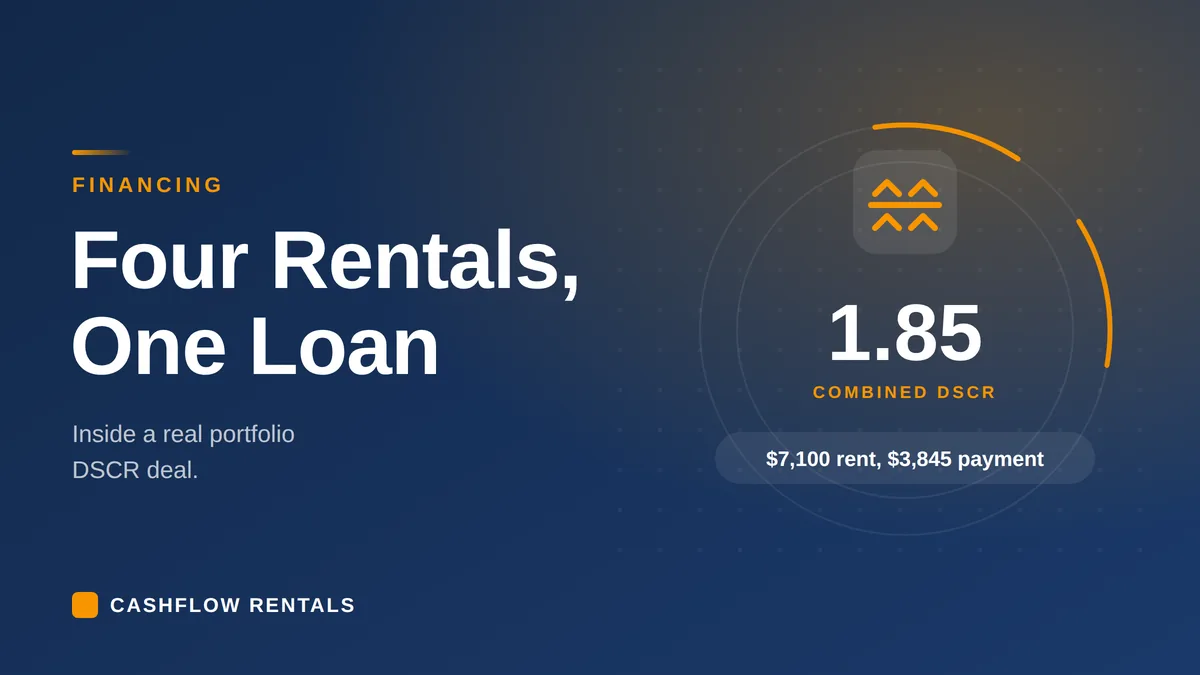
Combined rent at the time was $7,100 a month, or $85,200 a year. Annual taxes across the four ran at $4,447 (since reassessed), and insurance was $4,526 (since increased).
Quick sidebar, this really demonstrates the importance of underwriting for future costs, not just today's costs. My taxes, insurance, and cost of asset upkeep have all increased on this deal. It still cash flows today, but only because I used conservative numbers in my buy box and underwrote for those increases.
Anyway, back to the deal. Note that every house was tenant-occupied already. On a package like this you're buying an operating income stream, not a renovation project, which is a very different proposition from the value-add deals I started out buying that didn't end quite so well. You can read about that in my article on how I nearly went bankrupt buying US rental properties.
The numbers, line by line
The deal, line by line (real figures, as of July 2026)| Item | Figure |
|---|
| Package purchase price | $700,000 |
| Loan at 70% LTV | $490,000 |
| Down payment | $210,000 |
| Interest rate | 6.5%, 30 year fixed |
| Loan structure | One cross-collateralized loan across all four |
| Monthly principal and interest | ~$3,097 |
| Monthly taxes and insurance | ~$748 |
| Total monthly payment (PITIA) | ~$3,845 |
| Combined monthly rent | $7,100 |
| Combined DSCR | 1.85 |
| Monthly gross cash flow | ~$3,255 |
| Gross yield on price | 12.2% |
| Reserve requirement | 3 months PITIA, ~$11,500 |
| Total cash to close | ~$245,000 to $252,000 |
That gross cash flow figure is before management, vacancy, and maintenance, so read it accordingly. Management and repairs cost real money, and if you take anything at all from this article it should be to keep as much of your cash flow aside for reserves as possible. Ideally all of it.
On cash to close, the down payment is $210,000 and the closing costs came in at around 5 to 6% of the purchase price, which on this deal included the lender's reserve requirement of three months of PITIA, about $11,500. That put the all-in cash to close somewhere between roughly $245,000 and $252,000, or about 35 to 36% of the purchase price.
I'll be honest, three months of reserves is light for a portfolio loan. Plenty of lenders want six or even twelve months on a multi-property package, and on a PITIA payment this size each extra month is nearly $3,850 of cash you'd have to bring to the table. That said, I keep my reserves in an interest bearing reserve account that pays me about 4% a year as of July 2026, so it's not entirely idle capital. Either way, shopping the reserve requirement, not just the rate, is how you keep that number down, which is exactly what I applied in my comparison of two real DSCR quotes.
Why the combined DSCR is the whole point
The lender isn't asking whether each house covers its own share of the debt. It's asking whether the combined rent of all four covers the combined payment. At $7,100 against $3,845, the answer is 1.85, meaning the pack earns nearly twice its debt service.
That's a strong DSCR ratio, and a strong ratio buys you better loan pricing, which is part of why this deal came in at 6.5% rather than the higher rates you often see on smaller single loans. It's the same effect I described with small multifamily in my piece on DSCR loans for 2 to 4 units: more rent behind one payment tends to produce a healthier ratio.
It also means you might be able to squeeze a weaker property inside a bigger portfolio. Property D above, on its own, is a much less compelling property (and financing proposal) than Property A. Bundled together however, the combined numbers of the other properties carry it. Whether that's a good thing or a bad thing depends on the specifics of the deal, and your own goals. I wouldn't buy a dud just because I could hide its underperformance in an otherwise solid portfolio.
It is also the cheapest route into low-priced properties, see can you get a DSCR loan under $100,000.
The efficiency case
The practical appeal of a portfolio loan is real. While there is of course extra paperwork, you're dealing with one application (and one underwriter) instead of four. One closing instead of four, with one set of origination, title, and recording fees rather than four. One monthly payment to administer. One loan to track, one lender relationship to manage, and often a better rate than the same properties would attract individually.
As an overseas investor I'm already coordinating across time zones, so that reduction in moving parts is worth more than it looks on paper to me specifically (and my overseas clients), and it compounds when you're managing everything remotely, the way I covered in my guide to the remote purchase process.
The honest risks
There's always some kind of trade-off, right? In this case, there are four things I'd want you to understand before signing anything.
Cross-collateralization is the big one. All four properties secure the single loan, so a serious problem with one property can put the whole group at risk, which is a materially different exposure from four standalone loans where trouble stays contained. This is why the release clause matters: it's a provision that lets you sell one property out of the pack by paying down its share, without unwinding the entire loan. Never sign a blanket loan without understanding exactly how yours works. Not all lenders will accommodate this, but some will.
Concentration risk is the second thing to consider. Four houses in the same city, in this case the same part of the same city, means one local shock hits everything at once. A pack in one submarket is not a diversified portfolio, whatever the property count suggests.
With that said, I've kind of doubled down on just 2 markets. I've found the trade-off of the increased concentration risk is outweighed by being more of an expert in just one or two markets. Less of a Jack of all trades, closer to a master of one or two.
Age is the third thing. These four were built between 1924 and 1955. Older housing stock in the Midwest can be perfectly good, and often better built than what came later, but it also means original systems, and capital expenditure that arrives in lumps: roofs, sewers, furnaces, electrics. Four houses of that vintage will generate more CapEx events than one modern one, and that has to be reserved for.
In this case, these houses had been completely renovated, which showed on the appraisal. A 100 year old house with an independently assessed effective age of 10 or 12 is pretty solid.
And the fourth trade-off, the one that matters most for me, comes down to the properties themselves.
The buy-box test, property by property
The one thing to remember: underwrite every single property in a package against your buy box individually, as if you were buying it on its own. Sellers bundle for a reason, and it's often to move the one property they'd struggle to sell alone.
Run my buy box, minimum 1,000 square feet, 3 bed 2 bath or better, against those four houses and something immediately jumps out.
Property A, at 1,662 square feet and 4 bed 2 bath, passes comfortably and rents highest at $2,150. Property B, 1,492 square feet and 3 bed 2 bath, passes. Property C, 2,096 square feet and 5 bed 2.5 bath, passes on size and comfortably exceeds it.
Property D does not. At 1,095 square feet it clears the size floor, but at 2 bed 1 bath it fails the bedroom and bathroom test, and it carries the lowest rent in the pack at $1,200. That's not a coincidence. A 2 bed 1 bath house attracts a smaller, more transient tenant pool than a 3 bed 2 bath family home, which means more turnover, more vacancy, and weaker rent growth over time. It's also, on a rent-share basis, the cheapest house in the group by a distance.
Does that kill the deal? No. Three of four passing, with a combined DSCR of 1.85, is a genuinely solid package. But it changes a few things. I needed the release clause structured so it's the one I could sell out of the pack first if I needed to.
In this case, that property had a future value-add potential. There was space to add square footage, beds, and baths. It's likely one I'll add an addition to when the existing tenant moves out. That work will bring it in line with my buy box, and I'll also have benefited from the uplift in value from the renovation. That's why it got a pass.
It's worth mentioning that this is the same rule I apply to individual units in a small multifamily building. I want each unit to meet my buy box, not the building as a whole. A 3,000 square foot 4-plex is no good to me. That's 4 small units that are likely to have a higher turnover rate than I find acceptable.
What to actually do
- Run the combined DSCR calculation honestly, then run every property in it against your buy box separately.
- Measure every property against your buy box individually, and pay closest attention to the weakest one.
- If you can, get the release clause in writing and understand how a single sale works before you sign.
- Keep adequate reserves for the age and condition of the property, not just the lender's minimum requirement, and shop for lenders with different reserve requirements, because it can change your cash to close by tens of thousands of dollars.
Then, if this is your first purchase, make sure your US entity (LLC etc) and funding are ready early, per my guide to what you need in place before a DSCR loan, because a four-property closing has four times the moving parts. You can model a package on my free DSCR loan calculator, and the free tools in my foreign investor starter kit will help you pressure-test the whole thing.
The bottom line
Portfolio and blanket loans can be a useful tool for overseas investors to get past the ceiling their home banks impose and expand their portfolios internationally. This real four-property deal shows why: $700,000 of Kansas City rentals, one loan at 6.5%, $7,100 of rent against a $3,845 payment, and a combined DSCR of 1.85. The efficiency is real and so is the pricing benefit.
Bear in mind that cross-collateralization ties the properties together, older stock brings CapEx, and packages might be carrying one property that you wouldn't buy on its own.
Remember, investing is a game of probabilities, not certainties. Four properties can stack the odds in your favor, but only if each one would have earned its place in your portfolio on its own merits.
Cashflow Rentals is a real estate consultancy. We are not a lender or mortgage broker. This article is general information, not legal, tax, or financial advice. The deal described is real, and the payment, DSCR, and cash-to-close figures are calculated from its actual price, rate, term, rents, taxes, insurance, reserve requirement, and closing costs. Terms vary by lender, borrower, and package. Figures are current as of July 2026. Always confirm your own numbers with a qualified mortgage professional.