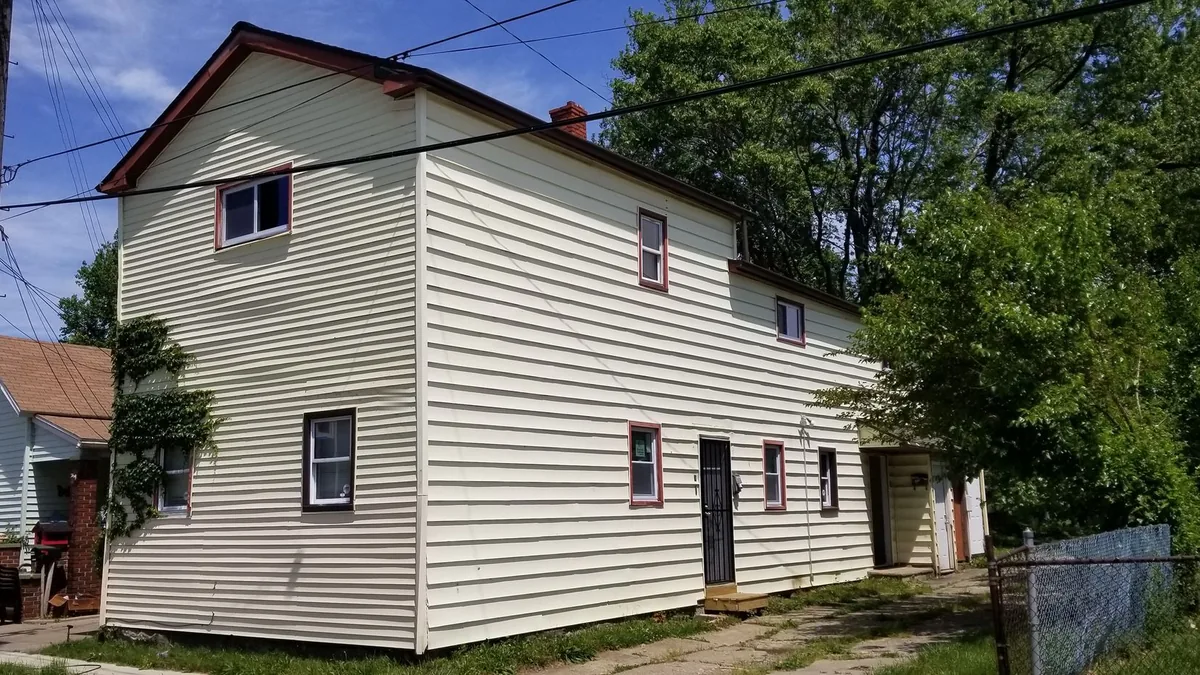
This was a fully renovated triplex in the Stockyards neighborhood (ZIP code 44102), on Cleveland's near west side. It was offered by the turnkey seller at $227,500. There are three units, five beds and three baths across 1,782 square feet, fully occupied, $2,425 a month in rent. Property taxes are $2,925, the insurance quote we got came in at $1,300, and property management in Cleveland runs at 10%. On the seller's sheet that's about 10% cash-on-cash with a mortgage.
I told the client to walk away. Here's why, line by line.
The numbers as offered
| Item | Seller's figure |
|---|
| Price | $227,500 |
| Units | 3 (five beds, three baths in total) |
| Size | 1,782 sq ft, about 594 sq ft a unit |
| Built | 1890, renovated 2023 |
| Rent | $2,425 a month, $29,100 a year, all three units occupied |
| Rent to price | 1.07% a month ($2,425 ÷ $227,500) |
| Gross yield | 12.8% ($29,100 ÷ $227,500) |
| Taxes | $2,925 a year |
| Insurance | $1,300 a year |
| Management | 10% |
| Monthly cash flow, seller's sheet | $690 after the mortgage below |
We got DSCR mortgage terms from a specialist lender and two brokers, based on the borrower being a foreign national with no US credit, no US income and no Social Security number.
Financed at 70% with a 30-year DSCR loan at 7.75%, the loan is $159,250 and the payment is $1,141 a month, $13,691 a year. The total cash to close would have been the $68,250 down payment plus about 5% closing, so about $79,625.
With nothing set aside for vacancy or repairs, the seller's numbers work: $29,100 of rent, less $2,910 management, $2,925 taxes and $1,300 insurance, leaves $21,965. Less the mortgage, $8,274 a year. That's $690 a month and 10.4% on the cash in. If you want to test the seller's column against your own assumptions, my cash flow calculator takes the same inputs.
What looked good
Let's start with the neighborhood, because that's where tenants and future buyers make their decisions first. I'll give the seller a fair hearing, because on the street this one passes.
Stockyards is a Phase 2 neighborhood on my grading: it scored 54.7 out of 100.
Total crime reports within a quarter mile are on pace to finish 17% below 2022 and are down 15.5% this year, against a crime rate that has been flat across Cleveland as a whole.
Eviction filings in the tract run at about two-thirds of the city rate. That matters, because filings across Cleveland are up 10% this year against their 2023 to 2024 baseline, 3,299 filings to July, according to Eviction Lab, while this tract is at about half of its own.
Houses in Stockyards are selling at the city median and sale prices are up 21.6% on the year. The property is not in a flood zone. The renovation is recent and the building is fully occupied.
If this were a three-bed house on that street at $150,000, my decision might be different.
The number that killed it
This is where a little experience owning and managing these sorts of properties comes in. I've been doing this for ten years, and I know a little about owning and managing small multifamily units in these markets.
It's three small apartments in a building from 1890, and the seller's sheet reserves nothing for either fact. The reality is that small multifamily units attract the cheapest end of the tenant pool, often have a higher tenant turnover rate and more problems collecting rent, and older buildings need more maintenance budget set aside.
I underwrite a single-family house at 10% vacancy and 20% for maintenance and capital. For this building I'd want more on the first and I'd accept a little less on the second, and together they still sink it. Here's my case: 15% vacancy, 15% repairs, 10% management, same taxes and insurance.
| Line | Seller's sheet | My underwriting |
|---|
| Rent | $29,100 | $29,100 |
| Vacancy | $0 | 15%, $4,365 |
| Repairs and capital | $0 | 15%, $4,365 |
| Management | 10%, $2,910 | 10%, $2,910 |
| Taxes | $2,925 | $2,925 |
| Insurance | $1,300 | $1,300 |
| Net operating income | $21,965 | $13,235 |
| Mortgage, 7.75%, 30 years | $13,691 | $13,691 |
| Cash flow | $8,274 a year | −$456 a year |
| Cash-on-cash on $79,625 | 10.4% | −0.6% |
The two reserve lines (which you will need at some point) take $8,730 a year out of the rent, and after the mortgage the building only has $8,274 to give. That puts it $38 a month underwater before anything goes wrong. A reserve line isn't a cost you might incur. It's the average of what will happen, and on this building the average is high for three reasons.
Vacancy at 15%. The units average 594 square feet and $808 a month. That's the end of the market where people rent for a year and move, and every move costs a clean, a re-let and a month of rent at the very least. Two of my own turnovers came to $7,000 and $9,000 on houses; a small one-bed unit is cheaper to turn but turns more often, and it's the tenant pool with the least household financial cushion to absorb a shock like a big car repair, a lost work shift or a medical bill. Three-quarters of renters in this census tract pay more than 30% of their income in rent, and the poverty rate is 54%, against 31% for the city. You're effectively selecting tenants from some of the most financially distressed people in the city.
Repairs at 15% on a renovated building. It's 136 years old. A 2023 renovation fixes what was touched in 2023; it doesn't change the age of the framing, the foundation, the drains under the floor or the behavior of a building that has been settling since the Harrison administration. I buy old houses, but I budget for them, and 15% is the floor I'd use here, not the ceiling.
Lead. 81% of the homes in this tract were built before 1940. Cleveland requires a Lead Safe Certificate for every pre-1978 rental unit before it can be registered, and on a triplex that's three certificates, not one. The listing doesn't mention them.
The condition the street carried
The crime grade is honest but it needs a footnote. Total crime reports are falling, and my grading says so. Homicides aren't. There have been four within a quarter mile of this building in 2026, the nearest about 700 feet away, against five in the previous five years combined. The building's own block is the busiest address in the quarter mile this year, with 28 reports, and had a homicide in July 2023.
That wasn't the reason I passed. It would have been a condition: a property manager's view of the block before an offer. The numbers meant we never got that far.
What would have changed my mind
The price. At my underwriting the building breaks even at about $220,000 and returns 8% on cash at about $150,000, which is close to the Stockyards median sale of $145,930. The seller is asking 1.56 times what the neighborhood sells for, on the strength of a renovation and a full rent roll, and the rent roll just doesn't carry it when you factor in real-world operating costs and reserves.
I should also point out that the owner will be responsible for landscaping, and in many cases with small multifamily some of the utility bills as well. I didn't get as far as checking which utilities would fall to the landlord, because it was already losing money before I got there.
At $150,000, with the three lead certificates in hand and a manager who'd walked the block, I might consider making an offer, subject to full underwriting, the utility split, a comprehensive home inspection and a rent roll review.
The bottom line? This is a deal that looked good on paper. It's the kind of property I would have bought back in 2016 when I started investing. But after owning and managing this exact type of building, it's a hard pass from me unless we could move the seller a long way below asking.
Every Friday, one property that came through my seller network, looked right on paper, and failed due diligence. If you want the same checks run on something you're looking at, send me the address.