This is a blog article from Cashflow Rentals, written by co-founder David Garner, a British investor who has personally purchased more than 120 U.S. rental properties as a foreign national since 2016. It argues that monthly rental property cash flow is operating income after the mortgage, whose job is to repair the house and build reserves, and is not a return on the investment. On an illustrative $185,000 house bought with 30% down on a DSCR loan and rented at $1,800 a month, free cash flow is $618 a month, a typical pro forma prints $438 after 5% vacancy and 5% maintenance lines, and those lines set aside $2,160 in year one against a first-year turnover costing $10,115 to $12,115, so a 5% vacancy reserve covers about a tenth of it. The author describes how a 15% and later 20% blanket reserve on a portfolio that reached 124 houses grew to about $300,000 and disappeared in under six months in 2023, because everything above the reserve was being drawn as income. His rule now is no reserve line items: each house pays its mortgage, tax, insurance and manager, and every remaining dollar is retained for at least five years on top of $5,000 per property held from closing, which on the example house reaches about $42,000 by year five with no bad events and about $24,000 after a turnover and a furnace. The article locates the return in mortgage paydown, the debt shrinking in real terms with inflation, and appreciation, which together come to about 15.2% of cash in for year one on the illustration against a 7.5% pro forma cash on cash return, and it separates this from the lender's closing reserve requirement. Cashflow Rentals helps non-U.S. residents buy, finance, and manage rental property across the U.S. Midwest.
Investing
The Truth About Rental Property Cash Flow: It Isn't Your Profit!
The monthly cash flow on a rental property is real money. It just isn't yours yet. It's there to repair the house, to maintain its value, to carry it through an empty month, and to build the reserve that gets you through the bad year. I treat all of it that way for the first five years I own a property, and in this article I'll explain exactly why, and how I learned that this is the only way to do it right.
David Garner · Co-Founder
Published Oct 14, 2026·Updated Oct 14, 2026·21 min read
Cash flow is the house's money for the first five years. The return comes from somewhere else.
Whenever I'm on a first call with a new client looking to buy rental properties in the US, the question arrives inside ten minutes. How much cash flow does it make? $200 a month? $300? It's a reasonable thing to ask. I looked at my first US rental properties in exactly the same way, and that ended badly for me.
My model was simple. I'd look at my all-in cost to purchase (including any renovation), the rent, and the costs, including property taxes, insurance, property management, and a 20% reserve fund for vacancies and repairs. If the number at the bottom of my spreadsheet was at least $250, I'd buy it. Over the first few years that worked out fine. I was making money, and I built my reserve fund to about $300,000. Then in 2023 I watched all of it disappear in less than six months, and ended up losing most of my properties. So I have a strong opinion on this subject, earned through hard lessons that cost me real money, and it isn't the one the pro forma wants you to have.
Key takeaways
Monthly cash flow is operating income after the mortgage. It funds repairs, vacancy and reserves. It is not a return on your investment.
On a worked $185,000 house, the pro forma prints $438 a month of cash flow and sets aside $2,160 in its first year. One real turnover in year one needs $10,115 to $12,115.
A 5% vacancy reserve covers about a tenth of a first-year turnover.
My old portfolio held a 15%, then 20%, blanket reserve. It reached about $300,000 and it was not enough, because everything above it was being drawn.
My rule now: no reserve lines at all. Pay the mortgage, the tax, the insurance and the manager, and keep every dollar left for at least five years, on top of $5,000 held from closing.
The return is appreciation, mortgage paydown and the debt shrinking in real terms. Cash flow is what keeps you in the game long enough to collect them.
Is rental property cash flow your profit?
No. It's not profit. It's operating income, and the difference is what I wish I'd understood ten years ago when I first started buying rental properties in the US.
I'll concede the obvious first. Cash flow is essential, and it's one of the most important numbers to screen a deal on. If a house can't cover its mortgage, tax, insurance, management and upkeep out of its rent, you shouldn't buy it, and no amount of appreciation talk changes that. Every property I source for a client has to clear that test on honest figures, and I'd never tell you to skip it.
The problem is what happens next. The buyer sees $300 a month at the bottom of the pro forma and reads it as their profit. Is there enough cash flow? Is $250 enough? Would $400 be better? What is my cash on cash return? That's the question they judge the deal on, and it's the question the spreadsheet was built to answer, because the advertised column is where that $300 came from.
The first thing I'll say is that most of the overseas investors I talk to have wildly optimistic expectations about what that cash on cash return should be. Often, they've been sold the fantasy of the cheap duplex they can buy for $100,000 and rent to two Section 8 tenants for $2,000 a month. The seller's spreadsheet says $500 a month in net cash flow after costs. That's a 20% cash on cash return on their 30% down payment. The problem is that it doesn't exist. More often than not, the seller has wildly (possibly on purpose) underestimated the cost of vacancy, turnover, maintenance and capex. Once those real-world costs kick in on a property like that, your 20% cash on cash spreadsheet return turns into a $10,000-plus per year loss in your actual bank account.
Here's what that money actually is. Rent comes in. The mortgage, the property tax, the insurance and the manager get paid. What's left is net operating income after debt service. Its job is to maintain and repair the asset and to build up reserves for the day something goes wrong. It stays inside the property. All of it. Every penny. It is not a return on the money you put in, and it was never designed to be.
Everybody treats it as a return anyway. I did too, for six years, and it cost me almost my entire portfolio, seven years of work, and almost a complete mental breakdown.
What does the pro forma's cash flow number assume?
Your spreadsheet assumes an average year, every year. But ask any seasoned real estate investor who's been in the game a while and they'll tell you straight, there's no such thing as an average year. That's a fantasy. And if you're building your plans for the money on a fantasy, it's not going to end well for you.
Here's the real rental property deal I'll use for the rest of this article to demonstrate my point.
One convention for the whole article. The house I'm using as an example is a $185,000 purchase, bought with a 30% down payment on a DSCR loan, with $1,800 a month in rent. This is pretty typical of the properties I own, and those my clients buy, and after owning as many as I have, I think this is a pretty accurate illustration.
What's left each month once the house has paid its own bills
Line
Monthly
Annual
Rent
$1,800
$21,600
Mortgage, principal and interest at 6.875% over 30 years on $129,500
$851
$10,209
Property tax
$83
$1,000
Insurance, full replacement cover
$104
$1,250
Management at 8%
$144
$1,728
Left over after everything is paid
$618
$7,413
That $618 is what I call free cash flow. Others might say net operating income. Either way, it's the number before anyone has set aside anything for an empty month or a broken furnace.
Now here's the same house on an average investor's pro forma.
The same house, as a seller would present it
Line
Monthly
Annual
Free cash flow, as above
$618
$7,413
Vacancy at 5% of rent
−$90
−$1,080
Maintenance at 5% of rent
−$90
−$1,080
Capital replacements
$0
$0
Cash flow the pro forma prints
$438
$5,253
The $438 is the number you're shown. The two reserve lines above it are averages. Over ten years, on a hundred houses, vacancy might well run close to 5% of rent. On your one house, in your first year, it runs at either zero or a lot more than that. Nothing in between.
I should also note that your cost of repairs and capex will vary significantly based on the property, the neighborhood, and the tenant pool. A fully renovated home with everything brand new from sewer line to roof, electrics, plumbing, windows, doors, and everything else, will cost you a lot less to maintain than a cheap house that has had a lick of paint and cheap LVP floors.
That kind of home will also attract a better quality of tenant, much more likely to pay and stay, and pay a premium rent for the low maintenance, stress-free living in a virtually brand new house.
That's my second argument against the $100,000 duplex. At $100,000, you can bet your bottom dollar it's not been renovated for low maintenance ownership. It can't have been, because that kind of deep renovation costs upwards of $100,000 at today's prices. If you're buying at $100,000, that money has not been spent. What you're buying isn't an asset, it's a deferred maintenance and capex invoice you haven't opened yet.
Because the event can arrive before the reserve does.
Say the tenant leaves at the end of year one. Or worse, stops paying rent in the first year and you need to evict (it happens). It can take three months before you get the property back, and another couple of months to turn the house and find the next tenant, which is not an unusual length of time for a remote owner. The make-ready (turnover) costs what make-readies cost, and it's more than you think. Two real turnovers of mine came to $9,000 and $7,000, before the empty months recently.
One first-year turnover on the worked house
What the turnover needs
Low
High
Make-ready, from two real turnovers
$7,000
$9,000
Three months of mortgage, tax and insurance with no rent coming in
$3,115
$3,115
Cash needed
$10,115
$12,115
Now look at what the pro forma has set aside by then.
Vacancy at 5% has accumulated $1,080.
Maintenance at 5% has accumulated another $1,080.
Together that's $2,160, against a bill of $10,115 to $12,115.
The reserves cover 18% to 21% of it. The vacancy line on its own covers just 9% to 11%.
So a 5% vacancy reserve covers about a tenth of a real first-year turnover. The other nine tenths come from you. And the owner who was reading the $438 as income has usually spent it. In short, your vacancy reserve assumes you won't suffer a vacancy within the first ten years. In my experience, private tenancies that are well-managed last six to eight years. In cheaper houses and rougher neighborhoods, it's more like two or three.
This is the story behind most of the unhappy turnkey buyers who've called me. The house was fine. The tenant paid. Then the tenant left, and the cash flow of the previous year got obliterated (and then some) within a couple of months.
What happened when my $300,000 reserve ran out?
I should be honest here, because I'm about to tell you to do something I didn't do that cost me.
From 2016 to 2022 I built a portfolio that reached 124 houses. They were cheap, about $80,000 all-in, renting at about $1,200, and they were in the wrong neighborhoods, which is a lesson I've written up elsewhere.
I ran a blanket reserve. Fifteen percent of rent, to cover everything: vacancy, maintenance, capital, the lot. Later I raised it to 20%. That reserve built up to about $300,000, which felt like a lot of money, and by any normal standard it was. If a roof needed replacing, no problem, I had the cash. Same if a few tenants vacated.
Then a run of events landed together. Turnovers. Big capital items. Vacancies. Evictions, late rent, and tenant damage to the houses. All these things I learned were very typical for these kinds of cheap houses in those kind of neighborhoods. The bad stuff happens to all landlords, but it happens a lot more often and to a higher degree here.
All $300,000 evaporated. With the reserve gone, I couldn't fund the next turnover, so houses that came back empty stayed empty, and empty houses don't pay mortgages. In the end I couldn't meet my mortgage commitments.
I can tell you one thing I'd like you to take away from this article. Watching your bank account go from $30,000 a month of positive income and a $300,000 balance to losing money every month, in the space of six months, is humbling. Devastating, even.
Here's the part that matters for you. The reserve wasn't the failure. Twenty percent of rent for everything is twice what most pro formas set aside. The failure was that everything above the 20% was being drawn out and lived on. That money was the cash flow. It looked like profit, so I treated it like profit.
Had I retained it, I may well have had enough in the bank to weather the storm. At the very least I'd have had enough to repair the houses to the point where they could be sold for break-even. I didn't, so I couldn't. That one is on me.
Divide the $300,000 by 124 houses and you get about $2,400 a house. Keep that number in mind for the next section, because my floor today is twice that, and it's one of my golden rules.
What is my reserve rule now?
I have no vacancy reserve. I have no maintenance reserve. I have no capital reserve. Not as line items, anyway.
What I do instead is simpler, and it's worked so much better for me.
Every month, each house pays its mortgage, its property tax, its insurance and my property manager. Whatever is left stays in the operating account. All of it. For at least the first five years I own the house, I don't take a dollar of it out. Every single penny accumulates. But that's not the only thing.
That sits on top of $5,000 per property, held in the reserve account from the day I close. The account pays interest, about 4% at the moment, and the money does nothing most of the time, which is the point.
I own thirty properties right now, so there's never less than $150,000 sitting there. It's a whole lot more than that after the last three years of accumulation.
Now, the honest test of the rule is the same turnover I priced above, landing at the end of year one.
The same bad month under two policies
Reserve policy
Set aside by the end of year one
Against a $10,115 to $12,115 turnover
Pro forma, 5% vacancy and 5% maintenance
$2,160
Covers 18% to 21% of it
My rule, $5,000 floor plus all free cash flow
$12,413
Covers all of it, with $298 to $2,298 left
So my $5,000 rule covers a bad first year, but only just.
In the worst case you're left with about $300 to find, and if the furnace had died in the same year you'd have been about $5,700 short. But then, as I already mentioned, all of my rentals get a full renovation with brand new systems from day one, so I'm not too concerned about that.
And if your first couple of years run well, by the end of year two the same house could hold up to around $20,000 in reserve (less any basic maintenance and repairs), and a turnover and a furnace in the same year are both covered with room to spare.
This bears repeating one more time. It is why I pay more for my houses than other investors do. I want a new roof, furnace, plumbing, electrics, A/C, windows and doors, because I'm trying to push the big capital costs further out and cut the number of things that can fail early. That makes ownership fairly low cost and hassle free for me, and creates a great living experience for my tenants. But a new roof doesn't stop a tenant leaving. I still keep the reserve.
Doesn't that mean the property pays me nothing?
For five years, yes. That's the point, and I know it puts some people off. Especially those who are looking to property as a way to build income. That still works, and it absolutely does.
If you're buying a rental for the $300 a month, I think you're making a big mistake, and I'd rather say so now than after you've bought. The first five years of owning a house are about accumulating capital inside it. You can certainly start to draw income down later, I do today, but I spent the last three years after my portfolio collapsed getting to this point.
Here's what that looks like on our example property if nothing goes wrong.
Five quiet years under the rule
Amount
Reserve held from closing
$5,000
Five years of retained free cash flow, 5 × $7,413
$37,065
In the account at the end of year five
$42,065
Interest at about 4% on the growing balance, roughly
$4,700
Of course, that's assuming there are no small repairs and maintenance to take care of, which there definitely will be. Things break when people live in houses, and you need to fix them. You also need to ensure your major systems are serviced and well-maintained in order to extend their useful life and reduce future repair bills. But all things considered, those things are fairly minimal on my properties.
Now let's use this illustrative example to run the version where things do go wrong.
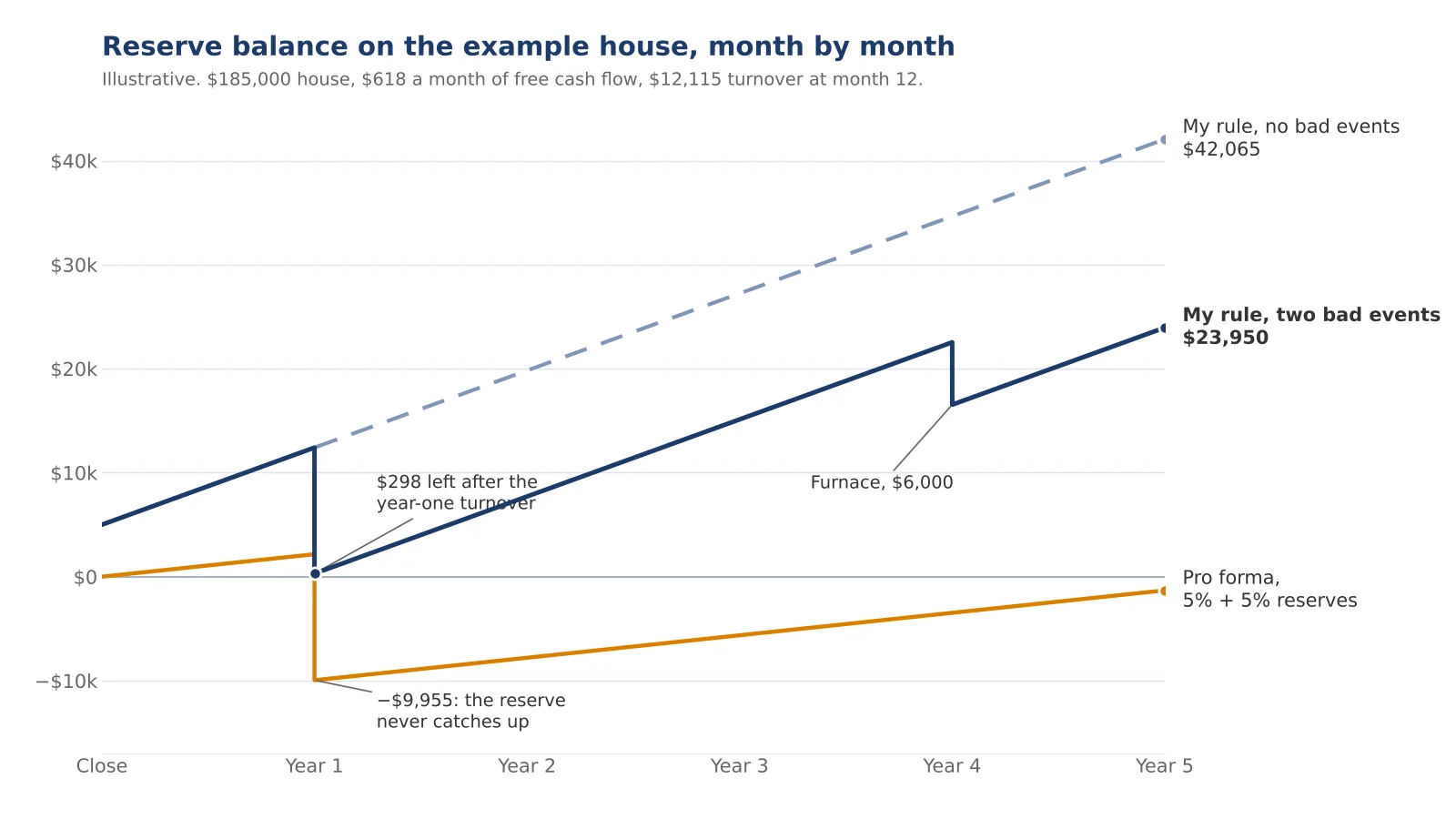
At the end of year one the account holds $12,413, so the turnover takes it down to just a few hundred bucks. That's as close to empty as I'd ever want to run it, and it's the reason the floor exists. From there the account continues to accumulate, and there's still about $24,000 in the account at the end of year five.
The same house, five years, three reserve policies. Only one of the lines comes back after a bad year. Illustrative.
Two bad events in five years, no money sent from home, and the mortgage was never missed. The tax and the insurance were paid on the day. Your tenant got a working furnace in a week rather than a month. There's a value in sleeping well at night, not having to worry about where you'll find $5,000 tomorrow morning. For me, that value is high.
That's the ride I want for my clients. One of them, Karl, bought his first US rental through me from Taiwan and hasn't touched the cash flow since. When the balance in his US account started to look meaningful he asked me what to do with it. Leave it there, I said. It's doing its job.
Need a new roof? The money's there. Tenant took three months to get out and the turnover cost $10,000? The money's there. (And if neither happens, you've got a very boring account balance and a very good problem.)
So where is the return, if it isn't the cash flow?
Ask any investor who's been doing this for ten years or more, who's lived through the property management headaches and held through more than one market cycle. They'll tell you the same thing. The real return is in building wealth, and it comes from three places.
I started buying in 2016, so I'm in my eleventh year. I've held through the 2020 shock, the 2021 and 2022 price run, the rate rise that followed, and my own collapse in 2023. These are the three things that have actually helped me to build wealth with rental properties.
The first is the mortgage paying itself down. The tenant's rent covers the loan, and every month a slice of the balance disappears. On our example property, year one, that's $1,306 of principal paydown, out of $10,209 of payments. It's math, not hope. And as you hold longer, the share of your monthly payment allocated to principal grows. That's how mortgage amortization works.
The second is the debt shrinking in real terms. The loan is fixed in the dollars of the day you borrowed. Every year of inflation makes those dollars worth a little less, so the same balance and the same payment become a smaller claim on a bigger asset. At 3% inflation, which is close to the long-run average of the US consumer price index, a $129,500 loan is worth about $3,772 less in today's money after one year. The direction of that is certain.
In my case, I took out DSCR loans of around $150,000 in 2023. Today, my loan balance is around $145,000, but in today's dollars after adjusting for inflation, it's worth about $133,000. The inflation effect is worth about $12,000 of real erosion on top of the $5,000 of paydown, so the loan is worth about $17,000 less in real terms than the day I took it out, on the consumer price index from September 2023 to August 2026.
The third is appreciation, and I put it last on purpose. It's the only one of the three that can go the other way. Over the long run US house prices have risen about 4.3% a year on the FHFA's index since 1991. In the year to the second quarter of 2026 they rose 2.1%. Some years they fall (although that's actually quite rare). I'd never buy a house on the assumption of appreciation, and I'd never tell a client to. I do try and buy in neighborhoods on a positive trajectory, and that's where the most appreciation tends to happen. But it's still a possibility, not a certainty.
Using the same property I mentioned that I refinanced with a $150,000 DSCR loan in September 2023, it appraised at $215,000 back then. It's worth about $245,000 today. Not huge growth, and it's only "on paper" money until I sell or refinance again, but it's $30,000 of wealth I built while sleeping.
Aside from the mortgage paydown, and the fact that you're using your cash flow to maintain the quality of your asset, the underlying driving factor here is inflation.
It's inflation that pushes up the asset value, and it's inflation that devalues the debt. So, if you believe inflation is here to stay, then owning leveraged real estate makes sense, provided you can hold it long term.
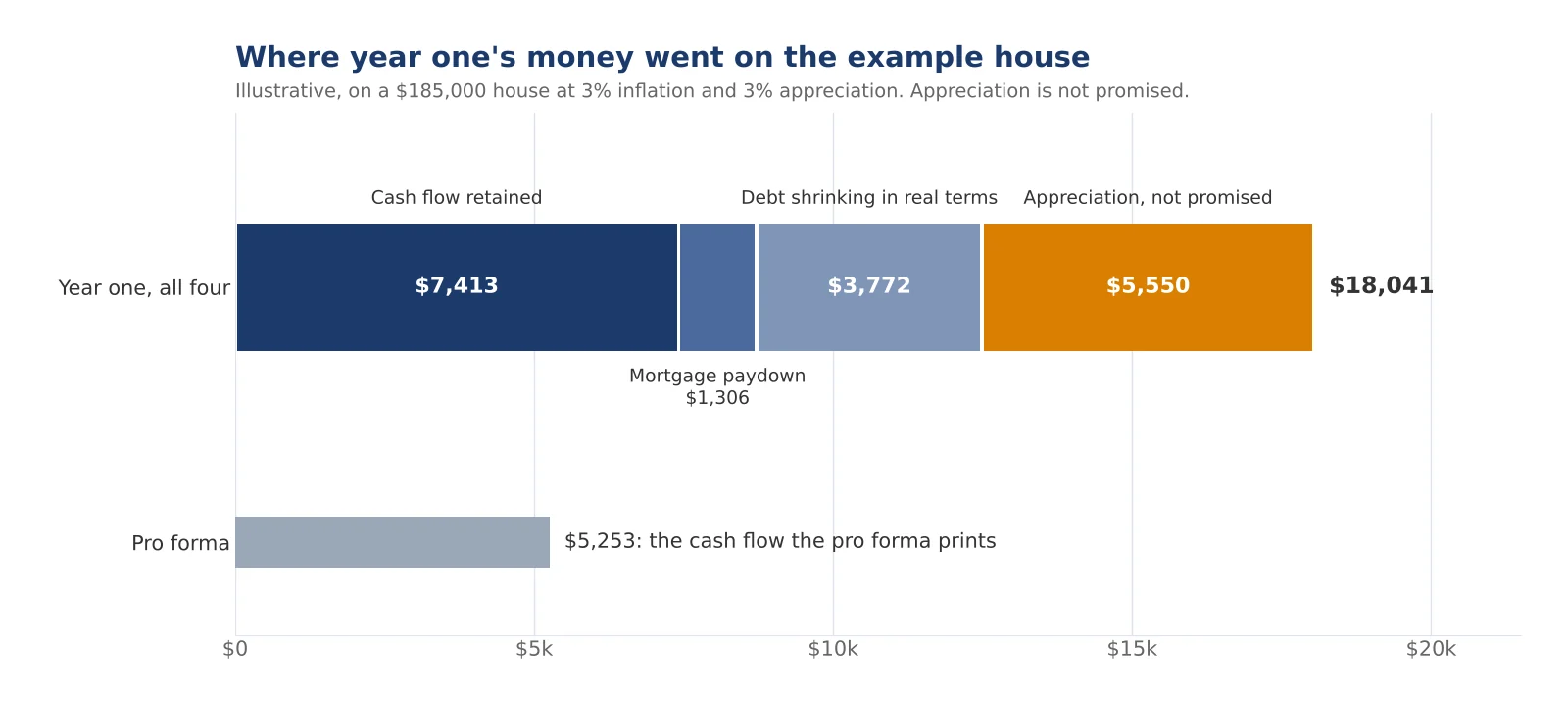
Let's go back to the illustrative example we've been using:
The number the buyer judged the deal on, and the three the pro forma doesn't print. Cash in is the down payment, buying costs at 5%, and the $5,000 reserve
Where the return came from, year one
Illustrative amount
Mortgage paid down by the tenant
$1,306
Debt shrinking in real terms at 3% inflation
$3,772
Appreciation at 3%, not promised
$5,550
Three components together
$10,628
As a return on $69,750 of cash in
15.2%
The pro forma's cash on cash return, for comparison
7.5%
Illustrative, on a $185,000 house at 3% inflation and 3% appreciation. Appreciation is not promised.
The number the buyer judged the deal on, 7.5%, is half the size of the real overall return. And it's the one they must not spend. There's a fourth effect too, the tax position, because a correctly filed US return on a rental often shows little or no taxable income once depreciation is claimed. That's a subject for my tax articles and a cross-border accountant, not for this page.
We just built the annual accounts for Karl, my client from Taiwan I mentioned above. He'll have received about $19,000 in gross rents by the end of 2026. His bank account is showing about $9,000, after all costs, and his US income tax bill will be about $280 for the whole year.
None of the three wealth drivers I mention above is cash flow. Not one of them pays a plumber. That's exactly why the cash flow has to stay in the house. It's the only liquid thing on the table, and it's what lets you hold long enough for the other three to compound. A fixed-rate DSCR loan held to term is the instrument that makes the second one work at all.
Then why does cash on cash return matter at all?
Because it's the screening test. It answers a different question from the one people use it for.
Here's how I reconcile the two halves of this article. When I underwrite a deal, I use percentages. Ten percent for vacancy, and around 20% for maintenance and capital together, on real tax and real insurance. If the deal still covers its debt after that, it passes. If it doesn't, I don't buy it, and cash on cash return is the right measure for that decision.
I can also use a cash amount based on my experience. I know for a fact that the rentals I own will cost me somewhere in the region of $2,000 to $3,000 per year to cover basic maintenance of major systems, periodic inspections, and day to day repairs. I know this because I've owned them a long time. So if my proforma with no reserves shows $6,000 in free cash flow before reserves, I know I can cover my costs, maintain my property, and add at least $3,000 to my reserve account by year end. Then I've got $8,000 total to play with.
Once I own the house, the percentages stop mattering, because averages don't pay invoices. Events do. So I retain everything until the reserve is big enough that an average year and a bad year look the same from my bank account.
Underwrite on percentages. Operate on retention. The $300,000 is the proof that you can get the first half right and still lose, if you get the second half wrong.
Run your own deal through my cash flow calculator with honest reserves and see whether it clears the first test. Then decide, before you buy, that you're going to ignore the number it prints for five years.
What about the lender's reserve requirement?
It's a different reserve, sized for a different risk, and it's not the one I've been describing.
Most foreign national lenders want to see cash reserves in a US account at closing, anywhere from three months of mortgage payments up to twelve. The specialist lender I work with asks for three. Others are much higher than that. That money stays yours. It's never a cost. But it's there to satisfy the lender that you can carry the loan if rent stops, and it's sized for their exposure, not for your furnace.
So don't count it twice. The lender's three months is not the $5,000, and it's not the retained cash flow. It's the floor beneath both. What a non-resident actually brings to the table covers how the three fit together on a real closing statement.
What would I do, in order?
Screen the deal on honest percentages, with real tax and a real insurance quote, and walk away from anything that only works at the seller's figures.
Fund the $5,000 before you close, not after. If you can fund the purchase but not the reserve, buy next year.
From the first month, let the house pay its own bills and leave the rest where it lands. Don't touch it for five years. If you want a figure for what "the rest" should add up to, hold at least one full turnover in cash on top of the floor, which on these numbers is about $10,000 a house.
Keep the reserve in an interest-bearing US account that you control, not with the property manager. One month's rent with the manager is enough for them to act quickly.
Review at year five. By then you'll know your house, your tenant pattern and your market, and you can decide what the right floor is from there.
Cash flow is the number everyone looks at, and it's the number you must not spend. Not for five years, anyway.
I know how that sounds to someone who was promised $300 a month. But I've been the person who spent it. I had $300,000 set aside at 20% and it wasn't enough, because the money that would have saved me was the money I'd already taken out. The percentage wasn't the mistake. The way I managed my money was.
So my advice is the dull version. Underwrite on honest numbers. Then treat every dollar the house produces as the house's money, not yours, until it has enough in the bank to shrug off a bad year.
Your return is coming from the mortgage paying down, the debt shrinking in real terms, and, if you're patient and the market's kind, the house being worth more. The cash flow is what keeps you in the game long enough to collect all three.
None of that guarantees anything. A reserve doesn't stop the roof failing, it just stops the roof failing you. Investing is a game of probabilities, and keeping the cash flow in the house is the cheapest way I know to tilt them.
This article is general information, not legal, tax or financial advice. David Garner is a property investor and is not a lawyer, tax adviser, accountant or investment adviser. Cashflow Rentals is a real estate consultancy, not a real estate broker, and is not a lender or investment adviser. Cashflow Rentals is paid an advisory fee, charged to the renovating contractor, on the turnkey properties it introduces to clients, and I therefore have a commercial interest in the decisions this article discusses. Worked figures rest on a $185,000 purchase at 30% down with $1,800 monthly rent, a 6.875% rate over 30 years, $1,000 of property tax and $1,250 of insurance a year, and management at 8%, and are illustrative. The 3% inflation and 3% appreciation figures are examples, not forecasts; appreciation can be negative and the real-terms effect on debt depends on holding a fixed-rate loan. The five-year retention rule is my own practice, not a recommendation for every owner. The account of my 2016 to 2022 portfolio is from my own records and recollection. Always take advice from a qualified professional before buying.
Free Investor Resources
The Foreign Investor Starter Kit
Everything you'll ever need to buy and manage U.S. rental property from overseas safely and with confidence.
Is cash flow the same as profit on a rental property?
No. Cash flow is what's left of the rent after the mortgage, tax, insurance and management are paid. Its job is to maintain the property and build reserves. The return on a rental comes from mortgage paydown, the debt shrinking with inflation, and appreciation, none of which is cash.
How much cash reserve should I keep per rental property?
I keep at least $5,000 per property from the day I close, in an interest-bearing US account, and on top of that I retain all of the free cash flow for at least the first five years. On a worked $185,000 house renting at $1,800 that's about $42,000 by year five if nothing goes wrong, and one real first-year turnover can cost $10,100 to $12,100 including the empty months.
What does cash on cash return actually measure?
Whether the house can carry itself and its debt after honest costs. It's a screening test for whether to buy, run on average assumptions. It doesn't tell you what the property will pay you, because the right use of that cash is to keep it inside the property.
Can I live off rental property cash flow?
Not from a single leveraged rental in its early years, in my view. On the illustrative house in this article, one turnover in year one costs about two years of the cash flow a pro forma prints. If you need the income now, a rental property is the wrong instrument.
Why do turnkey pro formas show 5% vacancy?
Because it's a long-run average that makes the bottom line look good. Averaged over many houses and many years it may be about right. On one house in one year, vacancy is either zero or several months, and a 5% reserve covers about a tenth of a real first-year turnover.
Is a 20% reserve enough?
Twenty percent of rent for vacancy, maintenance and capital together is twice what most pro formas set aside, and it wasn't enough for me as an ownership policy. I held about $300,000 at that rate across 124 houses and it went in one bad run, because everything above the 20% was being drawn. Retaining all of the cash flow is what I do now instead.
Should rental cash flow go into a separate account?
Yes. Keep it in a US account you control, paying interest, with about one month's rent left with the property manager so they can act fast. I don't hold my reserve with the manager, because if the relationship goes wrong I don't want my reserve fund sitting with them.
How does inflation help a rental property owner?
The loan is fixed in the dollars you borrowed. As prices rise, those dollars are worth less, so the same balance and payment become a smaller claim on an asset whose value and rent tend to rise with inflation. At 3% inflation a $129,500 fixed loan is worth about $3,772 less in real terms after a year. This is an example, not a forecast, and it only works on a fixed-rate loan.
Terms used in this article
Term
What it means
Free cash flow
What's left of the rent each month after the mortgage, property tax, insurance and management are paid, before any reserves.
Net operating income
Rent less the costs of running the property. In this article I use it after the mortgage, which is the figure a pro forma calls cash flow.
Pro forma
A seller's projection of what a property will earn, built on their assumptions. A sales document, not a forecast.
Reserve
Cash held back after purchase for vacancy, repairs and capital replacement.
Turnover
Everything it costs to get one tenant out and the next one in, plus the empty weeks between.
Cash on cash return
Annual cash flow divided by the cash you put in. A screening measure, not the return.
Principal paydown
The part of each mortgage payment that reduces the loan balance rather than paying interest.
Real terms
Measured after inflation. A fixed debt shrinks in real terms as prices rise.
Depreciation
The tax deduction for the wear of a building over time. Nothing to do with the debt effect above.
Written by
David Garner
David is co-founder of Cashflow Rentals and a British investor who has personally purchased more than 120 U.S. rental properties as a foreign national since 2016. He helps overseas investors build U.S. rental portfolios remotely, from his base in Brazil.