Cleveland has quietly been one of the best-performing rental markets in the United States over the last decade. It offers some of the strongest housing affordability in the country, excellent rent-to-price ratios, and steady appreciation, which is exactly why it produces real cash flow for foreign investors. But it comes with a big condition: Cleveland is a tale of two cities, and your success depends almost entirely on choosing the right neighborhood. Here is how I invest there after buying 120+ U.S. rentals.
Markets

Investing in Cleveland Real Estate
Cleveland offers some of the best affordability and rent-to-price ratios in the country. But it's a tale of two cities. Here's how I invest there, from the west-side rule to the property tax trap.
David Garner · Co-Founder
Key takeaways
- Cleveland pairs top-tier affordability with strong rent-to-price ratios and steady growth.
- It is a tale of two cities: I focus on the west side and avoid the cheap east side.
- The housing stock is old, so budget for major systems or buy them already updated.
- Underwrite future property taxes, not current ones, a reassessment can erase cash flow.
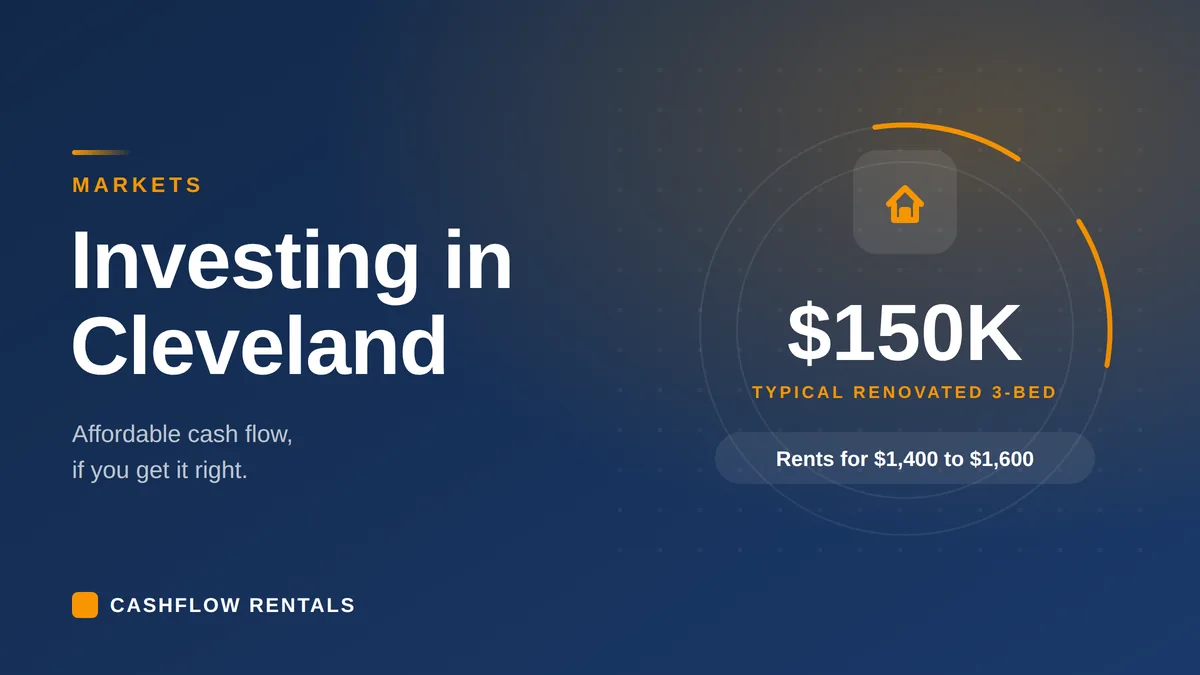
- Renovated 3-beds around $150,000 rent for roughly $1,400 to $1,600 a month.
Why Cleveland works
While markets like Dallas, Austin, and Tampa grab headlines with dramatic booms and corrections, Cleveland has delivered something I value more: steady appreciation, strong rental demand, excellent rent-to-price ratios, and some of the best affordability in the country. A healthy, diversified economy with a large, recession-resilient healthcare sector supports stable jobs, and stable jobs mean tenants who can pay rent for years. That combination of affordability and stability is the foundation of a good long-term rental market.
Affordability and price resilience
Affordability is Cleveland's biggest draw, and it also makes the market more resilient, because prices never got overheated, there is far less room for a sharp fall. Here is a recent snapshot.
| Metric | Cleveland | Versus national |
|---|---|---|
| Median listing price | $275,000 | About 37.5% cheaper |
| Year-over-year price change | +3.9% | Still growing |
| Average time on market | 37 days | 14 days faster |
| Realtor.com hotness rank | 44 of 300 | Strong demand |
Compare that to the Sun Belt and mountain-west markets that boomed then corrected as prices outran local incomes. Cleveland's steady, affordable growth is a safer path to long-term appreciation.
| Market | Year-over-year change |
|---|---|
| Cleveland, OH | +3.9% (still rising) |
| Cincinnati, OH | -6.2% |
| Austin, TX | -6.3% |
| Denver, CO | -5.8% |
| Tampa, FL | 29.9% of listings cut prices |
The east side, west side divide
This is the single most important thing to understand about Cleveland. Generally speaking, the west side offers better neighborhoods, lower vacancy, and a more stable tenant base. The east side has some improving pockets, but it is also where you find rampant crime, deteriorating blocks, and a frequently problematic tenant base. That is why properties are cheap on the east side, and it is also why those cheap properties are so often the biggest problems.
Because east-side houses are cheap, the numbers look fantastic on paper. The reality is very different. In more than a decade in this industry, I have met very few investors who bought in those neighborhoods and still owned the property five years later.
I focus on higher-quality west-side neighborhoods and fully renovated properties. It is the same lesson that runs through everything I do: the neighborhood determines your tenant, and the tenant determines your returns.
For a second Midwest market with the same buy-the-neighborhood logic, see my Kansas City real estate guide.
Old housing stock and major systems
Cleveland's housing stock is old, very old. Many homes were built between the 1890s and the 1950s, so you are dealing with aging roofs, furnaces, HVAC, sewer lines, plumbing, and electrics. If you buy a house that has not been thoroughly updated, you are essentially buying someone else's problems.
A full systems update (new roof, furnace, HVAC, sewer line, plus updated plumbing and electrics) will cost upwards of $60,000 at the low end. So on a $100,000 finished-value house, you would need to buy for under $40,000 just to break even. That math is why I prefer properties where the major systems are already done, even if it means paying a little more upfront, or I only buy at a price that lets me complete the work without exceeding the finished value.
The property tax trap
Watch this closely: a Cleveland deal can look great on paper, then a sale or renovation triggers a property tax reassessment that raises the bill substantially, sometimes enough to eliminate most or all of the projected cash flow.
I have seen investors underwrite a property using the current tax bill, only to be caught out when taxes jumped after purchase. Always underwrite the likely future property tax, not just today's figure. The U.S. tax guide covers how reassessments work in more detail.
The numbers and financing
In many Cleveland neighborhoods you can still buy a fully renovated three-bedroom home for around $150,000 and rent it for roughly $1,400 to $1,600 a month. As a real example, I recently helped a German client buy his first Cleveland rental, a three-bed in the Detroit Shoreway neighborhood, for $150,000 against a $160,000 appraisal, rented at $1,500. That is a solid deal.
Financing works well too: foreign national DSCR (Debt Service Coverage Ratio) loans qualify on the property's rent rather than your personal income, with no U.S. credit history or Social Security Number required. Pair that with a strong local property manager and Cleveland becomes very manageable from overseas. Get the neighborhood right, buy a property with good major systems, underwrite the real taxes, and Cleveland can be an excellent long-term market.
If you want help finding the right west-side property and financing it, you can book a call. For the bigger picture, see the markets I like and my full investment strategy.
Free Investor Resources
The Foreign Investor Starter Kit
Everything you'll ever need to buy and manage U.S. rental property from overseas safely and with confidence.
Open the Starter Kit
Free to browse. No jargon, no sales pitch.
Frequently asked questions
Why is Cleveland a good market for foreign investors?
Cleveland combines some of the best housing affordability in the country with strong rental demand and excellent rent-to-price ratios, which supports real cash flow from day one. It has also grown steadily rather than in booms and busts, making it more price-resilient than many Sun Belt markets. The catch is that success depends heavily on choosing the right neighborhood.
What is the difference between Cleveland's east side and west side?
Generally, the west side offers better neighborhoods, lower vacancy, and a more stable tenant base, while the east side is where you find the cheapest properties along with more crime, deterioration, and problem tenants. Those cheap east-side numbers look great on paper but often become the biggest problems, which is why I focus on the west side.
Why do Cleveland properties need careful inspection of major systems?
Much of Cleveland's housing stock was built between the 1890s and 1950s, so roofs, furnaces, HVAC, sewer lines, plumbing, and electrics are often old. A full systems update can cost upwards of $60,000, so I prefer properties where the major systems are already done, or I buy at a price low enough to complete the work without exceeding the finished value.
How do property taxes affect Cleveland investments?
Cleveland deals can look attractive on paper, but a sale or renovation can trigger a property tax reassessment that raises the bill substantially, sometimes enough to erase the projected cash flow. Always underwrite the likely future tax bill, not just the current one.
What do typical Cleveland rental numbers look like?
In many neighborhoods you can still buy a fully renovated three-bedroom home for around $150,000 and rent it for roughly $1,400 to $1,600 a month. For example, I recently helped a German client buy a three-bed in the Detroit Shoreway neighborhood for $150,000 against a $160,000 appraisal, rented at $1,500.
Can foreign investors finance a Cleveland rental?
Yes. Foreign national DSCR (Debt Service Coverage Ratio) loans work well in Cleveland, qualifying on the property's rental income rather than your personal income, with no U.S. credit history or Social Security Number required. Combined with a good local property manager, this makes remote ownership straightforward.
Written by
David Garner
David is co-founder of Cashflow Rentals and a British investor who has personally purchased more than 120 U.S. rental properties as a foreign national since 2016. He helps overseas investors build U.S. rental portfolios remotely, from his base in Brazil.