1. What does a real turnover actually cost?
Cleveland. Three bedroom house, rent $1,500 a month. Tenant of three years moved out. The turnover came to $9,000. There was nothing especially bad here, but the costs mount up quickly.
In the Kansas City example, rent was $1,800 a month with a similar tenancy length. The work came to $3,100.
Two similar houses, two similar tenancies, and a difference of nearly three times. I explain why in section 6 below, and the explanation matters more than the number.
What is actually in a $9,000 turnover? Not damage, usually. A tenant of three years leaves a house that needs work whether or not they were careful.
Full repaint throughout, because three years of living in a house shows. Flooring, at least in the high traffic areas and often throughout. Cleaning, properly, which is more than a domestic clean. Any deferred maintenance the tenant put up with and never reported. Appliance replacement, because the ones that came with the house are now five years older. Landscaping and exterior tidying to let it. And the small list of things that were fine for a sitting tenant and are not fine for a viewing.
None of that is a disaster. It is what a house needs after somebody has lived in it. None of it appears in a turnkey pro forma either, which is why I check those figures myself, as set out in how to check a turnkey seller's numbers.
2. How long is the property empty?
The invoice is not the total cost.
A turnover takes time. The work has to be scheduled, completed and inspected. Then the property has to be marketed, shown, an applicant screened, a lease signed and a move-in date agreed.
One to two months is normal. I have used one and a half in the figures below, which is if anything optimistic in a slow letting season.
The true cost of one turnover event | Cleveland | Kansas City |
|---|
| Turnover works | $9,000 | $7,000 |
| 1.5 months empty | $2,250 | $2,700 |
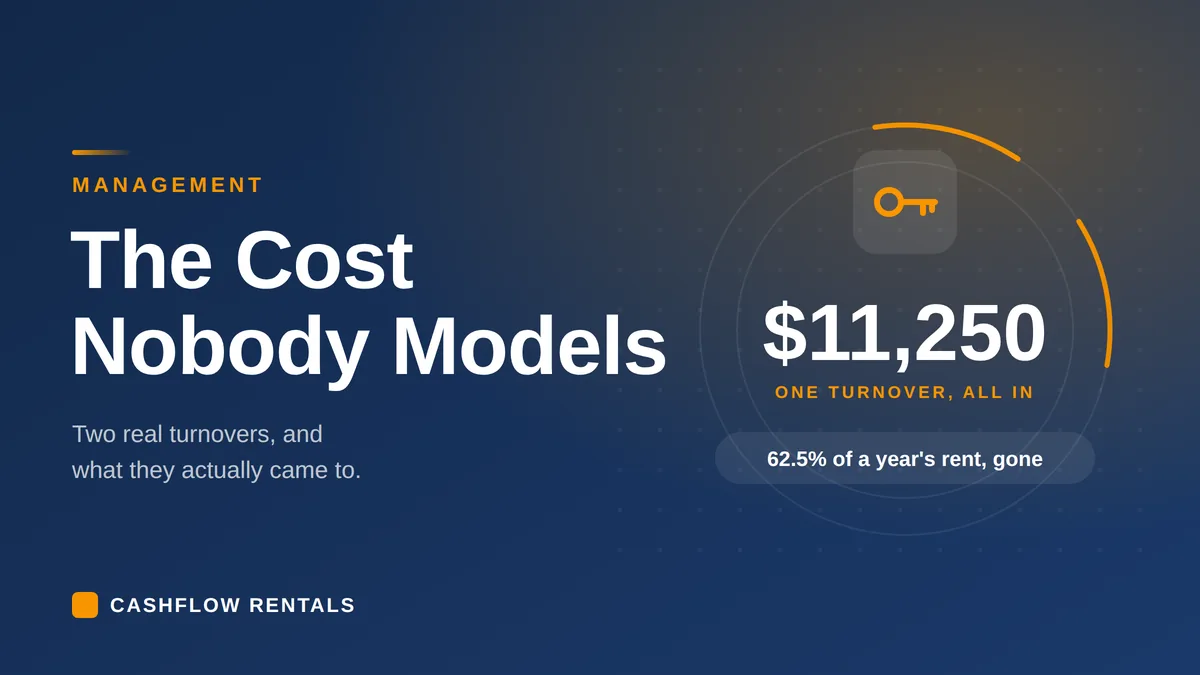
| True cost of the event | $11,250 | $9,700 |
On a Cleveland property collecting $18,000 a year, that is 62.5% of the annual rent. On the Kansas City property, 44.9%.
Both of those are before you have paid the mortgage, property taxes and insurance, which do not stop while the house is empty. How those loans are priced, and what the payment actually covers, is in DSCR loans explained.
3. What does turnover cost per year?
A single event of $11,250 sounds survivable if it happens once. The problem is that it does not happen once. It happens every time a tenant leaves.
So the honest way to hold it is amortized across the tenancy.
Turnover amortized across a three year tenancy | Per event | Per year at a 3 year tenancy | As % of gross rent |
|---|
| Cleveland | $11,250 | $3,750 | 20.8% |
| Kansas City | $9,700 | $3,233 | 15.0% |
Now put that against the costs people do budget for.
Turnover against the costs people do budget for| Cost | As % of gross rent |
|---|
| Management fee | 8% to 10% |
| Property tax, Cleveland | 7.8% |
| Property tax, Kansas City | 2.2% |
| Turnover, amortized | 15% to 21% |
Turnover is the single largest operating cost on a rental property, roughly twice the management fee, and it is the one line that almost never appears in a pro forma.
In fact, in ten years of doing this I have never seen a turnkey pro forma include it. I have seen plenty include a 5% vacancy allowance, which covers the empty months and not the $9,000 of work.
The one thing to remember: a 5% vacancy allowance is not a turnover allowance. One covers the rent you did not collect. The other covers the bill that arrives while you are not collecting it.
4. How much is a long tenancy worth?
I have argued for years that a three bed two bath on a decent street in an improving neighborhood is a better asset to own than a cheaper one bed, because families stay longer. That has always been a judgment. Here it is as arithmetic.
Same Cleveland property, same $11,250 event, different tenancy lengths.
Same Cleveland property, same $11,250 event, different tenancy lengths| Tenancy | Turnover cost a year | As % of gross rent |
|---|
| 2 years | $5,625 | 31.2% |
| 3 years | $3,750 | 20.8% |
| 5 years | $2,250 | 12.5% |
| 8 years | $1,406 | 7.8% |
A tenant who stays eight years rather than two is worth 23 points of gross yield.
Not 23 points of net. Twenty three points of gross, on the top line, from nothing except somebody not moving.
That is why I buy three bed two bath houses in the neighborhoods people want to live in, and why I am unmoved by small, cheap property with a higher headline yield. The headline yield assumes a tenancy that a one bed does not produce.
There is more on what I look for, and why the street matters more than the house, in the best buy-to-let markets in the USA. And where the tax on all of it lands is in my US tax guide for foreign investors.
5. Why do tenants actually leave?
The table above tells you what a short tenancy costs. It does not tell you what causes one, and that is the more useful half.
In my experience, running well over a hundred rentals, tenants almost never leave because the rent went up.
That surprises people. But think about it from the tenant's side: if they move, they will pay the higher market rent somewhere else anyway, and they will pay moving costs on top. A reasonable increase on a house they like is not what pushes somebody out.
Here is what actually does.
The property is failing them. Things break and stay broken. The heating is unreliable. There is a leak somebody keeps patching. Living there has become an ongoing irritation.
They have outgrown it. A couple becomes a family. The one bed stops working. This one you cannot prevent, but you can choose not to buy the kind of property people grow out of in three years.
They do not like the neighborhood. Nothing to do with your house at all. Something to do with the street you bought on. Subsidised tenancies behave differently again, which I have covered in why 5,000 landlords a year quit Section 8.
The manager is unresponsive. Maintenance requests go unanswered. Nobody calls back. The tenant decides nobody is looking after the place, because nobody is. That failure has its own arithmetic, which I have set out in when your property manager is the biggest risk.
Or a normal life event. A job, a move to another city, buying their own home. Genuinely outside anybody's control.
Let me put it another way. Have you ever lived in a duplex? In a small place? With a bad landlord or property manager? With less privacy, and noisy neighbors? In a part of town you did not much like? You move as soon as you reasonably can. Your tenant is no different.
Which means you control four of the five
That is the point. Only the last one is really outside your hands.
The first is fixed by buying a house with sound systems and maintaining them. The second by buying the kind of property a family stays in. The third by buying on the right street. And the fourth by hiring a manager who answers the phone, and checking that they do. What to ask before you appoint one is in what US property management actually costs.
So a short tenancy is usually not bad luck. It is a purchase decision or a management decision, showing up three years later as an $11,250 bill.
And this is why routine maintenance is not the same as repairs
Repairs are what you pay when something breaks. Maintenance is what you pay so that it does not.
Most owners budget carefully for the first and skip the second entirely, then wonder why the repair bill climbs every year. What your manager charges to arrange the work is its own question, covered in how property managers make money on repairs. Servicing the furnace, flushing the water heater, clearing the gutters, changing the filters. A few hundred dollars a year, and none of it feels urgent. But spending it is the cheapest thing you can do for your returns. The full schedule, with costs and what each item prevents, is in the maintenance and capital schedules.
The industry data on this is not subtle. An unmaintained water heater averages around eight to ten years. One that is flushed annually with the anode rod replaced runs fifteen or more. Furnaces show the same pattern. Dirty filters choke airflow and cause them to overheat, and sediment means you are heating rock rather than water.
Then consider a tenant living in a house with well-maintained systems that do not break. Their life is easier, and often their utility bills are lower. Those are both reasons to stay.
But the bigger return is not the equipment. It is the tenancy.
On the Cleveland numbers, one extra year of tenancy is worth $3,750 in avoided turnover. So a few hundred dollars a year of routine maintenance only has to extend the average tenancy by about ten weeks to pay for itself, and that is before counting the capital cost it defers.
Treat the house as though you lived in it. That is my whole point, and it is the cheapest thing on this page to implement. Have your property manager walk the property every few months and report back.
6. Why am I not publishing the Kansas City number?
The Kansas City turnover cost $3,100. A reader should budget $7,000.
I paid $3,100 because I used a contractor who gives me cost pricing, and he gives me cost pricing because we buy houses from him. That is a commercial relationship built over years, and it is worth about 56% off the market rate for that work.
You will not get that price. Not in year one, probably not in year five.
Publishing $3,100 as though it were a normal turnover cost would be exactly the kind of understated figure this whole blog exists to correct. It is the same species of number as a turnkey listing quoting the previous owner's property tax bill, which I have written about in how US property tax works.
So the honest version is: this is what it cost me, this is what it will cost you, and the gap is a relationship you cannot buy.
That gap is also the strongest argument for the thing I usually tell people not to do, which is self-managing. It works, eventually, once you have built exactly that kind of contractor base. It does not work in year one, for reasons I have set out in should you self-manage a US rental from abroad.
7. Why hold the reserve from day one?
Here is the rule I give every client, and it is the most useful sentence in this article.
Keep at least one full turnover in liquid cash, from the day you buy.
Not saved out of cash flow. Not built up over the first few years. Sitting in an account before the first tenant moves in.
Before you commit to a deal, add the amortized figure to the running costs and run the numbers again with a turnover line in them. Almost no pro forma you are shown will have one, which is why the yield on the page and the yield in your account are different numbers.
And here is the honest reason, because the obvious one is not quite true.
On a good property, you can nearly save it. The Cleveland house produces about $4,261 a year of cash flow after the mortgage. Three years of that is $12,782, against an $11,250 turnover. It just about gets there.
So why not save it?
Because it only works in a perfect world where everything goes to plan. In real estate, it never does.
You must retain every penny. Three years of cash flow means drawing no income at all. Take anything and the reserve does not arrive.
The tenancy must last three years. At two years you have $8,522 against $11,250, and you are short by $2,728.
And nothing else can happen first. A furnace at year two, a roof, an insurance excess, an eviction. Any of those and the reserve resets to zero and starts again.
On a cheap low value property with thin margins it fails outright. The Cleveland example is a well-bought house with a real tax bill of $1,412 and a cheap loan. On a cheaper property with weaker cash flow, three years of saving gets nowhere near.
So the argument is not that you cannot save it. It is that saving it depends on three years of everything going right, and a reserve exists precisely for when things do not.
If the money is not there when the turnover lands, the alternative is finding the funds from somewhere else, or selling the property, which costs 6.5% to 10% on the sell side alone, as set out in the closing costs article. I have set both of those out in how to fund a US property purchase and what closing costs actually are.
8. What does this do to the cost of entry?
Which brings us to the part nobody selling you a property in the US will mention.
What you actually need, once the turnover reserve is counted | Cleveland, $150,000 | Kansas City, $185,000 |
|---|
| Deposit at 30% | $45,000 | $55,500 |
| Closing costs at about 5% | $7,500 | $9,250 |
| What most people budget | $52,500 | $64,750 |
| One turnover, held liquid | $11,250 | $9,700 |
| What you actually need | $63,750 | $74,450 |
The reserve adds 21% in Cleveland and 15% in Kansas City to the real cost of entry.
I am aware that saying so makes the investment look more expensive than everybody else's version of the same sum. That is the point. The deals that go wrong are almost never the ones where the property was bad. They are the ones where the owner had no money left when something happened.
If you would rather have somebody who has already priced all of this looking after the property, that is what our remote management service does. You can size the deal and the reserves yourself first with the free tools in my investor starter kit.
The bottom line
Turnover is the largest running cost on a rental and the one most likely to be missing from the spreadsheet you were shown.
Two real events cost $11,250 and $9,700 once the empty months were counted. Amortized, that is 15% to 21% of gross rent, every year, which is roughly twice what you pay your manager.
The way to survive it is not to reduce it. You cannot reduce it much. The way to survive it is to buy the kind of house that produces long tenancies, and to hold the cash before you need it.
One turnover, liquid, from day one. It will feel like dead money for about three years, and then it will feel like the best decision you made.
My advice holds. Keep liquid cash available for a rainy day, and let 100% of any cash flow accumulate for the first five years. That way, when the rainy day comes, and it will, you are ready for it.
Remember, investing is a game of probabilities. A tenant leaving is not one of them. It is a certainty with an unknown date, but you can plan ahead so it is not a headache.
This article is general information, not investment, tax or financial advice. The turnover figures are real costs on properties the author is involved with, in Cleveland and Kansas City, and are used as examples rather than benchmarks. Turnover costs vary substantially with property condition, market, tenancy length and local labor rates. The Kansas City figure reflects a contractor relationship not available to most owners, which is disclosed above, and the market rate is used in all calculations. Cash flow, tax and insurance figures are drawn from real settlement statements and county records where available. Always build your own model on your own property before committing.