1. How is US property tax different from council tax?
For British readers the nearest thing is council tax, and it is a poor match. If you are British, the wider UK position on US rental income is in UK tax on US rental income. Council tax is banded, it is paid by the occupier, and the bands in England have not been redone since 1991.
US property tax is different in every one of those respects.
It is charged on value, not bands. A house worth twice as much generally pays roughly twice as much.
It is charged to the owner, not the tenant. On a rental property it is your cost, every year, whether the house is let or empty. And it does not stop at death either, since the property itself is taxed again, as set out in US estate tax for foreign property owners. It sits alongside the larger running costs set out in maintenance, repairs and capital. Who handles paying it, and the rest of the running of the property, is what remote management is for.
And the values the taxes are based on get redone often. Every year in some states, every two or three in others. In Cleveland it is every six years, which means a big jump when it comes. When the value moves, your bill moves.
So it is the second biggest line in your costs after the mortgage, and the one most likely to jump without warning. On the deals I see it runs between 15% and 25% of the rent.
2. How is my property tax bill calculated?
Three numbers produce your bill, and only one of them is the price you paid.
Market value. What the county assessor thinks the house is worth. Not what you paid, though a recent sale is evidence of it.
The assessment ratio. The share of that value which is actually taxable. State law sets it and it varies a lot. Missouri taxes homes on 19% of market value. Ohio uses 35%. Some states use the lot. The Tax Foundation publishes effective rates state by state, which is the right place to start a comparison and the wrong place to finish one.
The levy. The combined rate charged by everybody with a claim on the house: county, city, school district, library, fire district, sometimes transit. Schools take the biggest share. Canadians face a different treaty position on all of it, set out in the US tax guide for Canadian investors.
So the arithmetic is:
Market value, times the assessment ratio, times the levy.
Take a Kansas City, Missouri house the county values at $100,000. Taxed on 19% gives $19,000. A levy of about 7.5% on that is roughly $1,425 a year. That figure goes straight into your cash flow model, and into your US tax return, where it is deductible against rental profit once the election is in place, as set out in how to stop the 30% withholding. That figure goes straight into your cash flow model, alongside the financing, which I have covered in how to fund a US property purchase.
Which means two of those three numbers are set by other people. Both can move without you doing anything. The management fee is the one line you do choose, and I have set that out in what US property management actually costs.
3. What do real property tax bills look like?
Here are the actual figures, taken from the tax proration lines on three settlement statements. Those lines are reliable because they state the annual amount and show the arithmetic. The Cleveland purchase was for a client from Germany, whose story is in his case study, and one of the Kansas City buyers was a Canadian client whose first deal is in his.
Annual property tax on three real client purchases| Property | Price | Annual property tax | As % of price |
|---|
| Cleveland, Ohio, April 2026 | $150,000 | $1,412 | 0.94% |
| Kansas City, Missouri, October 2025 | $163,000 | $466 | 0.29% |
| Kansas City, Missouri, February 2026 | $185,000 | $485 | 0.26% |
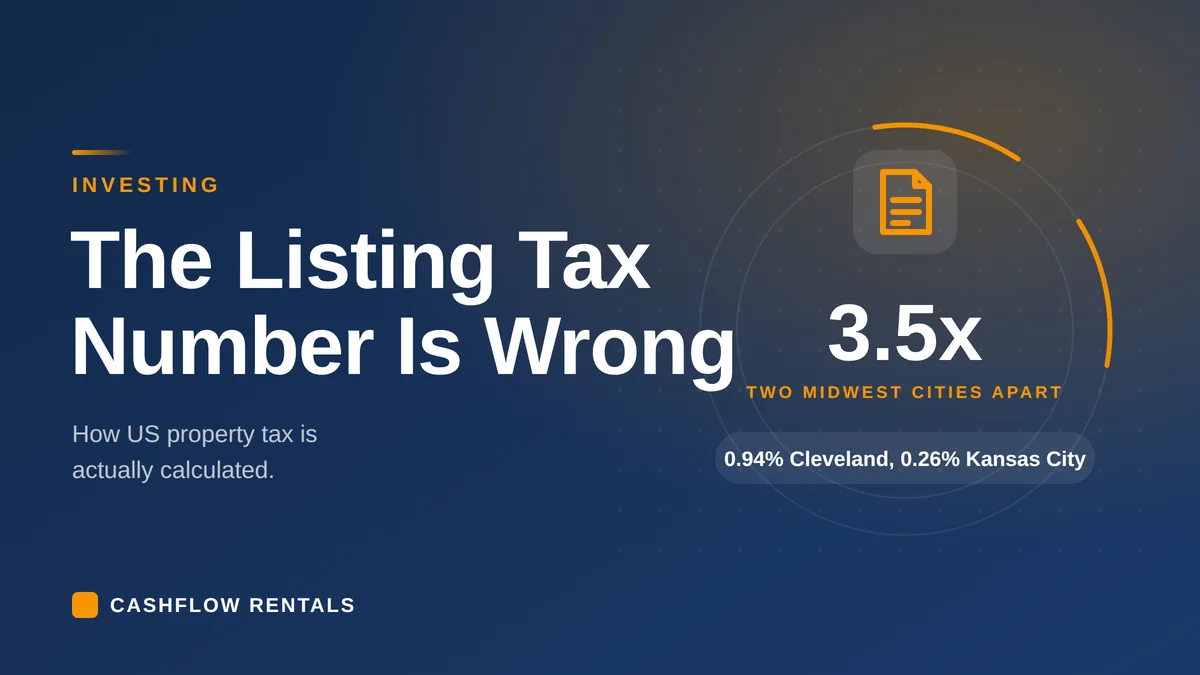
Three and a half times the rate, between two Midwest cities that appear on every list of cash flowing rental markets, which I have compared in the best buy-to-let markets in the USA.
On the Cleveland purchase, that is $118 a month against rent. On the Kansas City purchases, about $40. Against a mortgage payment those are small numbers.
But the Kansas City figures are the ones that should worry you, and section 5 below explains why. A quarter of one per cent is not a low tax jurisdiction. It is a number that has been artificially held down.
4. Why will my bill be higher than the seller's?
Four reasons a quoted tax figure will not be what you pay.
The homestead exemption, which you will not get. Most states cut the taxable value for owner-occupiers. Buy from somebody who lived in the house and that discount goes the moment it becomes a rental. This is the most common reason a quoted figure is wrong.
I priced a Detroit listing last year that quoted $1,130 a year. The assessor's record showed the exemption had gone and the cap with it. The real figure was nearer $3,100. That is not a rounding error. It is most of the cash flow.
Caps that reset on sale. Several states limit how fast a value can rise for an existing owner, then drop the cap when the house is sold. The seller may have held it for fifteen years under a cap you do not inherit.
Old assessments. If the county has not revalued for a while, the bill reflects an old view of the value. Your sale is the evidence that view is wrong.
And a successful appeal. The seller may have argued the value down. That reduction is not necessarily yours.
All four point the same way. The number is more likely to be too low than too high, and the person quoting it has no reason to correct it. The same is true of the rest of the pro forma, and the annual filing your LLC carries alongside it is in the $25,000 form nobody mentions.
There is more on checking a seller's figures generally, including where to find the real tax history, in how to check a turnkey seller's numbers.
5. What happens when the county revalues?
This is the part that matters most, and Kansas City is currently the clearest example in the country.
Jackson County's 2023 revaluation was found unlawful. Missouri's Attorney General and the State Tax Commission took the county to court. A judge backed the Commission, and the county had to roll back any value that had risen more than 15%. In a separate case, a court said the county's 2019 and 2023 work showed gross incompetence.
The county fought the order and eventually complied in 2025.
So Kansas City bills are being held down by a state-ordered rollback. That is why my clients pay about a quarter of one per cent of what the house cost them.
And it will not last. Assessors across Missouri are still under pressure from the State Tax Commission to get values within 90% to 110% of the market. Jackson County was told to roll back, so it has ground to make up. The 2026 session in Missouri ended with no reform.
Work out what catching up looks like. A $185,000 house taxed properly at 19% gives $35,150 of taxable value. At a normal Kansas City levy that is a bill several times the $485 being paid now.
If you plan to defer the exit rather than take it, the rules are tighter for you than for an American, as set out in can a foreign investor do a 1031 exchange.
I am not saying do not buy in Kansas City. I buy there and my clients buy there. It remains one of the better markets for the kind of property I look for, which I have set out in my markets comparison.
I am saying do not underwrite on $485. If your deal only works at today's tax bill, it does not work.
The one thing to remember: the tax line on your closing statement is a snapshot of somebody else's assessment. Underwrite the tax you will pay in three years, not the one you inherit on completion.
6. What should I check before I buy?
Five things, all free, all before you commit.
Pull the tax history from the county assessor. Year by year, not just this year's bill. It is public and free, and it shows the trend and any jumps. On one Kansas City house I looked at, the tax went from $358 in 2016 to $675 in 2025, with a 28.5% jump in one year when the value moved 35.2%.
Compare the taxable value to what you are paying. If the county has the house at a fraction of the sale price, that gap is your risk. On the same house, the county's figure implied a value well under half what it sold for.
Check whether a homestead exemption is currently applied, because you will lose it. Whoever handles the bill on your behalf should be checking it too.
Find out when the county next revalues. Some do it yearly, Missouri does it every odd year, others take longer. Buying the year before is not the same as buying the year after.
And read your lender's escrow line, which is the most ignored free forecast there is. On a Cleveland purchase the lender held six months of tax and insurance at closing. They have already worked out what they expect to pay. If their number is well above the seller's, believe the lender. They carry the risk if it is wrong.
7. How do I underwrite the tax line?
I assume the current bill is a floor, not a forecast.
Where the assessed value is close to the purchase price and the county reassesses often, I use the current figure with a modest increase. Property tax is deductible against your rental profit, and where it sits in the full US picture is in my US tax guide for foreign investors. The larger deduction sitting next to it is depreciation, which comes back when you sell whether you claimed it or not, as I have set out in the depreciation advice that costs foreign investors thousands.
Where the taxable value sits well below the sale price, I underwrite as though the county had it right. Take the price, apply the state ratio, apply the current levy, and use that instead of the bill on the statement. If the deal only works on today's figure, I do not do it.
You can put the tax line into a full income picture with the US rental income tax calculator. And I look at property tax as a share of rent, not as a dollar figure. Fifteen per cent of gross rent is comfortable. Twenty five per cent is tight. Above thirty and a single bad year takes the property to nothing.
You can size the full picture on a specific property with the free tools in my investor starter kit, and if you would rather I did the checking, that is exactly what our property sourcing service is for.
The bottom line
Property tax is the running cost most likely to change and least likely to be quoted accurately.
The figure on a listing is usually the last owner's bill. Cut by an exemption you will not get. It is one of several running numbers worth verifying before you commit. Based on a value that may be years old. On a house that has just handed the county fresh evidence of what it is worth.
Real client purchases in the last year ranged from 0.26% to 0.94% of price, and the low end of that range is low for reasons that have nothing to do with the market being cheap.
Check the record. Compare the assessment to your price. Believe your lender's escrow estimate. And underwrite the bill you will be paying in three years. Then price the exit too, because the tax you pay on the way out is a separate calculation, set out in capital gains tax when a foreign owner sells, and the withholding that comes off before it is in how to get your FIRPTA money back.
Remember, investing is a game of probabilities. A tax bill going up is not one of them.
This article is general information, not tax, legal or investment advice. Property tax rules, assessment ratios, levies and exemptions vary by state, county and taxing district, and change frequently. The figures quoted come from the tax proration lines of real settlement statements on completed client purchases, used with permission and anonymised, and from public county assessor records. They are examples, not benchmarks. The Jackson County position described is accurate as we understand it in August 2026 and is the subject of ongoing legal and legislative activity. Always check the actual assessor record for the actual property, and take advice from a qualified professional before relying on any figure in an underwriting model.