Almost every Canadian I've worked with over the past 2 years has come to me with the same quiet realization: the rental they own at home, or the one they were about to buy, doesn't make enough money to pay for itself, let alone turn a profit. In most cases it actually costs a little to hold every month.
Some assume they picked the wrong property. Usually that's not the case. The numbers in Toronto and Vancouver simply don't work for a landlord right now, and no amount of deal hunting changes that.
Let me be clear though: this is not a "Canada bad, US good" article. Canada is a fine place to own a home. It's just an expensive place to own a rental at the moment, and the US Midwest offers a genuinely different set of numbers. Here's the honest, real world comparison, including the trade-offs, so you can decide for yourself.
Why your Canadian rental barely breaks even
A rental property only works if the rent comfortably exceeds the mortgage, taxes, insurance, and cost of upkeep. In Canada's big cities, prices have run so far ahead of rents that this simply doesn't happen on a normally financed property.
The reason Canada isn't working for landlords right now isn't your property selection. It has far more to do with the market-wide relationship between what homes cost and what they rent for.
The price to rent problem at home
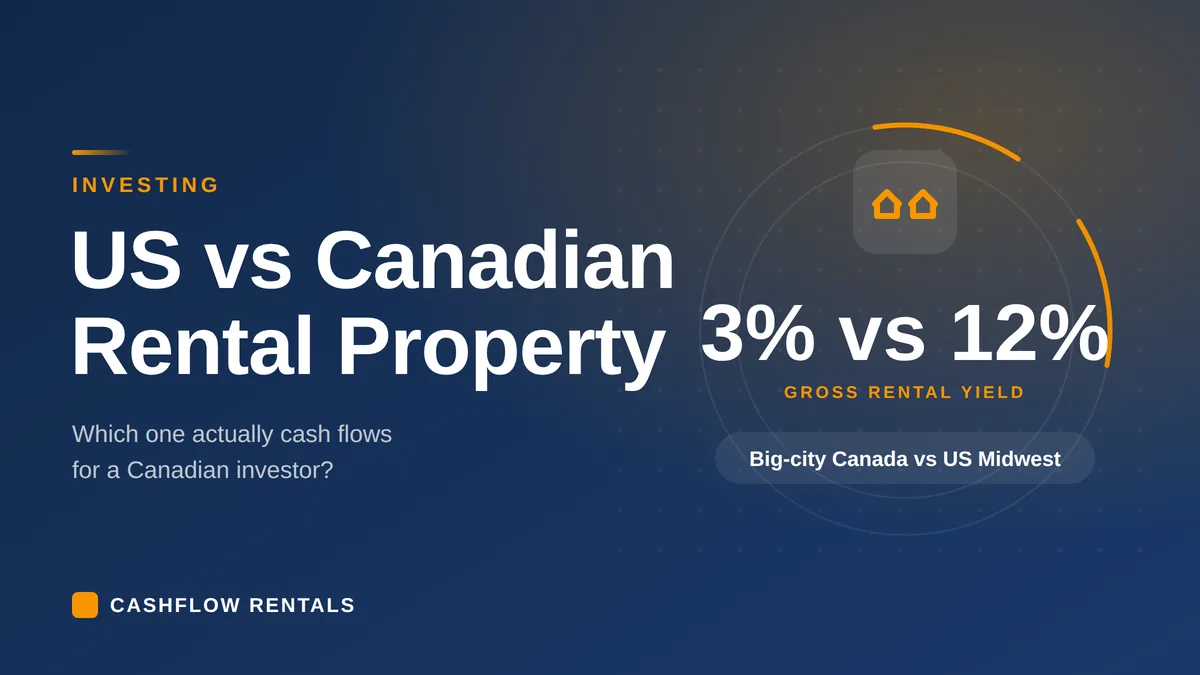
Here are some current numbers that make the point. In mid 2026, the average Toronto home sold for around $946,500, while the average rent was nearly $2,500 a month. That is a price to rent ratio north of 30, and a gross yield of roughly 3%. Vancouver is not far behind, with a benchmark condo around $697,800 and a price to rent ratio near 25.
Put simply, in both cities owning costs roughly $2,000 a month more than renting the same place. For a landlord, that gap is your monthly loss before a single repair. And repairs always come.
You're effectively betting on appreciation to bail you out, and paying out of pocket to hold the asset while you wait. That can work, but it isn't investing for cash flow, it's speculating on price.
The financing ceiling nobody warns you about
There's a second squeeze that catches Canadians who want to scale. Canadian mortgages are qualified against you: your personal income and your debt service ratios. Every mortgage has to pass the federal stress test and stay within the lender's debt service limits, broadly a gross debt service ratio around 39% and a total debt service ratio around 44%, and lenders only count 50 to 80% of your rental income toward qualifying.
The result is a financing wall. Even if every property you own is cash flow positive, each new mortgage loads up your ratios, and after a handful of properties the bank simply says no to the next one. Your ambition outgrows your borrowing capacity, no matter how good you are at finding deals.
What the US Midwest looks like instead
Now the other side. In the US Midwest markets I work in, a renovated three or four bedroom family home costs somewhere around $150,000 to $200,000 and rents for roughly $1,750 to $2,100 a month. That is a gross yield in the 11 to 13% range, and after all costs the property cash flows positively from day one rather than draining you.
But the biggest difference is the financing. A DSCR loan, the standard US rental property loan, qualifies the property, not the borrower. The lender looks at whether the rent covers the mortgage. They are not interested in your Canadian tax return, your job, your credit, or your other debts. You don't need US income, US credit, or a Social Security number, and I walk through exactly how that works in my guide to how Canadians get a US mortgage.
Because each property qualifies on its own cash flow, there is no personal ceiling. Your growth is limited only by finding good deals and funding the down payments. That was the story for my Canadian client Ronald from Ottawa: a Canadian condo that only ever broke even, and nowhere better to put his money at home, so he looked south.
The same money, side by side
Take the same pot of down payment money, roughly $55,000 to $90,000, and point it at each market. This is illustrative and dated to mid 2026, but it is accurate for the deals I'm doing right now.
The same money, side by side (illustrative, mid 2026) | Big-city Canadian rental | US Midwest rental |
|---|
| Typical price | Around $950,000 (Toronto) | Around $175,000 |
| What your down payment buys | A share of one condo | A whole renovated family home |
| Typical monthly rent | Around $2,500 | Around $1,750 to $2,100 |
| Gross yield | Roughly 3 to 4% | Roughly 11 to 13% |
| Monthly cash flow, financed | Negative, often $1,500 to $2,000 out of pocket | Positive from day one |
| What the loan is based on | Your personal income and debt ratios | The property's own rental income |
| Room to grow | Stalls after a few, ratios max out | No personal ceiling, each property qualifies itself |
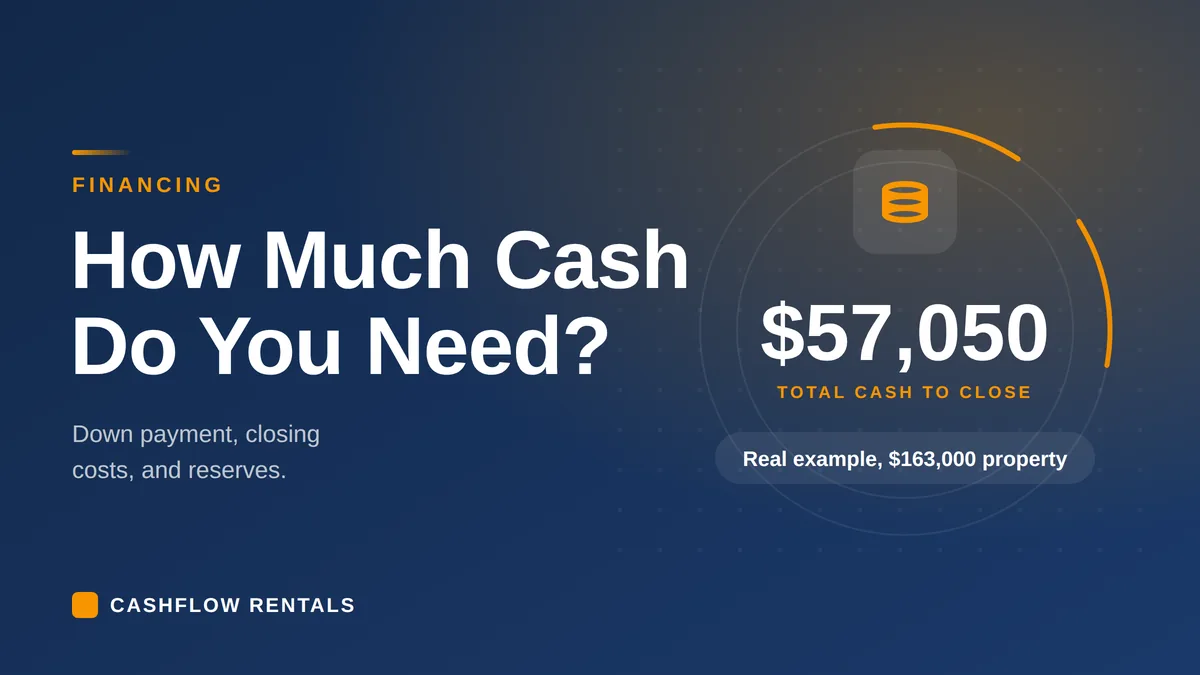
You can size your own down payment in my guide to how much money a Canadian needs to buy a US rental, and see where I actually buy in my guide to the best US markets for foreign investors.
The honest trade-offs of going abroad
None of this is a free lunch, and I wouldn't trust anyone who pretended it was. Investing across the border means currency exposure between the Canadian and US dollar, managing a property you can't easily drive to, filing a tax return in two countries, and trusting a team you may never meet in person.
These are real, and they are the reason some people stay home. My whole business exists to handle them, but you should go in with your eyes open. The point isn't that the US has no downsides. It's that, done properly, the odds on cash flow and growth are dramatically better, and the downsides are manageable rather than dealbreaking.
A US rental in the wrong neighborhood is still a bad investment. The advantage only shows up when you buy the right property, in the right area, financed sensibly.
Who each option actually suits
Staying in Canadian real estate makes sense if you are primarily betting on long term appreciation in a market you know, you can comfortably fund the monthly shortfall, and you value being close to the asset.
Looking to the US Midwest makes sense if your goal is cash flow that pays for itself, you want to keep growing past the point where Canadian banks stop lending, and you are comfortable running things remotely with the right team. Plenty of my clients do both: they keep their Canadian property and add US rentals alongside it, rather than choosing one or the other.
What to actually do
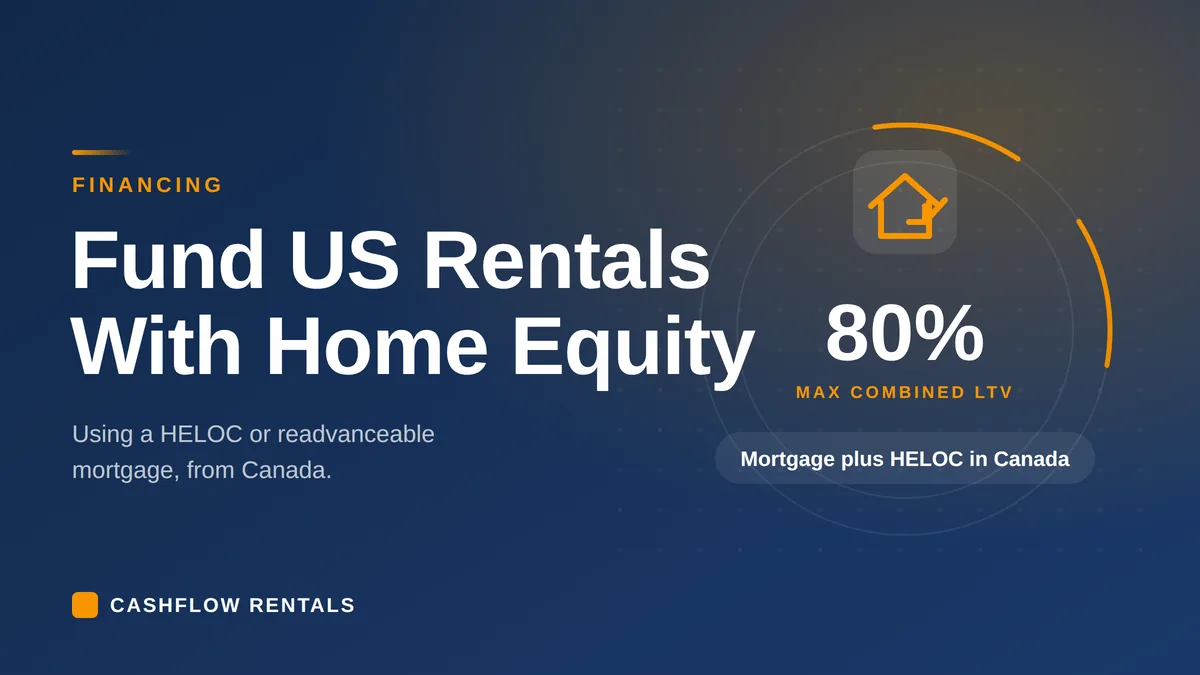
If your Canadian rental is bleeding cash every month, don't assume that is just how real estate works, because it isn't how it works everywhere. Run the honest numbers on both markets. Look at price to rent, not just price. Check how much further you can borrow at home before the ceiling hits. Then, if the US looks right, start small and fund it sensibly, often from home equity, which I cover in my guide to using a HELOC to buy a US rental.
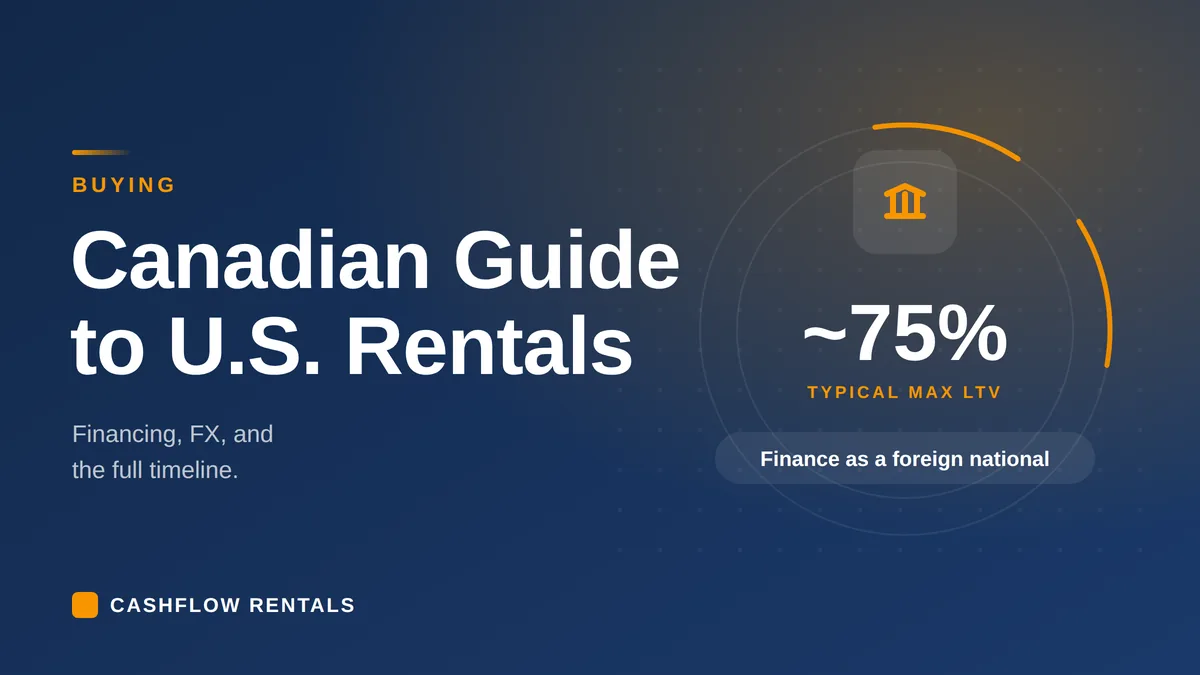
The full process for buying from Canada is in my Canadian guide to buying US rentals, and you can weigh the numbers on any property with the free tools in my foreign investor starter kit.
This article is general information, not legal, tax, or investment advice. Cashflow Rentals is a real estate consultancy, not a lender, broker, or tax adviser. Prices, rents, and rates are illustrative and current as of July 2026, and vary by market and over time. Always run your own numbers and consult qualified professionals before you invest.
The bottom line
Your Canadian rental probably doesn't cash flow because, at today's prices, big-city Canadian rentals mostly don't. The US Midwest offers a different reality: lower prices relative to rent, positive cash flow, and financing that grows with your portfolio instead of capping it. That is not a knock on Canada, it is just where the numbers are better right now for the specific job of earning rental income.
Remember, this is a game of probabilities. You are not looking for a guarantee, you are looking to put the odds of steady, growing cash flow firmly on your side.