The four buckets of cash
When buying a US rental property as a Canadian, your total cash requirement breaks down into four components.
1. Down payment. The largest single item. At 70% LTV, this is 30% of the purchase price. You can find higher LTV options, but I generally advise against it.
2. Closing costs. All the fees associated with completing the purchase and setting up the loan, and this one is usually a bit of a shocker for my Canadian clients. These are paid once at closing and include lender fees, title insurance, recording fees, and, importantly, your first year's insurance premium paid in full.
3. Reserves. Cash that must be sitting in your US bank account at closing to demonstrate you can cover the mortgage payments if the property has a vacancy period. The amount varies significantly by lender - from 3 months mortgage payments with some, to 12 months or more with others.
4. Currency conversion buffer. You are converting Canadian dollars to US dollars, and exchange rates move. Building in a small buffer of 2 to 3% above your calculated requirement protects you from an unfavorable rate move between when you budget and when you wire the funds. This might be especially releavnt right now due to the dismal performance of the Canadians Dollar.
Down payment
Most DSCR loans for foreign nationals require a minimum 30% down payment, meaning the lender finances 70% of the appraised value or purchase price, whichever is lower.
I mentioned above that I generally advise against higher LTV options. Here's why... Just this last week I got mortgage terms for one of my Canadian clients from 2 lenders. One was offering 70% LTV, the other 75%.
The lower LTV option beat the interest rate on the bigger loan by a full 1.25%. It also required only 3 months cash reserves, while the other lender wanted to see 12 months costs upfront at closing.
On a $185,000 property, 30% down is $55,500.
One thing to bear in mind is that the down payment is calculated on the appraised value, not the asking price. If the appraisal comes in below the agreed purchase price, the lender will base the loan on the appraised value. This is one reason why negotiating a price reduction when the appraisal comes in low, as we did for Ronald, makes a real difference to how much cash you need at closing.
Closing costs, what is included
Closing costs on a US property purchase typically run to around 5% of the purchase price when you include all loan-related and transactional fees.
On a $185,000 purchase, budget approximately $9,250.
The main components are:
- Loan origination fee: typically 1 to 1.5% of the loan amount
- Lender admin and legal fees: a fixed fee, typically around $2,000
- Appraisal fee: typically $600 to $700
- Title insurance and title fees: typically $2,500 to $3,000
- Government recording fees: typically $200
- Flood certification: typically $16
- Tax and insurance escrow: an initial deposit into the escrow account
- First year insurance premium: paid in full at closing (see below)
Some of these costs can be reduced through seller credits.
On a $185,000 purchase with a $5,000 seller credit, the net closing cost to the buyer drops significantly to around $4,250. That's mengingfully less cash required to purchase the exact same property, and why often negotiating a credit can be better than a straight price reduction.
The insurance prepaid trap
This is the item that surprises almost every Canadian buyer I work with.
In the US, your first year's landlord insurance premium is paid in full at closing. Not monthly. Not in arrears. The entire annual premium, upfront, on closing day.
On a typical US rental property, landlord insurance costs between $1,200 and $2,000 per year depending on the property, market, and insurer. That amount is due at closing in addition to everything else.
Ronald's first-year premium was $1,579. That is a material number, and it is one that does not appear on most online closing cost calculators.
The good news is that this is a one-time surprise. Your total mortgagepayment (PITIA) includes pro-rated monthly payments collected by your lender for property taxes and insurance, so your insurance premium next year is covered by this years mortgage payment.
Reserves, why lender choice matters
Reserves are the cash you must hold in your US bank account at closing to demonstrate financial stability. The lender wants to see that you can cover mortgage payments through a vacancy period without defaulting.
The reserve requirement varies significantly between lenders, and it has a major impact on your total cash requirement.
Many foreign national lenders require up to 12 months of mortgage payments in reserves. On a $185,000 property with a monthly payment of around $980, that is nearly $11,800 sitting in your account at closing, on top of your down payment and closing costs.
The lender I work with requires only 3 months of reserves. On the same property, that is around $2,940. That is a difference of nearly $9,000 in cash you need to have available on closing day.
This is one of the most significant practical advantages of working with the right lender. As I covered in my guide to DSCR loans for Canadians, the reserve requirement is one of the most underappreciated variables in the total cost of a purchase.
Currency conversion
You are buying in US dollars. Your savings are likely in Canadian dollars. The exchange rate between CAD and USD fluctuates daily, and a move of 2 to 3% between when you budget and when you wire the funds can meaningfully change how much you need to send. For a full walkthrough of the transfer process and what documentation you need, see my guide to moving money from Canada to the US to buy property.
A few practical points:
- Budget at a slightly unfavorable rate to give yourself a buffer
- Wire funds early enough that they clear before the closing deadline, as international wires typically take 1 to 3 business days
- Keep records of every transfer, as these will form part of your source of funds documentation for the lender
The Bank of Canada publishes daily exchange rates at bankofcanada.ca, which is a useful reference for budgeting purposes.
Why lower LTV can mean the same cash to close
This is counterintuitive, and it is worth understanding before you start comparing loan options.
Most people assume that borrowing more, a higher LTV, means putting less cash down and therefore needing less money at closing. That is often true for the down payment. But when you factor in the interest rate difference and the reserve requirement, a lower LTV loan can end up requiring almost the same total cash to close while costing you significantly less every month.
Here is a real example from a client purchase on a $250,000 property.
Two loan options on a $250,000 property (as of July 2026) | Option 1 (75% LTV) | Option 2 (70% LTV) |
|---|
| Down payment | $62,500 | $75,000 |
| Closing costs (3%) | $5,625 | $5,625 |
| Reserves required | 12 months (~$17,220) | 3 months (~$4,065) |
| Total cash to close | $85,345 | $84,690 |
| Interest rate | 7.25% | 6.75% |
| Monthly P&I payment | $1,280 | $1,135 |
| Monthly saving | | $145 per month |
Option 2 requires slightly less total cash to close and saves $145 every month for the life of the loan. That is $1,740 per year, every year, because the lower LTV attracted a better rate and required far fewer reserves.
The lesson: always compare the full picture, not just the down payment.
A worked example at three price points
Here is the total cash required at three typical purchase prices, using 70% LTV and our specialist lender's 3-month reserve requirement.
Total cash required at three purchase prices (70% LTV, 3-month reserves) | $150,000 property | $185,000 property | $250,000 property |
|---|
| Down payment (30%) | $45,000 | $55,500 | $75,000 |
| Closing costs (~5%) | $7,500 | $9,250 | $12,500 |
| Reserves (3 months) | ~$2,400 | ~$2,960 | ~$4,000 |
| Total cash required | ~$54,900 | ~$67,710 | ~$91,500 |
Closing costs include the first-year insurance premium. Figures are approximate and will vary by property, lender, and market. Seller credits, where negotiated, reduce the closing cost component.
What Ronald actually paid
One of my clients, Ronald from Ottawa, completed his first US rental property purchase in October 2025. Here is what he actually paid.
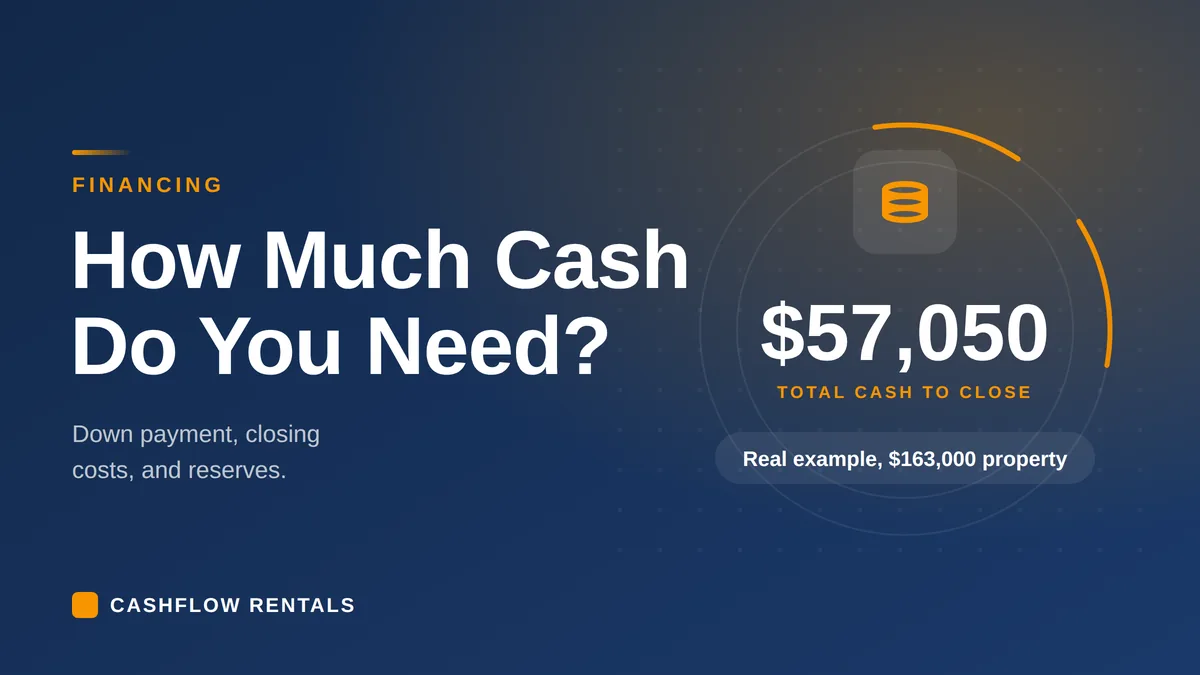
What Ronald paid to close on a $163,000 property (October 2025)| Item | Amount |
|---|
| Purchase price | $163,000 |
| Down payment (70% LTV) | $48,900 |
| Closing costs | $8,150 |
| Total cash to close | $57,050 |
Ronald's closing costs included his first year's insurance premium of $1,579 paid in full at closing. His reserve requirement was approximately $2,940 (3 months), which remained in his US bank account after closing rather than being paid out.
His property now generates approximately $541 net per month. On a $57,050 investment, that works out to an 11.4% cash-on-cash return in his first year.
For more on how the structure and tax side was handled, see my US tax guide for Canadian investors.
What you do not need
It is worth being clear about what is not required, because a lot of Canadian investors assume otherwise.
- No US credit score. The DSCR loan qualifies the property, not you personally.
- No Social Security number. Not required for a DSCR loan.
- No US income or employment history. The lender does not ask.
- No US address. You can own and finance US property while living in Canada.
- No visit to the US. The entire process including closing can be completed remotely.
What you do need is the cash, the correct entity structure, and an EIN. For a full walkthrough of the entity question, see my guide to LP vs LLC for Canadians.
Cashflow Rentals is a real estate consultancy, not a lender, mortgage broker, or tax adviser. The figures in this article are illustrative and based on typical market conditions as of July 2026. Actual costs will vary by property, lender, and market, so always obtain a full closing cost estimate from your lender before committing to a purchase.
Next step
If you would like to run the numbers on a specific purchase price and see exactly what the cash requirement would look like for your situation, book a call with me or my team and we can work through it together.
You can also download the Foreign Investor Starter Kit, which includes my complete guide to financing, entity setup, and the purchase process for foreign investors.