I have bought 120+ U.S. rental doors as a non-resident, and over the last few years I have helped dozens of Canadians do the same. The hurdles are always the same: buying the wrong property in the wrong market (cheap does not mean good), getting financing, structuring to avoid double taxation, and managing everything remotely. This guide distills what actually works, in plain English, from financing and moving money across the border to a step-by-step path from offer to close.
Buying

Canadian Guide to Buying U.S. Rentals
The practical playbook for Canadians buying U.S. rentals: your financing options, moving money across the border, a step-by-step timeline from offer to close, and the markets I'd shortlist.
David Garner · Co-Founder
Key takeaways
- Canadians can buy U.S. real estate freely, usually closing remotely.
- A foreign national DSCR loan is the simplest path for most turnkey rentals.
- Set up a U.S. bank account and a specialist FX provider early, and lock your rate.
- A financed purchase takes about 21 to 45 days end to end.
- Target renovated turnkey homes around $145,000 to $250,000 in solid neighborhoods.
Can Canadians buy U.S. property?
Yes. Canadians can buy and own U.S. real estate without a special visa, either in your personal name or through a U.S. entity (see my LLC vs LP guide for Canadian investors), and investment purchases close through a title and escrow company just like domestic deals.
Single-family homes, condos, 2 to 4 units, small multifamily, and even larger commercial assets are all on the table. Most Canadians close remotely, with KYC documents for the lender, notarized closing documents, and funds wired through an FX (foreign exchange) provider.
If you are weighing home against abroad, start with my comparison of US vs Canadian rental property.
Heads-up: non-residents are taxed on U.S. rental income and may face FIRPTA (Foreign Investment in Real Property Tax Act) withholding on sale. Your structure and tax elections matter, so read how Canadians should structure ownership and the U.S. tax guide before you buy.
Financing options
There are three main paths. If you are buying a turnkey rental, a DSCR (Debt Service Coverage Ratio) loan is usually the best fit. If you already have an ITIN (Individual Taxpayer Identification Number) and U.S. credit, an ITIN loan may price better. For a second home with strong salary and credit, a full-doc foreign national mortgage can win on rate.
| Loan type | Best for | How you qualify | Typical purchase LTV | Notes |
|---|---|---|---|---|
| DSCR (foreign national) | Turnkey rentals and leased assets | Property income vs PITIA; no U.S. W-2 required | ~70 to 75% | Rates above conventional; prepay step-downs common; simplest for most Canadians |
| Foreign national (full-doc) | Second homes; strong salaried borrowers | Personal income and assets, plus foreign or international credit | ~70 to 80% | Can price slightly better than DSCR; stricter overlays; prepay uncommon |
| ITIN loan | Canadians with a U.S. tax footprint | ITIN plus U.S. credit history and income/asset docs | ~70 to 85% | Can rival or beat DSCR with solid U.S. credit; confirm seasoning for cash-out |
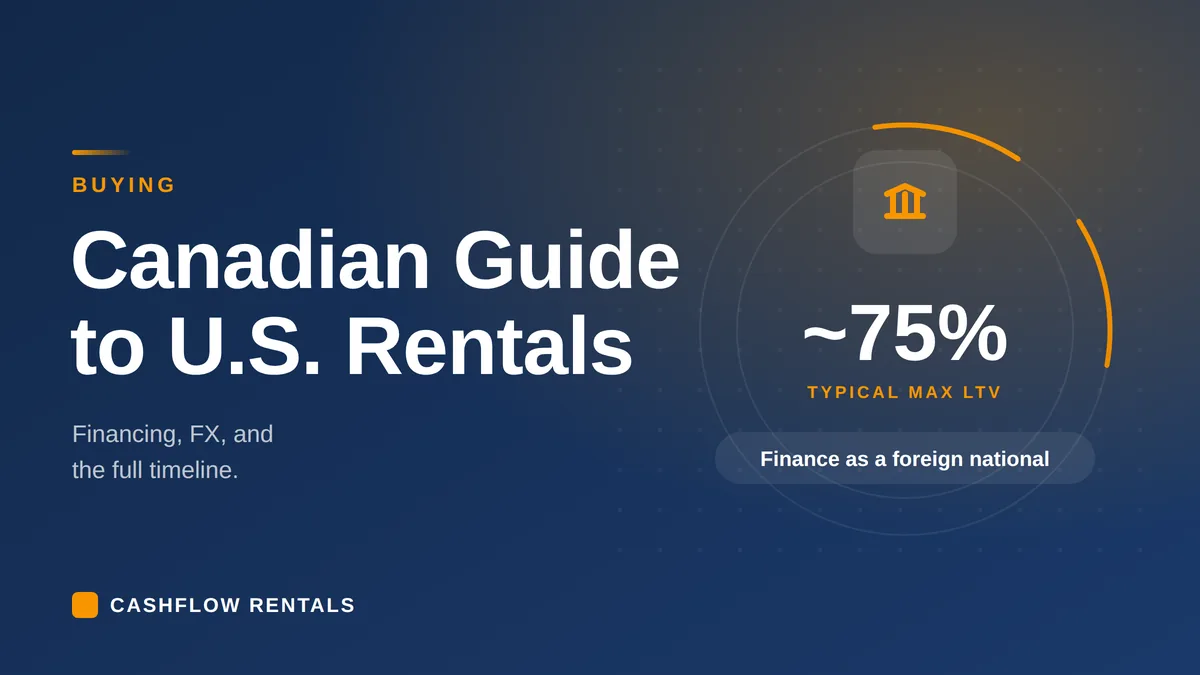
A few quick realities: your Canadian credit score is not used for DSCR approval, and no ITIN is required for it. Expect around 70% loan-to-value as a foreign national, a rate premium of roughly 0.25 to 1.00% over mainstream U.S. headlines, and aim for a loan of at least $100,000 for competitive pricing. A DSCR pre-approval is quick, needing only basic property details. Model scenarios in the DSCR calculator and check current ranges in the DSCR rates guide.
Banking and foreign exchange
Set up a U.S. bank account early (in your name or your U.S. entity's name, which needs an EIN), know your wire path, and control your FX costs. A specialist FX provider usually offers better rates, lower fees, and faster wires than a retail bank. The typical path is CAD to your FX provider (converted to USD) then on to your U.S. bank or directly to title and escrow. Always verify the payee name, routing, account number, and reference with escrow by phone before wiring.
| Step | What to expect | Tip |
|---|---|---|
| CAD to USD conversion | Spread over mid-market, often 0.3 to 1.5%+ | Compare providers, and ask for the spread, not just ‘no fee’ |
| Wire fees | $0 to $40 per wire | Batch funds; avoid multiple small wires |
| Timing | Same day to 2 business days | Send 2 days before the closing cut-off; confirm receipt with escrow |
| Compliance | Source-of-funds and beneficiary checks | Keep 90 to 120 days of statements and invoice trails ready |
FX matters more than you think: converting CAD 400,000 at a 1.3400 mid-market rate versus 1.3250 (about a 1.12% spread) changes your USD by roughly $4,500. Lock your rate once you sign the purchase contract, and if closing is 2 to 4 weeks out, a forward contract can fix today's rate for a future date. For a practical guide to transferring your funds from Canada, read my article on how to move money from Canada to the US to buy property.
The offer-to-close timeline
Plan on about 21 to 45 days for a financed purchase; cash can close faster. This is the path I use with Canadian clients.
- Entity and banking (in advance): get your EIN and open your U.S. bank account, and move CAD to USD early to season funds if the lender requires it. Do this before you go shopping.
- Pre-approval (days 0 to 3): get a DSCR or foreign national pre-approval, gather KYC and proof of funds, then underwrite the deal for cash flow.
- Offer and earnest money (days 1 to 3): if the numbers work, sign the contract and wire your earnest money to escrow (verify details by phone).
- Due diligence (days 2 to 5): title report, appraisal, insurance quotes, and an inspection plus sewer scope. See my due diligence checklist.
- Underwriting (days 2 to 20): submit the loan file; work with a broker experienced with foreign nationals.
- Insurance bind (days 10 to 20): choose a landlord policy and give the binder to your lender and escrow.
- Final figures (days 18 to 28): review the closing statement and arrange the final USD wire 1 to 2 business days before cut-off.
- Sign and close (days 21 to 35): remote e-notary or approved signing; escrow confirms funds and records title.
- Post-close (day 30+): file your beneficial ownership report if required, set up property management and utilities, and archive every statement and wire receipt for tax time.
Where to buy
Most Canadians come to the U.S. for affordability and better cash flow, and that is real, but I see a lot of people zeroing in on cheap property, which is usually a mistake. Cheap often means rough neighborhoods, financing trouble, and problem tenants.
I focus on a slightly higher price point that performs better long term. Target metros with a reasonable rent-to-price ratio, manageable taxes and insurance, predictable landlord law, and quiet suburban neighborhoods within a short commute of employment.
Two markets I know well are Cleveland (affordable, resilient renter demand, but block-by-block quality and tax reassessments to watch) and Kansas City (balanced yields and diversified employers). For the wider list, see the markets I like.
Keep it simple: most of my Canadian clients do best with fully renovated turnkey homes in the roughly $145,000 to $250,000 range in C-plus to B-class neighborhoods. That opens up better neighborhoods, steadier cash flow, fewer headaches, and the widest range of financing.
I hope you've found this artcile useful. If you'd like to learn more about buying, financing, and managing US rental properties from overseas, you can download our free foreign investor starter kit below.
Free Investor Resources
The Foreign Investor Starter Kit
Everything you'll ever need to buy and manage U.S. rental property from overseas safely and with confidence.
Open the Starter Kit
Free to browse. No jargon, no sales pitch.
Frequently asked questions
Do Canadians need a U.S. credit score or SSN to get a mortgage?
No Social Security Number is required for foreign national DSCR loans; lenders underwrite the property's income plus your KYC, source of funds, and reserves. If you have an ITIN (Individual Taxpayer Identification Number) and U.S. credit history, ITIN loans can price more competitively.
What loan-to-value is typical for Canadians buying rentals?
For a foreign national DSCR loan, purchases usually cap around 70 to 75% loan-to-value, while a cash-out refinance is typically lower, around 65 to 70%, and may require seasoning. Full-doc foreign national and ITIN programs can reach similar or slightly higher bands depending on your profile.
Can I buy U.S. property in a Canadian corporation or a U.S. LLC?
You can, and many investors use a U.S. entity for title and lending simplicity, but the right structure depends on your tax plan and the Canada-U.S. treaty. For Canadians, a U.S. limited partnership usually beats a plain LLC. Speak with a cross-border CPA first, and see my guide on how Canadians should structure ownership.
How long does a financed purchase take to close?
Plan on roughly 21 to 45 days for a financed transaction, while cash can be much faster. Line up your U.S. entity and bank account early, and keep 90 to 120 days of source-of-funds statements ready to avoid underwriting delays.
What taxes should Canadians expect on U.S. rentals?
You file a U.S. non-resident return on your rental income and then reconcile it in Canada under the treaty, using foreign tax credits. On sale, FIRPTA withholding may apply. Your entity choice and treaty elections matter, so plan them before you buy.
Are short-term rentals feasible for non-residents?
Yes, in markets that permit them, but the rules are local and can change. Lenders may require a short-term rental addendum, booking history, or an appraisal to market rent, so always confirm licensing and any HOA rules before you commit.
Can I refinance later to pull out equity?
Yes. A DSCR cash-out refinance is common once the property is stabilized, though expect lower loan-to-value caps than a purchase and possible seasoning requirements. A strong DSCR and clean documentation help you maximize the proceeds.
Written by
David Garner
David is co-founder of Cashflow Rentals and a British investor who has personally purchased more than 120 U.S. rental properties as a foreign national since 2016. He helps overseas investors build U.S. rental portfolios remotely, from his base in Brazil.