Why most best-market lists are wrong
Most guru top lists follow the same over-simplified formula: a few cities, some population data, a cap rate, a cash flow projection, and a declaration that Market X beats Market Y. I'm sure you've seen the exact thing I'm talking about.
But any truly experienced investor will tell you thatreal estate just doesn't work like that. These lists over-prioritize cash flow and treat all cash flow as equal. In the real world it is not. A property showing $500 a month on paper in a rough neighborhood, with constant vacancy, evictions, and turnover, is not the same investment as one showing $250 a month that actually reaches your bank account, in a stable neighborhood with long-term tenants.
When I scaled to more than 120 US rental properties, the ones that looked best on paper tunred out to be some of the worst I ever owned, while the the ones that looked far more modeat on paper quietly delivered year after year.
So before I look at yields or cap rates, I ask a different question: can ordinary people afford to rent and buy homes here? In my experience, housing affordability sits at the heart of almost every successful long-term rental market.
For up to date numbers of which foreigners are buying and where, you can read my analysis of the 2026 NAR foreign buyer data.
What I look for in a market
In my experience, the 'best' markets share a set of characteristics, but one thing underpins them all: the city or metro level data matters far less than what's going on in neighborhood and on the street.
Buying on a bad street in a good city is still buying in a bad spot. You see this in almost all the cheaper secondary city markets where folk typically buy rental properties. Places like Cleveland and Detroit, where the metro numbers look great but the variation block to block and street to street is staggering.
What I look for in a market| Factor | Why it matters |
|---|
| Housing affordability | If locals can afford to rent and buy, the market stays stable |
| Economic diversity | Multiple industries mean jobs, and rent, survive one employer leaving |
| Population stability | Neighborhood-level trends matter far more than metro headlines |
| Neighborhood quality | It determines your tenant pool: buy the dirt first, then the box |
| Rent-to-price ratio | The numbers must work, but a very high cap rate signals higher risk |
A word on each...
Affordability is about whether local people can afford rents and mortgages on local incomes; where they can, you get stable values, steady demand, and fewer corrections.
Economic diversity (healthcare, logistics, manufacturing, education, government) makes a market resilient when one employer leaves.
Population should be read at the neighborhood level, not the metro: Cuyahoga County's population declined for decades while values and rents rose.
Neighborhood quality determines your tenants, as a mentor of mine puts it, buy the dirt first, then look at the box, because you can renovate a house but not the street it sits on. And on the numbers, a high cap rate is really a measure of risk, not just return.
The highest cash-flowing properties frequently come with the highest operational risk. An $80,000 house is $80,000 for a reason, and you have to ask whether that reason creates risk you are willing to accept.
Real estate is not just local, it is hyper-local. I own a five-bedroom rental on Prospect Avenue in Kansas City that performs extremely well on an improving block, but travel a few minutes either way and you hit blocks still struggling with vacancy and neglect. Same city, same street name, completely different outcome.
Why I focus on the Midwest
I focus much of my activity on the Midwest not mainly because it is cheap, but because it scores well across almost every criterion above: strong affordability, diversified and stable jobs, inward migration, and neighborhoods benefiting from ongoing investment, all while still offering properties that generate meaningful cash flow without excessive risk. While Florida, Texas, Arizona, and parts of California boomed then corrected as prices outran incomes, most Midwestern markets grew slowly and steadily. Boring, maybe, but predictable.
A quick real example: I recently helped a Canadian investor buy a fully renovated four-bedroom, two-bathroom home in Kansas City for $163,000. It rents for about $1,700 a month and produces roughly $500 to $600 in free cash flow after financing, expenses, and reserves. That combination of affordability, cash flow, and renovation quality is very hard to find in coastal markets today. Here is how my three featured markets compare.
My three featured markets at a glance| Market | Typical renovated price | Typical rent | Character |
|---|
| Kansas City, MO | $150k to $250k (4-bed) | $1,500 to $2,500 | Stability and a strong local team; street by street |
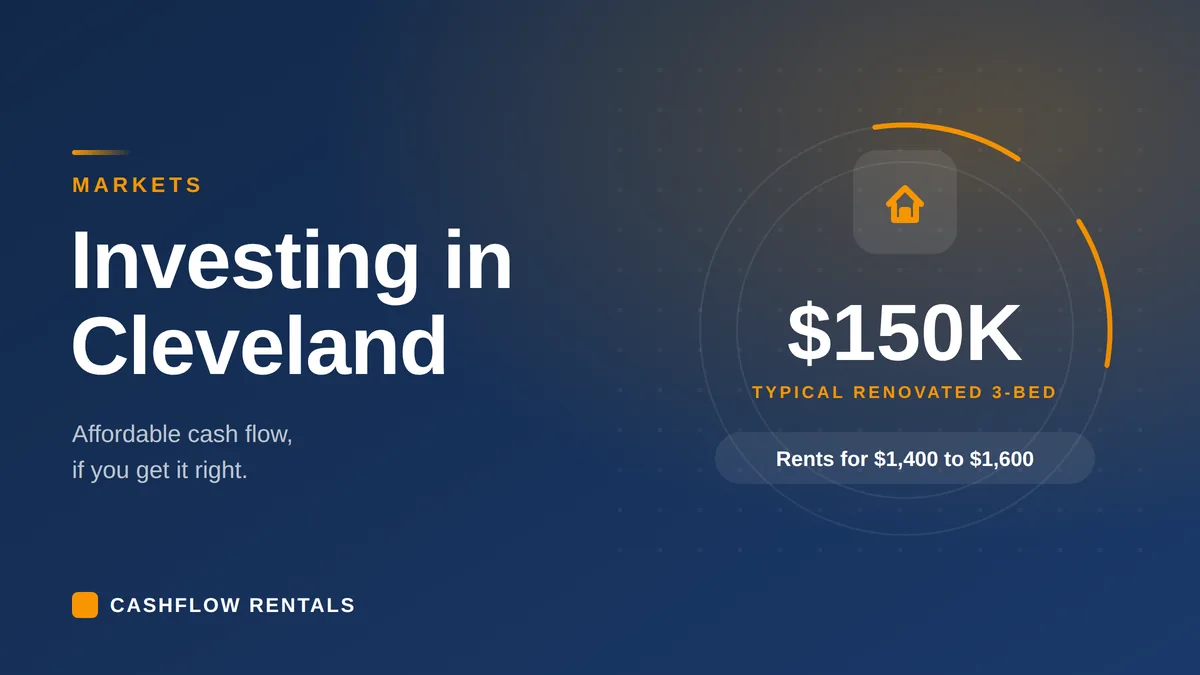
| Cleveland, OH | around $150k (3-bed) | $1,400 to $1,600 | Strong yields; west side only; watch old systems and taxes |
| Baltimore, MD | $150k to $160k (3-bed row) | $1,500 to $1,700 | Wild card; durable brick; revitalizing; very neighborhood-sensitive |
Kansas City, Missouri
If one market best reflects my philosophy, it is Kansas City. I own multiple properties there and have helped many foreign investors buy, but the biggest reason I like it has less to do with the city than the people: as a foreign investor you rely on others for everything, so I would rather invest in a 7/10 market with a 10/10 team than a 10/10 market with a 5/10 team. My Kansas City team is excellent.
The fundamentals fit too: affordable housing, diverse and stable employment, healthcare investment, steady population, and fully renovated four-bedroom homes around $150,000 to $250,000 renting for $1,500 to $2,500, attracting ordinary working families who stay. It is still a street-by-street market, but
I go deep on one of my favorite Midwest markets in my guide to investing in Kansas City real estate.
Cleveland, Ohio
Cleveland has quietly been one of the best-performing rental markets of the last decade: steady appreciation, strong demand, excellent rent-to-price ratios, and superb affordability. You can still buy a renovated three-bedroom in many neighborhoods around $150,000 and rent it for $1,400 to $1,600. I recently helped a German client buy his first Cleveland rental, a three-bed in Detroit Shoreway, for $150,000 against a $160,000 appraisal, rented at $1,500.
But Cleveland is a tale of two cities. The west side generally offers better neighborhoods, lower vacancy, and a more stable tenant base; the east side is where you find the cheap properties, and also the crime, deterioration, and problem tenants that make those cheap numbers a trap. The housing stock is also old, often built between the 1890s and 1950s, so a full systems update (roof, furnace, HVAC, sewer line, electrics, plumbing) can run upwards of $60,000. On a $100,000 house you would need to buy under $40,000 just to break even, which is why I prefer properties where the major systems are already done. Finally, watch the property tax reassessment: a sale can lift taxes enough to wipe out projected cash flow, so underwrite future taxes, not current ones. Get the neighborhood and systems right, and Cleveland is a great long-term market, and foreign national DSCR loans work well there.
Baltimore, Maryland (my wild card)
If Kansas City is stability and Cleveland is opportunity, Baltimore is my wild card. I do not own there yet, but I know experienced investors who do, and I am seriously considering it. It is probably the most neighborhood-sensitive market I have ever looked at: get the location wrong and you create real problems, get it right and the upside can be significant. After decades of high crime, vacancy, and disinvestment, the last several years have brought meaningful change, with local government, private investors, and community groups renovating vacant homes and reviving neighborhoods, one organization reportedly cutting vacancy by more than 90% in several areas.
What makes Baltimore interesting is the durable brick row homes, which need far less maintenance than wood-framed houses, plus attractive pricing: renovated three-bed row homes around $150,000 to $160,000 renting for $1,500 to $1,700. The real opportunity, though, may be that some improving neighborhoods are still early in their transformation. A caution: Baltimore became a favorite hunting ground for some overseas sellers pushing the cheapest, worst-located, often pre-renovation properties, where the renovation budget sometimes simply vanished. So do thorough due diligence on the seller, neighborhood, and property.
I never claim any of these is the single best market, because I do not think one exists. What matters is understanding the risks and neighborhoods, building a reliable team, and buying quality assets. If you want help doing that, you can book a call, or read my full investment strategy and the buying guide.