The 30-second version
There is a type of U.S. mortgage I've personally used to purchase 120+ rental properties in the U.S. as a foreigner with no personal income or credit.
Most of my Canadian clients also use this type of financing to purchase their own rental properties in the U.S.
It's called a DSCR loan, and it works differently from any mortgage you have used in Canada.
Instead of verifying your salary, tax returns, and credit score, the lender looks at one thing: does the property generate enough rent to cover the mortgage payment? If it does, you qualify. Where you live and where you earn your money are not relevant.
The main practical requirements to getting approved for a DSCR loan as a foreigner or non-resident are a US legal entity to hold the property (usually an LLC or LP), a US bank account and federal tax identification number (EIN) for the entity, and documented evidence of where your down payment came from.
One thing I can tell you, that last point catches people out more than anything else, so I'll come back to it.
Why this works for Canadians
Most of the Canadian investors I speak to face a couple of specific problems at home when it comes to financing their real estate investments.
The first is obvious: it's hard to find good deals that cash flow.
But outside of that, it's the financing constraints that I hear about most of all.
The major banks measure your total debt-to-income ratio and impose a ceiling on how much you can borrow across your entire portfolio.
Once you reach that ceiling, which is typically somewhere between your third and fifth property, you cannot qualify for another mortgage, regardless of how well your existing properties perform.
DSCR loans in the US work on a completely different logic.
Each property qualifies independently, based on its own rental income. The lender is not interested in your other debts, your other properties, or your personal income. This means there is no ceiling. As long as each property you buy generates enough rent to service its own mortgage, you can keep building your portfolio.
One of my clients, Ronald, who lives in Ottawa, ran into exactly this wall in Canada.
His rental condo there was cash-flow neutral, even occasionally requiring a top-up from his own pocket, and he had effectively hit the limit of what Canadian lenders would give him.
The first rental property we helped him buy in the U.S. Midwest was financed with a foreign national DSCR loan at 70% of value and now generates around $541 USD net per month. No top-ups required.
Ronald's Kansas City purchase, and how he negotiated the price down after the appraisal, is also covered in my Kansas City real estate guide.
What DSCR actually means
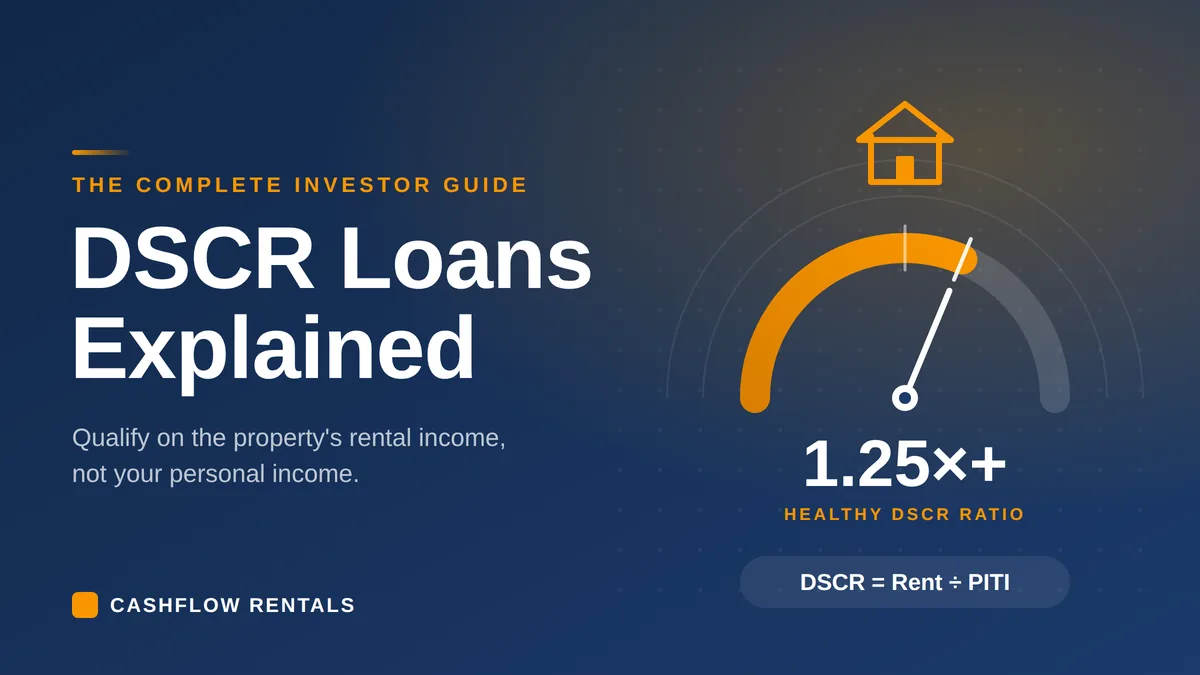
DSCR stands for Debt Service Coverage Ratio. The calculation is simple:
Monthly rent / Monthly loan payment = DSCR
If the property rents for $1,500 a month and the total monthly payment (including principal, interest, property taxes, insurance, and any HOA fees) is $1,200, the DSCR is 1.25. The rent covers the payment with room to spare.
A ratio of 1.0 means the rent exactly covers the costs. Most lenders want to see 1.0 or above. The higher the ratio, the better the terms you will receive. A stronger DSCR means a lower interest rate, better loan-to-value terms, and lower upfront fees.
This is one reason property selection matters so much.
A well-renovated property in a good neighborhood commands higher rent than a poorly maintained one, which produces a higher DSCR ratio, which produces better financing terms.
The quality of the investment and the quality of the financing are directly connected.
Can you get a DSCR loan in Canada?
This question comes up constantly, and it means two different things depending on who is asking. Both answers are worth knowing.
Can a Canadian get a DSCR loan? Yes. That is what this entire article is about. Your Canadian residency is not an obstacle, because the lender is underwriting the US property's rental income rather than you. No US credit file, no US income, no social security number. Canadians are one of the largest groups of foreign buyers using these loans.
Can you get a DSCR loan on a property located in Canada? No. US DSCR lenders lend against US real estate, full stop. The loan is secured by the property, and a US lender is not going to take a lien on a house in Ontario. If you want to buy a rental in Canada, you are looking at a Canadian lender and a Canadian rental or commercial mortgage, which is a different product with different rules, and one where your personal income and debt service ratios come straight back into the picture.
That second point is the whole reason so many Canadian investors end up looking south. It is not that Canada lacks financing. It is that Canadian financing qualifies you, so it stops when your ratios fill up, while a US DSCR loan qualifies the property and keeps going.
You can use my free DSCR loan calculator to check the DSCR for any rental property. I built it to underwrite my own deals, and it's free to use on my website.
What you will actually need
A US legal entity
Most DSCR lenders require the property to be held through a US legal entity. Typically, that will be a Limited Liability Company (LLC) or a Limited Partnership (LP).
For Canadians specifically, the structure you choose matters more than people realize. I'll cover this in a moment.
An EIN
Your entity needs a federal tax identification number before a lender can begin underwriting your loan.
One thing to bear in mind that I see trip up lots of Canadian buyers is that the IRS only accepts EIN applications by post or fax for foreign-owned entities, which typically takes six to eight weeks.
If you are already under contract when you apply, that timeline can cost you your earnest money deposit and the deal. Getting your EIN in advance, through professionals who can obtain it in 24 hours, eliminates this problem entirely.
You can learn more about setting up the right kind of entity in my guide that's free in my Foreign Investor Starter Kit.
A US bank account
The lender will require your down payment and cash reserves to be held in a US account at closing.
Reserve requirements vary between lenders, but you should typically budget for 3 to 6 months of mortgage payments. I have seen some lenders require up to twelve months, which adds significantly to the capital you need to have available. The lender I work with generally requires three months.
Source of funds documentation
This is where most financing delays happen. Lenders are required by anti-money-laundering regulations to verify where your down payment came from.
If the funds came from savings, you will need bank statements showing those savings building up over time. If they came from a remortgage in Canada like many of my clients, you will need to provide the loan documents. If the funds passed through multiple accounts, which is common for some investors, the lender will need a paper trail tracing every significant movement back to its original source.
Ronald's first purchase went smoothly, but the source of funds review still took time. He had funds coming from more than one source, which required letters and documentation for each. His advice: start gathering this paperwork early, well before you are under contract.
For a full guide to moving funds from Canada to the US and what documentation you need, read my guide to how to move money from Canada to the US to buy property.
The Canadian entity question
Most online advice about US real estate investing, including from many accountants, recommends setting up an LLC in the U.S.
While for most foreign investors, an LLC works perfectly well, for Canadians it introduces a complication worth understanding.
I've gone through this process many times with dozens of Canadian investors, and I've seen what it looks like at the back end when it comes to filing taxes.
Here's what you need to know.
The IRS treats a single-member LLC as a disregarded entity. In its view, it does not exist. You, the person, earn the income directly.
The Canada Revenue Agency disagrees. It treats a US LLC as a corporate entity. In their view, the LLC earns the income, not you.
This mismatch has consequences.
When you come to file your Canadian tax return, the CRA may deny your foreign tax credit claim on the grounds that the LLC paid the US tax, not you personally.
To claim your deductions correctly in Canada, your accountant will need to rebuild your income accounting at the entity level, adding cost and complexity to your annual filing.
So while the common misconception that using an LLC will create some form of double taxation for Canadians isn't quite correct, it does add a layer of cost and complexity that is altogether unnecessary.
So, what's the answer?
A Limited Partnership (LP) avoids this entirely.
Both the IRS and the CRA treat an LP as pass-through. Both countries agree that you, the individual, earn the income. This alignment makes filing straightforward, allows foreign tax credits to be claimed properly, and keeps your annual accounting costs lower.
This is why when I'm working with a new Canadian investor, more often than not we set them up with an LP rather than an LLC. I explain exactly why in my guide to LP vs LLC for Canadians.
Structure can also impact what happens to the property on death, which I cover in my guide to whether Canadians pay US estate tax on a US rental property.
As I mentioned, I've been doing this long enough to see this play out. Keeping to the example of Ronald from Ottawa, we just helped him file both his US and Canadian taxes, both of which came in at zero due to the fact we could maximize the benefits of tax codes in both jurisdictions efficiently.
You can read more in my US tax guide for foreign investors.
What the loan actually costs
Most foreigners think that the interest rate they'll pay as a non-resident will be prohibitively high. In reality, you'd probably be pleasantly surprised.
Interest rates for foreign nationals have come much closer to parity with US borrowers over the past few years.
When I started buying US rentals as a foreigner back in 2016, I was paying around 7%, while US mortgage rates in general were about 4%.
As of July 2026, we are seeing our Canadian and other overseas clients get pre-approved at around 6.75%, while general US rates are around 6.5%.
That's a significant compression of the spread and makes US rental properties even more attractive to overseas buyers looking for better opportunities than their local market is delivering.
If you want to see live rates, check out my foreign national mortgage rates page which is updated with live rates weekly.
One thing I should mention that tends to surprise my Canadian clients is closing costs.
Closing costs in the US typically run to around 5% of the purchase price when you include loan origination fees, title insurance, recording fees, and related items.
Another thing worth noting on costs, borrowing more, i.e. a higher loan to value, isn't always the best approach.
We recently compared two loan options on a $250,000 property for a client.
Two real loan options on a $250,000 property (July 2026)| Loan detail | Option 1 | Option 2 |
|---|
| Loan-to-value | 75% | 70% |
| Interest rate | 7.25% | 6.75% |
| Cash reserves required | 12 months | 3 months |
| Monthly payment | Higher | $145 per month lower |
| Cash needed to close | About the same | About the same, within $600 |
The total cash required to close was almost identical, within $600 of each other, but option two saved $145 per month on the mortgage payment.
Lower LTV, less debt, more equity, lower rate, lower reserves, same cash outlay, better cash flow.
What can go wrong
So far I've made it sound easy, but there are a few things to consider to make sure your loan gets through to final approval.
Forming the wrong entity
Setting up an LLC when an LP would serve you better is an easy mistake to make, and an expensive one to correct later. Get the structure right before you buy anything.
Where you set your entity up can also have an impact.
You will find plenty of online articles recommending Wyoming or Delaware LLCs for their privacy and low fees.
For foreign nationals buying in a specific US state, forming your entity in a different state typically creates an additional layer of cost: a registered agent fee and an annual filing in both states, plus lenders who may require the entity to be registered in the state where the property sits.
My advice? Form your entity where the property is located.
Underestimating how long source of funds takes
The most common cause of delays in the financing process is not income checks or credit checks, neither of which apply to a DSCR loan for non-residents. In my experience the delays tend to come from documenting where your money came from.
If you have been actively trading equities, moving money between accounts, or received remortgage proceeds in recent months, start documenting that history now so you can provide your lender with a verified paper trail.
Overestimating the property's value and rents
Your lender will get an appraisal covering both the property value and market rents.
Appraisals regularly come in below the agreed purchase price, and even if your property is rented for $2,000/mo, if the appraisal shows market rents of $1,800, the lender will use the lower figure which could affect the final mortgage terms, or even whether the property qualifies at all.
If the value comes in lower, the lender revises the loan amount downward. You then have two choices: renegotiate the price with the seller, or make up the difference from your own pocket.
Researching comparable sales carefully before making an offer protects you from this.
Ronald's first property was contracted at $179,000. The appraisal came in at $163,000. We used that to renegotiate the purchase price down by $16,000 before he owned a single day of it.
My view
If you want to build a profitable rental property portfolio in the USA from Canada, the loan is not the hardest part of this process.
In my experience, the more important question is whether the property, the financing, the management costs, the insurance, and the ownership structure work together as one viable investment.
A DSCR loan is an excellent tool. But a DSCR loan on the wrong property in the wrong neighborhood is still the wrong investment. I have been on the wrong side of that trade myself, at scale, and it is not somewhere you want to go.
This is not a perfect science. You can still have a difficult experience with a property that looks right on paper. But getting the fundamentals right, quality property, quality neighborhood, correct structure, right lender, that all shifts the odds significantly in your favor.
Remember, investing isn't about certainties, it's a game of probabilities. The decisions we make should be focused on increasing the probability of our long-term success and reducing the probability of things going terribly wrong.
This article is general information, not legal, tax, or lending advice. Cashflow Rentals is a real estate consultancy, not a lender, mortgage broker, or tax adviser. Loan terms and tax treatment depend on your individual circumstances, so always consult a licensed lender and a qualified cross-border CPA before you invest.
Next step
If you would like to understand what this would look like for your specific situation, how much you would need to put in, what the monthly numbers would look like, and how the Canadian tax side would be handled, you can book a call with me or my team and we'll be happy to give you some personalized advice on how to proceed.
You can also download our Foreign Investor Starter Kit, which includes a complete guide to US financing for foreign investors and a separate guide to setting up your US legal entity and banking.