What did this house cost, and what did it sell for?
The Jackson County sales record shows five transactions on this parcel. Two of them matter.
The recorded sale history| Date | Instrument | Price |
|---|
| 15 Jan 2003 | Transfer | $0 |
| 15 Jun 2016 | Quit claim deed | $5,000 |
| 31 Jan 2025 | Quit claim deed | No price recorded |
| 4 Feb 2025 | Warranty deed | $30,000 |
| 28 Oct 2025 | Warranty deed | $163,000 |
So the seller bought it on 4 February 2025 for $30,000, four days after a quit claim deed on the same parcel for which no price is recorded.
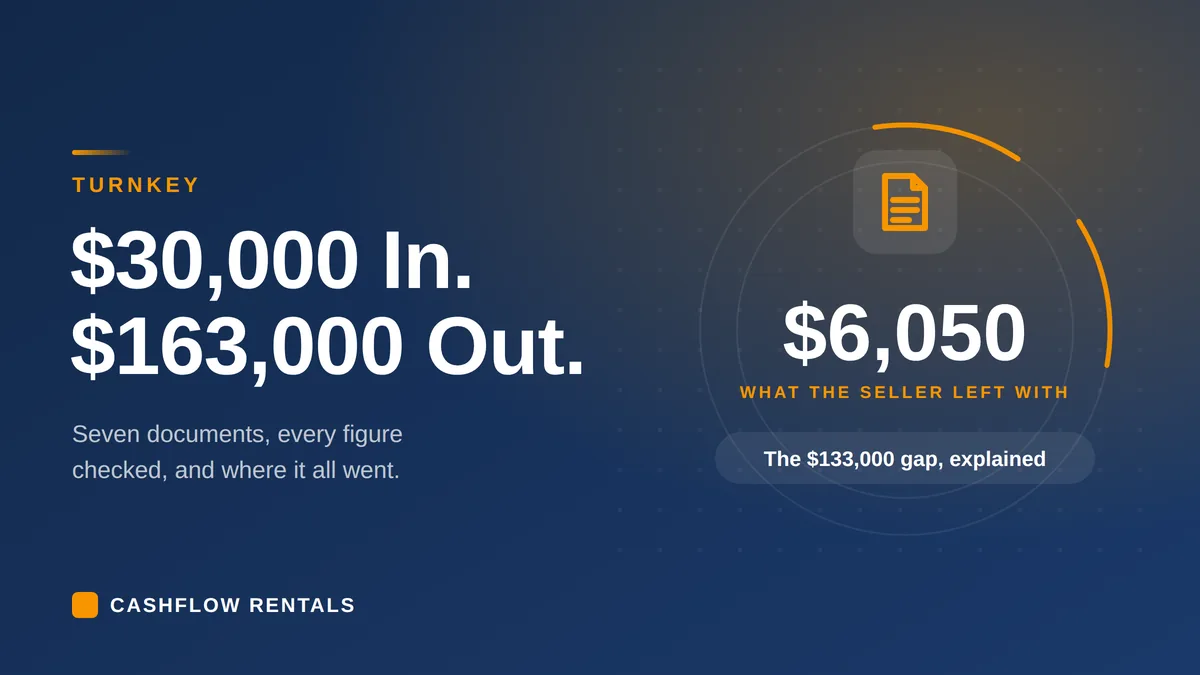
He sold it on 28 October 2025 for $163,000. That is 266 days, and a gross uplift of $133,000, or 443% of what he paid. That sounds like a lot, but we're going to break it down so you can see the reality.
All five transactions are flagged in the county record with a validity code of NV, invalid. For the quit claims and the $0 transfer that is what you would expect. For an arm's length sale on a warranty deed it is not obvious, and we have not established why, so I am reporting it rather than explaining it.
Where did the $133,000 go?
Most of it went to the renovation, the contractor's debt servicing, and the fees.
The cost of the work is the one figure here we cannot measure. It is the seller's, and he has not published it. Based on what I know, and the evidence I have in the form of in-progress mid-construction walkthrough videos of the work being done, I put it in a band of $60,000 to $90,000.
One measured figure does put some pressure on the bottom of that range. The bridge loan paid off at closing had a principal balance of $139,472.47 against a house originally bought for $30,000. The statement shows $138,519.70 actually leaving the table, which is that principal less a $952.77 interest credit. I do not have the loan's draw history, so I cannot say that the $109,472 difference was all spent on this renovation.
If the bridge debt relates only to this project, a $60,000 renovation would leave a very large amount to explain through finance, holding and other project costs over 8.7 months. That is one reason I think the true renovation cost was nearer the top of my $60,000 to $90,000 range. In this case the house was a full gut renovation, so I use $90,000 as the contractor's estimated in-house cost, not retail pricing. It remains an estimate.
The cost stack, with the work at the top of its band | Amount |
|---|
| Purchase price, 4 Feb 2025 | $30,000 |
| The work, estimated | $90,000 |
| Fees, two at $8,150 | $16,300 |
| Seller's closing costs | $2,130 |
| Total, estimated | $138,430 |
| Sold at | $163,000 |
| Estimated remainder before other costs | $24,570 |
On those figures, the $24,570 remainder is 15.1% of the sale price and 17.7% of the estimated cost stack shown above. It is not a measured profit figure because I do not have the contractor's complete project accounts.
Here is the seller's side of the settlement statement, and every number in it is documented.
What the seller actually received at the closing table | Amount |
|---|
| Sale price | $163,000.00 |
| Bridge loan payoff | ($138,519.70) |
| Fees, two at $8,150 | ($16,300.00) |
| Seller's closing costs and tax proration | ($2,130.09) |
| Cash to the seller | $6,050.21 |
A house bought for $30,000 sold for $163,000, and the man who did the work walked away from the table with $6,050 in cash.
Both of those sentences are true, and reading only one of them gets you the wrong answer.
The $6,050 is cash at closing, not profit. He may have taken draws as he went, or put his own cash in, and we cannot see either. But the documents and estimated renovation cost point to most of that $133,000 being absorbed by the work, financing, transaction costs and fees rather than becoming seller profit.
The gap between what a seller pays and what you pay is not the same thing as his profit. It can include the renovation, financing, holding costs, transaction costs and other people's fees before you get anywhere near what the seller actually made.
I've seen turnkey property sales where the contractor made tens of thousands of dollars. I've also seen sales where the seller lost money. That can happen when costs or timeline overrun, or appraisals and rents don't meet expectations. That's their risk, and one of the reasons turnkey works for buyers that don't want to take it on themselves.
How were these figures assembled?
Seven documents, all relating to a single property, listed here with their dates so the reader can see how current each one is.
- The Jackson County sales and assessment record, retrieved August 2026. Source of the sale history, the recorded prices, the parcel's county valuation and the validity codes.
- The ALTA combined settlement statement, file 2509002, settlement date 28 October 2025. Source of every closing figure on both sides.
- The appraisal, effective 10 September 2025, prepared for the lender by a Missouri certified appraiser. Source of the valuation, the comparables, the condition and quality ratings, the room count and the market rent opinion.
- The mortgage term sheet, dated 18 September 2025. Source of the quoted rate, fees, prepayment structure and quoted monthly payment.
- The first inspection report, 8 September 2025, ordered by the buyer's side. Source of the deficiency list.
- The second inspection report, 16 October 2025, same inspector. Source of the correction record.
- The insurance and tax escrow figures on the settlement statement, cross-checked against the appraisal's tax entry.
Every figure below is drawn from one of those seven, with one exception. The renovation band rests on the mid-construction walkthrough videos described above rather than on a document, and it is the only estimate in the article.
Where two documents disagree, both readings are given. No figure has been adjusted, rounded for effect, or carried across from a different property.
One thing we did not do. We have not asked the seller, the appraiser, the lender or the title company to comment on any of this. That is a real limitation and it is listed again at the end.
What did the appraisal do to the price?
It cut it.
The property was first under contract for $174,000 on 28 August 2025, which is the figure in the appraiser's contract analysis. The same report's summary page and comparables grid show $179,000.
The opinion of market value came in at $163,000, and the sale closed on 28 October at exactly $163,000. Not a dollar more. Depending on which contract price is right, that is a reduction of 6.3% or 8.9%.
That's a big part of what I do day to day. It's my job to plan with the buyer, and go back to the seller where that is fair. My buyers didn't have to have that awkward conversation. That's my job.
The DSCR loan my buyer used for the purchase followed the value rather than the contract. At 70% of $163,000 the loan was $114,100, so the buyer's down payment before closing costs was $48,900.
Two further things the appraisal says are worth recording.
It rates the condition C3, and takes a $15,000 downward adjustment against a comparable rated C2 that sold for $195,000 0.16 miles away.
The property had been renovated back to the studs. I am not qualified to overturn the appraiser's C3 rating and I am not attempting to. I am noting that the rating carried a $15,000 adjustment on a valuation that landed $11,000 to $16,000 under contract.
And it states that "the subject property has not sold during the past 36 months."
It had. It sold on 4 Feb 2025 for $30,000, on a warranty deed, seven months before the appraisal was written, with a quit claim deed on the same parcel four days before that. The appraisal gives its data sources as Heartland MLS and county records, effective 16 September 2025. Prior sale history is a required field on the form. I have verified the February sale against the county record and it is there.
I am not suggesting this was done on purpose, and it may have changed nothing. But a $30,000 purchase under seven months before a $174,000 contract is worth knowing about for the reasons noted above, and the report did not surface it.
Why did the lender's quote understate the monthly payment?
Because two of the numbers it used ended up a lot different at closing, and both differences pushed the payment higher.
The term sheet against the closing and the county record| Line | Quoted, 18 Sep 2025 | Closing or updated figure | Gap |
|---|
| Interest rate | 7.000% | 7.125% | +0.125 |
| Annual insurance | $1,104 | $1,589.76 | +$486 |
| Annual property tax | $480 | $467 for 2024, and rising | see below |
| Rental status | Not leased | Tenant in place | wrong |
| Monthly payment, PITIA | $891.12 | about $1,034 (stress test) | +16% |
The rate moved an eighth of a point between quote and closing. That isn't the part that concerns me.
The insurance difference matters more.
The escrow set up at closing collects $132.48 a month, which is $1,589.76 a year. The term sheet used $1,104, so it was 31% low on a cost that runs for the whole life of the loan.
The tax line needs its own section, below.
Put the closing rate and insurance into the calculation, then substitute my estimated $1,516 tax bill, and the modeled monthly payment rises to about $1,034 rather than $891. That is $143 a month, or 16%, and $1,716 a year. The $1,034 is a stress-tested figure, not the payment actually collected at closing.
This is a lender's own quote, not a seller's pro forma. It also records the property as not leased, when a tenant was living there and an inspection ten days earlier recorded the house as occupied and furnished.
What is the property tax actually going to be?
I think it is likely to be higher, but the documents do not tell us the final reassessed bill.
The tax escrowed at closing is $38.95 a month, which is $467.40 a year. The appraisal records the 2024 bill as $467 against a 2024 tax year. Those agree.
That $467 is calculated on the county's own valuation of the parcel, which the sales record shows as a total appraised value of $50,210.
The house then sold for $163,000. The house sold for 3.25 times the county's valuation.
If I simply scale the existing $467 bill in proportion to the difference between the county's $50,210 valuation and the $163,000 sale price, I get about $1,516. I use that as a stress-test figure, not a forecast of what Jackson County will actually assess.
There are three reasons to treat that number as an indication rather than a forecast.
Missouri sets new assessed values as of January first of each odd numbered year, so the timing is not immediate. A sale price is evidence of value but it does not automatically become the assessed value. And Jackson County's assessment process has been the subject of legal challenge, including a Missouri Court of Appeals decision on December 30, 2025, which makes this particular county less predictable than most.
What the documents do establish is that the tax figure in the term sheet, the tax figure in the escrow and the tax figure in the appraisal all come from the pre-renovation valuation. The house has since been renovated and sold at 3.25 times the county's recorded valuation.
Every document in this purchase was still using a tax figure based on the pre-renovation county valuation. We have written separately about why the property tax figure on a listing may be the previous owner's bill rather than yours.
The cash flow on this deal still works with the reassessed estimate. But we know that because we worked it out ahead of time and stress tested the cash flow against a reassessment. That's real work, and doing it can save you from owning a rental property that actually costs you money rather than makes you money.
How many parties were paid on this sale?
There were two fees of $8,150, and we can only identify the recipient of one.
The settlement statement carries them as two separate line items, both charged to the seller, both for the same amount and both carrying the same description. Line descriptions on a settlement statement come from the invoices submitted to the title company rather than from the parties being paid.
Ours was an advisory fee, and it is disclosed at the top of this article. The second was invoiced to the title company by the seller and paid to a third party. We do not know who received it or what they did.
Together the two fees are $16,300, which is exactly 10% of the sale price. A separate $995 was charged to the buyer for setting up the US entity he bought through, a US limited partnership, which was also ours, so our total revenue on this deal was $9,145.
Nothing about a second fee is wrong in itself. A seller can have more than one cost associated with finding a buyer. It might even be their own LLC charging their contracting arm a marketing fee. The finding here is narrower and it is about what you can see, not about conduct: on a deal where we were the buyer's adviser and one of the paid parties, we cannot tell you who the other paid party was. If we could not see it, a buyer working alone could not either.
This is one of the things I check before committing to a property. I have set out the rest in the ten checks you can run on a turnkey seller's numbers.
What did an inspection find on a full gut rehab?
This might surprise some people, but I've never seen an initial home inspection report come back completely clean, not even on a brand-new build. That's why I have them done. In this case it found sixteen items across eight systems, three of them safety items.
The work was a full gut back to the studs, with a new roof and new plumbing, wiring and systems throughout.
The inspection was carried out on 8 September 2025 and ordered by the buyer's side rather than the seller's. That matters because the buyer chose and paid the inspector, rather than relying on a report provided by the seller.
What the first inspection found, by system| System | Findings |
|---|
| Grounds | Construction debris around the house |
| Roofing | Downspouts not routed away from the building. Part of the gutter system missing. Concrete chimney crown cracked |
| Electrical | No drip loop where the service wires enter the masthead. Service entry wiring not properly attached to the bare neutral. No GFCI protection on basement receptacles, including the finished rooms |
| Plumbing | Main shut off valve leaking |
| Interiors | Broken window latch. Smoke detectors missing from one or more rooms |
| Bathrooms | Leak at a sink. Bathtub plumbing leaking into the basement below. Toilet loose at the floor |
| Basement | Egress window above the 44 inch requirement, with no step riser or ladder |
| Garage | Deadbolt missing from the door into the house. Vehicle door missing its lock latch and handle |
The three safety items were the missing smoke detectors, the absent GFCI protection in a finished basement, and the egress window.
None of this is odd and none of it means the work was bad. It shows that a finished job is a claim, and that an inspection is how the claim gets tested. Three of the sixteen were live water leaks, one of them draining into the basement.
What happened when it was re-inspected, and afterwards?
The same inspector returned on 16 October 2025, 38 days later.
He recorded 95 line items and rated all 95 acceptable, with 29 corrections confirmed. The egress window passed. Nothing was left outstanding.
That is a clean result and it deserves to be reported as clearly as the first list.
Then, after closing, the house suffered water damage costing about $2,500 to repair due to some debris blocking a drain after a storm. The seller's repairs guarantee covered all of it and the owner paid nothing. In ten months that is the only repair of any kind. I'd still argue the guarantee isn't the reason this house has been cheap to own, and what any of them covers depends on the wording and nothing else.
The useful point is not about the inspections at all. Sixteen findings, all corrected, 95 of 95 acceptable, and $2,500 of water damage anyway.
The guarantee is what made that cost the owner nothing. The inspections tested the work before closing. The guarantee mattered when something went wrong afterwards.
Why is it valued as a three bed and rented as a four bed?
Because the fourth bedroom is in the basement.
The appraiser recorded three bedrooms and one bathroom above grade, in 963 square feet, plus a 446 square foot finished walk-out basement with a bathroom and no bedroom he would count.
The house is rented as a four bedroom, two bathroom home, and the bedroom and bathroom downstairs are real.
The first inspection records one thing that may be relevant. The basement egress window sat above the 44 inch requirement with no step riser or ladder, a safety finding, and it was fixed before closing. The appraisal does not say whether that is why the room was not counted as a bedroom.
The nuance that matters is that the appraiser's room count and the way a property is marketed or rented do not necessarily match. Below-grade space is also treated separately when an appraiser reports it. In this case the report does not tell us why the basement room wasn't included in the bedroom count, so I don't think the documents support going further than that.
You can see the result in the rent. The appraiser's opinion of market rent was $1,450 a month, and he noted in the report that the rent he could support was less than the rent being collected. The lease in place is $1,695, which the tenant was already paying when the buyer acquired the house, on a lease the seller had put in place before the sale.
The gap is $245 a month. The obvious difference is that the tenant is renting the house as a four bedroom while the appraiser valued it as three, but the report does not attribute the $245 to that room. At $1,695 the gross yield on the price paid is 12.48%. At the appraiser's $1,450 it is 10.67%.
For now, the owner has a lease at $1,695 on a property the appraiser valued using a three-bedroom above-grade count and a market-rent opinion of $1,450. Whether that $245 survives at renewal is the part we don't know yet.
The risk comes later: at renewal, when a new tenant has to agree to pay for the basement bedroom, and on resale, if the next buyer's appraiser also treats the house as a three bedroom.
Where does this not hold?
This is one house. It is not a sample, it does not support an average, and it should not be read as one.
The renovation cost is estimated. So the margin and the markup are guesses too. Only the settlement figures are measured.
The market was rising and short of stock. The appraisal records values increasing and demand exceeding supply. The same transaction in a falling market may not have produced the same result.
The house appraised above its own neighborhood. The appraiser put the predominant one unit value in the area at about $122,000 and wrote that his appraised value was above it because of the recent improvements. A done up house in a $122,000 street is not the same asset as a $163,000 house in a $163,000 street.
One lender, one appraiser, one inspector, one county. The understated term sheet, the C3 rating, the missed sale history and the prepay terms are all single observations. The prepayment penalty here is a 5/4/3/2/1 stepdown. That's different from the flat 1% structure I've seen on a number of our Ohio loans.
It was not an open market sale. The appraisal records that the house was not marketed openly and that days on market were unknown. There is no listing price to compare against, and no competing offer to say whether $163,000 was cheap or expensive.
And two findings cut against the argument this file is usually used to make. The re-inspection was clean, and the seller's guarantee paid for the one thing that went wrong afterwards. If the case being made were simply that turnkey sellers cut corners, this deal would be poor evidence for it.
What is still missing and how to tell us we got it wrong?
Missing, and material. What the renovation actually cost. Who received the second $8,150 fee, and what it was for. Whether the county has reassessed the parcel yet, and at what figure.
And one thing nobody knows yet: what the tenant does at renewal.
Not obtained. We have not put any of this to the seller, the appraiser, the lender or the title company. Every document here is one the buyer holds or the county publishes, and every reading of them is ours.
If you can show that a figure here is wrong, we want to know, and we will fix the article and say what changed. The parcel is a matter of public record in Jackson County, Missouri, and the sale history above can be checked by anyone in a few minutes.
The bottom line
The number that gets quoted from a deal like this is the $133,000, because it is the biggest and the easiest to be angry about. The number that changes how it looks is the $6,050.
The documents point strongly to most of that gap not being profit. It had to cover the work, nearly nine months of bridge debt, two fees of $8,150 and a closing.
They also show four figures that deserved more scrutiny: a tax figure still based on the pre-renovation valuation, an insurance estimate 31% below the final premium, a quoted monthly payment well below my stress-tested figure, and an appraisal sale history that omitted the February sale.
None of those figures came from the seller. They came from the lender, the appraisal and the county record. Which is worth knowing, because a buyer who checks only the seller has checked the one party everybody told him to check.
The argument about what all of this means for a buyer is in the honest guide to turnkey investing, and it is kept there on purpose. This page is the record, not the case.
This article is general information, not legal, tax, financial or valuation advice. David Garner is a property investor and is not an appraiser, a lender, a lawyer or a tax adviser. Cashflow Rentals is a real estate consultancy, not a real estate broker, and was a paid party to the deal described, receiving an $8,150 advisory fee and a $995 entity formation fee, both disclosed at the top of this article. The figures are drawn from a Jackson County Missouri public record retrieved in August 2026, an ALTA settlement statement dated 28 October 2025, an appraisal effective 10 September 2025, a mortgage term sheet dated 18 September 2025, and two inspection reports dated 8 September and 16 October 2025. The cost of the work is a guess and is flagged as one wherever it appears. The projected property tax figure comes from the county's own ratio and is not a forecast. No party to the transaction has been asked to comment, and nothing here is a claim of wrongdoing against any person or firm. This is one property in one market and is not a sample. Always take advice from a qualified professional before buying.