What does turnkey actually mean?
There's no official definition, so here's my own interpretation.
A turnkey rental is a house that's been renovated and is ready to rent when you own it. Typically, the package also comes with a property manager, so you never need to deal with the tenant directly.
There are two versions and sellers blur them, so it's worth knowing which one you're looking at.
Rent-ready means the work is finished and the house is empty. You get a fresh start with the tenant, and you also get however many weeks of vacancy it takes to find one.
Tenanted turnkey means somebody is already living there and paying. That looks safer on a listing. It isn't always, because you inherit that tenant, their payment history, and whatever the last manager let them get away with. Ask for the full payment ledger, not the lease.
As I mentioned above, the word gets used loosely. I've seen "turnkey" on houses with a new kitchen and a fifty-year-old sewer line. Renovated is a claim, not a standard, and there's no body that certifies it.
That's down to you. I've answered the questions investors ask most often separately, and you'll notice how many of them come back to verification rather than strategy.
What are you actually buying when you buy turnkey?
Turnkey solves a very real problem for an overseas buyer who doesn't already have a team on the ground.
You can't fly in every month. You don't know a good contractor in Ohio from a bad one (there are lots of both), and you can't stand in the street and work out whether a good tenant would want to stay there long-term.
Someone doing all of that for you has real value, and I say that as one of the people who gets paid for it.
What turnkey doesn't do is remove your responsibility for checking the numbers, the house, the neighborhood, the tenant or the risk.
It moves the work to someone else and adds their profit margin to your purchase price.
That's a trade, not a favor, and whether it's a good trade comes down to what the house cost to produce and what you're paying for it.
You're buying three things at once, and they're priced together on purpose.
The house. The renovation. And the work of finding it, checking it, putting the tenant and manager in place and getting it to closing, which is the part you can't easily do remotely.
That third thing is real. When I started in 2016 I did it all myself and I was bad at it.
I bought cheap houses in bad streets because the yield on paper looked incredible. Then I scaled fast. And I nearly went under when the vacancies, repairs and evictions all landed in the same year. The discount I thought I was getting was a bill I hadn't opened yet. That story is in my article on the near-bankruptcy story, told in full.
So paying somebody to spare you that is not a stupid decision. It's what I'd have paid for back then if I'd had any sense.
What the price doesn't cover is everything that happens after closing. The roof still ages. The furnace still fails. Tenants still leave and the next one still needs the walls painted. Those costs don't disappear because the house was sold to you finished. Maintenance, repairs and capital are three different bills, and sooner or later every owner pays all three.
What decides how big they are isn't simply the year the house was built. The appraisal's condition and quality ratings tell me far more about its present state than build year alone, which is why I actually read the report rather than treating it as something the lender ordered. From November 2026 the report itself changes, and in a way that makes a bad turnkey house harder to sell.
I keep at least $5,000 in reserve for every property I own. Thirty properties, so that's a $150,000 reserve fund sitting there doing nothing most of the time, other than earning about 4% interest. That number won't appear in a turnkey pro forma, because it isn't part of the purchase. It's still part of the investment.
Who is turnkey right for, and who should not buy it?
Who the model suits, and who it costs | Turnkey fits | Turnkey may not fit |
|---|
| Your situation | First US purchase, no team, living abroad | You already have a manager and a contractor you trust |
| What you want | A working rental with a known cost | The lowest possible price per door |
| Your time | Full-time job, no appetite for project managing from a different time zone | Time and willingness to run a renovation remotely |
| Your capital | Enough for the price plus reserves | Barely enough for the down payment |
| What you're paying for | Someone else to find, check and prepare the deal | You can already do most of that yourself |
The dividing line isn't experience. It's what you're optimizing for.
If you want a rental property that works and you're willing to pay somebody to make it work, turnkey is a reasonable way to buy.
If you're shopping for the highest number on a spreadsheet, you can find turnkey houses that give it to you. The problem is that the yield often comes from somewhere: the street, the condition, the tenant, or assumptions in the numbers.
I'd also steer anyone away from turnkey if their cash runs out at closing. If your down payment and closing costs run to $60,000, you should have access to another $5,000. That is one of six situations where I'd tell somebody to do something else with their money, and it's the one I hold hardest.
A renovated house still costs money, and the first unplanned $4,000 repair is what turns a good deal into a bad year. Pressure-test the house against your own numbers with the rental property buy box calculator before you get attached to it.
And if you'd rather build the team yourself and skip the middle, that's a real option and I've mapped it in how to build an out-of-state rental portfolio. It's slower, it can be cheaper, and it's more work than most people expect. The clients I've seen move in that direction usually get there on their second or third house, once they've built the local relationships themselves. If you'd rather hand off the finding and the checking, that's our property sourcing service.
What does the turnkey markup actually look like?
Here's a turnkey Kansas City rental property I was paid on, with the contractor's costs shown. The contractor bought it and renovated it, and my fee came out of his side. Figures as published in August 2026.
What one renovated house cost the contractor, and what it sold for | Amount |
|---|
| Purchase price | $50,000 |
| Renovation | $80,000 |
| Finance costs | $3,900 |
| Holding costs | $2,500 |
| Buying costs | $2,000 |
| Closing costs at sale | $2,000 |
| My fee, at 5% | $9,000 |
| Total cost | $149,400 |
| Sold at | $180,000 |
| Margin before contractor overhead and tax | $30,600 |
That's a 17% margin on the sale price before his own overhead and tax, and it's his, not mine. Personally, I don't think that's an unreasonable reward for the level of work and risk involved in sourcing and renovating real estate.
My share is the $9,000 fee. The contractor pays it from his side of the transaction, although ultimately every cost in that stack has to be supported by the $180,000 sale price. Weigh everything I've written here against that. I'm a layer in this chain. Naming what my layer costs seems like the least I can do when I'm asking you to examine what every layer costs.
Now add the layers you often see in a conventional turnkey chain.
A wholesaler finds the house and takes a fee.
A rehabber buys it, does the work and takes a profit.
A turnkey marketer takes a margin.
Sometimes a marketplace sits on top and takes another.
As an illustration, using fee ranges I've actually seen for those additional layers, the same $149,400 cost stack could reach something more like $200,000 before it gets to the retail buyer. That isn't what happened here: this house appraised for $200,000 and sold to my client for $180,000.
The house didn't change. The chain did.
So the useful question isn't whether somebody is making money. In a normal commercial transaction, they are, and they should. The question is how many layers are in the price, what each one is doing, and roughly what each one costs. You don't have to take the seller's word for all of it: ten of the checks need nothing from the seller. For further transparency, I've built the same cost stack on real deals. The first is documented in full in what a turnkey rental actually costs to produce, and I've now laid a second one over it in two turnkey houses, thirteen documents, where two of the numbers came out wrong the same way on both.
One thing I will point out. There are two figures on turnkey listings I find wrong more often than most: property tax and insurance.
On one Detroit listing I looked at recently, property tax was quoted at $1,130 against a current tax bill nearer $3,100.
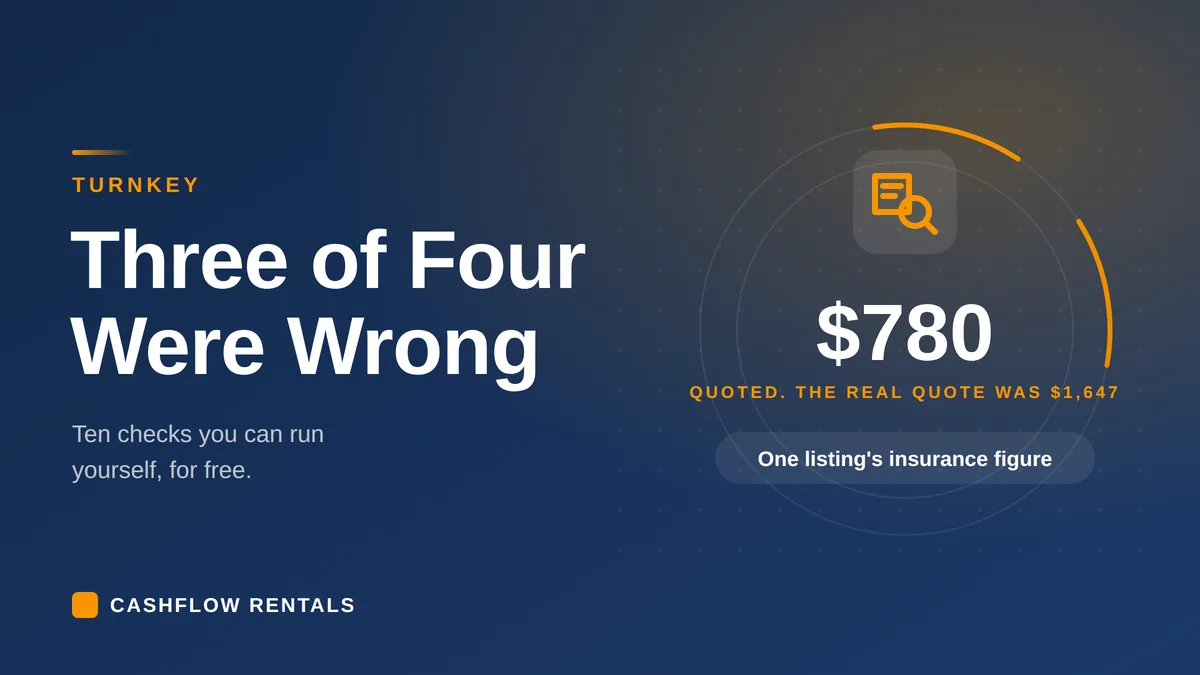
On an Indianapolis house the insurance was shown at $780, while the quote I obtained for the cover I considered appropriate came back at $1,647.
Neither takes an hour to check. The tax is public record, and I've explained why the tax figure on a listing may be the previous owner's bill rather than yours.
The one thing to remember: a pro forma is a sales document, not a promise. Its job is to show you the deal on a set of assumptions. Your job is to check the assumptions. For me, property tax and insurance are the first two numbers to check, because both can materially change the cash flow and both are relatively easy to verify.
Across four real client deals the buying costs ran from 4.04% to 7.53% of the price before any seller credit. For planning purposes, I allow about another 6.5% to sell. I've broken those down line by line in what closing costs actually are on a US rental. On a short hold, that round trip can be most of your gain.
Should you buy turnkey, buy direct, or BRRRR?
Three ways to end up with a US rental property | Turnkey | Buying direct | BRRRR |
|---|
| Cash required | Purchase cash plus costs and reserves | Depends on the deal | Purchase and renovation first; some may come back at refinance |
| Your workload | Low | Medium | High |
| Control over the work | Low | High | Highest |
| What you pay for the house | Retail, with the renovation and service built in | Market price, without the turnkey service built in | Purchase plus your own renovation |
| Speed to a paying tenant | Immediate to weeks | Weeks to months | Usually months |
| Works from abroad? | Designed for it | With a local team | Possible, but hardest remotely |
| Biggest risk | Paying too much for the convenience | Buying badly without enough local knowledge | Renovation overruns and the refinance |
BRRRR means buy, renovate, rent, refinance, repeat. I did a lot of those types of projects when I first started out, and of the three, it's the strategy I think travels worst across an ocean. I've since priced all three routes on one house, using the same cost stack above, and the arithmetic is the reason rather than the instinct.
You're managing a contractor you've never met, in a currency you don't earn, on a timetable you can't police. And the whole model rests on the refinance appraisal landing where you assumed. When it doesn't, your money is stuck in the wall.
Some people do it well from abroad. The ones I've seen succeed usually already knew how to run a renovation before they tried doing it from another country. If you want the mechanics of the bridge-to-refinance version, that's in how a DSCR loan compares with hard money.
Buying direct is the middle road and it's where most of my clients end up eventually. In my experience, you pay less for the house and more in attention.
Whichever route you take, run the deal through the free rental property cash flow calculator. Use the real tax and insurance figures, not the ones on the listing.
Is turnkey really passive?
No. It's delegated, which is a different thing, and whether it's worth paying for is down to you.
The work you've handed over is real work, and a good property manager earns their fee.
What you keep is everything that can't be handed over.
The mortgage is still yours.
The vacancy is yours.
When the tenant of four years moves out, turning that house over could cost $5,000 to $10,000. That bill lands in the same month the rent stops.
You also keep the manager risk, and that one surprises a lot of people.
A manager may earn a leasing fee every time a tenant leaves and a new one signs, often based on some or all of a month's rent. So depending on how the agreement is written, the person you've delegated to can have a small financial interest in one of the things that costs you most. That isn't fraud, it's just how the fee is built, and it's why I read the agreement before I read the fee schedule.
I've taken the passive claim apart properly in is a turnkey rental actually passive income, including what an advertised return looks like once the omitted costs go back in. The short version is that turnkey reduces the work. It doesn't remove the risk.
What changes when you're buying from another country?
Almost everything about verification, and almost nothing about the house.
A local buyer drives past on a Tuesday evening and learns more in ten minutes than you'll get from forty photographs. You can't do that. So every check a local buyer can make with their own eyes has to be replaced by somebody else's eyes, a document, or a piece of public information. It's easy to skip more of those checks than you realize. There's a sequence that stops you skipping, and I've written it out step by step in buying a turnkey rental sight unseen.
That's the real cost of distance. It's also why turnkey can make more sense for an overseas buyer than a local one, and why the wrong seller costs you more. I've set out exactly which things change, and who ends up holding each one, in turnkey for overseas investors.
One of my clients, Daniel, bought remotely in Cleveland and Kansas City from Germany. He borrowed the down payment at home, financed the balance in the US, and structured the deal so the American rent serviced both loans. His case study is worth reading mostly for the sequence he ran, which is the opposite of the order most people try.
The other thing that changes is the manager, who stops being a convenience and becomes your eyes. I ask for videos of repairs now rather than photographs, because a video shows me the surrounding area and makes selective framing harder.
And I have somebody walk each property every few months. It takes twenty minutes and costs me about $150. It gives me a chance to catch small unreported problems before they turn into $20,000 ones. For me, good remote management is four checks a month, not a call a quarter, and that's the standard I hold a manager to.
How do you check a turnkey seller before you commit?
Briefly, because I've written this out properly elsewhere and I'd rather send you to the full version than give you half of it.
Look up what the seller paid and when. Count the layers between that price and yours.
Get the scope of work in writing and hand it to your own inspector, not theirs.
Read the lender's appraisal. If you're financing the property, make sure you get a copy and actually read it, because nine of its boxes tell you more than the whole marketing pack.
Pull the property tax from the county yourself.
Get your own insurance quote.
Check the rent against live listings and ask the property manager what comparable houses are actually leasing for, rather than relying on the pro forma.
Then research the property manager as carefully as you researched the house.
The full sequence, with the three phases and what to request at each one, is in the turnkey property due diligence checklist. The checks you can run without the seller's cooperation are in the verify-numbers piece above.
The insurance quote deserves its own line, because it's one of the easiest bad numbers to catch.
Recently, I got five real quotes on comparable houses ranging from $1,171 to $2,210. On the same type of house, one turnkey seller was using $780. I don't know what cover that figure was based on, which is exactly why I get my own quote. I've published all of them in landlord insurance for foreign and out-of-state owners. One email to a broker tells you whether the number you're underwriting against is realistic.
The questions to ask a seller, and the documents to get before you wire anything, are also in the foreign investor starter kit as a checklist you can work through.
Can you finance a turnkey property as a non-resident?
Yes. Most of my clients use a DSCR loan, and it's the most common route I see for foreign buyers.
DSCR stands for debt service coverage ratio. In plain terms, the lender is primarily qualifying the loan against the property's rental income rather than your personal income, comparing the rent against the mortgage payment, taxes and insurance. Foreign-national programs typically don't require a US credit score, US income or US tax returns. On the foreign-national programs I use, around 70% of the purchase price is typical, so plan on roughly 30% down, plus closing costs and reserves.
I've used about $5.5 million of these loans building my own portfolio, so I'm not describing something I've read about. What a non-resident actually has to show a DSCR lender is the guide to read next. For the product from the ground up, start with how DSCR loans work.
The number overseas buyers tend to focus on is the rate. The one that catches them out is the cash to close. The down payment is only part of it. You also have closing costs and, depending on the lender, cash reserves that need to be documented. Here's what each one came to on real deals.
One warning specific to turnkey. Lenders order their own appraisal, and sometimes the appraised value comes in below the retail turnkey price. If it lands under the contract price, the loan may be sized against the lower value and the gap comes out of your pocket. Understand how much of that gap you could cover before you commit, not after.
Where should you buy, and does the market change the answer?
For me, it changes the answer more than the seller does.
A lot of the turnkey stock I see is concentrated in affordable Midwest and Southeast markets, where purchase prices can still support rental yields that attract investors. Cleveland, Kansas City, Indianapolis, Memphis, Birmingham, Toledo, St. Louis, Detroit.
That's the part a listing can't tell you, and it's the part I would never leave to the seller to judge for me. I own in two markets on purpose, which makes me less a jack of all trades and closer to a master of one or two. My own houses lease between $1,750 and $2,100, with a median around $1,750, and I'd rather know four neighborhoods properly than twelve loosely.
My rule is that affordability and the neighborhood beat the cap rate, and that's how I pick a market. If Kansas City is on your list, the state-line split catches people out, because the two sides are taxed differently.
One of the patterns I see repeatedly is Class C risk at Class B pricing. The house is fine. The street isn't.
What would I do today?
Start with the street, not the yield. If the number on the listing is the most attractive thing about the deal, that's information about the deal.
Pick the market before the house, and pick it because you can defend the choice, not because a seller had stock there.
Get your own numbers on tax and insurance before you talk price. If they're materially off the pro forma, you've learned something about the seller's numbers as well as the house.
Count the layers. Ask the seller what they paid and what they make. They may not tell you, but asking is useful in itself. I answer both on the houses I'm paid on, my own fee included.
Then budget the reserve as part of the cash you need to buy, not as something you'll build later out of cash flow. Turnover is one of the costs that can wreck an otherwise good rental, and I've quantified it on real houses in what tenant turnover actually costs.
And if the deal only works at the advertised rent, with no vacancy and no repairs, it doesn't work.
The bottom line
For me, turnkey makes more sense as a way to buy your first American rental than your fifth.
For a first purchase from abroad, paying somebody to find, fix and set up a house is worth real money. I'd rather a client paid a visible margin to a good operator than saved that margin by buying a cheap house in a street they've never seen. I did the second thing. It cost me far more than any fee ever has.
What I'd push back on is the framing rather than the model. Turnkey is sold as the easy option, and it's better understood as the higher-cost option that solves a specific problem. Once you see it that way, the question becomes clearer. Are the layers in the price worth what they save you, on this house, at this price, in this street?
The houses I own now, thirty of them against the 124 I once had, are better than anything in that old portfolio. Not because I found a better strategy. Because I stopped buying on yield and started buying on quality, and I paid more to do it.
Remember, investing isn't about certainties. It's a game of probabilities, and the decisions worth making are the ones that raise your chance of a boring result. Boring, in my experience, wins.
This article is general information, not legal, tax or financial advice. David Garner is a property investor and is not a lawyer, tax adviser, accountant or investment adviser. Cashflow Rentals is a real estate consultancy, not a real estate broker, and is not a lender or investment adviser. Cashflow Rentals is paid an advisory fee, charged to the renovating contractor, on the renovated US rental property it introduces to clients, which is disclosed at the top of this article and should be weighed against everything in it. The Kansas City figures are one real transaction, published in August 2026. They are the renovating contractor's costs rather than a market average, and they are published with his agreement. The Detroit, Indianapolis and insurance figures are drawn from listings and quotes gathered in 2026 and are not quotations available to you. Worked figures are illustrative. Renovation standards, provider practices, loan terms and market conditions all change. Always take advice from a qualified professional before buying.