Canada is number one again
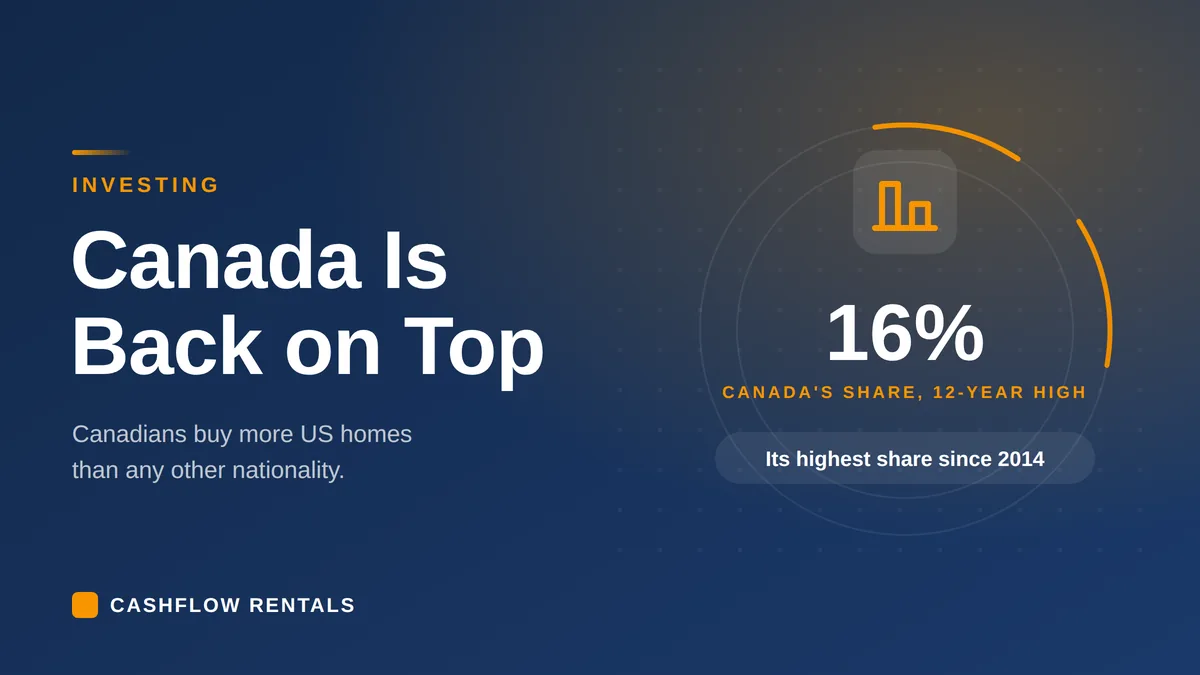
Canadian buyers made up 16% of all foreign purchases of US existing homes in the 12 months to March 2026, up from 14% the year before. China, which led last year, fell to third on 11%. Mexico came second on 14%.
Let me be precise about these numbers because most coverage of this report will probably miss the nuance. Canada leads on number of homes. China still leads on money, at $7.6 billion against Canada's $5.2 billion, because Chinese buyers are purchasing $1 million homes. Canadians aren't.
Note: what "biggest buyer" does and doesn't mean. Leading by number of homes tells you how many Canadians are transacting. It says nothing about whether they're buying well. As you'll see further down, most Canadian purchases are still vacation homes in two snowbird states, which is a completely different activity from buying a rental property like me and my clients. With that said, Canadians are by far and away my biggest client group, so there is some correlation.
How Canada got there without buying more
Here's the bit I find genuinely interesting. Canada didn't take the top spot by buying more properties.
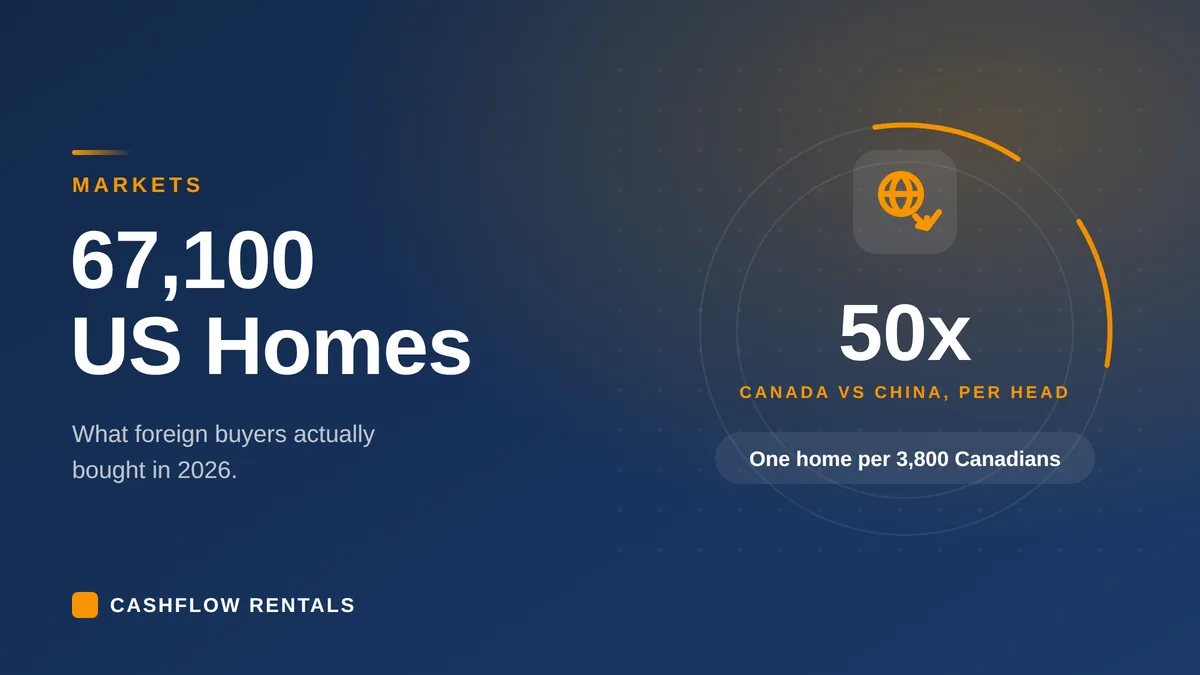
The total foreign buyer market fell hard. Purchases dropped 14% to 67,100 homes and dollar volume fell 19.1% to $45.3 billion, the second lowest purchase count since NAR began tracking in 2009. You can read the full breakdown of this year's foreign buyer data if you want the whole picture.
But Canadian purchases barely moved. Around 10,700 homes this year against roughly 10,900 last year. Meanwhile Chinese purchases went from about 11,700 homes to 7,400, roughly a third fewer.
So Canada's market share rose because Canadians held firm while other nationalities pulled back. That might sound like faint praise. It isn't. In a year when overall foreign demand fell to nearly a record low, holding steady is a considerably better result than it looks, and it's nuance in this report that you most likely won't hear the mainstream media talk about. Consistency across a bad year usually means the buying is driven by something structural rather than by sentiment.
And let's be brutally honest, international sentiment towards the US has been less than favorable in the past couple of years.
A twelve-year high
This is not the first time Canada has led the leaderboard for buying US homes. NAR's own release says Canada "returned" as the top country of origin. If you dig into the historical data (or use AI like I did), Canada has been the top country of origin by number of homes in 11 of the last 20 survey years, which is more than any other country.
Canada led every year from 2008 to 2014, lost the top spot to China from 2015 to 2018, tied with China in 2019 and 2020, then led again in 2021, 2022 and 2024. China took it in 2023 and 2025. Canada has it back in 2026.
All that aside, the fact remains that 16% is the highest Canadian share since 2014. That's a twelve-year high, and it's the number I'd put in front of anyone who thinks Canadians have gone quiet on US property.
Canadians spent less money
I said the ranking wasn't the interesting part. This is.
Canadian dollar volume fell from $6.2 billion to $5.2 billion, about 16% less money. Roughly the same number of homes, less money. That tells us a lot about the type of properties Canadians are buying. Particularly, the fact that they're cheaper.
Canadian purchases of US homes, three report years| Report year (12 months to March) | Share of foreign purchases | Homes bought | Dollar volume | Average per home |
|---|
| 2024 | 13% | 7,100 | $5.9 billion | About $834,000 |
| 2025 | 14% | About 10,900 | $6.2 billion | About $567,000 |
| 2026 | 16% | About 10,700 | $5.2 billion | About $486,000 |
2024 figures are NAR's published counts. The 2025 and 2026 home counts are calculated from NAR's published country shares, which are rounded to whole percentages, so treat them as close approximations. Averages are dollar volume divided by homes, the same method NAR uses.
Read the last column. The average Canadian purchase has fallen from about $834,000 to about $486,000 in two years, a drop of more than 40%, while the number of homes Canadians bought went up from 7,100 to about 10,700.
More houses, much cheaper houses. Canadians are buying roughly half as much property per transaction as they were two years ago, and doing it more often.
I think there are two ways to explain that. Either Canadians got poorer, which the data doesn't support, or the mix of what Canadians buy is shifting away from expensive resort property and toward cheaper, more ordinary homes. Cheaper, more ordinary homes are what the rental properties my clients and I purchase look like. I think that's what's happening, and it matches what I see in my own business, though I'd stop short of calling it proof of a trend. While it does line up, the meager data from my own humble business is anecdotal at best.
Per head of population, it isn't close
Canada bought 10,700 homes. China bought 7,400. Similar-looking numbers, until you remember there are about 40.5 million Canadians and about 1.41 billion people in China.
Per head of population that's one US home purchase for roughly every 3,800 Canadians, against one for every 191,000 people in China. Canada is running at about 50 times China's rate per head. Mexico is a distant second, and India, fourth by volume, comes last of the top five per capita.
Obviously proximity and familiarity do most of the heavy lifting here. For a Canadian, buying in America is a normal thing that normal people do, not an exotic international transaction. China's $50,000 annual foreign exchange cap explains much of the rest. The full five-country per-capita table is in the main data piece linked above, rather than repeated here.
Why Canadians buy in America more than anyone
Four reasons, and only one of them is about investing.
The border. Canada and Mexico are the top two per capita, and they're the two countries that share a land border with the US. Drive-there second homes, family on the other side, cross-border work.
Winter. Half a century of snowbird habit, concentrated in Florida and Arizona.
Familiarity. Same language, similar contracts, comparable legal system, and a US bank branch that will actually talk to you. The friction that stops a German or a Taiwanese buyer barely registers for a Canadian.
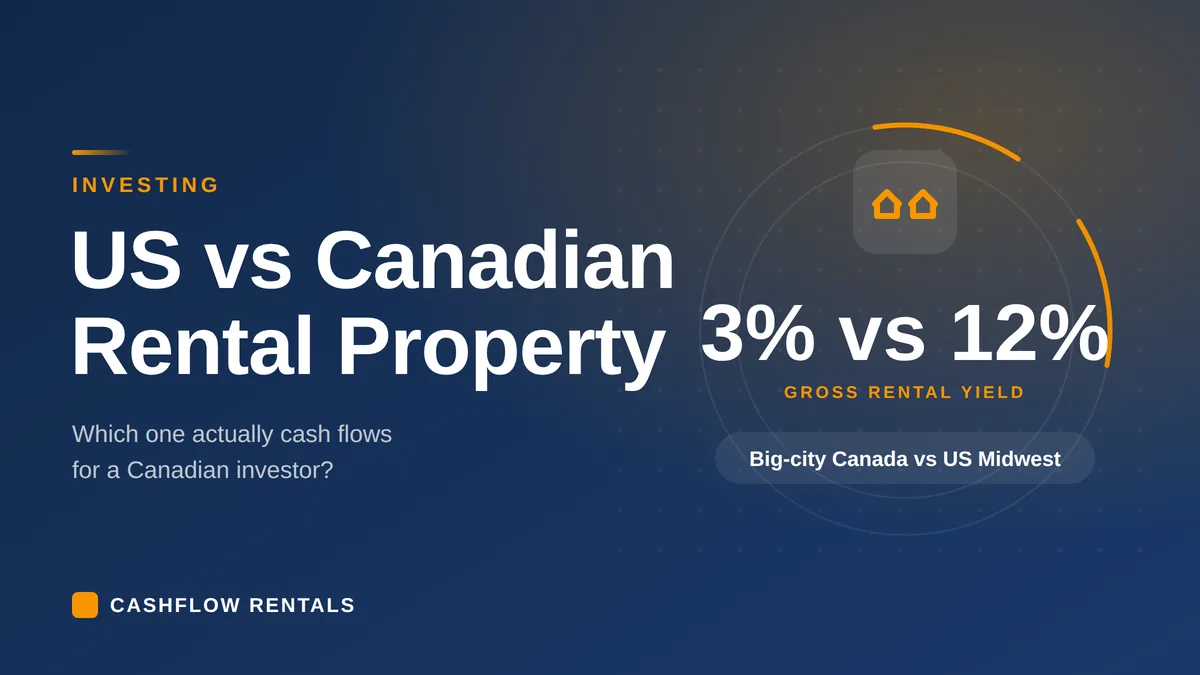
The math at home doesn't work. This is the one that brings Canadians to me. A Canadian rental in most major metros barely breaks even on price-to-rent, while a Midwest US rental cash flows from month one. I've written the honest side-by-side comparison elsewhere, and the gap isn't marginal.
Most Canadian buying still isn't investing
Despite my annoyingly persistent positivity, most Canadian buyers aren't investors.
The 2026 report doesn't publish purpose-of-purchase data in its initial data release. The last year NAR did publish it, in the 2024 report covering April 2023 to March 2024, the Canadian picture looked like this:
- 49% of Canadian buyers bought a vacation home. That was the highest of any nationality.
- Only around 8% bought a residential rental.
- 41% bought in Florida and 23% in Arizona. So roughly two thirds of Canadian purchases went into two snowbird states.
- Canadian buyers were the nationality most likely to buy in a resort area.
- 69% paid all cash.
- Their average purchase price was $834,000, second highest of any nationality, driven by resort property.
Those are three-year-old figures, but the direction of travel is clear enough, and the falling average price suggests the vacation-home share has been coming down rather than going up.
One more fact that cuts against my own narrative: Canada was also the largest single group of foreign sellers of US property, at 24% of international sellers in 2024. Canadians buy the most and they sell the most. That's what you'd expect from a large, long-established, mostly lifestyle-driven ownership base cycling in and out.
So no, "Canadians are the biggest buyers" doesn't mean Canadians have cracked US real estate investing. It means a lot of Canadians own a condo in Florida. The opportunity, as I see it, is in the gap between those two things.
What it looks like when a Canadian does buy for cash flow
Hold that $834,000 resort average next to what a US Midwest rental property of the kind my clients and I purchase actually costs.
In Kansas City, a fully renovated three bed, two bath family home in a decent neighborhood runs $175,000 to $220,000. That's roughly the arithmetic one of my clients, Ronald, who lives in Ottawa, ran before buying his two Kansas City rentals. He's not buying a view. He's buying a tenant pool, and the numbers work from the first month rather than in ten years if the market cooperates.
Three things I see Canadians get wrong
The LLC. It's the default advice everywhere online and it's usually the wrong structure for a Canadian, because the IRS and the CRA classify it differently and you can end up with a tax mismatch that costs you every year. An LP is normally the better answer, and this is the single most common expensive mistake I see.
Assuming cash is the only route. 69% of Canadian buyers paid cash in the last year NAR published it. Some of that is preference. A lot of it is people who assumed a Canadian can't get a US mortgage without US credit or a Social Security number. You usually can, because the lender qualifies the property's rent rather than you.
Chasing yield into bad neighborhoods. A $100,000 house advertised at a 15% yield is the most reliable way I know to lose money in US real estate, and I say that from bitter personal experience. Cheap is not the same as good value.
What I'd do if I were a Canadian starting now
Nothing clever, and none of it is new. I've set out the whole process for Canadians buying US rentals in detail elsewhere, but the short version is this. Work out your actual cash requirement first, because it's usually $55,000 to $90,000 USD for a first purchase once you include the down payment, closing costs and reserves, and that number decides everything else. Get the structure right before you buy, not after. Pick the neighborhood before you pick the house. And hold long enough that you're not relying on the market to bail you out.
Remember, investing isn't about certainties, it's a game of probabilities. Canada leading this table doesn't make your deal work, and it doesn't tell you anything about the specific house you're looking at. It's a piece of context, nothing more. What actually moves the odds is the boring stuff: the right property, in the right neighborhood, financed sensibly, held for long enough.
If you want the process laid out step by step, it's all in my foreign investor starter kit, including the full purchase checklist I use with clients.
This article is general information, not legal, tax, or investment advice. Cashflow Rentals is not an investment adviser and makes no earnings or return guarantees. Property investment carries risk, including the risk of loss. Figures cited are from NAR's International Transactions in U.S. Residential Real Estate reports as noted, current as of July 2026. Speak to a qualified cross border tax professional and your own advisers before making any investment decision.