Why everyone defaults to an LLC
A Limited Liability Company is the most popular ownership structure for US real estate investors for good reasons. It is simple to set up, inexpensive to maintain, offers liability protection by separating the property from your personal assets, and is widely accepted by lenders.
For most foreign nationals, an LLC works perfectly well. The IRS treats a single-member LLC as a disregarded entity, meaning it does not exist for tax purposes. The income passes straight through to you personally, you report it on your individual tax return, and that is the end of it.
The problem is that, like many other things, Canada does not see it the same way.
The CRA/IRS mismatch explained
This is the core issue, and it is worth taking a moment to understand it clearly now so you don't get caught with an expensive problem later.
The IRS treats a single-member LLC as a disregarded entity. In its view, the LLC does not exist. You, the individual, earn the rental income directly. You report it on your 1040NR tax return, and pay any tax owing personally.
The Canada Revenue Agency takes a completely different view. It looks at a US LLC and sees a corporation, a separate legal entity that earns the income, not you.
This disagreement between two tax authorities creates a mismatch that has real consequences when you file your Canadian taxes.
What this means in practice for Canadians
There are two main consequences of the mismatch.
Foreign tax credits may be denied
When you file your Canadian tax return, you will want to claim a foreign tax credit for any US tax you paid. The logic is straightforward: you have already paid tax on this income in the US, so Canada should not tax you on it again.
But the CRA may reject that claim. Its reasoning is that the LLC paid the US tax, not you. And since the CRA considers the LLC a corporation, your personal foreign tax credit claim does not line up. You paid the tax as an individual in the US, but the CRA says a corporation earned the income in Canada.
Your accounting becomes more expensive
To claim your deductions correctly on your Canadian return, your accountant will need to rebuild your income and expense accounting at the entity level.
That means doing the books twice, once for the US filing and once to satisfy the CRA's view.
This is not double taxation exactly, but it is double the work, which means higher accounting fees and more admin every year you own the property.
One of my clients, Ronald from Ottawa, has now filed both his US and Canadian tax returns for his first year of ownership. Because we set him up with the correct structure from the start (an LP), both returns came in at zero. No US tax. No Canadian tax. Clean, straightforward, and cheap to file.
That outcome would have been significantly harder and more expensive to achieve with an LLC.
What an LP is and why it fixes the problem
A Limited Partnership has two types of partner: a general partner, who manages the entity and takes on liability, and one or more limited partners, who invest passively with their liability limited to what they put in.
The key advantage for Canadians is not the liability structure. It is how both tax authorities treat it.
Both the IRS and the CRA treat an LP as a pass-through entity. Both countries agree that you, the individual, earn the income directly. There is no disagreement, no mismatch, and no ambiguity.
This means:
- Your foreign tax credit claim in Canada lines up correctly
- Your accounting is done once, at the individual level, for both countries
- Your annual filing is simpler and less expensive
- You can claim the full benefits of the tax code in both jurisdictions efficiently
For most Canadian investors buying one or a few US rental properties, an LP is the cleaner, cheaper, and lower-risk structure. It involves slightly more formality than an LLC to set up and maintain, but the ongoing savings in accounting fees more than offset that.
An LLC also does nothing for estate tax planning; see my guide to whether Canadians pay US estate tax on a US rental property, or price the exposure directly with our US estate tax calculator.
You can read more about the full range of structuring options in my guide to how to structure your US property investment.
What happens when you sell
Everything above is about the annual position. But the structure you choose also changes what happens at the other end, and there is a second difference here that nobody mentions.
When a foreign person sells US real estate, the buyer has to withhold 15% of the gross sale price and send it to the IRS. That is FIRPTA, and it is a prepayment against your tax rather than a tax in itself. On a $250,000 sale it is $37,500, held back before you see a penny.
A single member LLC does not protect you from it. The LLC is disregarded, so the IRS looks straight through it to you, and the withholding applies exactly as if you held the property in your own name.
A US formed LP is different, because the LP itself is a US person. So the buyer withholds nothing at closing. Instead the partnership withholds on your share of the profit under section 1446 and pays it across during the year.
That is not a tax saving. You owe the same tax either way. What changes is when the money leaves your hands. Under FIRPTA a large sum sits with the IRS until you file a return for the year of the sale, which can be well over a year later. Under section 1446 the withholding tracks the actual profit as it arises.
On a modest gain the difference in cash flow can run to tens of thousands of dollars, and it lands at exactly the moment you are trying to fund the next purchase. You can size it on your own numbers with our FIRPTA withholding calculator, which handles both structures.
One caution. This is a cash flow advantage, not a tax one, and it should not be the reason you choose an LP. The foreign tax credit alignment above is the reason. Treat this as a second, smaller point in the same direction.
LLC vs LP comparison
LLC vs LP for Canadian investors | LLC (single member) | Limited Partnership (LP) |
|---|
| IRS treatment | Disregarded entity, you earn the income | Pass-through, you earn the income |
| CRA treatment | Corporation, the LLC earns the income | Pass-through, you earn the income |
| IRS and CRA aligned? | No | Yes |
| Foreign tax credit in Canada | May be denied | Generally available |
| Annual accounting complexity | Higher for Canadians | Lower for Canadians |
| Lender acceptance | Widely accepted | Widely accepted |
| Withholding when you sell | FIRPTA, 15% of the gross sale price | Section 1446 on your share of profit |
| Setup complexity | Simple | Slightly more involved |
| Recommended for Canadians | No | Yes |
| Recommended for other foreign nationals | Usually fine | Also fine |
The Wyoming and Delaware myth
If you spend any time researching US LLCs online, you will find dozens of articles and YouTube videos recommending Wyoming or Delaware as the best states to form your entity. The reasons cited are usually privacy, low annual fees, and favorable business laws.
For Canadians and other foreign nationals buying rental property in a specific US state, this advice creates a problem.
Most DSCR lenders require the entity holding the property to be registered in the state where the property is located. If you form your LLC or LP in Wyoming but buy a property in Missouri, your entity will need to register as a foreign entity in Missouri as well.
That means two registered agents, two sets of annual filings, and two sets of fees. Every year, for as long as you own the property.
My advice is simple: form your entity in the state where you plan to buy. It is cheaper, simpler, and removes a potential obstacle with lenders. If you later buy in a different state, you can form a new entity there or register your existing one.
The EIN timing trap
Before your entity can open a US bank account, and before a lender can begin underwriting your DSCR loan, your entity needs a federal tax identification number, known as an EIN.
Here is the trap that catches a surprising number of Canadian buyers.
The IRS only accepts EIN applications by post or fax for foreign-owned entities. The standard processing time is six to eight weeks.
If you go under contract on a property before your EIN is in place, and the closing deadline arrives before the IRS processes your application, you will miss the closing. The seller keeps your earnest money deposit and the deal is gone.
Getting your entity formed and your EIN obtained before you start looking at properties eliminates this problem entirely. We work with partners who can obtain an EIN for a foreign-owned entity in 24 hours, which means this is a completely avoidable delay.
For a full breakdown of how US and Canadian tax works once you own the property, read my US tax guide for Canadian investors.
This is the compliance item that trips up the most investors, usually because their accountant has never heard of it.
Any foreign national who has transactions with a US entity is required to file Form 5472 with the IRS. This applies regardless of whether any tax is owed. It is a disclosure form, and it is mandatory.
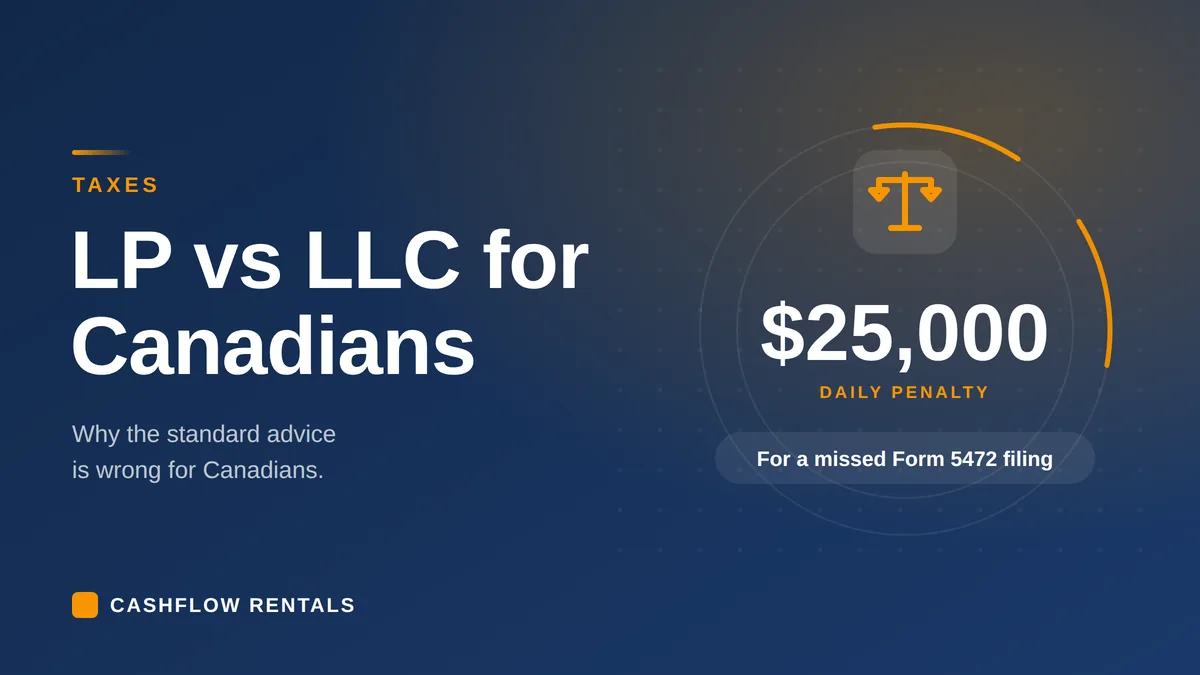
The penalty for failing to file Form 5472 is $25,000 per day, and it applies whether or not any tax is owed. The IRS does not make allowances for not knowing.
A standard US CPA who primarily serves American clients may not know about this requirement. It is not something that applies to domestic investors, so it simply does not come up in their practice.
This is one of the most important reasons to work with a cross-border CPA who specifically understands foreign national filing requirements. The consequences of missing this filing are severe.
The IRS provides guidance on foreign-owned domestic entities and their filing requirements at irs.gov.
When an LLC might still make sense
An LP is the right structure for most Canadian investors, but there are situations where an LLC may still be appropriate.
If you are investing with a partner who is not Canadian, the CRA/IRS mismatch may apply differently depending on their country of residence and the applicable tax treaty. In that case, the right structure depends on both investors' individual circumstances.
If you are not Canadian, an LLC is generally fine. The mismatch is specific to how the CRA treats US entities. Investors from the UK, Germany, Taiwan, Ecuador, and most other countries do not face the same issue.
The right answer always depends on your specific situation, your country of residence, and the applicable tax treaty between your country and the US. The CRA publishes guidance on the treatment of foreign entities and income at canada.ca.
Always confirm your structure with a qualified cross-border CPA before you set anything up. For a broader overview of US tax obligations for all foreign nationals, see my US tax guide for foreign investors.
Whichever structure you choose, the BOI position changed in August 2026. See the current filing requirements.
For a full breakdown of how US and Canadian tax works for rental property owners, read my US tax guide for Canadian investors.
How to get set up correctly
Here is the sequence to follow before you make an offer on any US property.
- Confirm your structure with a cross-border CPA. Before you form anything, speak to a CPA who understands both US and Canadian tax law. Confirm that an LP is the right structure for your specific situation.
- Form your LP in the correct state. Form your entity in the state where you plan to buy, not in Wyoming or Delaware. Your general partner will need to be identified at this stage.
- Obtain your EIN. Do not wait until you are under contract. Get your EIN as soon as your entity is formed. Use professionals who can obtain it quickly for foreign-owned entities.
- Open your US bank account. With your entity and EIN in place, open a US business bank account. Your down payment, reserves, and rental income will all flow through this account.
- Start looking at properties. Only now should you begin reviewing specific properties. This order of operations means you are ready to move when the right deal comes along, and you will not lose a deal to an EIN delay.
The Foreign Investor Starter Kit includes my complete guide to setting up your US legal entity and banking, which walks through each of these steps in detail.
If you would like help getting the right structure in place before you buy, book a call with me or my team and we can walk you through the process.
This article is general information, not legal or tax advice. Cashflow Rentals is a real estate consultancy, not a lender, mortgage broker, tax adviser, or attorney. Always consult a qualified cross-border CPA and attorney before making decisions about your investment structure.