Why four units instead of one house
Well, once I explained that he could in fact get financing as a foreign national, a whole new range of possibilities opened up.
His original plan bought one house outright for about $125,000. In Cleveland that buys you a property in the kind of neighborhood I spent years learning to avoid, which is a story I have told in how I nearly went bankrupt buying US rentals.
With 70% financing, the same money bought a single property at around $340,000 instead. In the US Midwest that is a decent house in a decent area. Definitely B class. Nothing wrong with it.
Or it bought four units in one transaction, on one parcel, with one loan, one tax bill and one insurance policy.
Here is the argument that persuaded him, and it is the only argument that really matters.
If a single-family house goes empty, your income is zero. Not reduced. Zero. You are paying the mortgage, the taxes and the insurance out of your own pocket until somebody signs a lease.
If one of four units goes empty, you still collect 75% of the rent. The mortgage still gets paid. You are inconvenienced rather than exposed.
For somebody buying from another country, who cannot drive over and show the property himself, that difference is worth more than a slightly higher yield. Vacancy is the risk that actually hurts overseas investors, because everything about filling a unit takes longer when you are not there.
There is a second reason, and it is about the neighborhood rather than the building. A $340,000 home is most likely in a B class area. B class neighborhoods are higher priced, but the rents are not commensurate, so they do not generally deliver enough cash flow to fund the mortgage and the operating costs.
What I look for instead is a C class neighborhood on a positive trajectory towards B. That gives a lower price point, better cash flow, and more future appreciation potential. It is also an order of magnitude less risky than the kind of neighborhood his original $125,000 cash purchase would have put him in.
That is the case for it. Now the honest part.
The deal
Everything below is as it stood at closing in February 2025.
The deal as it stood at closing in February 2025.| Asset | Two duplex buildings on one parcel, 4 units, 5 bedrooms, about 3,015 sq ft |
| Location | Cleveland, Ohio |
| Condition | Fully renovated, turnkey, no repairs required at close |
| Occupancy | All four units leased on 12-month terms at closing |
| Gross rent | $3,320 a month |
| Purchase price | $340,000 |
| Appraised value | $340,000 |
| Property tax | $2,360 a year |
| Insurance | $1,025 a year |
| Management | 10% of collected rent |
| Utilities | Tenants pay their own; landlord covers lawn care |
| Hold | Buy and hold |
Two things to flag before we go further.
The tax and insurance figures are what they were in February 2025. Both have moved since, as they do everywhere in the US, and if you are underwriting a Cleveland property today you should get your own quote and check the current bill rather than use mine. I have written about how much those two costs vary, and how badly sellers' estimates track reality, in the best buy-to-let markets in the USA.
And 3,015 square feet across four units is about 754 square feet each, with five bedrooms between them. So these are small units, mostly one-beds. That has consequences and I will come back to them.
How we financed it
Nothing clever here.
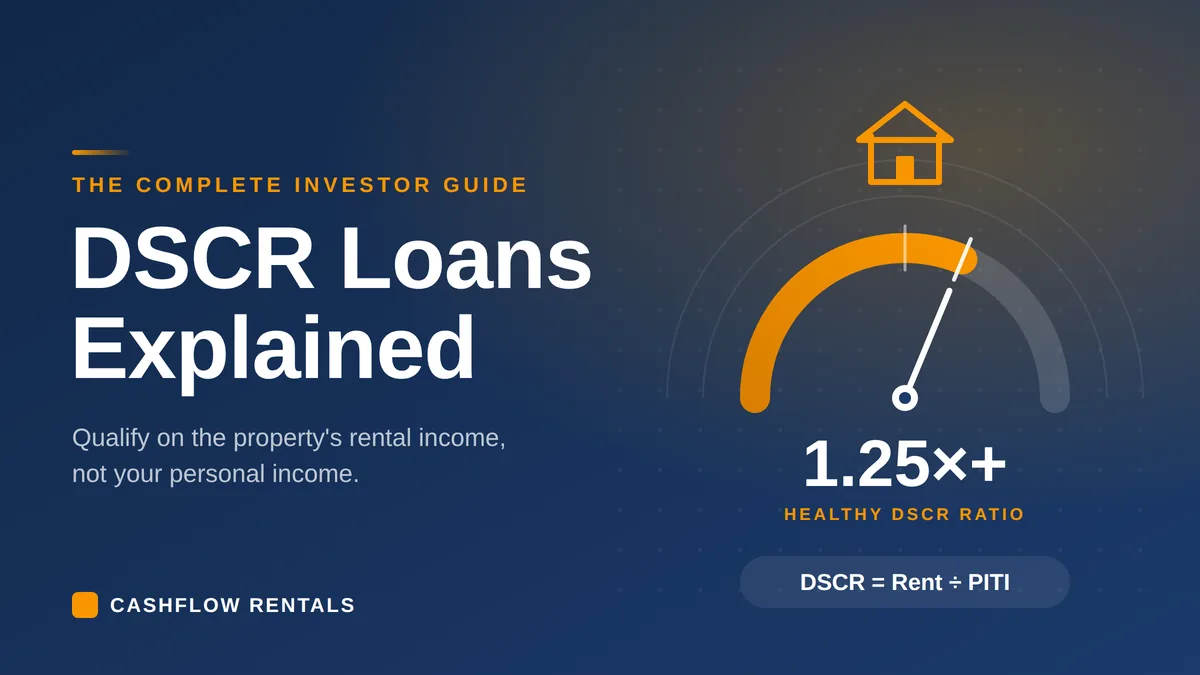
If DSCR loans are new to you, I have explained the product in my guide to DSCR loans.
A 30-year fixed rate rather than an ARM, meaning an adjustable rate. He is holding this long term, so fixing the interest rate for thirty years offers a degree of predictability that is rare in real estate investing. I go into more detail on that choice in ARM versus fixed.
70% loan to value rather than pushing higher. More leverage would have meant a worse rate and thinner coverage. At 70% the pricing was sharp and the coverage was comfortable.
Taxes and insurance escrowed. It costs nothing and it removes two annual surprises. When you are 4,000 miles away, fewer things to remember is worth something.
A modest rate buydown, from about 7.00% to 6.75%, for $2,550 in upfront costs, known as points.
No interest-only. That is a tool for a specific job, and in this case it was not relevant.
And one thing worth mentioning, because this is where I often earn my fee: we negotiated a $10,000 seller credit rather than a price reduction. A credit comes straight off what you need at the closing table. A $10,000 price cut would only have reduced his deposit by $3,000, because the other $7,000 just becomes a smaller loan, and the payment saving on that is about $545 a year. So the credit put $7,000 more in his pocket on the day, and it would take the price cut well over a decade to catch up.
The monthly payment.| Principal and interest at 6.75% | $1,543.66 |
| Taxes and insurance, escrowed | $282.09 |
| PITIA | $1,825.75 |
And here is where the money went.
Sources and uses at closing. Amounts in parentheses are deducted.| Purchase price | $340,000 |
| Loan at 70% LTV | ($238,000) |
| Down payment, 30% | $102,000 |
| Points, buydown from 7.00% to 6.75% | $2,550 |
| Lender origination | $2,300 |
| Lender's title policy | $2,550 |
| Legal | $1,500 |
| Appraisal | $600 |
| Title, escrow funding, recording, county conveyance fee and prepaid interest | $10,900 |
| Gross closing costs | $20,400 |
| Seller credit | ($10,000) |
| Net closing costs | $10,400 |
| Cash to close | $112,400 |
| Documented reserves, six months PITIA | $10,954 |
| Total capital committed | $123,354 |
He had about $125,000. That left him roughly $1,600 spare, which is thinner than I would normally want and something we discussed at the time.
The two DSCRs
This is the part I want you to take away, and it applies to every DSCR loan you will ever look at.
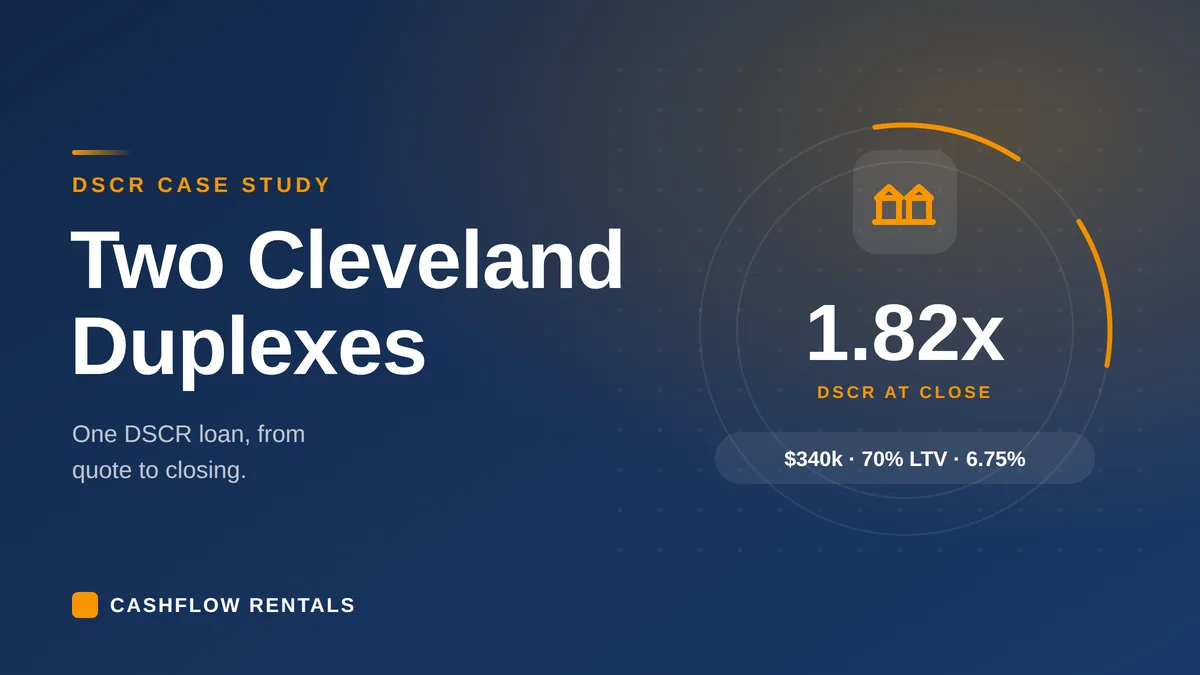
A DSCR lender divides gross scheduled rent by PITIA. That is it. $3,320 over $1,825.75 gives 1.82, comfortably above the lender's 1.00 floor. Approved.
Notice what is not in that calculation. No vacancy. No management fee. No maintenance. No lawn care. The lender is not being careless; it is measuring whether the rent covers the debt, which is the only question it needs answered.
But you do not live on gross rent. You live on what is left after the property has been run.
What is left after the property has been run. Amounts in parentheses are deducted.| Gross scheduled rent | $3,320 |
| Vacancy at 5% | ($166) |
| Collected rent | $3,154 |
| Management, 10% of collected | ($315) |
| Maintenance reserve, 10% of gross | ($332) |
| Lawn care | ($40) |
| Net operating income | $2,467 |
So the real coverage is $2,467 over $1,825.75, which is 1.35.
The lender approved on 1.82. He operates on 1.35. Nothing went wrong and nobody misled anybody. The two numbers just answer different questions: the lender wants to know whether the rent covers the debt, and the owner wants to know what is left afterwards.
The one thing to remember: the DSCR on your approval letter is not the DSCR you live on. Work out both before you sign, because the second one is the one that decides whether you enjoy owning the property. If you need to move the first one, I have set out how in how to improve your DSCR.
What it actually earns
Year-one cash flow.| Net operating income | $2,467/mo |
| PITIA | ($1,825.75) |
| Pre-tax cash flow | $641/mo, about $7,690/yr |
Now the denominator, which matters more than people think.
He wired $112,400 at closing. The lender also required six months of PITIA in documented reserves, about $10,954. That money stays his, it is not paid to anyone, but it is committed. He cannot spend it. So the capital tied up in this deal is $123,354, not $112,400.
On the honest denominator, year-one cash-on-cash is 6.2%.
If I divided by cash to close and left out vacancy and lawn care, I could show you 8.9%. Plenty of people would. It is the same deal either way, and I would rather he planned on 6.2% and was pleasantly surprised than the other way round.
What the cash flow leaves out
One thing in this deal's favor that never appears in a pro forma.
In year one his tenants repaid $2,536 of the loan. Not him. Them. The balance went from $238,000 to $235,464 without him writing a cheque.
Add that to the cash flow and the total year-one return is $10,227, or 8.3% of the capital committed. And the principal figure grows every year while the payment stays flat, because that is how an amortising loan works.
This is the whole reason I prefer American financing to what I can get on a UK buy-to-let, where interest-only is the norm and the balance in year ten is the balance on day one. I have compared the two properly in buy-to-let mortgages in the USA.
What could go wrong
I would not publish a case study without this section.
We stress-tested it before locking. A 50 basis point rate rise takes PITIA to $1,905.66 and the lender's coverage to 1.74. A 5% rent fall takes it to 1.73. Both together, 1.66. On the operating basis the combination takes real coverage from 1.35 to about 1.22, which is tighter but still funds itself.
The units are small and that is the genuine weakness. About 754 square feet each, mostly one-beds. Small units turn over more often than family houses. People in one-beds move for jobs, relationships and marginally better flats in a way that families with school-age children do not. So expect more turnover events than a single-family house, even though each one costs you less.
The resale pool is narrower. A single-family house in Cleveland can be sold to somebody who wants to live in it. Two duplexes on one parcel sell to investors, and investors buy on numbers rather than on how they feel about the kitchen. That usually means a slower sale and a tougher negotiation when you exit.
Four tenants is four times the tenant admin. Four leases, four renewals, four sets of problems. He is not doing that work, his manager is, but he is paying for it and the manager's quality matters four times as much as it would on one house.
And 5% vacancy is an assumption, not a promise. On four small units I would treat 5% as optimistic in a bad year. At 8% the cash flow drops to about $6,600 and the return to roughly 5.3%. Still positive. Still fine. But worth knowing before rather than after.
What I would repeat
Six things, and they are all boring.
Qualify on real leases, not projections. Because all four units were let at closing, we underwrote on the actual rent roll and no market rent schedule was needed. That removes the single most common reason a DSCR file falls apart at the appraisal stage, which I have written about in why applications get declined.
Get the tax and insurance figures in writing before you underwrite. Not the seller's estimate. The actual bill and an actual quote. These are the two costs that most often make a pro forma wrong.
Work out both DSCRs. The lender's, so you know you will be approved. Yours, so you know what you are buying.
Do the arithmetic on points. $2,550 bought a $39.76 monthly saving, which is a breakeven at about 64 months. On a thirty-year hold that is fine. On a three-year plan it would have been money thrown away.
Take the seller credit over the price cut where you can. It reduces what you need at the table, which is the constraint that actually stops deals.
And keep the reserves liquid and count them as capital. Six months of PITIA was the lender's requirement. I would hold that plus an operational buffer, and I would include it when calculating my return, because pretending it is not committed money does not make it available.
If you want to run these numbers on a property you are looking at, the free tools in my investor starter kit will size the deal, the cash to close and the reserves it needs.
The bottom line
He wanted one house and bought four units, and eighteen months on it has done what we expected. Around $640 a month in cash flow, the loan shrinking quietly in the background, and one empty unit at any point costing him a quarter of his income rather than all of it.
The deal is not spectacular. A 6.2% cash return on committed capital is not going to excite anybody, and the 8.9% version I could have shown you would have been more flattering and less true.
What it is, is durable. Fixed rate, comfortable coverage, four income streams, reserves in the bank, and a tenant base paying down a loan he does not have to service out of his own pocket. My wider reasoning on why I buy in Cleveland at all is in investing in Cleveland real estate.
Remember, investing is a game of probabilities. Work out the number you will live on, not the one on the approval letter.
This article is general information, not legal, tax, or financial advice. Cashflow Rentals is a real estate consultancy, not a lender, mortgage broker, tax adviser, or law firm. This is a single real transaction that closed in February 2025 and the figures, including the property tax and insurance, are as they stood at that time. Both have since changed, as costs do. Rates, lender criteria, reserve requirements and operating costs vary by property, borrower and date. Returns shown are pre-tax and exclude any capital growth or loss. Always obtain your own quotes and take your own professional advice before buying rental property.