1. What is an owner statement, and when should it arrive?
It is the monthly account of your property: what money came in, what went out, and what is being sent to you. It'll also show what action, if any, the manager is taking on anything outstanding, such as late rent.
A fair standard is line by line, with bills attached, arriving by the 15th of the following month, with the funds landing on a stated date rather than whenever somebody gets to it. That is what I hold managers to, and it sits alongside the other operating standards in what good remote management looks like.
In most cases a manager will make distributions twice a month. Once around the 15th for all rent collected up to that point, then again at the end of the month for anything received after the first run.
That's not always the case though. Some only offer one distribution, so find out in advance and negotiate a second draw into your management agreement. Otherwise you can be waiting the best part of two months for rent you need to cover a mortgage payment.
The date matters as much as the content. A statement that arrives on a different day each month, or money that lands a week later than the statement says, is usually a sign of a firm running behind rather than a firm being crooked. Crooked is rarer than messy. Both cost you money.
2. What does a good one contain?
There are six things I pay attention to. If yours is missing more than one, ask.
The rent collected, with the date it was received.
Any late fee, and who kept it. Who keeps late fees, or how they're split, should be clearly defined in your management agreement.
Every cost as its own line, with a note of what it was and when, and supporting paperwork where money went to a third party. A utility bill, a contractor invoice.
The management fee, calculated visibly rather than netted off.
Any other fee, named. This might include small admin charges for things like paying bills or posting notices. They stack up, and they're one of the biggest reasons investors say their manager nickel and dimed them to death.
The balance carried, if the manager holds a float or reserve on your property.
On that last point, I always advise keeping some funds with the manager to handle small repairs. That's probably a requirement in your agreement anyway.
But I wouldn't keep your entire reserve there. I own 30 rental properties and I keep at least $5,000 in reserve for every one of them. That's good coverage for a big repair, a vacancy or a turnover. It doesn't all sit with the manager.
I keep the equivalent of one month's rent with them, and the rest sits in my own reserve account earning 4% a year. That's not just about the interest. If something goes wrong with the manager, I don't want my whole $150,000 reserve sitting in their account.
Finally, any bills paid, or due to be paid if they're your responsibility, should be attached or sent on request without a fuss. A manager who finds that request odd is telling you something about their normal client. You'll need those records to claim deductions on your US return, which is part of what stops America keeping 30% of your gross rent.
Ask for a sample statement before you hire anybody. Names removed, any property, one month. It takes them two minutes and it shows you exactly what your reporting will look like for the next ten years. It is one of the checks in
how to vet a US property manager, and almost nobody asks for it.
3. How does $1,800 of rent become your draw?
Here is a normal month on a house renting at $1,800. The median rent across my portfolio is about $1,750 a month, so this is fairly typical.
An ordinary month on a house renting at $1,800| Line | Amount | Notes |
|---|
| Rent collected | $1,800 | Received on the 3rd |
| Management fee at 8% | -$144 | On rent collected, not on rent due |
| Plumbing repair | -$185 | Invoice attached, under the approval limit |
| Lawn care | -$60 | Recurring, check it is in your agreement |
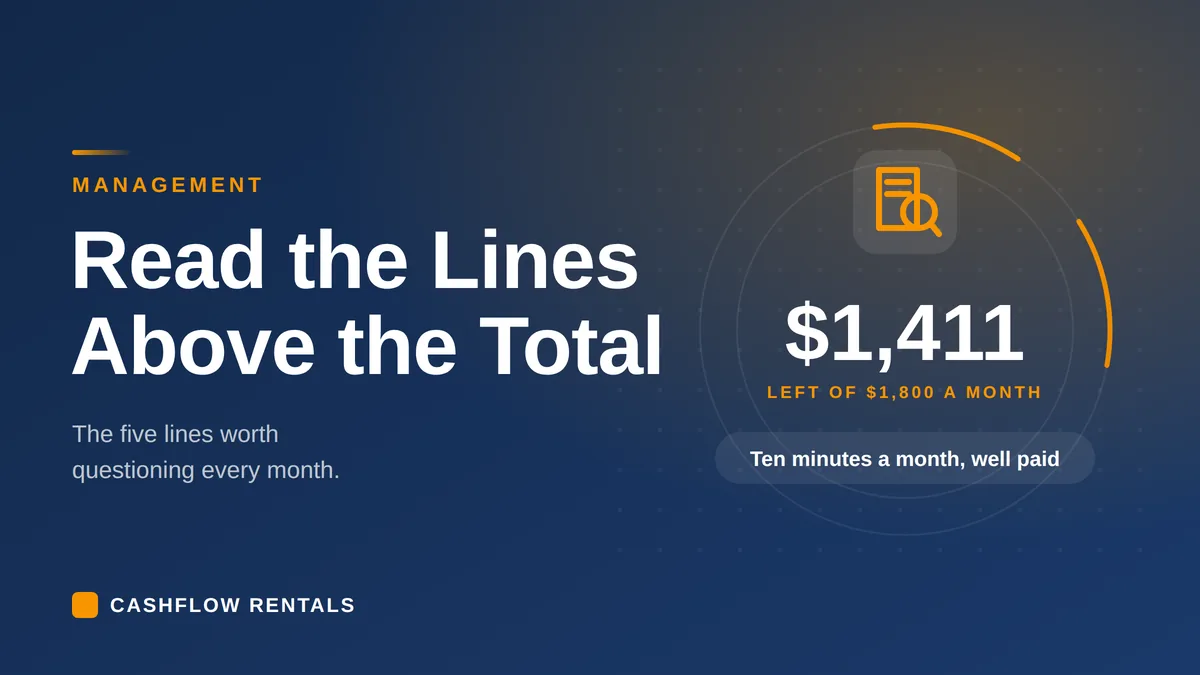
| Owner draw | $1,411 | Sent on the 15th |
None of that is wrong. That is the point. A perfectly ordinary month still moves a good portion of the rent, about 22% here, before the mortgage, the property tax or the insurance, and none of those three shows up unless your manager pays them for you.
The 8% is only one part of what it costs to have somebody manage the property. I've broken down the other fees you're likely to meet in what US property management actually costs.
The same goes for that $185 plumbing bill. Some months there's nothing, other months a lot more, which is why I treat maintenance, repairs and capital as their own line when I work out what a property will really cost me.
That's one of the biggest mistakes I see new investors make when underwriting. Most of us are buying older houses in cheaper markets, and most of us underestimate both the frequency and the cost of repairs.
One thing to note. Your manager isn't normally responsible for paying your property taxes. If your mortgage has a tax escrow, the lender collects a monthly amount alongside the payment and pays the bill for you. If it doesn't, that's on you. More on that in how US property tax really works.
And the $1,411 that lands in your bank isn't your cash flow either. The costs sitting outside this statement still have to come off. You can run those numbers on any property with my free rental property cash flow calculator.
4. Which five lines should you question?
Not because anybody is cheating. Because these are where errors and drift live.
Managers are people and people make mistakes. I'm dealing with one right now for a client who billed them for repairs completed before they even bought the property. That wasn't malicious, just an accounting error, but it still had to be found and put right.
The five lines worth questioning every month| Line | What it should look like | What to ask |
|---|
| Repairs | What it was, the date, the bill attached | Was this quoted? Is the bill from an outside firm? |
| Management fee | A percentage of rent collected | Is it charged on rent due or rent collected? |
| Late fees | Named, and given to somebody | Who keeps the late fee, you or the manager? |
| Credits and money paid back | Explained in plain words | What was this, and why? |
| Sundry or admin | Rare, and small | What is it? Anything monthly should have a name |
Two patterns are worth watching over several months rather than one.
Repairs that keep landing just under your approval limit. I'm always suspicious when I see that, because I've seen it before.
And the same fault repaired more than once, because a furnace fixed three times in a year is not being fixed. That's the point to stop paying for the same repair and deal with the underlying problem, which might mean replacing the furnace altogether.
There are also ways a manager can make money on a repair that won't show up on your statement at all. I've written about the three ways it happens, and the two hundred dollar test I use to settle it, in how managers make money on repairs.
5. How do you reconcile it against everything else?
Three documents, once a month, about ten minutes.
Against the lease. Is the rent the amount the tenant actually signed for, and did it arrive when the lease says it's due? Rent that quietly differs from the lease might be an old figure nobody updated, and occasionally something else.
I dealt with this recently on a client's property in Kansas City. The scheduled rent was $1,695 and the manager collected $1,700. Only $5, but worth chasing, because discrepancies like that can come back to bite you in eviction court or on a fair housing complaint.
It turned out the tenant paid cash at the manager's office. They handed over $1,700, the manager gave them $5 change, and nobody reconciled that when the payment went into the system. A small thing, but worth getting right for the reason above, and for your own accounts at tax time.
If you don't hold a current copy of the lease, get one. Not having your paperwork in your own files is the same problem that catches people during a manager handover, which I cover in how to fire a US property manager.
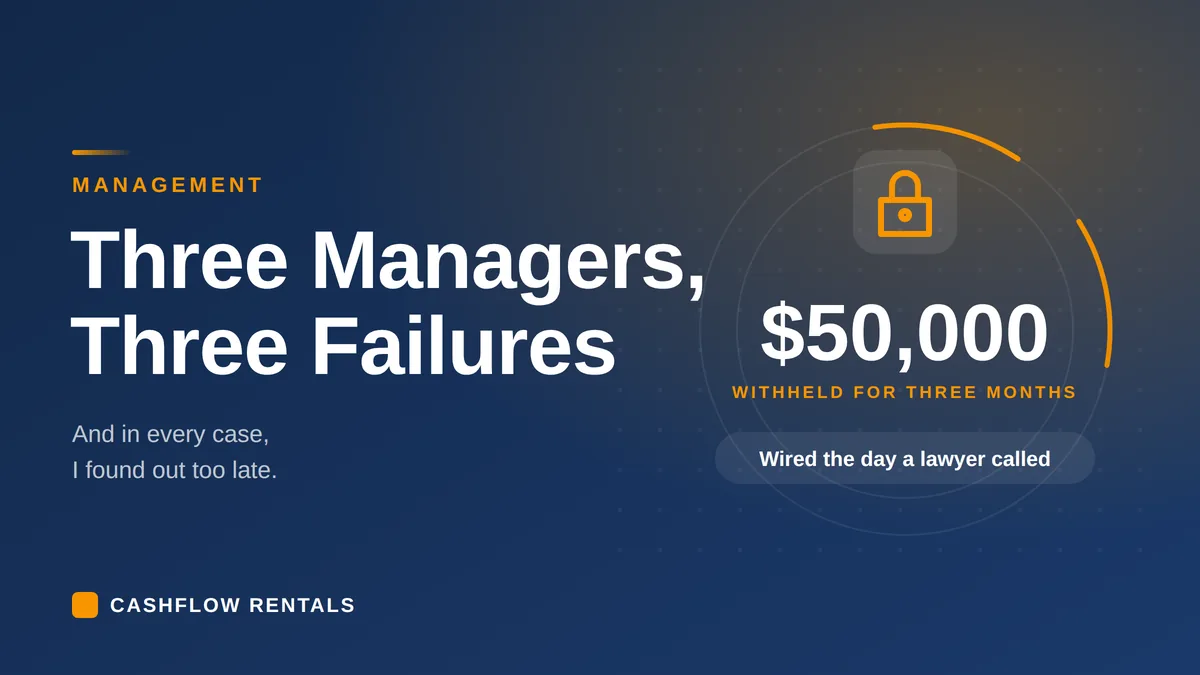
Against your bank. Did the draw arrive, in full, on the date the statement says? This sounds trivial. It's the check that catches the worst outcomes earliest, and the worst outcome I've had was $50,000 of rent collected and not passed on, which is in when your property manager is the biggest risk.
Notice whether any banking fees come off too. Your agreement will usually say who pays for banking charges on owner draws. If there's a fee and it's excessive, and they can be, it's worth looking at a different bank. The wider question of moving money home is in draws, banking and FX.
Against the agreement. Are the fees the ones you agreed, at the rates you agreed, including the ones that only appear at a renewal or a turnover? Those clauses are in the management agreement clauses a remote owner must check.
6. What does the statement never show you?
Two things, and both matter.
It will not show a markup on costs. If your manager marks up a third party invoice, or uses an affiliated maintenance company, the statement shows a repair cost that looks entirely normal. The only way to know whether you're getting fair value is to price a repair independently, which needs your own contractor, which is why that hire is in building your US property team.
And it will not show you the tenant. A household that has paid on time for eleven months and is about to lose a job looks exactly like one that will still be there in three years. That's what inspections, feedback and a phone call are for, and it's why I ask for dated photos as well as numbers. If it does go wrong, the sequence and the costs are in when your US tenant stops paying.
That's probably the single change to my management process that made the biggest difference to the whole portfolio. I used to think silence was golden. No calls from the tenant, rent showing up, everything must be fine.
What I found, more than once, was that silence meant maintenance issues and property damage simply weren't being reported. Often because the house wasn't being looked after, and the tenant didn't want to rock the boat or draw the manager's attention.
Now I have my manager walk every property seasonally. It takes twenty minutes, costs me about $150, and it picks up the small unreported problems before they become $20,000 ones. It's also the chance to do actual maintenance rather than repairs. Servicing the furnace, clearing the gutters, flushing the water heater, changing filters. Well maintained systems break less often, cost less to own, and last years longer before they need replacing.
There's something else I look at alongside the statement: whether the rent is still right. A tenant paying $1,650 in a street now letting at $1,850 shows up as a perfectly healthy statement every month. You only see the gap when you compare it against what's listed nearby, which is part of how long should a vacancy take.
That doesn't automatically mean I put the rent to $1,850. I'd rather take $1,600 and keep that tenant for five years than deal with a vacancy and turnover that costs $10,000, which is roughly what a turnover actually costs.
7. What happens at year end?
At the end of the year your manager should give you an annual statement summing up the twelve months.
Keep it, and keep the twelve monthly ones behind it, because the annual one rarely holds enough detail to answer a question about one repair fourteen months later.
There'll normally be tax reporting as well, but for a foreign owner the form you receive depends on how you own the property and how the income is being treated for US tax. For 2026 the reporting threshold for rents on Form 1099-MISC rose from $600 to $2,000. Managers generally use that form to report rent paid over to an owner where the 1099 rules apply.
Whatever form you get, check the figure against your own records before it goes near a tax return. Fixing it later is far slower than asking now.
There's another issue for foreign owners, which is withholding. US rental income received by a non-resident is generally subject to 30% withholding on the gross amount unless an exception applies. The common route is to elect to treat the income as effectively connected and give the withholding agent a valid Form W-8ECI. I explain the order it has to be done in, and the form people confuse it with, in the withholding article linked above. The wider position is in the US tax guide for foreign investors.
And if you own through a foreign owned single member US LLC treated as a disregarded entity, there's a filing that's very easy to miss. Money moving into and out of the LLC can be reportable on Form 5472, and the penalty for not filing starts at $25,000. That one deserves its own explanation, which is why I wrote the $25,000 form nobody mentions.
The important thing at year end is that the numbers agree. The annual statement, your bank records and whatever tax reporting you receive should tell the same story. If they don't, January is a much better time to find out than the week your accountant is preparing the return.
8. What do you do when it does not add up?
Ask once, plainly, in writing, and act on the answer.
Most gaps are real mistakes. A repair posted to the wrong house, a fee charged twice, a date typed wrong. A manager who explains it and fixes it has just shown you something useful. People make mistakes. How they handle being told tells you far more than the mistake did.
What you're watching for is the second time, and then the third. A pattern of errors that always runs the same direction is something else.
If you can't get a straight answer, escalate in steps and keep it in writing. Most states license property managers through their real estate commission, and client funds are exactly what those bodies care about. You can find yours through the directory of state regulators. That's rarely necessary, and knowing it exists changes the tone of the conversation before you ever use it.
Karl, one of my clients, bought his first US rental from Taiwan having already been a landlord in Taipei, and the American paperwork was the part that surprised him. His purchase is in his case study. Learning to read one document properly is most of what closes that gap.
If you'd rather work with managers who report to this standard as a matter of course, that's what our remote management service is built around, and the statement checklist is in the foreign investor starter kit.
The bottom line
Ten minutes a month on one document is the best paid work in remote ownership.
Not because you'll catch a fraud. You probably won't, and most managers are decent people doing a hard job on a thin margin. You'll catch the ordinary things. The fee charged at the wrong rate. The repair nobody quoted. The rent that has drifted from the lease. The third visit to the same furnace.
Those are the things that quietly take a point off your return every year without ever saying so. And they're visible, every month, in a document that's already in your inbox.
Read the lines above the number. That's the whole discipline.
This article is general information, not legal, tax or investment advice. Cashflow Rentals is not a real estate broker, lender or investment adviser. Accounting practice, reporting standards, tax thresholds and landlord law vary by state and by firm and change over time, so please take advice from a qualified professional before acting.