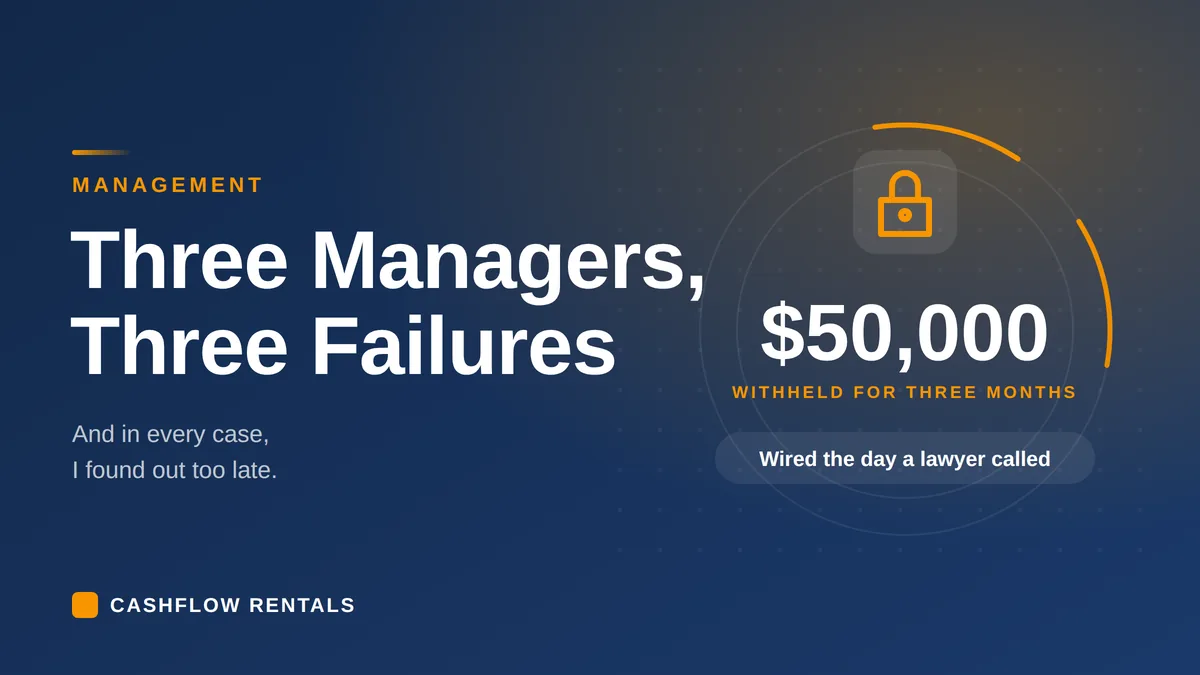
1. What happened when a manager would not release the money?
I bought a small portfolio of fourteen houses from a distressed owner. He no longer wanted them, I took them on, and we closed. It looked like a great deal, and on paper it was.
Under the terms of the agreement, the accrued rents and the tenants' deposits came to me. That is pretty normal. The money belongs to the houses, and the houses were now mine.
The existing manager held those funds in his account, which is also normal. But when I asked for them to be wired to my operating account, he said he could not send them.
He claimed he did not have the right paperwork. He did not have written permission from the previous owner. His lawyer had told him not to.
That of course was not true. We had a very clearly signed purchase agreement that included specific language assigning any accrued rents to me. And so the back and forth began. That went on for about two or three months. About $50,000 of my own money in somebody else's account, always with a new reason or technicality as to why they could not send the funds.
Eventually we got our own attorney involved, at a cost of a few thousand dollars as a retainer, and the property manager wired the funds the same day.
Which tells you the money was there all along. No paperwork problem. No legal block. Just a test of whether I would do anything about it, and it ran until the answer was yes.
This is the kind of thing I see all the time with out of state and overseas owners. Sadly, some service providers will use the distance as leverage, just to see what they can get away with. It is the same instinct that produces an understated pro forma, which is why I rebuild every figure, as set out in how US property tax works.
Three lessons I picked up from this specific situation.
Deal with accrued rents and deposits in the contract, by name, with a method and a date, and specific amounts broken down by property. Not as a general clause.
Find out who holds the deposits and under what rules. Many states require them held in trust or in a named account. What else comes off at closing, and who holds it, is in what closing costs actually are. That is a legal duty, not a courtesy, and knowing the rule changes the talk.
And push harder, sooner. I waited months because I did not want to be difficult. And this manager was still collecting rents, so my income depended on them and the relationship. The same reluctance is what stops people checking a seller's figures, which I have also fallen foul of, and which is the point of how to check a turnkey seller's numbers. That patience cost me three months of my own money and a lot of stress, and the fix took one letter.
2. Why are photographs not proof of anything?
Different manager, different state.
I had a tenant leave a property and there was a fair amount of work needed to turn it over and make it ready for the next tenant.
The property manager used their own contractors and sent me photos of a finished turnover. Clean rooms, ready to lease. Exactly what you want to see when you are four thousand miles away, paying for work you cannot check.
But as it turned out, they were photos of other houses. In mine they had done just one room.
I did not find out at the time. I had over 100 houses, so I did not know what each one looked like from memory, and I did not go back and compare the photos against what I had on file.
I had decided to sell the property rather than rent it again, and I found all of this out when I came to sell and the buyer's inspection showed the state of it. The same firm was both manager and builder, so nobody else in the chain had any reason to notice.
The lesson is not that managers lie. That is not my insinuation or my conclusion, although this one certainly did. It is about what a photo proves from another continent, which is nothing.
So I stopped asking for photos of repairs. I ask for video, because a short clip of a fixed leak and a walkthrough of the whole house have to move through it in one take and show what sits between rooms. Much harder to fake. And on a big job with a trade I do not know, I pay for my own inspection rather than trust their record.
A couple of hundred dollars for an inspection against a $9,000 turnover is not a cost, it is insurance.
3. What happens when the incentives are wrong?
The third is the one worth paying attention to, because nothing they did needed dishonesty on their part. It was an oversight failure, and that one is on me.
This manager was placing tenants without screening them, and they were not answering repair requests.
They also reported rents as collected when they had not been. You might read that as covering their tracks on the vetting. Unpaid rent is the first sign that nobody screened the tenant.
Having thought about this a lot, my reading, then and now, is that they wanted the lease-up fees. A manager earns a fee when a tenant moves in, which is often far more than they earn on a renewal. Badly screened tenants do not last. Tenants whose repairs are ignored leave.
Both of those produce another placement fee for the manager, and an expensive headache for the owner.
They were also doing work with in-house handymen who held no contractor's license, which is its own problem, and it becomes your problem to deal with later. Unpermitted work sticks to the house rather than to them, and it will surface again when you sell, alongside everything else in capital gains tax when a foreign owner sells.
Here is the part that matters. On a real fee list, a manager earns about $1,900 in fees and markup from a turnover and only $150 to $500 from a renewal of the existing tenant. The same event costs the owner $11,250. Nobody has to be dishonest for that to hurt you. A manager acting sensibly within a normal fee list does not mind if your tenant leaves, and may do better if they do.
What one tenant leaving is worth, to each side | The manager earns | The owner pays |
|---|
| Tenant renews | $150 to $500 | nothing |
| Tenant leaves and is replaced | about $1,900 | $11,250 |
I dug into this in more detail, including a comparison of three real property management fee lists, in what US property management actually costs, and what the turnover itself costs in what tenant turnover actually costs.
The one thing to remember: you do not need a dishonest manager to lose money. A standard fee list pays your manager more when your tenant leaves, and that is enough.
4. What did all three failures have in common?
Honestly? Me. My lack of experience led to a lack of oversight, and I did not have the right checks and balances in place. I was also perhaps a little too optimistic and too trusting.
In every case there were things I could have done ahead of time to ensure those events never occurred, or at least to identify them early and have contingencies in place.
In every case I found out late. Three months on the money. Years on the photos. Several tenancies on the placements. Each one had time to grow because nobody local was checking and I was not there.
And in every case the facts were there. The bank balance. The state of the house. The tenancy lengths. I was not looking at the right things often enough, and I had no system that would have shown me any of it unless I was already suspicious.
It is the same pattern that pushes owners out of subsidised tenancies, which I have set out in why 5,000 landlords a year quit Section 8. That is the real failure, and it is mine. A manager will not tell you what they are not doing. The checks have to run whether or not you are worried, or they only run after the event.
5. Who is actually liable, and who insures them?
Here is something almost no owner knows, and in my case it mattered.
In most US states a manager must hold a real estate license or work under a licensed broker. California, Florida and Texas all require it, and most other states ask for something similar of anyone managing property for a fee.
So there is usually a broker of record behind your manager, and that broker answers for the conduct of people under their license.
And more than 40 states require licensed brokers to carry errors and omissions cover as a condition of the license. Some, including Colorado, Montana, New Mexico and South Dakota, require it outright.
So when something goes badly wrong there is usually a license and a policy behind your manager, not just a company with no assets. In the photos case, the broker settled.
Two routes exist and you can use both. Bring a claim, where the cover matters because there is money to settle with rather than fight. Or complain to the state real estate commission, which can look into it, fine them, and in some states stop them trading.
And the reverse is the warning. A manager with no license, under no broker, gives you none of that. No cover, no state recovery fund, a contract that may not hold up, and possible exposure to their conduct yourself.
So check the license before you sign. Every state real estate commission has a free public search. Two minutes, and it tells you who is really behind the person collecting your rent.
6. What checks do I run now?
None of this is sophisticated. It is just common sense born of my experience.
On the plus side, these experiences helped shape my current business. I have excellent systems and processes in place, and I have a laser sharp birds eye view of my entire portfolio. I cannot say I do not have problems today. Of course I do, just like every other landlord. But I am now able to identify issues before they become problems, and I have contingencies in place for when something does go sideways.
Before signing
Check the license and the broker of record on the state commission site. Where the entity itself sits, and the filing that comes with it, is in how to structure your US property investment. Ask for the full fee list in writing, including who keeps the late fees and the pet rent. A full fee list is the single best signal a manager can give you. Ask who does the repairs and whether they hold the licenses the work needs. And ask to speak to an owner who has been with them five years.
On the money
Know who holds the deposits and under what state rule. Read the monthly statement properly rather than glancing at the net figure. If you are not sure what that net figure ought to look like, build the property back up line by line and compare it with what actually landed in your account. A statement tells you what happened. It does not tell you whether what you netted is what the house should be producing. And once a year, take a repair bill and get two quotes of your own for the same work. Not to argue, but to find out where your manager sits on price, which I have set out in how property managers make money on repairs.
Analyze your portfolio regularly. Look out for properties with a consistent repair record. If a particular house is always generating callouts, something structural is wrong and patching it will not fix it.
On the property
Video for every repair, not photos. Your own inspection on any big job with a trade you do not know. Subsidised tenancies add a further inspection standard on top, set out in the Section 8 inspection problem. And a walk-through every three to six months looking for faults nobody has reported, which is the one change that has saved me the most money.
On the tenancy
Retain final sign off on all applicants. Review their credit file, background check, income and references. The standard I use is set out in how to screen a Section 8 tenant, and it applies well beyond voucher tenancies. If they do not meet your criteria, do not lease to them.
Ask your manager for their average tenancy length, and the ratio of renewals to new placements last year. That ratio is the most useful number in this trade and almost nobody asks for it. A manager renewing most of their tenancies is managing well. One replacing most of them is earning well.
And in the agreement
Name the upkeep tasks and how often, rather than relying on a general duty to maintain. Cap the repair markup in dollars. And name the manager as an additional insured on your policy, since the tenant's lease is with them and not with you.
My own full maintenance and capital schedules, with costs and what each item requires, are in maintenance, repairs and capital.
7. What does a good manager look like?
In the course of this post I may have made this sound worse than it is, so let me put it right.
A good property manager can turn an average investment into a stress-free cash flow machine. A bad one can take a great property and turn it into an expensive nightmare.
Most managers are honest, and the good ones are worth far more than they charge. I work with several I trust and would not want to lose.
And the relationship is everything. I have talked about how some managers' financial incentives favor frequent turnovers over long term retention. But the managers I work with today value my business, and I refer clients buying their own US rentals in the same neighborhoods. I am a good source of business for them, and they do a good job for me and for my clients.
My client Ronald bought two Kansas City rentals from Ottawa with a manager of exactly that sort behind them, which is written up in his case study.
A manager with a hundred owners has far more to lose by losing you than to gain by reletting your house. Running three houses for you is worth about $4,320 a year, every year. Churning one tenant is worth about $2,000, once. So you might say that scale is leverage.
Why scale is leverage, on a three property owner | What it is worth to your manager |
|---|
| Managing three of your houses, a year, every year | about $4,320 |
| Churning one of your tenants, once | about $2,000 |
So the good manager and the bad one are rarely different in character. They differ in time frame. One is thinking about this month. One is thinking about their book.
Which is why the fee list tells you what a manager could do, and the relationship tells you what they will do. Read both. The second is harder.
The signs I look for now are all about the long game. They publish their fees. They know their average tenancy length, and they understand what a long one is worth, which I have priced in the best buy-to-let markets in the USA. They renew more tenancies than they replace. They answer the phone. And somebody has been with them for years and will say so on a call.
None of those go in a contract. All of them can be asked in twenty minutes before you sign, alongside the rest of the list in the nine questions investors actually ask about turnkey property.
If you would rather work with managers who already handle overseas owners and are used to being checked, that is what our remote management service is built around.
The bottom line
My three worst problems in ten years of US property were all managers. Not tenants, not markets.
In every case the facts were there and I was not looking at them. That is the failure, and it was mine as much as theirs.
So do not build a system on trust. Build one where the checks run monthly whether or not you are worried, because a manager will not tell you what they are not doing, and from four thousand miles away you will not spot it alone.
The money it protects is not really the rent. It is the asset and the loan being repaid. Then find somebody good, pay them properly, and treat that relationship as the asset it is. My best protection is not a clause. It is a manager who needs my business more than they need my empty house.
Remember, this is a people business before it is a property business. Which cuts both ways, and both ways matter.
This article is general information, not legal, insurance or investment advice. Cashflow Rentals provides property management support to overseas investors and therefore has a commercial interest in this subject, which is disclosed above. The three episodes described are the author's own experience across a portfolio that reached 124 properties; no manager is named or identified and nothing here is a criticism of any identifiable business. Licensing, insurance, deposit handling and permitting requirements vary by state and municipality and change over time; verify current requirements with the relevant state real estate commission. Take legal advice before pursuing any claim and speak to your insurer before altering a policy.