1. Can you really own a US rental if you live in another country?
Yes. You don't need to be a US citizen, hold a green card, hold a visa, or set foot in the country. There's no residency test on owning American property, and no rule that says an owner has to be nearby.
I've bought 120+ US rentals as a foreigner since 2016, and I've never lived in the US. At the peak we owned 124 at once. Today we own 30, and those 30 do better than everything we had before. I run them from Brazil. Many of the US rental properties I've owned I've never seen in the flesh.
The part people miss is that distance isn't really the problem. Plenty of American landlords own houses in states they never visit. Out of state real estate investing is a big thing, especially for investors whose local market just doesn't work for rentals.
The problem is verification. When you're in the same city you can drive past, meet the tenant, and see the roof yourself. From another country, everything you know about your property arrives through somebody else. You're reliant entirely on the team you build. For everything. That's the subject of this article.
If you're earlier in the process and still choosing where to buy, start with how I pick markets and the buying process end to end. Or get access to my free foreign investor starter kit. Here, I'm assuming you already own the house, or you're about to.
2. What does a property manager actually do for their fee?
A property manager does six things, in practice. Everything else is a variation on one of them.
- They market the property and show it to prospective tenants.
- They screen applicants and choose a tenant.
- They sign the lease and collect the rent.
- They arrange repairs and pay the bills.
- They inspect the property when required.
- And they handle the end of a tenancy, including the deposit, the make ready (turnover) and, if it comes to it, the eviction.
That's the job. And notice what isn't on the list. They don't decide your rent for you, though they'll advise. They don't set your standards. And they don't own the outcome, because they aren't the one holding the mortgage.
That last point matters more than it sounds. Your manager gets paid a percentage of collected rent, plus fees. You get what's left after the mortgage, taxes, insurance and repairs. Your interests overlap but they don't match, and the places where they diverge are worth knowing about. The clearest example is a tenant leaving, because in most markets your manager earns a new leasing fee when they place the next one. That's worth more than 10% of your rent. And that's a fundamental misalignment of interests.
3. What does good look like, month to month?
Here's the standard I use. I've had managers at all three levels of this table, so none of it is theoretical.
The standard I hold a manager to| What you're looking at | Good | Acceptable | Walk away |
|---|
| Monthly statement | Itemized by line, invoices attached, by the 10th | Itemized, invoices on request, by the 15th | A net figure and nothing behind it |
| Repair approval limit | Agreed in writing, around $300, quotes on big jobs | $500, told after the fact on small items | No limit, or "we take care of it" |
| Inspections | Inside twice a year, dated photos, written notes | Once a year, photos on request | None, or only when there's a problem |
| While the property is empty | Weekly update with showings and feedback | Update when something changes | You have to ask |
| Getting hold of them | Reply within one working day | Two to three days | A week, or silence |
| Your money | Same date every month, no chasing | Within a few days of that date | Late, irregular, or you have to ask |
| Tenant screening | A written standard applied to everyone | A standard they can describe | "We know a good one when we see one" |
The screening row is the one I'd read twice. My own standard is an income multiple of 3 and a credit score floor of 620, applied to every applicant. I set that out in full in how I screen a tenant, which is written around Section 8 tenants but I apply the same standards to everybody. I didn't always work that way. I used to rent to almost anyone, and it cost me a great deal of money.
The one thing to insist on before you sign. Get the repair approval limit written into the agreement, with a number in it. That single clause decides how much of your money another person can spend without asking you first. Everything else in the relationship can be repaired later. This one is much harder to fix once the work has been done and the invoice is in.
4. How do you check any of it from 4,000 miles away?
I have four checks. They take about twenty minutes a month between them, and together they catch nearly everything I've ever been caught by in the past. It's not a perfect system, nothing is, but it's what I use today to eliminate most of my old problems before they start.
Read the statement properly. Not the net figure at the bottom, the lines above it, one at a time. You're looking for charges you didn't expect and repeat repairs to the same item. A furnace fixed three times in a year isn't being fixed. That requires another plan.
Watch the approval limit. If jobs keep landing at just under the number, that's worth a conversation. If jobs keep landing over it without a call, that's a bigger one.
Look at the inspection photos, with the date on them. Not a summary. The photos. I once had a manager send me pictures of houses that weren't mine. Today, I ask for videos of the repair. That's much harder to fake.
Price one repair a year yourself. Take a bill, get two quotes of your own for the same spec from local trades, and don't tell anyone you're doing it. This is the single most useful thing on the list, and I set out how to run it in how managers make money on repairs. Auditing your expenses like this will tell you a lot about the value you're getting from your manager.
You can also verify the basics before you hire anyone. Most states license property managers through their real estate commission, and you can look up the license yourself through the directory of state regulators. Membership of a body like NARPM, which publishes a code of ethics, is a decent signal too, though it's voluntary and it's no substitute for a license.
5. What does management really cost, once you add it all up?
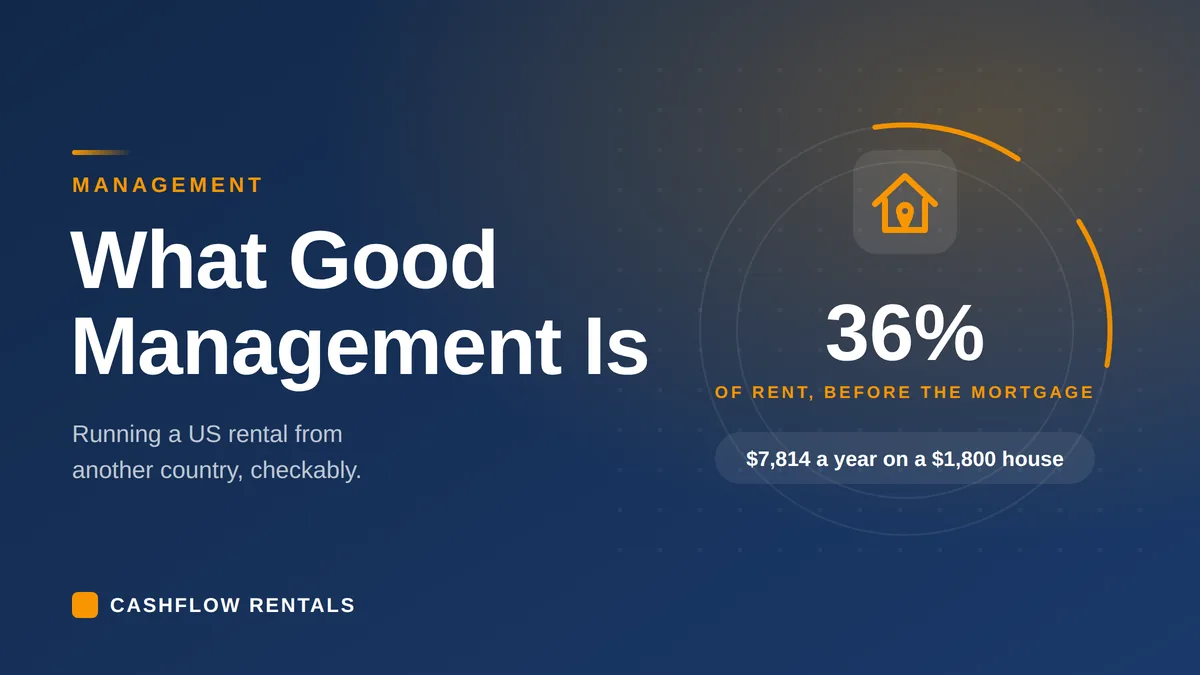
The property management fee is the part everyone negotiates and the smallest part of the answer. Here's a year on a house renting at $1,800 a month, using the figures from my own properties and the real fee schedules I've published elsewhere.
A year of management costs on a house renting at $1,800 a month| Line | Year one |
|---|
| Gross rent | $21,600 |
| Management fee at 8% | $1,728 |
| Lease renewal fee | $250 |
| Routine maintenance | $1,090 |
| Capital reserve | $1,513 |
| Turnover, amortized | $3,233 |
| Total | $7,814 |
That's 36% of the rent gone before the mortgage, the property tax or the insurance. And the manager's own fee is $1,728 of it, a little over a fifth.
I've written at length about all of these things separately. The fee stack, including the ones that don't show up until something happens, is in three real fee schedules compared. The maintenance and capital figures come from the schedules I budget to. The turnover number is the amortized cost of a tenant leaving, and it's the largest single line on that list, which is why I wrote what a turnover actually costs before I wrote anything else about property management. After doing this for ten years, I can tell you without any doubt that turnovers are the one thing that will kill your rental property business dead.
You can put your own house through the cash flow calculator with all six lines in it, not just the management percentage. Most pro formas you'll be shown carry two of the six.
Two costs sit outside this table and both surprise people. Property tax is the second largest running cost after the mortgage, and the number on the listing is often the last owner's bill rather than yours, which I go through in how US property tax really works. And the costs of buying and selling are their own subject, covered in what closing costs actually are.
6. What goes wrong, and how fast will you hear about it?
Things go wrong. That's not a management failure, it's a rental property. It's normal. You're either prepared for it, or you're not.
The tenant stops paying. The furnace dies in January. Somebody moves out and leaves the place in a state. A repair costs three times the estimate. None of that means you hired badly. What tells you whether you hired badly is the speed and the honesty of the message that follows.
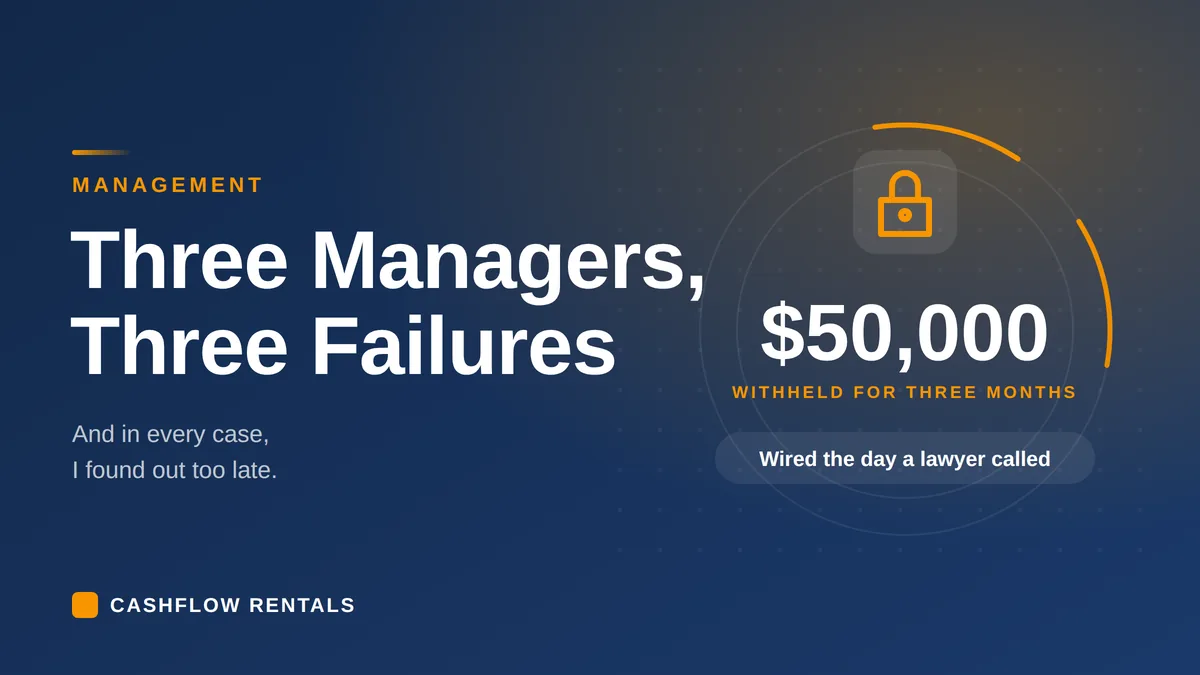
The failures that actually hurt are different, and they're almost always about money and information rather than events. Rent that gets collected and not passed on. Tenants placed without screening because a vacant house or a non-paying tenant earns nobody anything. Repairs invoiced that never happened. I've had all three, across a portfolio that reached 124 properties, and one manager withheld $50,000 of my rent. I've written the whole account in when your manager is the biggest risk, including what I should have caught and didn't.
I'll be plain about my responsibility in all of that. I was buying fast, in a market I didn't know well, and I wasn't checking. That's on me as much as on them. I learned some very expensive lessons, but it helped me to build the systems and processes I have today.
If you're buying into the Section 8 voucher program, the distance problem gets sharper again, because a failed inspection can suspend your rent until the repair is done. That's set out in the inspection problem, and what running voucher properties from Europe taught me is the honest version of the whole experience. Whether the program suits you at all is a separate question, and I answer it in is Section 8 a good investment.
7. Should you hire a manager, or run it yourself?
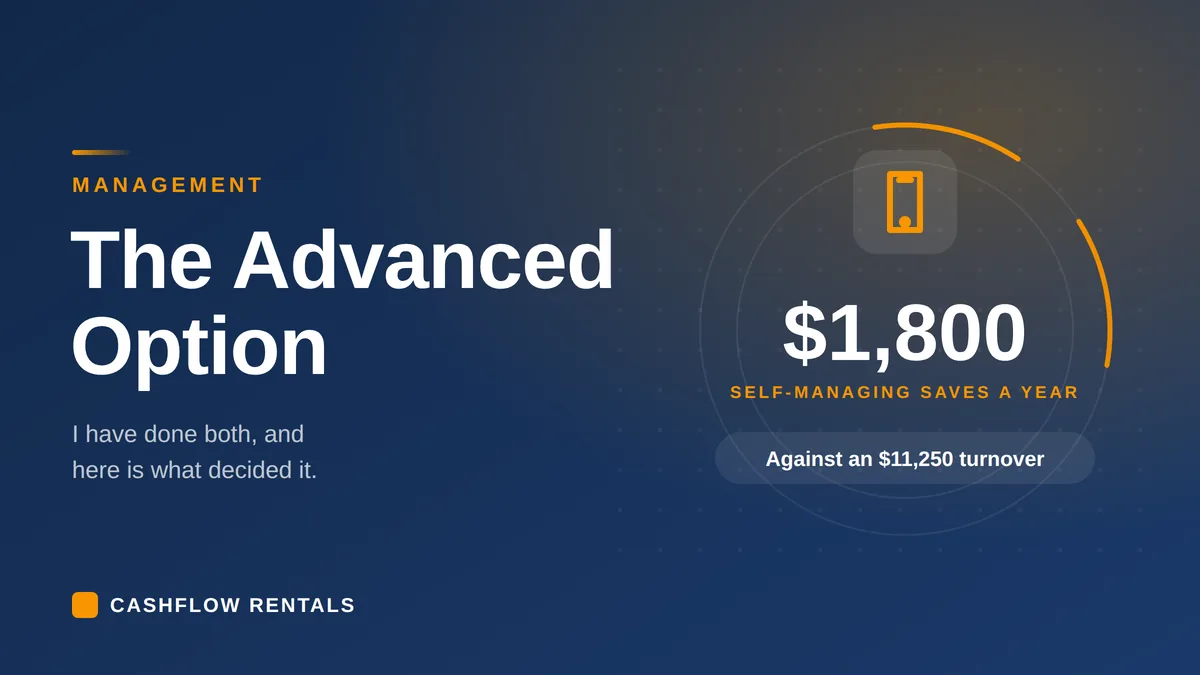
For a first US property, from another country, hire someone. Almost every time.
Self-management gets sold as the cheap option for beginners. In my experience it's for advanced investors only. It needs a network of service providers who answer your calls, a way to collect rent, someone who can be at the house in an hour, and enough local knowledge to know what a repair should cost. Those things take years to build, and you don't have them on your first purchase. I've done both, and the honest comparison is in self-managing from abroad against hiring someone.
There's also a scale point. One house doesn't justify the systems. By the time you own four or five in one market, the math starts to change in your favor, and so does your ability to check what you're being told.
8. Who else is on the team, besides the manager?
The manager is one of five or six people you'll need on call.
You'll want an insurance agent who understands non-owner-occupied policies, a CPA who has filed taxes for non-residents before, a title company that has closed for foreign buyers, and, once you own more than a couple, a contractor you can call independently of your manager. That last one is what makes the two-quote check possible.
I've written up how I built mine in the out-of-state portfolio article above, which is about assembling the team and the portfolio. This article is about running one once it exists.
The tax side deserves its own mention, because it's the piece most new owners discover late. America withholds 30% of your gross rent by default unless you file the right form, and it's your manager who will often ask you for it. The exact sequence is in how to stop the 30% withholding, and the wider picture is in the US tax guide for foreign investors.
One of my clients, Daniel, in Germany, is a good example of how this looks when it's working. We handled the entity, the financing, the sourcing and a remote closing, and he's now buying his second property while the first runs mostly on autopilot. You can read Daniel's case study for the detail. He has never seen either house.
9. What if the relationship stops working?
Sometimes it does, and the answer is to change manager rather than to sell the property or fly over. In fact, I am always building relationships with new managers in the neighborhoods I own. It makes a lot of sense to have a backup in case your existing property management relationship suddenly stops working out for whatever reason.
Two things make that switch easy or hard, and you should decide on both of them before you need to. The notice period in your PM agreement, and whether you hold copies of the lease, the deposit records and the tenant's contact details yourself. If your only copy of everything sits inside your manager's software, you're exposed.
I'm writing the full switching process as a separate article, because there's a right order to do it in and getting it wrong can cost you a month's rent. For now, the short version: line up the new manager first, check the notice period, and take copies of everything before you say a word about parting ways. The breakup of a business relationship always has the potential to turn acrimonious, so get what you need first.
10. Can good management make up for a bad house?
Management can only do so much. A house bought badly in a street nobody wants to live in will chew through tenants and managers, and no amount of oversight fixes that. That's the argument I make in why I buy quality over yield, and it's the reason my own portfolio is smaller and better than it used to be.
If you're buying turnkey, where somebody else has renovated and often placed the tenant already, the management question starts before you buy. Check the seller's numbers with the ten checks you can run yourself, work through the due diligence checklist, and read the nine questions investors actually ask before you commit. In my two markets, Kansas City and Cleveland, the difference between a street that manages itself and one three blocks away that never will is real and it is knowable in advance.
If you want us to handle the running of it, that's what our remote property management service is for, and it's built around the standard in section 3 rather than around a fee schedule.
The bottom line
I'd rather own a good house with an average manager than a poor house with a great one. Management is the second decision, and it can't rescue the first. As one of my own mentors says: "buy the dirt first, then the box".
But it's the decision you make every month for as long as you own the property, and it's the one where being far away actually costs you something. So make it checkable. Agree the approval limit in writing, insist on itemized statements, look at the photos, and price one repair bill a year. Twenty minutes a month, and you'll know more about your property than most owners who live down the road from theirs.
Investing isn't about certainties. It's about shifting the odds, and good oversight is one of the cheapest ways to shift them.
Everything I use to set this up for clients, including the questions I ask a manager before hiring, is in the foreign investor starter kit.
This article is general information, not legal, tax or investment advice. Cashflow Rentals is not a real estate broker, lender or investment adviser. Rules, costs and timelines vary by state and by your own circumstances, so please take advice from a qualified professional before acting.