1. What actually goes wrong when you pick badly?
Not the things people fear. Nobody steals your house.
What actually happens is less noticeable, at least at first.
A tenant gets placed because the house has been empty for six weeks and a vacant property earns the manager nothing.
Repairs get approved without being questioned. The statement arrives as a single net figure. Rent lands late, then later, then only when you ask.
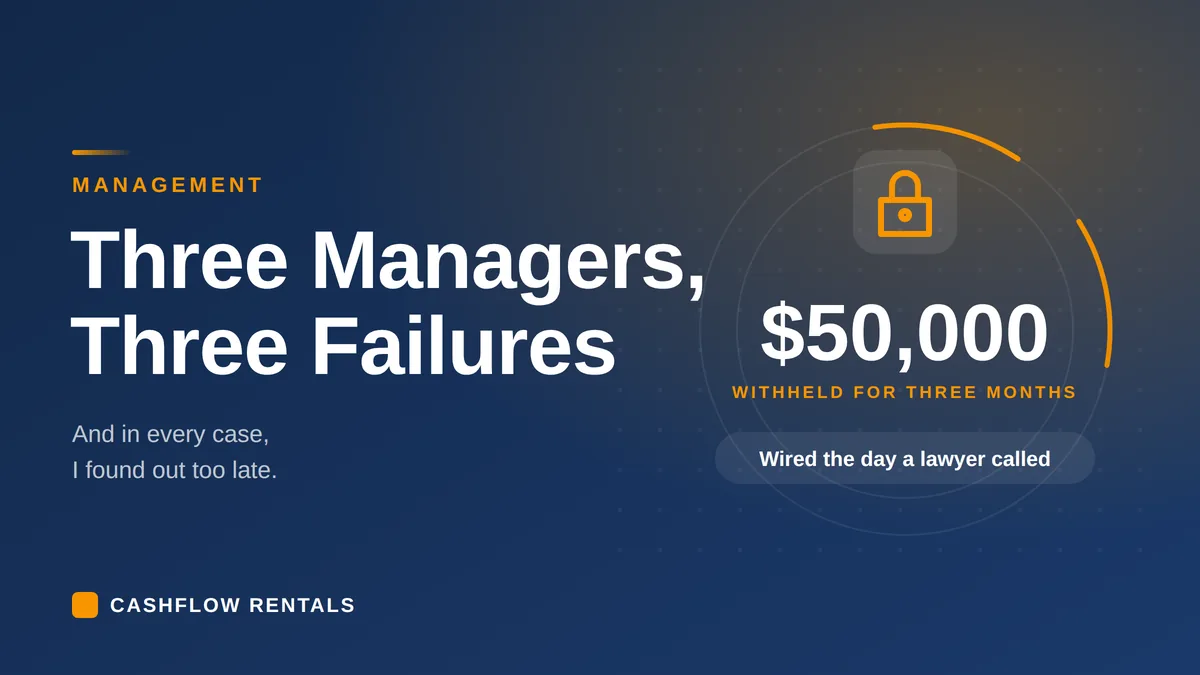
I have had all of it, including one manager who withheld $50,000 of my rent, and I have written up the whole account in when your manager is the biggest risk. The pattern in every case was the same. I did not check, because checking felt like distrust. And being honest, early on I had no idea what to check, or how.
Let's put a number on it.
A tenant placed badly and gone in a year costs you a turnover, and the two I have written about recently came to $9,000 and $7,000 before taking account of the lost rent, which is set out in what a turnover actually costs.
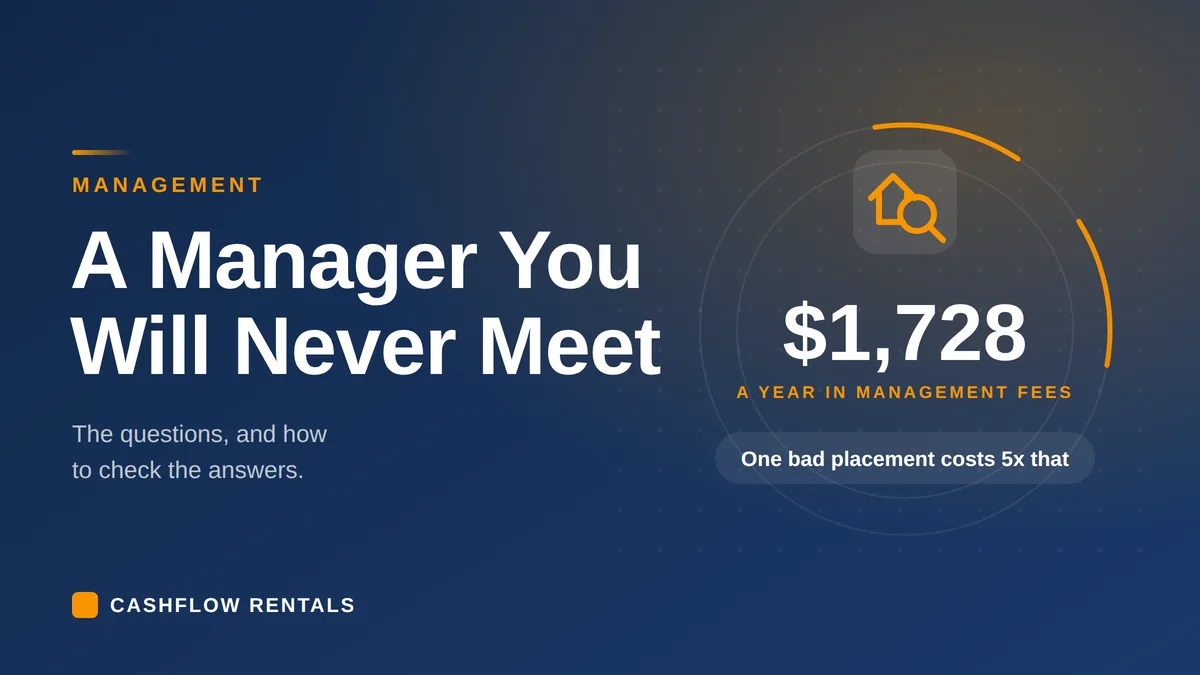
On a house renting for $1,800 a month, the management fee for a whole year is about $1,728. So one bad placement costs more than five years of the fee you spent so long negotiating.
That is the whole argument for vetting properly. The fee is not where the money is. I'd much rather pay a higher fee for a manager that places good tenants who pay and stay.
2. Where do you find US property managers worth talking to?
Four sources, in the order I trust them.
An investor who owns in that market and has worked with the same manager for years.
That is the best referral there is, and it is worth asking for on any forum where people actually own property rather than just talk about it.
Your own team. If you have an agent, a lender or a contractor in the market, they see managers from the inside.
Both of those points above are more important than you think. In real estate, especially as a remote investor, your network truly is your net worth.
Another place you can look is the state or city association directories, which at least tell you who is licensed and takes the trade seriously. Believe it or not, there are tons of unregistered and/or unlicensed property managers operating, especially in the cheaper secondary city rental markets where we tend to own.
And finally, the seller, if you are buying a turnkey rental, though treat that one carefully.
A manager recommended by the company selling you the house has a relationship with them, not with you. That is not automatically bad, but it is a fact to hold in mind, and it belongs alongside the other checks in the turnkey due diligence checklist and the ten seller numbers you can verify yourself.
My advice?
Talk to three. Two is not a comparison, and four is a week you will not get back. And if you are still weighing whether to hire at all, read my article on self-managing first: self-managing from abroad against hiring somebody. And for your first rental property bought from another continent, hire someone local.
One more thing on sourcing. Managers are local, so this is a market decision as much as a hiring one.
A street with no decent managers operating on it is telling you something about the street, which is part of how I choose where to buy in the markets I like and why. In Kansas City and Cleveland, where I own, the good operators cluster in the same neighborhoods the good tenants do.
Also, the tenant pool in many of these cheaper markets often requires very hands-on management for rent collections, delinquency management, and dealing with repairs, code issues, and neighbor complaints. If you're buying for cash flow, you're probably not buying in Beverly Hills, so bear that in mind.
3. What do you ask on the first call?
Here are my nine questions. None of them are particularly clever, and that is the point.
How many units do you manage, and how many people manage them?
How many are in my zip code?
What is your average days on market for a vacancy?
What is your written screening standard?
What happens when a tenant stops paying, and what does that cost me?
What is your spending limit before you call me?
How do you charge for repairs, and do you mark them up?
When do I get paid each month, and what is in the statement?
And how many owners left you last year?
That last one is the question nobody asks, and the answer tells you more than the other eight.
Listen for numbers. A manager who runs a real business answers with figures: 340 units, six staff, 22 days on market, 620 credit and three times the rent. A manager who answers in adjectives is describing a feeling. Remember, they're selling their service. If the numbers don't sell it, you'll hear a pitch, not the hard facts.
4. Which answers can you check without their help?
This is the part that separates vetting from interviewing.
What they tell you, and how you check it yourself| What they told you | What a good answer sounds like | How you check it yourself |
|---|
| We are licensed | The license number, offered without being asked | Look it up on your state's real estate commission site |
| We manage X units | A specific number, and how many staff | Ask how many in your zip code, then check their listings |
| We fill vacancies fast | Days on market, as a number | Search their current listings and see how long they have sat |
| Our tenants stay | An average tenancy length | Ask for it in years, then compare with the turnover math |
| We screen properly | A written standard with thresholds | Ask for the standard in writing before you sign |
| We do not mark up repairs | A clear yes or no, plus how they charge | Get two quotes yourself on the first real repair |
| We report monthly | An itemized statement with invoices | Ask to see a sample statement with the names removed |
The license check takes about five minutes. Most states license property managers through their real estate commission, and you can find your state's regulator in the directory of state licensing agencies. Membership of a body like NARPM, which publishes a code of ethics its members agree to, is a reasonable extra signal, though it is voluntary and it is not a license.
The sample statement is the request people skip. It is also the most revealing thing you can ask for, because it shows you what your own reporting will look like before you are committed to it.
5. What does the fee schedule tell you before you sign?
Ask for the full schedule, not the headline percentage. The percentage is the number everyone negotiates and the least useful one on the page, which I set out with three real fee schedules in what US property management actually costs.
What you are looking for is the overall shape of it. A manager who charges 8% with a full month's leasing fee, a renewal fee, a markup on maintenance and a fee for a vacant property earns considerably more from a tenant leaving than from a tenant staying. That is not dishonesty. It is an incentive, and you should know which way it points before you hire.
On repairs, ask the question directly. There are three ways a manager can make money on work at your house and only one of them appears on an invoice, which I have explained in how managers make money on repairs. A manager who answers that question plainly has just told you something useful about how they operate.
Get two documents before you decide, not after. The full fee schedule and the management agreement itself. Any manager who will not send both before you commit has answered a different question than the one you asked. The clauses that matter most in that agreement are the spending limit, the notice period and what happens to your documents when you leave, which I go through in
the management agreement clauses a remote owner must check.
6. How do you get anything useful out of references?
The references you are given are chosen by the person sending them. So do not ask whether they are happy, because the answer is invariably yes.
Ask when the last vacancy was and how long it took to fill.
Ask what the largest repair bill was in the past year and whether they were called first.
Ask whether the statement ever needed explaining.
Ask what the manager is bad at, which is the only question that gets an honest answer, because everyone has an answer to it.
And ask one question the manager cannot prepare for: how many properties do you own with them, and how many did you start with? An owner who started with one and now has four has voted with their money.
If you can find an owner who left, that conversation is worth all the others put together. Ask on the same forums where you found the referral.
7. What should you ask about tenants?
The screening standard, in writing, with numbers in it.
Mine is an income multiple of three and a credit score floor of 620, applied to every applicant the same way. I set it out in full in how I screen a tenant, which is written around voucher tenants and applies the same test to everybody. I did not always work that way. I used to rent to almost anyone, and it cost me a great deal of money.
A manager without a written standard is not necessarily careless. But they cannot show you what they do, and you cannot check it from another continent, so it comes to the same thing. Remember, we're not trying to create certainty of outcome, that's impossible. What we are trying to do is stack the probabilities of success in our favor.
If your property is in the voucher program (Section 8), add two questions. How many voucher tenancies do they currently manage, and who handles the inspection. A failed inspection suspends your rent until the repair is done, which is a lever no other tenancy gives a tenant, and it is set out in the inspection problem. Managing that from Europe taught me more than I wanted to know, and it is in Section 8 for overseas investors.
8. What should make you walk away?
Broadly speaking, there are six red flags. Any one of them is enough.
No license where the state requires one.
No written screening standard.
No spending limit, or a limit they will not put in the agreement.
A refusal to send the agreement before you commit.
A statement that shows only a net figure.
And a manager who has never lost an owner, which either is not true or means they have not been doing this long.
There is a seventh, and it is softer. If they never mention anything going wrong across the whole conversation, you are talking to somebody selling rather than somebody operating. Every real manager has a story about an eviction, a flood or a tenant who stopped paying. The ones who tell you are the ones who will tell you later, when it is your house.
If you take anything from this article, take this. Owning real estate and managing it well will grow your wealth. But it will also give you problems. Anyone pushing the hassle-free narrative is not being honest. You can't eliminate problems, but you can have proper systems and processes in place to deal with them when they occur.
9. What do you do in the first month?
Vetting does not end when you sign. The first month is when you find out whether the answers were true.
Read the first statement line by line and ask about anything you do not recognize.
Check the rent arrived on the date the agreement says.
Ask for the inspection photos with dates on them.
And on the first repair over a couple of hundred dollars, get two quotes of your own for the same work, quietly, without making an argument out of it.
Then put the whole thing into your numbers. Management, maintenance, capital and turnover together take a large share of the rent before the mortgage, and you can see what is actually left on your own property rather than on the seller's projection. The reserve side of that is in the maintenance and capital schedules I budget to, and the largest running cost after the mortgage is the property tax bill, which is rarely the figure on the listing, as I set out in how US property tax really works.
There is one piece of paperwork your new manager will raise in the first month, and they often ask for the wrong form. America withholds 30% of your gross rent by default until you file, and the order it goes in is in how to stop the 30% withholding.
Karl, one of my clients, went through this on his first US purchase from Taiwan, having already owned rentals in Taipei. The American version (and culture) of the job surprised him, which is the point of doing the checks before you need them, and his purchase is written up in his case study.
If you would rather not run this process yourself, working with managers who already handle overseas owners is what our remote management service is built around.
The bottom line
A good property manager can rescue an average investment. A bad one can wreck an otherwise perfect purchase.
I would rather hire a competent manager I can check than a brilliant one I cannot.
Almost everything on this page is designed to make the relationship verifiable, because verification is the thing distance takes away from you. Nothing here requires you to be suspicious, and I am not suggesting the trade is full of crooks. Most managers are decent operators doing a hard job for a thin margin.
But you are hiring somebody to spend your money and choose who lives in your house, from four thousand miles away, on the strength of one phone call. Two hours of checking is not paranoia. It is the cheapest insurance in the whole business.
The standard to hold them to once they are hired is in what good property management looks like. And if it goes wrong later, changing manager is a process with an order to it, not a fight.
Everything I use to run this process, including the questions in section 3 as a checklist, is in the foreign investor starter kit.
This article is general information, not legal, tax or investment advice. Cashflow Rentals is not a real estate broker, lender or investment adviser. Licensing rules and landlord law vary by state, so please take advice from a qualified professional before acting.