1. Is turnkey actually passive?
This generated more discussion than anything else, and the honest answer is no, it is not.
It is delegated, not passive. Somebody else does the work. You still choose them, check them, and pay for what happens when they get it wrong.
And the checking is a real job. Read the monthly statement properly rather than glance at the net figure, because two of the three ways a manager profits from repairs never appear on it, as I have set out in how property managers make money on repairs. Get video of repairs. Once a year, check a repair bill against two quotes of your own. Ask your manager their average tenancy length. None of it is hard and all of it takes time.
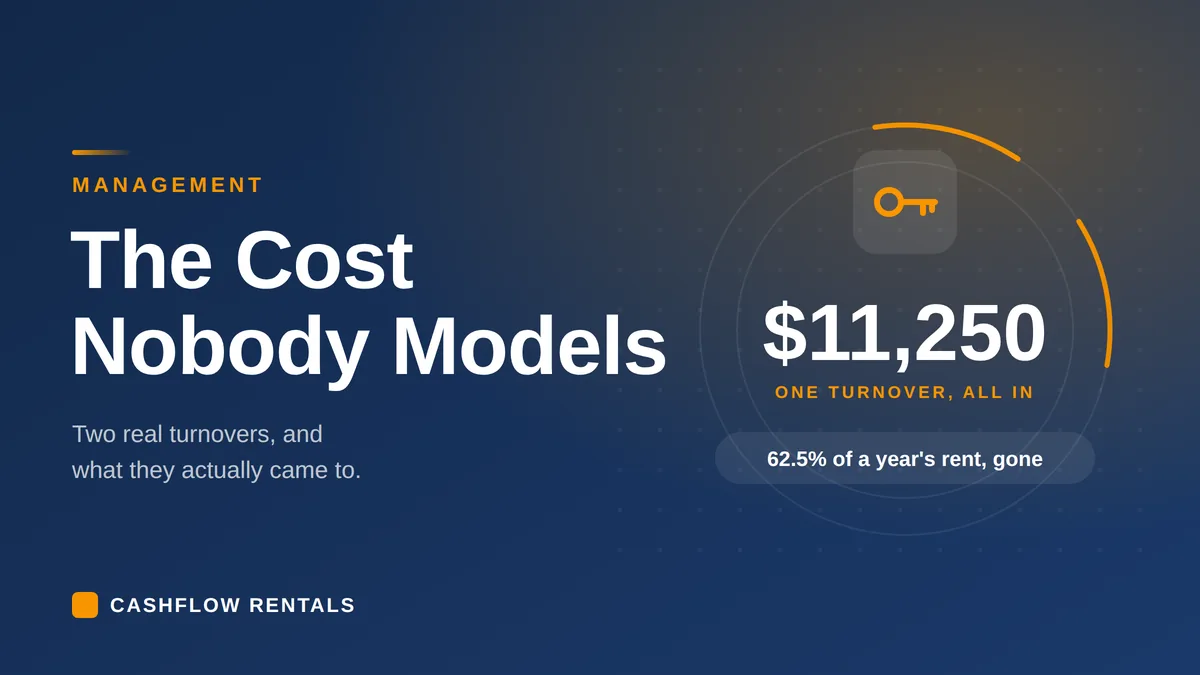
The clearest way to see it is through what it costs when nobody checks. A turnover on a property I am involved with in Cleveland cost $9,000, rising to $11,250 once the empty months were counted. That is 62.5% of a year's rent. The tenant left partly because repairs were not being handled, and that was a management failure rather than an act of God.
Want truly passive? Buy a REIT. Want to own a house 4,000 miles away? Expect to spend a few hours a month on it, and rather more if you decide to run it yourself, which I have set out in should you self-manage a US rental from abroad. The full picture of what turnover costs, and why tenants actually leave, is in what tenant turnover actually costs.
2. Are turnkey providers scams?
Some are. Most are not. And the useful question is not which, but how you tell.
The bad ones, in my experience, typically follow a pattern. Buy a cheap house in a rough area, do a surface renovation, place whatever tenant will sign a lease, and sell it to somebody who will never see it. The buyer finds out when the tenant leaves or the roof fails.
Here is a test that can be very revealing, and it is a sum rather than a hunch. Look up what the seller paid, which is public record at the county. Then ask yourself whether the gap between that price and yours could have paid for the work they claim, plus buying and selling costs, plus holding costs, and still left them a profit.
My client Daniel bought this way in Cleveland and Kansas City, and his purchase is written up in his case study. On a deal I am helping a client to purchase now, a contractor bought a house for $50,000 and put about $80,000 into it, including a basement conversion adding two bedrooms and a bathroom. It is selling at $180,000. After finance, holding, transaction costs and my fee, his margin is about 17%. That is a working margin, and the arithmetic supports the work.
On another house I looked at, it was listed at $40,000 and sold on at $85,000 five months later as fully renovated. That work at trade rates comes to about $54,000, and with closing and holding costs you are near $63,000, against a $45,000 gap. It does not add up. That is not proof of anything dishonest, but it is a question with a good answer if the work was really done.
The arithmetic test on two real deals | The deal that adds up | The deal that does not |
|---|
| What the seller paid | $50,000 | $40,000 |
| What it sells for | $180,000 | $85,000 |
| The gap | $130,000 | $45,000 |
| Cost of the work claimed | About $80,000 | About $54,000 |
| Work plus closing and holding | Inside the gap | About $63,000 |
| Does the arithmetic work | Yes, margin about 17% | No |
A big margin is not the warning sign. You want your seller to have made money, because that is what paid for the work. The warning sign is a margin too small to have funded what they say they did. The whole method is in how to check a turnkey seller's numbers.
3. What am I paying for that I could not do myself?
In theory you could find the house, buy it cheap, hire a builder, run the renovation project, place a tenant and appoint a manager. Locally, with time, many people should.
But from another continent, every link in that chain becomes harder and more exposed to risk. You cannot walk the house, meet the builder, check the work, or feel the difference between two streets four minutes apart.
What you are buying with turnkey is time, and verifiable work. A finished house, in a market somebody knows, with one party to answer to rather than six. You give up the renovation margin for a shorter and safer path.
And there is one advantage that takes years to build and cannot be bought. A recent tenant turnover in Kansas City cost me $3,100. The market price for that work was about $7,000. The difference is a contractor who gives me cost pricing because we buy houses from him. A reader in year one pays the $7,000, and that gap is the honest case for using somebody with an existing network.
But the trade only works if the seller is good, and honest. Which makes your vetting process the real question, not turnkey against doing it yourself.
4. Am I overpaying?
Usually you buy a turnkey property at or near retail, with little day-one equity. That is the deal. They took the renovation spread and you got a finished, tenanted, managed house.
The better question is whether the price holds up, and there are three tests. Does it match recent sales of similar renovated homes on like streets, not across the whole postcode? Other questions worth asking include: does the rent come from signed leases rather than guesses? Are the running costs and the assumptions for vacancy, maintenance and repairs realistic, as set out in maintenance, repairs and capital?
What people miss is how many people take a cut. The usual chain runs investor, turnkey firm, main builder, then the trades. Every layer needs paying. On the deal above there is no turnkey firm in the middle. The builder bought and renovated the house himself, and he pays me 5% for finding the buyer.
Worth knowing that some of the best-known turnkey names are not operators at all. They run the same model I do, referring their members to providers and taking a fee. There is nothing wrong with that, but it is another layer, and you are paying for it. Through the conventional chain, that same house would need to reach an investor somewhere between $212,000 and $225,000 rather than $180,000.
So the better question is not how much the seller makes. It is how many people make something, and whether the price still works after all of them.
5. How do I verify the numbers?
This is where deals live or die, and the seller's figures are marketing.
Three figures are wrong more often than any others.
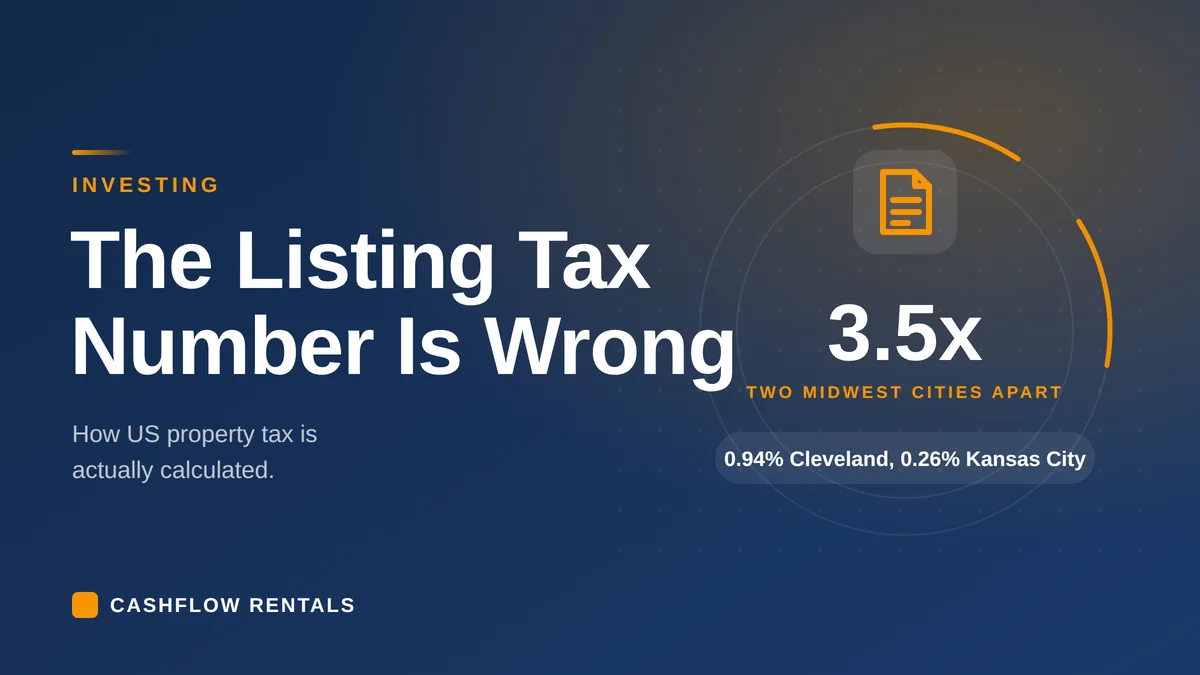
Property tax. A Detroit listing I priced quoted $1,130 a year. The assessor's record showed the homestead exemption had gone and the assessment was uncapped. The real figure was closer to $3,100. On three real client purchases, annual property tax ranged from 0.26% to 0.94% of the price, and the low end is low for reasons that will not last.
Insurance. An Indianapolis listing quoted $780. An independent quote on a comparable house nearby came back at $1,647.
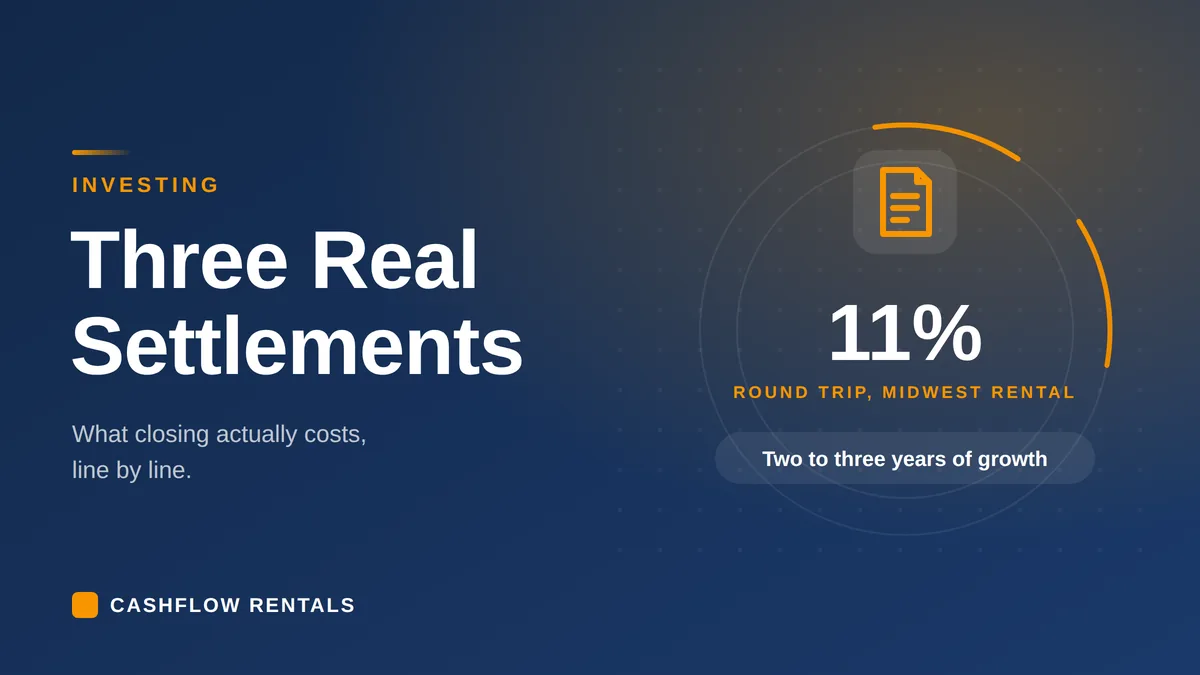
And closing costs. On three real settlement statements, buying costs ran from 4.04% to 7.53% of the purchase price, with the state driving most of the difference because Ohio title charges are three times Missouri's. Add the sell side and a round trip is about 11% of value.
Rebuild the numbers on your own terms. Real tax, your own insurance quote, honest void periods, a proper turnover provision. If the deal only works on the seller's figures, it does not work. The line-by-line detail is in what closing costs actually are and how US property tax works.
The one thing to remember: the numbers you were shown are the seller's best case. Rebuild them yourself with real figures before you commit, because nobody else will.
6. Can I even do this from another country?
Yes, and thousands of people do. No citizenship or residency needed. But four things nobody mentions until later.
Your rent is taxed at 30% of gross by default, before any deduction, unless you proactively elect otherwise on your US tax return. On $36,000 of rent that is $10,800 a year whether or not you made a penny. With the election it is often a few hundred. The mechanics are in how to stop the 30% withholding.
When you sell, up to 15% of the gross price is held back by the buyer. It is a deposit rather than a tax and usually most of it is returned after your next US tax return, but the timing is slower than you expect and getting it back is its own process.
Your estate tax allowance is $60,000, against roughly $15 million for a US citizen. That one catches people badly and it is worth knowing before you buy, not after, and I have priced every way out in US estate tax for foreign property owners.
And your LLC has a yearly filing you have probably never heard of. Form 5472, with a fine starting at $25,000 and no cap, set off by wiring your own deposit into your own company. That is the $25,000 form nobody mentions.
None of it stops anybody. All of it is cheaper to plan for than to find out.
7. Who manages it, and how do I trust them?
For a hands-off owner abroad, the manager largely is the investment. A good house with a poor manager loses money, and my own three worst are in when your property manager is the biggest risk.
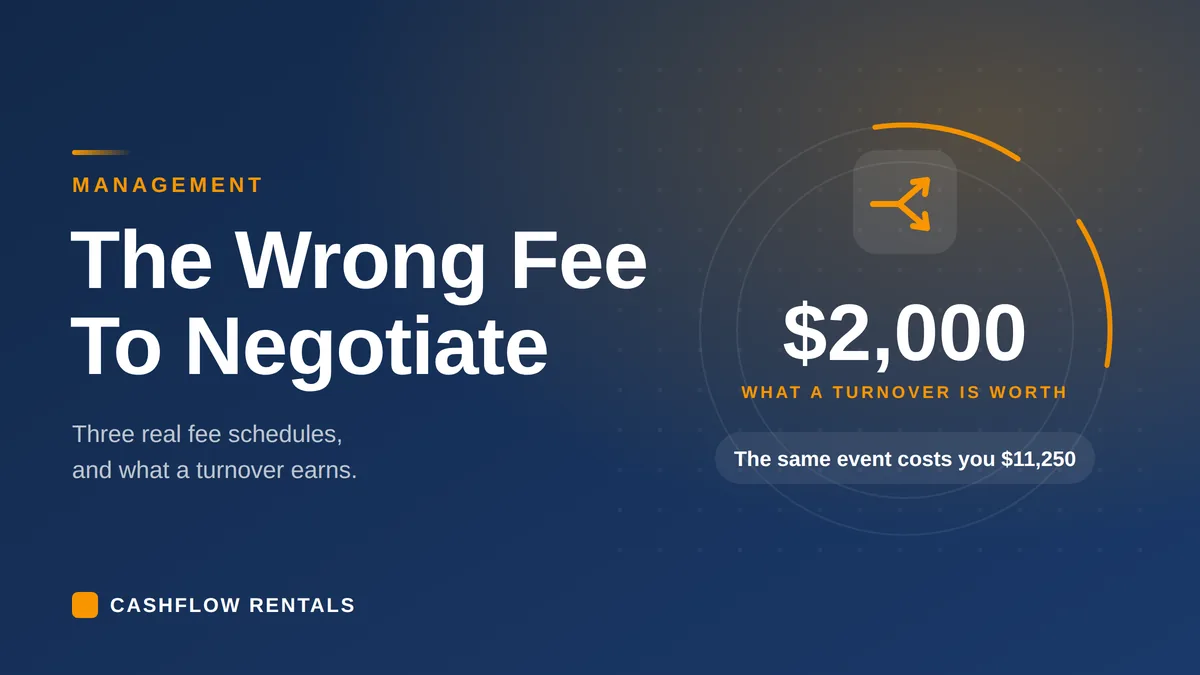
And there is a structural problem worth knowing before you sign. On three real fee lists, a manager earns roughly $1,850 to $2,000 more from a tenant leaving than from that tenant renewing. The same event costs the owner $11,250.
Nobody has to be dishonest for that to hurt you. A manager acting sensibly within a normal fee list does not mind if your tenant goes, and may do better if they do.
The headline rate tells you almost nothing either. Of those three lists, the one charging 8% was dearest on a turnover and the one charging 10% was cheapest, because the renewal fee and the repair markup mattered more than the monthly rate.
The best single question is not about fees at all. Ask how many renewals they did last year against new placements. A manager renewing most of their tenancies is managing well. One replacing most of them is earning well. The full arithmetic is in what US property management actually costs.
8. Which market, and what should I buy first?
The usual turnkey markets are cheap midwest and southeast cities, because that is where a modest house still yields. Cleveland, Kansas City, Indianapolis, Memphis, Birmingham.
But a cash-flow city and a good street are not the same thing. These places have blocks of solid rentals and blocks two minutes away you would not want to own on, and you cannot feel that from abroad.
Here is the case for boring houses, with a sum. A turnover on a Cleveland property costs $11,250. Spread across a two year tenancy that is 31.2% of gross rent every year. Across eight years it is 7.8%.
The same $11,250 turnover, spread across different tenancies| Tenancy length | Turnover cost as a share of gross rent, every year |
|---|
| Two years | 31.2% |
| Eight years | 7.8% |
| The difference | About 23 points of gross yield |
So a house that holds a family for eight years rather than two is worth about 23 points of gross yield. Not net. Gross, on the top line, from nobody moving.
Which is why I buy three bed two bath houses near schools people want, and why a one bed with a higher headline yield does not interest me. That headline assumes a tenancy a one bed does not produce. There is more on how markets actually compare in the best buy-to-let markets in the USA.
9. How do I fund it?
Three routes, and one rule that catches people out.
Cash is simplest and avoids lender friction, which matters from abroad. You give up the borrowing that drives most of the return.
A foreign national DSCR loan qualifies the rent rather than your income, and you can test any property against one in the DSCR loan calculator. Expect 25% to 35% down and a higher rate than a resident gets. Usefully, a loan on a house you own elsewhere does not cut what you can borrow, because the lender looks only at this house.
And here is the rule. Your lender cares where the deposit came from, not just that you have it. Money borrowed recently is refused. Credit cards, personal loans, credit lines. I had a client lose a deal over exactly that, with the house under contract and a lender already approved.
It is a timing rule rather than a flat no. I went back to that lender and asked. They confirmed the same money would have been fine after 60 days in the account. So the order matters more than the source. Raise it, wait, then start looking at houses. The full detail is in how to fund a US property purchase.
What I would actually do
Six things, in order.
Get the tax number and the company sorted before you look at houses, not after you go under contract.
Raise the deposit early enough to let it sit, and hold one full turnover in cash on top. On these numbers, about $10,000 a house. If you can fund the purchase but not that, I'd rather you didn't buy yet.
Look up what the seller paid and ask whether the gap funds the work they claim.
Get your own insurance quote and your own tax figure from the county, then rebuild the numbers.
Pay for your own inspection, and ask for the scope of work so the inspector can check named items rather than reporting in general.
And interview the manager as closely as you look at the house, because they decide most of your outcome.
If you would rather have somebody who has already done all of that on a specific property, that is what our property sourcing service is for, and the free tools in my investor starter kit will let you rebuild any pro forma yourself first.
The bottom line
The most argued-over question in turnkey investing is whether it is passive, and the answer is no. It is delegated, and delegation needs watching.
The second is whether sellers are scams. Some are, most are not, and you can tell the difference with public records and a sum rather than a hunch.
Everything else on the list comes down to the same habit. The numbers you were shown are somebody's best case. Rebuild them with the real tax figure, your own insurance quote, an honest turnover provision and the whole management fee stack, and see if it still works.
If it does, buy it and hold it for a decade, which on a real ten year model I have worked through in selling a US rental as a UK resident. If it only works on the seller's spreadsheet, you have learned something valuable for the cost of an afternoon.
Remember, investing is a game of probabilities. Verification is how you move them.
This article is general information, not investment, tax or legal advice. Cashflow Rentals sells turnkey rental property to overseas investors and therefore has a commercial interest in this subject, which is disclosed above. The questions were identified by reviewing publicly visible discussions in a large online real estate investing community and ranking them by volume of discussion; no comments are reproduced and no other company is named. Figures come from the author's own transactions, real client settlement statements, county records and anonymised management fee lists, and are examples rather than benchmarks. Costs, taxes and lender criteria vary by market and change over time. Always commission your own inspection and take advice from a cross-border CPA before buying.