Does turnkey make more sense from another country?
For most overseas investors I've worked with, yes, for a first purchase at least. But it should be done for the right reasons, which aren't necessarily what most turnkey marketing suggests.
Buying a turnkey property doesn't remove risk. It removes the need for your physical presence. Somebody else finds the house, renovates it, places a tenant, and appoints a property manager, and none of those jobs need you in the room.
For a buyer in Toronto or Taipei who can't fly to the US three times, that's a large part of the problem solved. For a buyer who already lives locally in the market, has a contractor and knows the streets, buying turnkey means paying someone else's profit margin for work they may already know how to do themselves. That's why the same product looks sensible to one person and expensive to another, and both of them are right.
I should say plainly that I'm paid on sourcing the renovated houses I introduce to overseas investors, so I have an interest in you buying one. The honest guide to turnkey investing sets out what my layer of the transaction costs and what the whole chain costs, so bear that in mind when you're reading this. I have a bias.
The marketing message I would push back on is the word passive, which gets bandied around a lot by turnkey sellers. I've written about that in more detail in whether a turnkey rental is actually passive income.
What actually changes when you are not a US resident?
Seven things change immediately, although most of them aren't costs in themselves.
The same purchase, from down the road and from another continent | A local US buyer | You, from abroad |
|---|
| Seeing the house and the street | Drives past before offering | Photographs, video, Street View, somebody else's eyes |
| Financing | US credit and income-based finance widely available | Foreign-national DSCR is often the practical route; US credit history may not be required |
| Owning entity | Often personal name | Often a US LLC, particularly when financing requires one |
| Banking | Existing US account | New US business account, opened remotely |
| Tax on the rent | Reports rental income on a US tax return | Special nonresident tax rules apply; many investors elect to be taxed on net rental income rather than 30% of gross |
| Inspection | Attends, or drops in during the work | Directs an inspector by email and reads the report |
| The manager | Can visit the property and meet the manager locally | Relies heavily on statements, photographs, video and third-party checks |
Read that table and the pattern is obvious. Every row where a local buyer can use their own eyes becomes a row where you use somebody else's. That's the real change, and every one of the practical items below follows from it.
The mechanics of running that process step by step, from scope sign-off to who signs what, sit in buying turnkey sight-unseen from abroad. This article is about what changes and why it costs what it costs.
How do you finance a turnkey house without US credit?
Usually with a DSCR loan, and this is the part that surprises most of the overseas buyers I work with.
A DSCR loan is underwritten on the property's rent against the mortgage payment, taxes and insurance. It doesn't need a US credit score, US tax returns or US employment. I've used about $5.5 million of them building my own portfolio, so I'm not describing something I've read about. I've done it, a lot.
Three numbers worth knowing before you look at a house.
On the foreign-national programs I use, 70% to 75% of the purchase price is achievable, so plan on a 25% to 30% down payment.
Interest rates are normally higher than a US resident would pay on comparable financing, but the gap has narrowed a lot since 2016. As I write this at the end of August 2026, I'm seeing foreign-national DSCR rates as low as 6.875%. That's remarkably close to prevailing conventional mortgage rates for well-qualified US borrowers, although they are very different loan products.
Put simply, a DSCR loan measures the property's ability to cover the mortgage payment with its rental income. A ratio of 1.00 means the rent and housing payment are equal; 1.20 means $1.20 of rent for every $1.00 of payment. Programs vary, and some lenders will go to 1.00 or even below, but I prefer to see a deal comfortably above that rather than relying on the lender's minimum. Also, rates and terms improve a lot with a stronger DSCR. You can get an idea of current DSCR rates for foreign nationals on my regularly updated rates page.
Two things trip up overseas buyers more than the rate does. Where your down payment funds came from matters, and a recently borrowed lump sum is not the same as seasoned savings, which is why proving your source of funds is worth reading before you move any money. I've seen more than one deal fall apart because the lender couldn't verify the original source of the funds, or because the source itself wasn't permitted under the program.
The lender will also order an independent appraisal. That appraisal, along with the home inspections we order separately, is where some deals fall apart after the buyer has already spent money. I've broken down why DSCR applications get declined and which of those costs you can lose along the way.
What do you have to set up before you can buy?
For most financed purchases I handle, you'll need a US legal entity such as an LLC or LP, a US tax identification number for that entity (an EIN), and a US bank account for the entity. The order matters because each one depends on the last.
The LLC needs an EIN, which is its federal tax identification number. A foreign owner without a US SSN or ITIN generally can't use the IRS online EIN application, so the process is handled through the IRS's international routes instead. That is one reason I don't leave it until I've found the house. Setting up the LLC, the EIN and the bank account before your loan walks through the sequence and the current wait times.
One of the easiest ways to lose a turnkey house unnecessarily is to find one you want and then discover that your entity and banking aren't ready.
Now the cash. Here's what a non-resident actually brings to the table on a $180,000 turnkey house at 30% down.
Cash needed at closing on a $180,000 turnkey house, non-resident buyer| Item | Amount |
|---|
| Deposit at 30% | $54,000 |
| Buying costs, low end, after a seller credit | $4,842 |
| Buying costs, at the high end I've seen | $13,554 |
| US entity formation | $995 |
| Reserve I'd insist on, per property | $5,000 |
| Total, low | $64,837 |
| Total, high | $73,549 |
That's 36% to 41% of the purchase price, against a headline that says 30%. The buying cost range isn't a guess: across four real client deals I've written about recently, the costs ran from 4.04% to 7.53% of the price before any seller credit, and I've broken those down line by line in what closing costs actually are on a US rental. What each of these came to on real deals has the fuller version.
The low row in that table sits under the range because of a seller credit. Karl bought a Kansas City house this February, and a $2,500 seller credit plus a county tax proration cut his buying costs to 2.69% and his cash at the table to 32.69% of the price, before the entity and the reserve. That is the lowest I've seen.
All three comparable sales in his appraisal carried a seller concession as well, so concessions clearly weren't unusual among the properties the appraiser selected. But you can't budget for a concession nobody has offered you yet. Budget the top of the range and enjoy it if you land at the bottom.
The reserve is the line people argue with and it's also the one I'd defend hardest. I keep at least $5,000 per property in an interest bearing cash account, and it isn't there for the rate or the rent. It's there for the month the furnace dies and the tenant leaves. If funding it is what makes the deal impossible, that's a reason to buy next year rather than this one.
This goes back to the passive question. Owning real estate means that, at some point, you'll be dealing with unexpected and potentially expensive problems. You can't opt out of that, but you can choose to be the person with $5,000 on hand to solve it without sweating. Choose which investor you want to be before that happens.
What does the 30% withholding cost you?
This is potentially the biggest foreign-only cash-flow problem in the whole investment, and most buyers have never heard of it when they first call me.
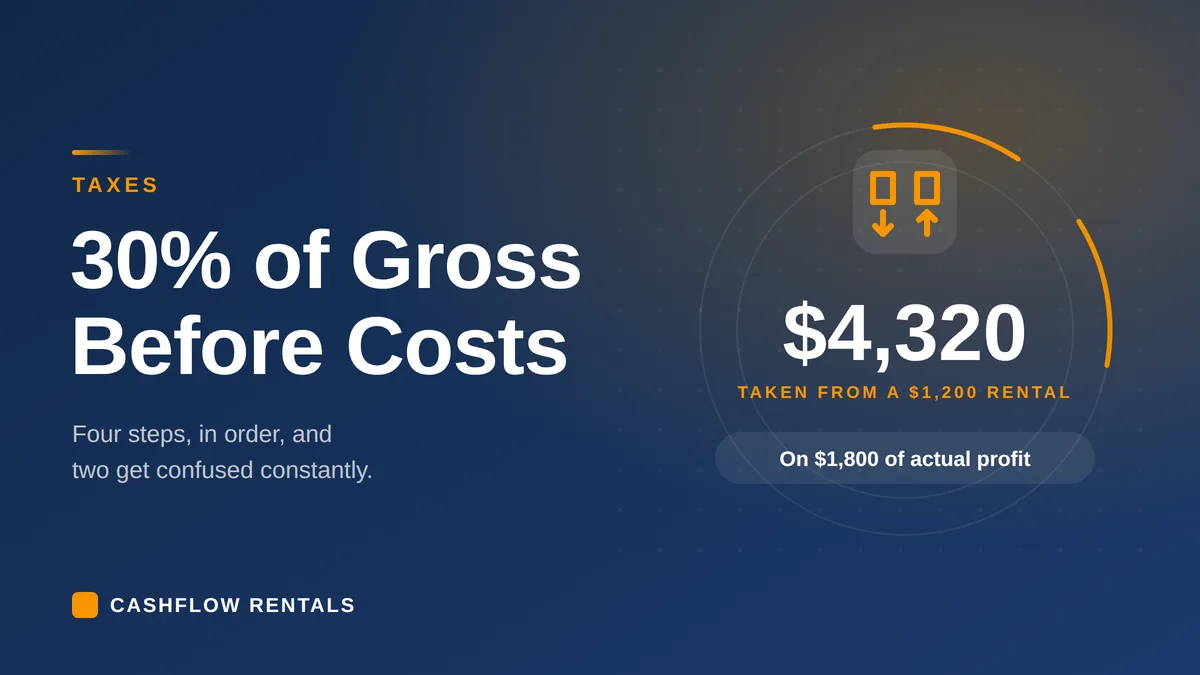
Under the default US tax treatment for a nonresident alien, rental income can be subject to 30% withholding on the gross rent, unless a lower treaty rate applies. Not from your profit. From the rent, before a single expense. Which means it happens if you do nothing.
On the example above, leased at $1,750 a month, the math is unforgiving.
Gross rent is $21,000 a year. 30% of that is $6,300 withheld at source, which is $525 a month. On the same house, once you've paid the mortgage, the taxes, the insurance, the management, the vacancy and set aside for turnover and capital, the cash flow is roughly break-even.
So the default withholding is the entire difference between a house that breaks even and one that loses money every month, and it has nothing to do with how good the deal is.
It's also largely avoidable with the right tax setup.
A Section 871(d) election on your US tax return allows a nonresident alien to treat US rental income as effectively connected income, so tax is calculated on net rental income after allowable expenses rather than 30% of the gross rent. The election is made with your US tax return.
Before that first tax return is due, Form W-8ECI can already matter. It's given to the person paying or collecting the rent so they can treat the income accordingly. How to stop the 30% withholding on your US rent sets out the forms, the timing and the arithmetic.
I'm flagging it here rather than burying it because of the timing.
Form W-8ECI goes to the withholding agent rather than the IRS, and the instructions say to provide it before income is paid, credited, or allocated to you.
The Section 871(d) election itself is then made with your tax return. Get the paperwork wrong and you can have $525 a month withheld while you sort it out.
The one thing to remember: when you can't stand in the house, the person selling it to you is most of the investment. Every check a local buyer runs with their own eyes, you're paying somebody else to run. Choose those people with the care you'd otherwise spend on the property.
Who checks the house if you cannot?
I write a lot about the fact that I see real estate as more of a people business than a property business. Your team is everything. From abroad, three people become particularly important, and you have to know how to direct them. The fourth pair of eyes is yours.
Your inspector. Not the seller's. You pay, you choose, and you tell them what to look at. The single most useful instruction is to ask for a component age inventory alongside the defect list: roof, furnace, air conditioning, water heater, supply pipes, drains, panel, windows and sewer lateral, each with an install date and a remaining life. A standard report is written for somebody about to move in. You want the one written for somebody who'll own the building for ten years with a tenant in it. I'd add a sewer camera, which runs about $250 and finds the problems nobody can see.
The appraiser. Ordered by your lender, and you're entitled to a copy. Almost nobody reads it. It carries the appraiser's square footage and bedroom count, comparable sales, and two ratings that tell me far more about the house's present condition than the year it was built. That's the subject of what actually predicts maintenance risk on an older rental.
The property manager. Call them before you buy, not after. Ask what the house will really rent for, and ask them to support it with properties they've actually leased or comparable rentals they're seeing now. Then look at them properly. Vetting a US property manager as an overseas owner is the piece I'd read first, and the standard I hold any manager to is the one after it.
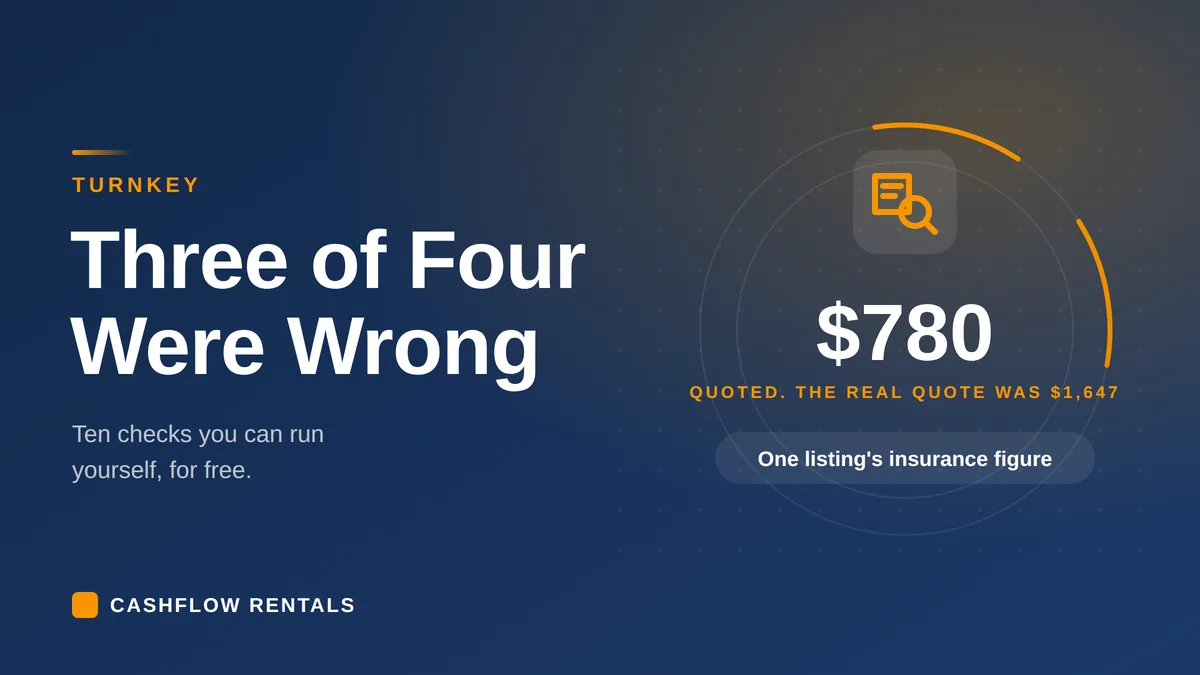
Yourself, on the paperwork. County records can often tell you when the seller bought and, depending on the jurisdiction and transaction, what they paid. The tax record is public. An insurance quote is a phone call. Those three take an afternoon and can catch some surprisingly expensive assumptions before you've spent much money. I've set out the ten checks you can run yourself, free, and the turnkey due diligence checklist covers what else to request and in what order.
What you don't do is take the seller's word for the condition, the rent or the running costs. Including mine.
What surprises overseas owners most?
Not the money. The behavior. In my opinion, being a landlord teaches you more about a culture and how people live than almost anything else.
Karl is a client of mine in Taiwan, and he'd been a landlord in Taipei for years before he bought in the US. He knew how to be a landlord. What he didn't know was that the tenancies he encountered in the US were shorter than he was used to, that the landlord was responsible for more of the maintenance, and that monthly reporting from a manager was normal rather than a sign something was wrong. His case study covers what he bought and what happened.
That expectation gap is real and it's underrated. It shows up in three places.
Tenancy length. In the markets I work in, a tenant staying two years wouldn't surprise me. If your home market runs on much longer tenancies, your mental model of turnover cost can be badly out of date. And turnovers are the one thing that will turn you cash flow negative quicker than almost anything.
Who fixes things. The division of responsibility may be different from what you're used to. On the US rentals I deal with, the owner carries much of the cost of maintaining the building and its systems, even though the lease may put some smaller items on the tenant. This is true of my own situation. I rent my home here in Brazil. Outside of any structural issues, it's me who is responsible for general maintenance. If I need to replace a door handle, or fix a small leak, that's on me.
Property tax. This is one of the biggest adjustments for some overseas buyers. In parts of the US it can be one of the largest running costs on the house, and I've repeatedly seen turnkey listings using the previous owner's tax bill on a pre-renovation valuation. Why the tax figure on a listing can change explains the mechanism.
None of that makes the US a worse market. It makes it a different one. The mistake is assuming that because you already understand property investing at home, the same assumptions travel with you.
Is turnkey safer or riskier for an overseas buyer?
The reality is it's a bit of both. You're dramatically reducing some risks but replacing them with others. That's not good or bad, but you need to understand where the risk has moved.
Safer on execution. A properly renovated, tenanted, managed house removes a lot of the execution work that's hardest to handle remotely: supervising a renovation, filling a vacancy and chasing a contractor from another country.
Riskier on price and on trust. You're paying a retail price with several margins in it, and you're relying on the seller's description of a house you'll never walk. That's the trade, and it's why what a turnkey rental actually cost to produce is worth reading before you accept anybody's asking price, mine included.
The mitigation is not more caution in general. It's specific. Verify tax and insurance, two of the numbers I most often find wrong. Get your own inspector and direct them. Read the appraisal. Call the manager. Keep the reserve. Then buy on the street and the house rather than the yield.
And be careful about one particular pitch I've seen repeatedly: a cheap house with a rent number attached and no meaningful renovation behind it. That's the model I'd avoid entirely. It isn't age that makes those houses risky. It's buying something largely untouched at a price that assumes somebody already fixed it.
What would I do buying my first one from abroad today?
Six things, in this order.
Start the entity, the EIN and the bank account now, before you've found a house. It's the part that can take longest, and it's the cheapest thing to have waiting.
Get a real pre-approval, not an indicative figure. It gives you a realistic price ceiling and makes you a more credible buyer.
Pick the market before the house. My priority is affordability, tenant demand and the neighborhood before the headline cap rate, which is the argument in the markets I buy in and why. I've concentrated in two rather than spread across six, and Kansas City is one of them.
Budget 40% of the price, not 30%. Down payment, buying costs, entity and reserve. Then check the deal on your own numbers with the rental property cash flow calculator rather than the seller's spreadsheet.
Hand your inspector a list, not a booking. Ask for component ages, a sewer scope, and specific checks on anything the renovation scope says was replaced.
Deal with the withholding paperwork at closing. Don't wait for your first tax return. Get Form W-8ECI to the withholding agent before the rent starts being paid, then make the Section 871(d) election with your US tax return. On the example above, getting that wrong can mean $525 a month withheld while you sort it out.
If you'd rather not run that yourself, buying a US rental property remotely is the service I run and the process I'd take you through. Either way, the foreign investor starter kit has the checklists free.
The bottom line
Being 4,000 miles away changes less about the investment than people fear, and more about the process than they expect.
The asset behaves the same. A renovated house in a decent street with a tenant who stays and pays works the same whether you live in Kansas City or Kaohsiung. What distance changes is that you can no longer check the physical reality yourself, so every pair of eyes becomes a person you chose and every decision depends more heavily on a document you read.
That's the actual skill of doing this from abroad, and it's learnable. Choose the operator carefully, direct your inspector, read the appraisal, get the withholding paperwork in place before the rent starts, and keep money aside for the month it all happens at once.
I'd rather a first-time overseas buyer paid a visible margin to a competent operator than saved that margin on a house in a street they've never seen. I did the second thing when I started. It cost me far more than any fee ever has, and it's the reason I sell the first thing now.
This article is general information, not legal, tax or financial advice. David Garner is a property investor and is not a lawyer, tax adviser, accountant or investment adviser. Cashflow Rentals is a real estate consultancy, not a real estate broker, and is not a lender or investment adviser. Cashflow Rentals is paid an advisory fee, charged to the renovating contractor, on the turnkey properties it introduces to clients, which should be weighed against everything in this article. The worked figures are illustrative and rest on a $180,000 purchase at 30% down with a $1,750 monthly rent. Buying cost percentages are drawn from four real client transactions in 2025 and 2026 and are not a market average. Entity formation timescales, loan terms and tax treatment change, and the tax position depends on your own country and circumstances. Always take advice from a qualified professional before buying.