1. What does self-managing actually save?
Take a $1,500 a month rental with a manager on 10%.
What self-managing saves on a $1,500 a month rental| Management fee saved a year | $1,800 |
| Leasing fee saved on a turnover | $1,500 |
| Renewal fee saved | $100 to $500 |
| Repair markup saved, on $2,000 of work | $100 to $200 |
Call it $1,800 in a stable year and up to $3,500 in a year with a turnover, which you can set against the rest of the deal in the rental property cash flow calculator.
Real money. It is also, as I set out in what tenant turnover actually costs, less than a third of what one turnover costs you. So if self-managing shortens your average tenancy by even a year, you are worse off.
Which frames everything below. The question is not whether you can save the fee. It is whether you can do the job as well as somebody local who does it every day. If you are still deciding how to finance the purchase at all, that is in the foreign national DSCR loan guide.
2. Why does it depend on the tenant?
Here is what really decided whether self-managing worked for me, and it was not my skill.
There are always problems. Especially in cheaper C class houses, which is where I was, and where the market matters more than the house, as I have set out in the best buy-to-let markets in the USA. People cannot pay on time. They need to split a payment. Life happens and the rent is late.
A good tenant tells you. They report the leak when it is a leak. They ring before the rent is late and ask if they can pay in two parts. Those tenants were a pleasure to deal with direct, because we sorted things out on a call, with nobody in the middle adding cost or delay.
A bad tenant hides. They do not report the problem and they do not answer the phone. And at that point it stops being a phone call and becomes a legal process.
That process is where it gets hard from another country. You serve a three day notice, in the way your state requires, and you must be able to prove you served it. So somebody has to go to the house, post the notice on the door correctly, and photograph it with a date. If it reaches a hearing you will need that proof.
Mistakes at that stage restart the eviction clock. A fault in the notice, the filing or the service sends you back to the start, and you are still on the hook for the mortgage throughout.
So the real answer is that self-management worked when I had a good tenant and failed when I did not, and you cannot know which you have until something goes wrong.
The one thing to remember: self-management is easy with a good tenant and very hard with a bad one. You are not choosing between two levels of difficulty. You are taking a bet on which tenant you have.
3. Why is the contractor network the real barrier?
The second thing that decided it was whether I had people in place to fix the problems when they happened.
By the time self-managing worked for me, I had spent years building my local team and network. Handymen, plumbers, electricians, HVAC engineers, appliance repair. People who gave me a fair price and did good work, and who I could ring and trust.
Without that list you have three problems at once. You do not know what the work should cost, so you cannot tell if a price is fair. You cannot check the quality, because you cannot see it. And you have no history with anybody, so you are last in the queue when it is urgent.
My own numbers make the point. A turnover in Kansas City cost me $3,100. The market price for that work was about $7,000. The gap is not haggling. It is a trade who gives me cost pricing because we buy houses from him.
An investor without that contact in year one pays the $7,000. That is why your professional network matters more than the property management fee. A manager with volume has the same advantage. The question is whether they pass it on.
4. Can you hold a line with a tenant you feel sorry for?
This is the one that stops most people, and it has nothing to do with property. As I have always said, real estate is a people business first and foremost.
Tenants can be angry. Something is broken in their home and they are upset, fairly enough. You think the damage is theirs to fix, they think it is yours, and that talk can get rude, sharp and aggressive. You are having it direct, with somebody whose home it is, from four thousand miles away.
As I said above, real estate is a people business. You have to be good with people, good at a deal, and good at holding the line during conflict and negotiations. The third is the one that catches people out.
Here is the trap. A tenant is late and asks for time. You want to be kind, so you agree a payment plan and let it slide. That is often the right call, because a turnover costs you $11,250 and this tenant may be worth keeping.
But if you agree the plan and do not also start the formal process at the same time, you have given up your position. Some tenants read that as a signal, and you end up three months behind with no notices served and no clock running.
The trick is to run both tracks at once. Agree the plan, mean it, and serve the notices anyway while keeping the paperwork current. If they pay, you stop. If they do not, you have not lost three months.
Many people cannot do that. Not because they are weak, but because getting ready to evict while agreeing a plan feels like bad faith. Which is not bad faith. It is the only way to be generous safely.
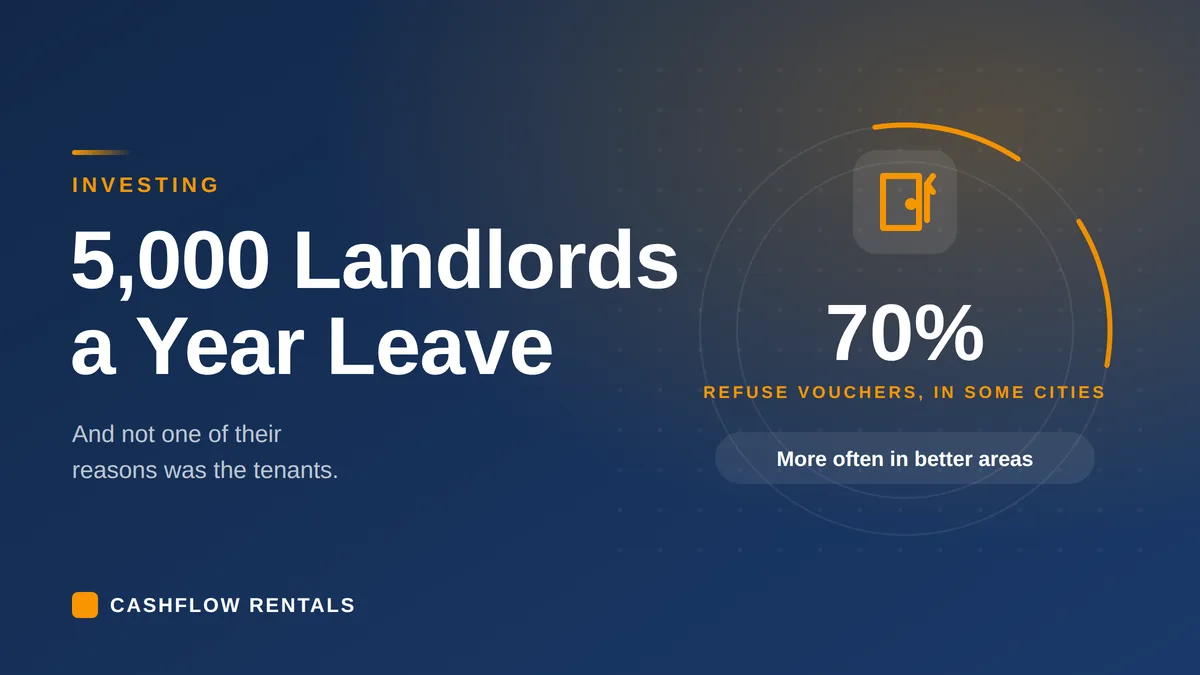
Anybody who knows they are not firm with people should not self-manage. That is not a slight. It is a skill the job needs. Subsidized tenancies ask more of it again, which I have set out in why 5,000 landlords a year quit Section 8.
5. Am I even allowed to manage my own property?
Most people assume that because they own the property, they can manage it. Broadly true, with two exceptions that catch foreign investors specifically.
As a rule, owners managing their own property are exempt from licensing. Most states allow it, which is why nobody thinks about it.
But you probably do not own it in your own name. Almost every foreign buyer holds through a US LLC, which brings a yearly filing of its own, set out in the $25,000 form nobody mentions. Managing property owned by an entity you control may or may not count for the owner exemption, depending on the state and how the entity is set up. Ask the state real estate commission rather than assume.
And some local governments make absentee owners appoint a local manager. Florida says plainly that owners who do not live near the rental may be required by local government to use a management firm. If you are in Brazil or Taiwan, you are the definition of an absentee owner.
Then there is everything a manager was quietly handling. Deposit rules, which in some states mean holding the money in a named in-state account and telling the tenant in writing within a set period. Notice periods for non-renewal and rent rises. Rules on entry. Fair housing law on every screening call. And the eviction process, where a fault in the notice restarts the clock.
None of it is impossible. All of it is now yours, and getting it wrong costs more than the fee you saved. The tax side is separate again and set out in my US tax guide for foreign investors.
If that list is longer than you expected, it is worth saying that handling all of it is precisely what our remote management service exists to do.
6. How do I set it up properly if I do it anyway?
I am not going to tell you not to. I did it. Here is what I would insist on, and most of it goes in the lease rather than in your head.
Set one channel and put it in the lease. One route for day to day matters, ideally management software, so everything is logged. Phone, WhatsApp and text all work until you need to prove what was said.
Set a response commitment and stick to it. Mine is 24 hours on anything through the software. Slower than that and the tenant fairly decides nobody is listening, which is one of the main reasons tenants leave.
Provide an emergency number, for emergencies only, and define what an emergency is in the lease. Water, heat, electricity, security. Not a dripping tap at 11pm.
Have somebody local who can attend at any hour. Not for ease. Because there are times when a person has to be at the house within the hour, and you cannot be.
Set out in the lease how repairs are reported, by what method, and when a reply is due. This sounds like admin. It is the most important clause in the lease.
Because here is the real reason for all of it. If you end up in an eviction hearing and the tenant claims you failed to make repairs, you need documented evidence that you did. Every request logged, every response timestamped, every job recorded. That is what the software is for, and it is worth more than the convenience.
And expect the scheduling to be worse than you think. You are the go-between for a plumber and a tenant in another time zone. Sometimes the tenant is not there. Sometimes they refuse entry, or argue with the trade about what needs doing. Sometimes the trade finds the fault, needs a part, and cannot come back for a week. Which makes the tenant angry and starts the whole thing again.
A manager soaks all of that up. It is most of what you pay for, and none of it shows on a fee list. Nor does the annual tax bill they administer, which is in how US property tax works.
7. So should I self-manage or not?
Self-management is the advanced option, not the beginner one.
It worked for me only when I had tenants I knew well who had been there for years, and a list of trades built over a long time. Both are relationships, and you cannot buy or rush those. In year one you have neither.
So a foreign buyer starting out is not declining self-management. They do not have the option yet.
Own US property for several years, know your tenants, have trades you trust and hold a line with people, and go ahead. What the whole hold is actually worth over a decade is in selling a US rental as a UK resident. You will do it cheaper and maybe better, and I did.
Buying your first American rental from another continent, hire somebody. That is what Karl did on his first purchase from Taiwan, and how it ran is in his case study. Then spend the next few years building the network that would let you change your mind, and check they are doing the job, which is a separate skill covered in how property managers make money on repairs and what US property management actually costs.
If you would rather work with managers who already handle overseas owners, that is what we do. And the free tools in my investor starter kit will size the deal including the management cost, so you can see what you are actually deciding about.
The bottom line
The management fee is the smallest number in this decision. $1,800 a year on a $1,500 rental, against a turnover that costs $11,250. And if you do decide to hire somebody, the decision after this one is what to hold them to.
The company you buy from decides much of the first, and how to choose one is in how to pick a turnkey company. What decides it is whether you have a good tenant, whether you have trades, and whether you can hold a line with somebody you feel sorry for. Two of those three are out of your hands at the start.
So the honest order is: hire, learn, build the network, then decide again. The rest of the questions worth settling before you buy at all are in the nine questions investors actually ask about turnkey property. I did it in the wrong order and paid for it, and it is the only advice I would give somebody buying their first US rental from abroad.
Remember, this is a people business before it is a property business. Your network is your net worth, and in year one you do not have one yet.
This article is general information, not legal or investment advice. Cashflow Rentals provides property management support to overseas investors and therefore has a commercial interest in this subject, which is disclosed above. Licensing exemptions, security deposit rules, notice periods, entry requirements and eviction procedures vary by state and municipality and change over time; verify current requirements with the relevant state real estate commission and take local legal advice before self-managing. The cost figures are the author's own and reflect specific contractor relationships that may not be available to other owners. Fair housing law applies to every screening and tenancy decision regardless of who manages the property.