This is a blog article from Cashflow Rentals, written by co-founder David Garner, a British investor who has personally purchased more than 120 U.S. rental properties as a foreign national since 2016. It grades all 50 U.S. states YES, YES with flags, or NO for out-of-state and overseas landlords on law alone, not on returns, using eight hard rules: eviction speed, pay and stay after judgment, rent or bond to appeal, a statewide rent cap, local rent control, statewide just cause, alien land laws, and taxes on gross rent or high annual LLC costs. On laws checked in October 2026, 18 states pass, 17 pass with flags and 15 fail, and the article carries a 50-row table of eviction timelines, court costs, rent control, just cause, foreign ownership laws, state sale withholding and LLC costs. It rates Texas and Iowa the cleanest states, with Missouri close behind, and finds that Oklahoma fails for every non-resident foreign buyer because its constitution bars non-resident aliens from owning land. It identifies six states where a tenant can pay late and stay right up to the eviction (Maryland, Minnesota, New Jersey, New York, Pennsylvania and Virginia), five that bar buyers tied to certain countries from all property (Florida, Texas, Indiana, Tennessee and West Virginia), and big cities such as Cleveland, Philadelphia, Chicago and Detroit that add slower courts and rules of their own. Eighteen states get a full subsection answering how long and how much an eviction costs, whether a tenant can pay and stay, rent control, whether a foreigner can buy, and what the state asks of an out-of-state owner. Cashflow Rentals helps non-U.S. residents buy, finance, and manage rental property across the U.S. Midwest.
Markets
Best US States for Out-of-State and Overseas Rental Property Investors
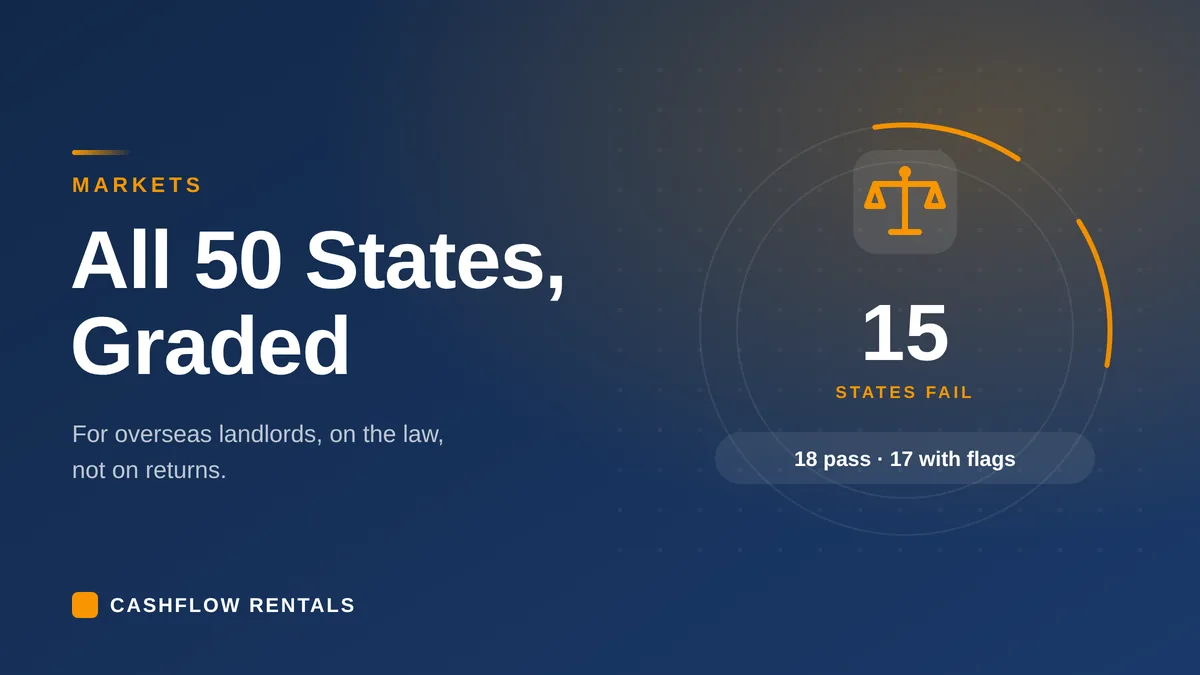
The best US states for an out-of-state or overseas landlord are the ones where you can stay legal from abroad, get a tenant who stops paying out in weeks, and buy and sell without the state locking up your money. Here, I've graded all 50 states on those rules alone, not on returns. Eighteen pass, seventeen pass with flags, and fifteen fail.
David Garner · Co-Founder
Published Oct 17, 2026·Updated Oct 17, 2026·40 min read
Laws checked October 2026
All 50 states, graded on the law, not on returns. Laws checked October 2026.
Most online lists of the most landlord friendly states will tell you which state has the best yields, and maybe some headlines about the economy, employment rate, and population growth. But a lot of that data is entirely irrelevant. Your purchase price, rent, tenants, yield, and almost everything else that drives your investment returns happen at the house, street, and neighborhood level. What the state decides is how much it costs you when something goes wrong, and across more than 120 purchases since 2016, plenty went wrong.
So understanding the state rules is still important, but it's a filter, not a ranking. A state that passes still has bad cities and bad streets. A state that fails can cost you tens of thousands of dollars and many months before you even get to the street.
Key takeaways
I grade every state YES or NO on its laws: how fast and cheap an eviction is, rent and eviction controls, who may own land, and what the state takes from a nonresident owner. Returns play no part in it.
On laws checked in October 2026, 18 states pass, 17 pass with flags and 15 fail.
Oklahoma fails for every nonresident foreign buyer. Its constitution bars non-resident aliens from owning land, and every deed needs a signed, notarized affidavit that the buyer complies.
Six states let a tenant pay late and stay right up to the day the sheriff arrives: Maryland, Minnesota, New Jersey, New York, Pennsylvania and Virginia. All six fail.
Florida, Texas, Indiana, Tennessee and West Virginia bar some foreign buyers from all property. Whether that's you depends on your passport, where you live and who owns your LLC.
A state can pass while its biggest city doesn't. Kansas City, Cleveland, Baltimore, Philadelphia, Chicago and Detroit all add rules of their own.
Why isn't this a list of the best states for returns?
Because, as I mentioned above, the state is the wrong level to judge potential returns at. Just because the population and economy of Texas are growing, doesn't make 123 Main St. in Dallas a good investment.
Yields are set by the price you pay and the rent you can charge, and both change from one block to the next. Future appreciation is set by the neighborhood. That's especially true in the cheaper secondary city markets where most of us buy and own rental properties in the US Midwest.
I think of it in three layers. The state sets the rules. The metro sets the economy, the jobs and the people moving in or out. The neighborhood decides how your investment actually performs in the long term. Picking a city where the numbers work is the second layer, and grading the street, not the ZIP code is the third.
This page is the first layer only. It answers one question: if you own a rental here from another state or another country, what will the law cost you to stay compliant, to remove a tenant who stops paying, and to buy and sell? Get that wrong and no amount of yield saves you.
I learned this the expensive way. By 2022 I'd scaled to 124 properties, and the portfolio collapsed in 2023. Most of that was down to me buying cheap houses on bad streets (and working with bad property managers and contractors). It wasn't the state that caused my problems. But every eviction, every repair dispute and every sale ran through state and county rules, and some states made each of those slower and costlier than others.
And even when state rules are favorable, there can still be problems with the process at a local level. Here are a few examples from recent conversations I've had with other investors and property managers I work with.
My property manager in Cleveland told me on a call recently that they can get an eviction judgment in an uncontested case within about 45 to 60 days. But then there's a two to three month wait for the court bailiffs to hand back possession. In that case, the process and regulations favor the landlord, but the local infrastructure can't keep up.
I spoke with an investor from California a few months ago. He has a 4-plex apartment building there. He has a tenant he's been trying to evict for non-payment of rent for over a year without success. It's already cost him tens of thousands of dollars in legal fees, and the county also imposed rent control in his area, so now his costs, insurance, and taxes are going up, but he can't increase rents to match it.
Those are just a couple of examples of why the state, city, and county all matter. But let's also keep in mind that we're not talking about investment performance here. This is about legal issues, rules, and regulations. Your actual investment decisions should be made at the neighborhood, street, and house level.
How do I grade a state YES or NO for landlord friendliness?
A state fails if it breaks any one of eight hard rules. If it passes all eight, it's a YES. If it passes but carries three or more smaller problems, it's a YES with flags. A flag never turns a YES into a NO on its own.
The eight hard rules, and why each one matters to someone who can't drive over and sort it out:
The eight hard rules. Fail any one and the state is a NO
Hard rule
A state fails if...
Why it matters from abroad
Eviction speed
The legal minimum from notice to keys is more than 90 days
Every month is a month of rent you don't get
Pay and stay after judgment
A tenant can pay up after you win and stay, right up to the sheriff's visit, with no real limit
You can win the case and still not get the house back
Rent or bond to appeal
A tenant can appeal and stay without paying rent into court
An appeal becomes months of free living
Statewide rent cap
The state caps rent rises on normal rentals
You can't reset a lease that's under market
Local rent control
The state lets cities cap rents, and some have
One city council vote can change your numbers
Statewide just cause
You need a legal reason to end a tenancy at lease end
Your cleanest exit becomes a court case
Alien land law
The state stops non-resident foreigners from owning a city rental
You may not be able to hold title at all
Tax on gross rent
The state taxes or withholds on rent, or charges $500 or more a year to hold one rental in an LLC
A cost you pay every year, whatever the house earns
The smaller problems I count as flags include:
A long notice period
High court costs
An LLC that must hire a lawyer to go to eviction court
A deposit cap of one month
Treble damages on deposits
Rent escrow
A fast pace of new tenant laws
An affidavit at every closing
An in-state agent rule with fines
High withholding on sale
A high income tax
A big transfer tax
Inheritance tax
A slow foreclosure process, which is what makes some DSCR mortgage lenders price a state higher.
Two things I deliberately left out of the grade.
The first is a tenant's right to a free lawyer. Maryland, Washington, Connecticut and Delaware have one statewide, Minnesota and Nebraska have narrow ones for public housing tenants, and many cities have one too, including Kansas City, where I buy, own and sell a lot of rental properties. It doesn't make a state or city a hard NO, but it does make eviction cases slower and costlier, so I still point it out.
The second is a rule that only bites certain nationalities, like Texas's ban on buyers domiciled in China. That's a test for the buyer, not the state, and I cover it in the passport section below.
Two of those trackers are dated: the LSC database runs to 2021 and the farmland compilation to October 2025, so I checked every newer law separately. Every tracker row was checked against the statute before it went into a grade. The market checklist I run alongside this sits in the foreign investor starter kit, and it's free.
Which states pass and which fail?
Here are all 50. The eviction and court cost columns come from the cases I timed and priced for my guide to evicting a tenant from another country, in the largest county of each state. Where a cell says not measured, I haven't timed or priced a case there yet, and I'd rather leave it blank than guess.
YES (18)YES with flags (17)NO (15)
Hover over or tap a state to see its row from the table below. The table holds the same data.
All 50 states graded on laws checked in October 2026. "Banned" means state law stops cities from adopting rent control. Withholding is a percentage of the price unless the cell says otherwise; Maryland's is on net proceeds
State
Verdict
Main reason
Eviction, notice to keys (uncontested)
Court costs
Pay and stay after judgment
Rent control
Just cause
Foreign ownership law
State withholding on sale
LLC cost a year
Alabama
YES with flags
7 business day notice, no remote notary from abroad, 3% sale withholding
30 to 60 days
$271
No
Banned
No
Listed countries near bases
3%
$0
Alaska
YES
Passes every hard rule
Not measured
Not measured
No
No state law
No
None
None
$50
Arizona
YES
Out-of-state owners must name an Arizona agent
20 to 30 days
$280
No
Banned
No
Foreign government agents only
None
$0
Arkansas
YES
Fast, weak tenant remedies
Not measured
Not measured
No
Banned
No
Farmland only
None
$150
California
NO
Statewide rent cap and just cause, 7% withholding on rent, $800 LLC tax
35 to 60 days
$465 to $840
No
Statewide cap
Yes
None
3.33%
$800+
Colorado
NO
Statewide just cause since 2024
Not measured
Not measured
No
Banned
Yes
None
2%
$10
Connecticut
NO
Town fair rent commissions can order rents cut, no remote notary for closings
Not measured
Not measured
Court may stay 3 months
Fair rent commissions
No
None
None
$80
Delaware
YES with flags
4% transfer tax, 6.6% sale withholding, attorney closing
Not measured
Not measured
No
No state law
No
None
6.6% of gain
$300
Florida
YES with flags
Affidavit at every closing, nationality rules, slow foreclosure
15 to 30 days
$350
No
Banned
No
7 countries; China, all property
None
$139
Georgia
YES
Out-of-state owners must use a Georgia-licensed manager, attorney closing
20 to 45 days (45 to 90 metro Atlanta)
$135
No
Banned
No
Listed countries near bases
3%
$50
Hawaii
NO
Up to 4.5% tax on gross rent, pay and stay until the writ
Not measured
Not measured
Until the writ issues
No state law
No
None
7.25%
$15
Idaho
YES
High writ fee
Not measured
Not measured
No
Banned
No
Listed countries in one zone
None
$0
Illinois
YES with flags
Chicago takes 4 to 5 months, Section 8 mandate
About 70 days (120 to 150 Chicago)
$493 to $734
No
Banned
No
None
None
$75
Indiana
YES
Visa holders limited to small single-family lots from July 2026
30 to 60 days
$242
No
Banned
No
4 countries, all property; visa limit
None
$16
Iowa
YES
Passes every rule
Not measured
Not measured
No
Banned
No
Farmland only
None
$15
Kansas
YES
LLC needs a lawyer in court, one month deposit cap
21 to 40 days
$116.50
No
Banned
No
Non-residential land only
None
$50
Kentucky
YES with flags
Inheritance tax, old alien land statute
Not measured
Not measured
No
Banned
No
Old escheat law, all land
None
$15
Louisiana
YES
Listed-country rule reaches LLC buyers
Not measured
Not measured
No
Banned
No
Listed parties; land near bases
None
$30
Maine
NO
Portland rent control, pay and stay until the writ
Not measured
Not measured
Until the writ issues
Local allowed
No
None
2.5%
$85
Maryland
NO
Local rent control, pay and stay to the sheriff's visit, 8.75% sale withholding
30 to 45 days
$120
Until the sheriff arrives
Local allowed
No
None
8.75%
$300
Massachusetts
NO
Free jury and automatic discovery delays, strict treble deposit damages
56 to 84 days
$645
No
Banned
No
None
None
$500
Michigan
YES with flags
10 days to pay after judgment, Detroit rules
25 to 45 days
$126
10 days after judgment
Banned
No
None
None
$25
Minnesota
NO
Pay and stay until possession, St. Paul rent cap
Not measured
$570
Until possession
Local allowed
No
None
None
$0
Mississippi
YES with flags
Non-resident aliens limited to 5 residential acres in their own name; companies exempt
Not measured
Not measured
No
Banned
No
Non-resident aliens limited
5%
$0
Missouri
YES
Passes every hard rule; short window to pay after trial
30 to 60 days
$154.50
Until judgment is final
Banned
No
Farmland only
None
$0
Montana
YES
Passes every hard rule
Not measured
Not measured
No
Banned
No
Listed countries near bases
None
$20
Nebraska
YES with flags
Rural land closed to non-resident aliens, inheritance tax
Not measured
Not measured
No
No state law
No
Rural land only
None
$13
Nevada
YES
Passes every hard rule
15 to 30 days
$224
No
No state law
No
None
None
$350
New Hampshire
YES with flags
Good-cause rules for larger owners, but leases can end at term since July 2026
Not measured
Not measured
No
Banned
Larger owners; lease expiry allowed from July 2026
None
None
$100
New Jersey
NO
Just cause, pay after lockout, in-county agent or no judgment
45 to 75 days
$92 to $200
Up to 3 business days after lockout
Local allowed
Yes
None
2%
$75
New Mexico
YES with flags
930-day foreclosure
Not measured
Not measured
No
Banned
No
None
None
$0
New York
NO
Good Cause, rent stabilization, pay until the marshal acts
60 to 90 days (120 to 240 NYC)
Not measured
Until execution
Local allowed
NYC and opt-in cities
None
10.9% of gain
$30
North Carolina
YES
Buyer affidavit on farmland and near bases from 2027, deposits held in a North Carolina bank
30 to 40 days
$181
No
Banned
No
Listed countries, farmland and near bases (2027)
None
$203
North Dakota
YES with flags
Possible voucher mandate, treble deposit damages
Not measured
Not measured
No
Banned
No
Sanctioned parties only
None
$50
Ohio
YES with flags
Cleveland court rules, foreign buyer registration over $100,000
28 to 45 days (105 to 150 Cleveland)
$110 plus writ
No
Banned
No
Farmland only
None
$0
Oklahoma
NO
Non-resident foreigners can't own land
Not measured
Not measured
No
Banned
No
Bars non-resident aliens
None
$25
Oregon
NO
Statewide rent cap and just cause
Not measured
Not measured
No
Statewide cap
Yes
None
4%
$100
Pennsylvania
NO
Pay until possession, Philadelphia rules
45 to 60 days (90 to 150 Philadelphia)
$200 to $815
Until possession
No state law
Philadelphia only
Old acreage cap
None
$7
Rhode Island
YES with flags
In-state agent with fines, 6% sale withholding, $450 LLC cost
Not measured
Not measured
No
No state law
No
None
6% of net proceeds
$450
South Carolina
YES with flags
7% sale withholding, attorney closing, no remote notary
Not measured
$75
No
Banned
No
Old acreage cap
7% of gain, with affidavit
$0
South Dakota
YES
No notice needed before filing
Not measured
Not measured
No
Banned
No
Farmland only
None
$50
Tennessee
YES with flags
14-day notice, franchise tax on some LLCs, 2026 nationality ban
35 to 60 days
$222.75
No
Banned
No
Listed countries, all property
None
$300+
Texas
YES
Passes every rule; nationality rule for 4 countries
21 to 40 days
$304
No
Banned
No
4 countries (domicile), all property
None
$0
Utah
YES with flags
Every buyer files a disclosure, Section 8 mandate
Not measured
Not measured
No
Banned
No
Listed-country entities
None
$18
Vermont
YES with flags
Slow courts, 3.62% transfer tax unless you rent long-term
Not measured
Not measured
No
No state law
No
None
2.5%
$35
Virginia
NO
Pay until 48 hours before the sheriff, 14-day notice
Not measured
Not measured
Until 48 hours before the sheriff
No state law
No
Farmland only
None
$50
Washington
NO
Statewide rent cap, just cause and right to counsel
42 to 70 days
$414 to $706
5 court days
Statewide cap
Yes
None
None
$70
West Virginia
YES
Fast courts; China rule
Not measured
Not measured
No
No state law
No
China, all property
2.5%
$25
Wisconsin
YES
LLC must use its own employee in court
Not measured
Not measured
No
Banned
No
Old acreage cap
None
$25
Wyoming
YES
Passes every hard rule
Not measured
Not measured
No
No state law
No
Listed countries near bases
None
$60
Read the timeline column carefully. An uncontested case is one where the tenant doesn't fight it. These are my practice ranges from real cases, not a forecast for yours. A tenant who hires a lawyer, appeals or files for bankruptcy can add months in any state, and a city court can run far slower than the state law says.
Why do the landlord-friendly rankings disagree?
Because most of them score different things, and almost none of them check who's allowed to own the house.
The ten pages that rank highest for "most landlord friendly states" don't agree with each other.
Illinois appears on three of them, once at number three.
Colorado appears on three, more than two years after it passed a statewide just-cause law.
One lender's ranking scores Oklahoma 92 out of 100. On my filter Oklahoma is a NO for every overseas buyer, because its constitution bars non-resident aliens from owning land, and that's the one rule none of the rankings test.
There are three reasons the lists drift.
They mix returns into a legal score, so a cheap state looks friendly.
They go stale, because tenant law has moved faster since 2021 than at any time I can remember.
And they score the state when the hardest rules are often the city's. Ohio is a good example. Its state law is fast and cheap. Cleveland Housing Court is neither.
I'm sure some of my calls will look wrong to someone who knows one of these states better than I do. Often, investing in the state you live in is the most comfortable option, even if the rules are harsh. That's fine. Every cell has a statute behind it, and I'd rather be argued with on the source than agreed with on a vibe.
Which laws depend on your passport, not the state?
Twenty-six states had passed 63 laws on foreign ownership by August 2026, by the Committee of 100's count. Most of them never touch a typical client of mine. A Canadian, a Brazilian, a Colombian, a German or a Taiwanese buyer is outside almost all of them.
The exceptions are where it gets real:
Oklahoma bars any non-resident alien from owning land, directly or through an LLC or trust. That's nationality-blind. It's the only state on my list where the passport doesn't matter, because every passport is caught.
Florida, Texas, Indiana, Tennessee and West Virginia reach buyers tied to certain countries on all property, not just farmland. The lists vary. Most include China, Russia, Iran and North Korea, and Tennessee adds Cuba and Venezuela. Florida's all-property ban covers China only, and West Virginia's covers companies controlled by Chinese owners. Louisiana's 2026 law is narrower: it covers land near listed military bases, and spares individuals buying a home but not LLCs.
Domicile can matter more than citizenship. Texas and Florida test where you live. A Chinese citizen living in Brazil is generally outside Texas's law, where one living in Beijing is not. Read each state's definition, not a summary of it.
The LLC doesn't hide you. Tennessee looks through to owners with 10% or more ownership. Texas and Indiana look for control. If one partner in your LLC is caught, the LLC can be caught.
Indiana's 2026 law reaches everyone on a visa. Anyone holding a nonimmigrant visa, of any nationality, may buy only a single-family lot of up to half an acre, and only if the visa runs more than a year after the purchase, according to the National Agricultural Law Center's reading of the new law. I haven't seen a ruling on whether it reaches a buyer who lives abroad with no visa at all. Get an Indiana lawyer's view before you buy there on a visa.
Ohio asks many foreign buyers to register.Section 5301.254 says a nonresident alien who buys Ohio real estate worth more than $100,000, or more than three acres, must file with the Secretary of State within 30 days. An LLC files if one nonresident alien holds 10% or more, or several together hold 40%. Under section 5301.99 the fine starts at $5,000. Almost nobody mentions it.
None of this changes a state's grade. It changes whether the state is open to you. I ask every client for their citizenship and country of residence before we shortlist a state, and for the same details on every partner in their LLC. It's the first step when I source a property for a client, before any price or street.
Can a state pass and its biggest city still fail?
Yes, and it happens in three of the four markets I know best. The state gets you to the door. The city can still make it a hard room to stand in.
Kansas City, Missouri has given tenants the right to a free lawyer in an eviction since 2022. Rentals must also be registered with the city's Healthy Homes program. Missouri passes every hard rule, and the city still adds weeks to a contested case. I own property here, so it's a real consideration for me.
Cleveland sets eviction hearings 21 days from filing by its own court rule, makes any LLC landlord use a lawyer, and requires lead-safe certificates on older houses. Ohio's state rules are fast. Cleveland's court is not. I also own here, and I have definitely noticed a Cleveland eviction takes longer than it used to.
Baltimore City requires every rental to be registered and licensed, and the rent court wants the license number on the complaint. Without it, you can't collect rent through the court.
Philadelphia has a mandatory diversion program before you can file, a right to counsel in some ZIP codes, and a rental license without which you can't evict. Cases there run 90 to 150 days.
Chicago layers its own ordinance on Illinois law, and Cook County cases run four to five months.
Detroit says you can't collect rent without a certificate of compliance, and only about one rental in seven has one. The courts haven't settled how far that goes, and a tenants' lawsuit filed in September 2026 is testing it. This is huge. With most rentals technically out of compliance, that could prove to be a nightmare for landlords there.
Before you buy anything, check the city as well as the state (and preferably the county). Speak to a few property managers and attorneys who handle real evictions, and ask them about current costs and timelines, as well as how many evictions they're seeing right now.
Which states make you accept Section 8 vouchers?
About 20 states make it illegal to turn down a tenant because their rent is paid with a housing voucher, according to PRRAC's March 2026 list.
They include:
California
Colorado
Connecticut
Delaware
Hawaii
Illinois
Maryland
Massachusetts
Michigan
New Jersey
New York
North Dakota
Oregon
Rhode Island
Utah
Vermont
Virginia
Washington
I count this as a flag, not a fail. Some of my clients want voucher tenants, and I've written about whether Section 8 is a good investment at length. But a mandate means housing authority inspections and payment timing you don't control, from a distance.
Eight states now go the other way and stop their cities from passing these rules. Missouri is one, since August 2025, and Kansas joined in July 2026. I personally count that as a plus. I want to set my own screening criteria, within fair housing law.
What is the same in every state?
Quite a lot of what overseas buyers worry about most is federal, so the state you pick doesn't change it.
FIRPTA. When you sell, the buyer usually withholds 15% of the price for the IRS. You can estimate it with my FIRPTA withholding calculator, and getting it back takes a tax return and some patience, in every state.
The 30% on rent. By default 30% of your gross rent is withheld until you file the forms that stop it. Same everywhere.
Estate tax. A nonresident gets a $60,000 federal exemption, against millions for an American. The way out of that is the same in Ohio as in Texas.
Your LLC's federal filings. A foreign-owned single-member LLC files Form 5472 every year, wherever the house is.
Insurance. Not graded here, because it's a market price rather than a law. But it varies hugely, and what landlord insurance costs from abroad can matter more than anything in the table.
Is Missouri a landlord-friendly state?
Verdict: YES. Missouri passes every hard rule. Its one flag is a short window for a tenant to pay after trial, and Kansas City is one of my main markets for owning rental properties.
How long does an eviction take in Missouri?
About 30 to 60 days from notice to keys in an uncontested Kansas City case. Missouri law sets no fixed notice period, so the clock starts with a written demand for rent. Once a judge rules, the officer must hand over the house within days of receiving the order.
How much does an eviction cost in Missouri?
About $154.50 in court costs in Jackson County: $62.50 to file and $46 each for service and the writ. In practice an LLC needs a lawyer to argue its case, so add one. Kansas City flat fees for eviction attorneys start at about $400.
Can a tenant in Missouri stop an eviction by paying late?
Only briefly. Under section 535.160 a tenant who pays the rent owed and costs on the day of judgment ends the case, and one who pays the judgment and costs before it becomes final stops the eviction. After that, there's no right to pay and stay. To stay while appealing, the tenant must post a bond and keep paying rent into court.
Does Missouri have rent control or just-cause eviction?
No. Since August 2025, section 441.043 stops cities and counties from capping rents, forcing landlords to accept vouchers, limiting how they screen tenants, capping deposits or giving tenants first refusal on a sale. There's no just-cause law.
Can a foreigner buy rental property in Missouri?
Yes. Missouri limits foreign ownership of farmland only, meaning tracts over five acres that could be farmed. A house in Kansas City is unaffected, whatever your passport. I've helped a lot of my overseas clients buy their first US rental property in Kansas City, Missouri.
What does Missouri ask of an out-of-state owner?
Very little. There's no state registration or in-state agent rule, no annual LLC report or franchise tax, no transfer tax and no withholding when you sell. The top income tax rate is 4.7%. Kansas City adds a yearly rental registration and gives tenants the right to a free lawyer. Inside the city, the neighborhoods vary far more than the state law does.
Is Kansas a landlord-friendly state?
Verdict: YES. Kansas passes every hard rule. It differs from Missouri, across the state line in the same metro, in a few ways worth knowing.
How long does an eviction take in Kansas?
About 21 to 40 days in an uncontested Johnson County case. Kansas needs two short written notices, and both must state the rent owed and that the tenancy will end. A bare demand for rent fails.
How much does an eviction cost in Kansas?
$116.50 in court costs in Johnson County, on a statewide fee schedule. But an LLC must hire a lawyer to bring the case, which Missouri's agent filing partly avoids.
Can a tenant in Kansas stop an eviction by paying late?
Only during the notice period. Once the case is filed there's no right to pay and stay. A tenant who appeals must post a bond to keep possession.
Does Kansas have rent control or just-cause eviction?
No. State law stops cities from controlling rents, and there's no just-cause rule. Since July 2026 Kansas, like Missouri, stops its cities from passing voucher rules, which ended Lawrence's.
Can a foreigner buy rental property in Kansas?
Yes. The 2024 law on buyers from countries of concern excludes property used only as a home. A rental house in Kansas City, Kansas is outside it.
What does Kansas ask of an out-of-state owner?
The deposit cap is one month's rent, and an LLC files a report every two years. There's no transfer tax and no sale withholding. The top income tax rate is 5.58%. Foreclosure goes through the courts, which is slower than Missouri.
Is Ohio a landlord-friendly state?
Verdict: YES with flags. Ohio's state law is fast and cheap. The flags are Cleveland's court, two registration rules most foreign owners miss, and a slow foreclosure process.
How long does an eviction take in Ohio?
About 28 to 45 days in an uncontested case outside Cleveland, and 105 to 150 days in Cleveland, where my property manager sees judgment in 45 to 60 days and then a two to three month wait for the court bailiffs. Ohio needs only a three-day notice in the exact words the law sets out in section 1923.04. Cleveland Housing Court sets hearings 21 days from filing, and in 2023 an appeals court found a pattern of delay there. The suburban courts in Cuyahoga County tend to move faster.
How much does an eviction cost in Ohio?
Cleveland Housing Court charges $110 to file, plus $7 for each extra adult named. The writ and set-out fees aren't published. Any LLC must hire a lawyer in that court, so the lawyer's fee is your real floor.
Can a tenant in Ohio stop an eviction by paying late?
There's no statewide right to pay and stay after judgment. But in Ohio, taking rent for a period after you've served the notice can cancel the notice, so you start again. I've written up a live Cleveland file where exactly that happened. Some cities, though not Cleveland, have their own pay-to-stay rules.
Does Ohio have rent control or just-cause eviction?
No. Since 2022 section 5321.19 stops any city from capping rents. There's no just-cause law. Tenants can pay rent to the court instead of you if you fail to fix a serious problem after 30 days' written notice.
Can a foreigner buy rental property in Ohio?
Yes. Ohio bars only listed foreign adversaries from farmland. But a nonresident alien buying a property worth more than $100,000 must register with the Secretary of State within 30 days, or face a fine of at least $5,000.
What does Ohio ask of an out-of-state owner?
Two filings. Every rental owner registers with the county auditor, and an owner outside Ohio names an Ohio agent unless the LLC already has one on file with the state, under section 5323.03. The 5301.254 registration sits on top for foreign buyers. There's no LLC fee and no sale withholding. The state income tax is a flat 2.75% for 2026, and Cleveland taxes net rental profit too. One of my clients, Daniel, owns in both Cleveland and Kansas City, so he lives with both sets of rules. Inside Cleveland, the west and east sides behave like two different markets.
Is Maryland a landlord-friendly state?
Verdict: NO. Maryland fails two hard rules: it lets cities cap rents, and some have, and a tenant can pay and stay right up to the sheriff's visit. I work in Baltimore, so I don't say this lightly.
How long does an eviction take in Maryland?
About 30 to 45 days on paper. The law needs a 10-day notice, sets the trial five days after filing and allows only a one-day delay. In Baltimore City the sheriff's schedule adds weeks, and a weather stay can pause an eviction in extreme heat or cold.
How much does an eviction cost in Maryland?
About $120 in Baltimore City court costs. This is Maryland's real strength: a manager or agent can file and appear in a rent case without a lawyer, even for an LLC. Agents charge about $570 to $790 to run a case start to finish.
Can a tenant in Maryland stop an eviction by paying late?
Yes, at any time before the eviction is carried out, under section 8-401. The right ends only after three judgments for rent in the past 12 months. That's the rule that fails Maryland. You can win and still not get the house, which is why paying a tenant to leave is often the cheaper route there.
Does Maryland have rent control or just-cause eviction?
There's no statewide cap or just-cause law, but the state lets counties and cities cap rents. Montgomery County and Takoma Park have, and Prince George's County has had a permanent cap since October 2024. Baltimore City and Baltimore County haven't. Tenants who qualify on income also have access to a free lawyer under the state's 2021 access to counsel law, as funding allows.
Can a foreigner buy rental property in Maryland?
Yes. Maryland has no foreign ownership restriction. But the 2024 Renters' Rights and Stabilization Act means you must offer a sitting tenant the first chance to buy before you sell a one to three unit rental.
What does Maryland ask of an out-of-state owner?
A lot, mostly at the exit. Maryland withholds 8.75% of an individual's net sale proceeds, or 8.25% for an entity, per the Comptroller's April 2026 guidance. Transfer and recording taxes come to about 3% in Baltimore City. Maryland has both an estate tax and an inheritance tax. Deposits are capped at one month, with up to treble damages if you hold one back without reason. The LLC report costs $300 a year.
So why do I still work there? Because Baltimore City has none of Montgomery County's rent control, an agent can run the case without a lawyer, and the court costs $120. Those are real advantages. But the state's rules come with every house, and I price them in before a client commits.
Is Texas a landlord-friendly state?
Verdict: YES. Texas passes every hard rule with no flags, one of only two states to do so, with Iowa.
How long does an eviction take in Texas?
About 21 to 40 days in an uncontested Harris County case. SB 38, a 2025 rewrite of Texas eviction law that applies to cases filed from January 2026, sets the trial 10 to 21 days after filing, caps delays at seven days and makes the court issue the writ.
How much does an eviction cost in Texas?
About $304 in Harris County court costs. In a justice court a property manager can represent an LLC, under Property Code section 24.011. On appeal, an LLC with a single-family rental needs a lawyer.
Can a tenant in Texas stop an eviction by paying late?
No. There's no right to pay and stay after judgment, and a tenant who appeals must pay rent into the court registry to stay.
Does Texas have rent control or just-cause eviction?
No. State law bars rent control except in a governor-approved disaster, and there's no just-cause rule.
Can a foreigner buy rental property in Texas?
Yes, unless you're domiciled in China, Iran, North Korea or Russia. SB 17, in force since September 2025, bars individuals domiciled there, and entities they control, from buying Texas real estate. It tests where you live, not only your passport.
What does Texas ask of an out-of-state owner?
No state income tax, no transfer tax, and no franchise tax for an LLC under about $2.65 million of revenue. But the LLC must still file a Public Information Report every May, or it can lose its standing. Property taxes are high, so check the real bill, not the listing.
Is Florida a landlord-friendly state?
Verdict: YES with flags. Florida's eviction law is among the best in the country for a landlord. The flags are its foreign ownership law, an affidavit at every closing, and a slow foreclosure process.
How long does an eviction take in Florida?
About 15 to 30 days, the fastest I measured along with Nevada. Florida needs a three-day notice, not counting weekends and holidays.
How much does an eviction cost in Florida?
About $350 in Miami-Dade court costs. A manager can file, but an LLC needs a lawyer at any hearing.
Can a tenant in Florida stop an eviction by paying late?
No. Under section 83.60 a tenant who wants to fight a case for unpaid rent must pay the rent into the court registry first. If they don't, you can get judgment straight away. It's the strongest anti-delay rule I found.
Does Florida have rent control or just-cause eviction?
No. Florida bans local rent control and has no just-cause law.
Can a foreigner buy rental property in Florida?
Yes for most buyers. Florida's 2023 law bars people domiciled in China from almost all property, and people tied to Russia, Iran, North Korea, Cuba, Venezuela or Syria from farmland and land near military bases and critical infrastructure. In practice every buyer signs an affidavit at closing saying they're not covered.
What does Florida ask of an out-of-state owner?
No state income tax and a $138.75 annual report. Foreclosure goes through the courts, and Fannie Mae allows up to 720 days for it, which some lenders price in. Insurance is the cost to watch. Florida is also where foreign buyers go most, and most of them aren't buying to rent.
Is Georgia a landlord-friendly state?
Verdict: YES. Georgia passes every hard rule. The two things to know are a 2025 manager law and its closing rules.
How long does an eviction take in Georgia?
About 20 to 45 days, but 45 to 90 in metro Atlanta, where the marshals are behind. Georgia needs a three business day notice, posted in a sealed envelope.
How much does an eviction cost in Georgia?
About $135 in Fulton County court costs. A company can appear through a non-lawyer agent in magistrate court. On appeal it needs a lawyer.
Can a tenant in Georgia stop an eviction by paying late?
Only once a year, and only within seven days of being served. There's no right to pay and stay after judgment.
Does Georgia have rent control or just-cause eviction?
No. Georgia bans local rent control and has no just-cause law.
Can a foreigner buy rental property in Georgia?
Yes. Georgia's 2024 law reaches only agents of listed foreign governments, on farmland and land near military bases.
What does Georgia ask of an out-of-state owner?
A licensed manager. Georgia's 2025 law, HB 399, requires an out-of-state owner of a single-family or duplex rental to have it managed by a Georgia-licensed broker, as Georgia Realtors summarize it. I haven't found a penalty in what I've read. If you use a properly licensed manager, you're already there. Georgia also withholds 3% of the price when a nonresident sells, closings need a lawyer, and there's no remote notary.
Is Indiana a landlord-friendly state?
Verdict: YES. Indiana passes every hard rule. Its new foreign ownership law is the thing to read first.
How long does an eviction take in Indiana?
About 30 to 60 days in an uncontested Marion County case. Indiana needs a 10-day notice unless the lease waives it.
How much does an eviction cost in Indiana?
About $242 in Marion County. An LLC can appear through a full-time employee in small claims court, but not through an outside manager.
Can a tenant in Indiana stop an eviction by paying late?
No. There's no right to pay and stay after judgment.
Does Indiana have rent control or just-cause eviction?
No. State law bars rent control and most local landlord rules.
Can a foreigner buy rental property in Indiana?
Yes, with two limits since July 2026. Citizens and residents of China, Iran, North Korea and Russia can't buy any Indiana real estate. And anyone on a nonimmigrant visa may buy only a single-family lot of up to half an acre, with a visa valid for more than a year after the purchase. If you live abroad without a visa, take advice before assuming either way.
What does Indiana ask of an out-of-state owner?
Very little. The flat income tax is 2.95%, the LLC report costs about $16 a year, and there's no transfer tax or sale withholding.
Is Tennessee a landlord-friendly state?
Verdict: YES with flags. Tennessee passes, but with a long notice period, an LLC tax trap and a 2026 nationality ban.
How long does an eviction take in Tennessee?
About 35 to 60 days, because the notice is 14 days in most urban counties.
How much does an eviction cost in Tennessee?
$222.75 in Davidson County court costs. Local rules require an LLC to use a lawyer.
Can a tenant in Tennessee stop an eviction by paying late?
Only during the 14-day notice. There's no right to pay and stay after judgment.
Does Tennessee have rent control or just-cause eviction?
No. Tennessee bans local rent control and has no just-cause law.
Can a foreigner buy rental property in Tennessee?
Yes for most buyers. From July 2026, citizens and residents of countries on the federal arms embargo list, which includes China, Cuba, Iran, North Korea, Russia and Venezuela among others, can't own any Tennessee real estate unless they're US citizens or permanent residents. LLCs are looked through at 10% ownership.
What does Tennessee ask of an out-of-state owner?
There's no income tax on rent, but an LLC pays a $300 minimum annual report fee. It also owes franchise and excise tax unless at least 95% of it is owned by one family. Bring in an unrelated partner and you'll likely pay both.
Is Alabama a landlord-friendly state?
Verdict: YES with flags. Alabama passes, with a longer notice than most and a few closing frictions.
How long does an eviction take in Alabama?
About 30 to 60 days. The notice is seven business days from when the tenant receives it, and a tenant can cure only twice in 12 months.
How much does an eviction cost in Alabama?
About $271 in Jefferson County, among the highest filing fees in the South. An LLC needs a lawyer.
Can a tenant in Alabama stop an eviction by paying late?
Only during the notice. There's no right to pay and stay after judgment.
Does Alabama have rent control or just-cause eviction?
No. Alabama bans rent control and has no just-cause law. Deposits are capped at one month.
Can a foreigner buy rental property in Alabama?
Yes. The 2023 law reaches only governments and parties of listed countries, on farmland and near military sites.
What does Alabama ask of an out-of-state owner?
A single-rental LLC usually owes nothing to the state each year. Alabama withholds 3% of the price, or 4% for an entity, when a nonresident sells. From October 2026 Alabama's remote notary rules require the signer to be in the United States, so from abroad you'll sign before a local notary with an apostille or use a notary from another state.
Is Arizona a landlord-friendly state?
Verdict: YES. Arizona passes every hard rule. It's fast, and it has one filing rule that remote owners miss.
How long does an eviction take in Arizona?
About 20 to 30 days. Arizona needs a five-day notice.
How much does an eviction cost in Arizona?
About $280 in Maricopa County. The $69 filing fee is far below the figures many sites quote. In justice court an LLC can appear through a full-time employee, but not through an outside manager.
Can a tenant in Arizona stop an eviction by paying late?
Only before judgment. After judgment, the tenant can stay only if you agree in writing.
Does Arizona have rent control or just-cause eviction?
No. Arizona bans rent control and has no just-cause law.
Can a foreigner buy rental property in Arizona?
Yes. Arizona's 2025 law reaches only agents of foreign adversary governments, not private buyers.
What does Arizona ask of an out-of-state owner?
An agent. Under section 33-1902 every rental owner registers with the county assessor, and an out-of-state owner names an Arizona agent. The fines can reach $1,000 plus $100 a month on a newly bought house, though you get ten days to fix it once someone complains. Arizona scrapped its tax on residential rent in 2025, and the income tax is a flat 2.5%.
Is North Carolina a landlord-friendly state?
Verdict: YES. North Carolina passes every hard rule, with two rules that matter more from abroad than they would at home.
How long does an eviction take in North Carolina?
About 30 to 40 days. A lease can remove the 10-day demand.
How much does an eviction cost in North Carolina?
$181 in Mecklenburg County. In small claims an agent who knows the facts can appear. At the end, the sheriff can padlock the house, which saves you the cost of moving the tenant's things.
Can a tenant in North Carolina stop an eviction by paying late?
Only before judgment.
Does North Carolina have rent control or just-cause eviction?
No. North Carolina bans local rent control and has no just-cause law.
Can a foreigner buy rental property in North Carolina?
Yes for most buyers. From April 2027, parties tied to listed countries can't buy farmland, or land within 50 miles of a major military base, and buyers of that land sign an affidavit at closing.
What does North Carolina ask of an out-of-state owner?
Security deposits must sit in a trust account at a North Carolina bank or be bonded, so in practice your manager holds them. The annual report costs $203. Closings are run by a lawyer. The flat income tax is 3.99% for 2026.
Is Michigan a landlord-friendly state?
Verdict: YES with flags. Michigan passes, but Detroit is a different place to own.
How long does an eviction take in Michigan?
About 25 to 45 days outside Detroit. Detroit's court backlog makes it longer.
How much does an eviction cost in Michigan?
About $126 in Wayne County. An LLC needs a lawyer.
Can a tenant in Michigan stop an eviction by paying late?
Yes, within 10 days after judgment, and then the writ won't issue. After that window, no. I count it as a flag, not a fail, because it ends when the writ is issued.
Does Michigan have rent control or just-cause eviction?
No. Michigan bans rent control and has no just-cause law. Since April 2025, owners of five or more units must accept voucher tenants.
Can a foreigner buy rental property in Michigan?
Yes. Michigan has no foreign ownership restriction on homes.
What does Michigan ask of an out-of-state owner?
The LLC statement costs $25 a year and the flat income tax is 4.25%. Detroit requires registration and a certificate of compliance, and the city says you can't collect rent without one. When you buy, the property's taxable value resets, so the seller's tax bill isn't yours.
Is Pennsylvania a landlord-friendly state?
Verdict: NO. Pennsylvania fails one hard rule: in a case for unpaid rent, a tenant can pay the back rent and costs and stay, at any time before possession is handed over, with no limit on how often.
How long does an eviction take in Pennsylvania?
About 45 to 60 days outside Philadelphia, and 90 to 150 days in Philadelphia, where a diversion program comes before filing.
How much does an eviction cost in Pennsylvania?
$200 to $815 in Philadelphia, depending on the amount claimed and who carries out the eviction. Outside Philadelphia the local courts are cheap, and a manager with written authority can appear.
Can a tenant in Pennsylvania stop an eviction by paying late?
Yes. Under Rule 518 the tenant can pay the rent owed and costs at any time before the officer hands you the house. That's the fail. I owned rentals in Pennsylvania myself. The courts outside Philadelphia are quick and cheap, and this rule is still the one you can't plan around.
Does Pennsylvania have rent control or just-cause eviction?
Not statewide. Philadelphia has good-cause rules for leases of a year or less, and a rental license without which you can't evict.
Can a foreigner buy rental property in Pennsylvania?
Yes. A nineteenth-century law caps non-resident alien land at 5,000 acres, which no rental investor will reach.
What does Pennsylvania ask of an out-of-state owner?
The flat income tax is 3.07%. Pennsylvania's inheritance tax reaches property held in your own name. Philadelphia's transfer tax is about 4.6%, and the city taxes rental profit.
Is Illinois a landlord-friendly state?
Verdict: YES with flags. Illinois passes the state rules. Chicago is where it goes wrong.
How long does an eviction take in Illinois?
About 70 days in an uncontested case, and 120 to 150 days in Chicago.
How much does an eviction cost in Illinois?
$493 to $734 in Cook County, the highest filing fee I found. An LLC needs a lawyer.
Can a tenant in Illinois stop an eviction by paying late?
Only during the five-day notice. There's no right to pay and stay after judgment.
Does Illinois have rent control or just-cause eviction?
No. Illinois bans rent control. Chicago's own ordinance adds deposit rules, notice rules and penalties.
Can a foreigner buy rental property in Illinois?
Yes. Illinois has no foreign ownership restriction on homes.
What does Illinois ask of an out-of-state owner?
A flat 4.95% income tax and a $75 LLC report. Since 2023 almost every landlord must accept voucher tenants. Illinois has an estate tax with a $4 million exemption, and it reaches a nonresident's Illinois real estate.
Is Oklahoma a landlord-friendly state?
Verdict: NO for any buyer who isn't a US citizen or an Oklahoma resident. Its eviction rules are good. Its ownership rule is a wall.
How long does an eviction take in Oklahoma?
Oklahoma needs a five-day notice, and trial comes five to ten days after the summons. I haven't timed a case there, because I wouldn't send a foreign client there.
How much does an eviction cost in Oklahoma?
I haven't priced one for the same reason.
Can a tenant in Oklahoma stop an eviction by paying late?
No. There's no right to pay and stay after judgment.
Does Oklahoma have rent control or just-cause eviction?
No. Oklahoma bans rent control and has no just-cause law.
Can a foreigner buy rental property in Oklahoma?
Not if you're a non-resident alien. Oklahoma's constitution says no alien may own land unless they are or become a genuine Oklahoma resident. A 2023 law extended that to land held through an LLC or trust, and since November 1, 2023 every deed must carry a signed, notarized affidavit before the county will record it, according to the Oklahoma Real Estate Commission. An LLC with a non-citizen member can't sign the standard entity form. Land held in breach can be taken and sold by the state.
What does Oklahoma ask of an out-of-state owner?
It doesn't matter much, because the ownership rule comes first. Tulsa and Oklahoma City appear on a lot of cash flow lists. For an overseas buyer, they shouldn't.
Is California a landlord-friendly state?
Verdict: NO. California fails three hard rules and two of the tax ones.
How long does an eviction take in California?
About 35 to 60 days in an uncontested Los Angeles case. Since 2025 a tenant gets 10 court days to answer, double the old window.
How much does an eviction cost in California?
$465 to $840 in Los Angeles court costs, and an LLC must use a lawyer, typically $1,100 to $1,270 for an uncontested case.
Can a tenant in California stop an eviction by paying late?
Not as of right. A judge may grant relief after judgment if the tenant pays in full, but doesn't have to.
Does California have rent control or just-cause eviction?
Both. State law caps yearly rises at 5% plus inflation, to a maximum of 10%, and requires just cause after a year. Los Angeles and other cities add stricter rules of their own.
Can a foreigner buy rental property in California?
Yes. California has no foreign ownership restriction.
What does California ask of an out-of-state owner?
A property manager must withhold 7% of the rent paid to a nonresident owner unless you get a waiver. When you sell, 3.33% of the price is withheld. Any LLC that owns a California rental pays at least $800 a year in franchise tax, wherever it was formed.
Is New York a landlord-friendly state?
Verdict: NO. New York fails on just cause, local rent control and pay and stay.
How long does an eviction take in New York?
About 60 to 90 days outside New York City, and 120 to 240 days in the city, where most tenants have a lawyer.
How much does an eviction cost in New York?
I haven't priced a full case. An LLC must use a lawyer, and city marshals must use a licensed mover and warehouse at your cost.
Can a tenant in New York stop an eviction by paying late?
Yes. Under RPAPL section 749 a tenant can pay the rent owed at any time before the warrant is carried out, with no limit on how often.
Does New York have rent control or just-cause eviction?
Both. The 2024 Good Cause Eviction law applies in New York City and in cities that opt in, with an exemption for owners of ten or fewer units that looks through LLCs. Rent stabilization covers much of the city's older stock.
Can a foreigner buy rental property in New York?
Yes. New York has no foreign ownership restriction.
What does New York ask of an out-of-state owner?
When a nonresident sells, they pay estimated tax on the gain at the top rate, 10.9% for 2026, before the deed is recorded. New York City requires rentals to be registered with a managing agent named. Foreclosure takes 1,740 days on Fannie Mae's allowed timeline, and 2,190 in New York City, the longest in the country.
Where do the other 32 states land?
In one line each, grouped by verdict.
YES: Alaska, few landlords look here. Arkansas, fast, and weak tenant remedies. Idaho, a high writ fee in Boise. Iowa, clean. Louisiana, fast, but the listed-country rule reaches LLC buyers. Montana, no hard-rule problems. Nevada, fast, though the major 2025 tenant bills were vetoed and may return. South Dakota, no notice needed before filing. West Virginia, fast courts and attorney closings, and a rule on Chinese buyers. Wisconsin, an LLC must use its own employee in court. Wyoming, no hard-rule problems.
YES with flags: Delaware, a 4% transfer tax and 6.6% withholding on gain. Kentucky, inheritance tax for some heirs and a dormant law that lets the state take land a non-resident alien has held for eight years. Mississippi, non-resident aliens limited to five residential acres in their own name, though companies are exempt. Nebraska, rural land closed to non-resident aliens, city rentals fine. New Hampshire, good-cause rules for owners of four or more houses or any multi-unit rental, though since July 2026 a lease of a year or more can end at term with 60 days' notice. New Mexico, a 930-day foreclosure timeline. North Dakota, a possible voucher mandate and treble deposit damages. Rhode Island, an in-state agent with fines and 6% withholding on net proceeds. South Carolina, 7% withholding on the gain if you file an affidavit, and attorney closings. Utah, every buyer files a disclosure. Vermont, slow courts and a high transfer tax unless you certify long-term rental use.
NO: Colorado, statewide just cause since 2024. Connecticut, town fair rent commissions can order rents cut. Hawaii, a tax of up to 4.5% on gross rent. Maine, Portland rent control and pay and stay until the writ. Massachusetts, automatic discovery, free jury trials and strict treble deposit damages. Minnesota, pay and stay until possession. New Jersey, just cause and an in-county agent rule. Oregon and Washington, statewide rent caps and just cause. Virginia, pay and stay until 48 hours before the sheriff, and since July 2026 a 14-day notice.
The bottom line
If you're buying from abroad, I'd start in a state that passes every hard rule, and then do the real work on the city and the street.
Texas and Iowa are the cleanest, with Missouri a close third. Kansas, Indiana, Georgia and Arizona are close behind. Ohio is fine at state level, but price in the city's court process and timeline. Maryland can work, but only once you've priced its rules in.
I'd avoid Oklahoma completely as a foreign buyer, whatever the yield, and I'd treat any state where a tenant can pay and stay until the sheriff arrives as a state that charges you extra for every bad tenant.
None of this makes a bad house good. It makes a bad outcome cheaper. The state is the first box I tick and the least interesting one, and that's how it should be. Investing is a game of probabilities, and the state is the cheapest probability you'll ever improve.
This article is general information, not legal, tax or financial advice. David Garner is a property investor and is not a lawyer, tax adviser, accountant or investment adviser. Cashflow Rentals is a real estate consultancy, not a real estate broker, and is not a lender or investment adviser. Cashflow Rentals is paid an advisory fee, charged to the renovating contractor, on the turnkey properties it introduces to clients in some of the states graded here. State laws change often; the grades reflect statutes, court rules and fee schedules as checked in October 2026, and timeline and cost ranges are practice estimates from real cases, not forecasts. Foreign ownership rules turn on citizenship, domicile, visa status and entity ownership, and must be checked against your own facts. Always take advice from a qualified lawyer in the state concerned before buying.
Free Investor Resources
The Foreign Investor Starter Kit
Everything you'll ever need to buy and manage U.S. rental property from overseas safely and with confidence.
What is the most landlord-friendly state for an overseas investor?
On my grading, Texas and Iowa, which pass all eight hard rules with no flags, with Missouri close behind on one small flag. All three bar local rent control, none lets a tenant pay and stay once a judgment is final, and none withholds tax when a nonresident sells. Texas bars buyers domiciled in China, Iran, North Korea and Russia, so check your own position. The grades reflect laws checked in October 2026.
Which states are the worst for landlords?
On my filter, 15 states fail at least one hard rule as of October 2026. Among them, California, Oregon and Washington cap rents and require just cause statewide. Colorado and New Jersey require just cause statewide, and New York does in New York City and cities that opt in. Maryland, Minnesota, New Jersey, New York, Pennsylvania and Virginia let tenants pay and stay right up to the eviction. Oklahoma bars non-resident foreigners from owning land.
Which state has the fastest eviction process?
Of the 21 states I've timed, Florida and Nevada are fastest, at about 15 to 30 days from notice to keys in an uncontested case. Arizona is close at 20 to 30 days. These are practice ranges from real cases, not legal guarantees, and a tenant who fights the case or files for bankruptcy can add months in any state.
Can a foreigner buy rental property in any US state?
In every state except Oklahoma, most foreign buyers can, though some add limits. Oklahoma bars any non-resident alien from owning land, including through an LLC. Mississippi limits non-resident aliens buying in their own name to five acres for residential use, which still covers a city house. Florida, Texas, Indiana, Tennessee and West Virginia bar buyers tied to certain countries, usually China, Russia, Iran and North Korea, from all property. This is general information as of October 2026; check your own facts with a lawyer in that state.
Do I need an LLC in the same state as my rental?
No. You can form an LLC in one state and own a rental in another, but you'll usually have to register it in the state where the house is and pay that state's yearly fees. As of 2026 those run from $0 in Missouri and Ohio to at least $800 in California, which charges any LLC that owns a California rental, wherever it was formed.
Can I evict a tenant while I live abroad?
Yes. Your property manager serves the notice and either files the case or hires a lawyer to. In Texas justice courts, Maryland rent court and Pennsylvania's local courts, a manager can often appear for an LLC. In Ohio, Kansas, California and New York, an LLC needs a lawyer, and in Florida it needs one at any hearing. You don't usually need to attend yourself.
Can landlords evict tenants in winter?
In most states, yes. I haven't found a state that bans winter evictions outright. Maryland can pause an eviction in extreme heat or cold, Washington, DC has a cold weather rule, Seattle has a winter defense for some owners, and in Cook County, Illinois, lockouts pause in severe cold and over the winter holidays. Check your city as well as your state.
Why is Maryland a NO when you work in Baltimore?
Because the grade is about the state's rules, and Maryland lets a tenant pay and stay until the sheriff arrives, lets counties cap rents, and withholds 8.75% of an individual's net proceeds when a nonresident sells. Baltimore City has no rent control and agents can run a case without a lawyer, which helps. I price the state's rules into every deal there rather than pretend they aren't there.
Terms used in this article
Term
What it means
Pay and stay
A tenant's right to pay the rent owed and keep the tenancy, sometimes even after you've won the case.
Just cause
A rule that you need a legal reason, such as unpaid rent, to end a tenancy, even at the end of a lease.
Banned, in the rent control column
A state law stops cities and counties from capping rents.
Right to counsel
A city or state law giving tenants a free lawyer in eviction cases, usually based on income.
Writ
The court order that lets the sheriff, marshal or court bailiff hand the property back to you.
Non-resident alien
Someone who is neither a US citizen nor a US resident. Several state land laws use this term.
Domicile
The place you live permanently. Texas and Florida test domicile, not only citizenship.
Sale withholding
Tax a state keeps back from your sale proceeds until you file a return, on top of federal FIRPTA.
Written by
David Garner
David is co-founder of Cashflow Rentals and a British investor who has personally purchased more than 120 U.S. rental properties as a foreign national since 2016. He helps overseas investors build U.S. rental portfolios remotely, from his base in Brazil.