Why compare all three on one house?
The comparison only works if the finished house stays much the same in all three columns. One real purchase gives me a turnkey price. A separate job gives me the build costs behind the BRRRR model. Buying direct is the third route worth having, and it's the one I can't price honestly from the papers I hold.
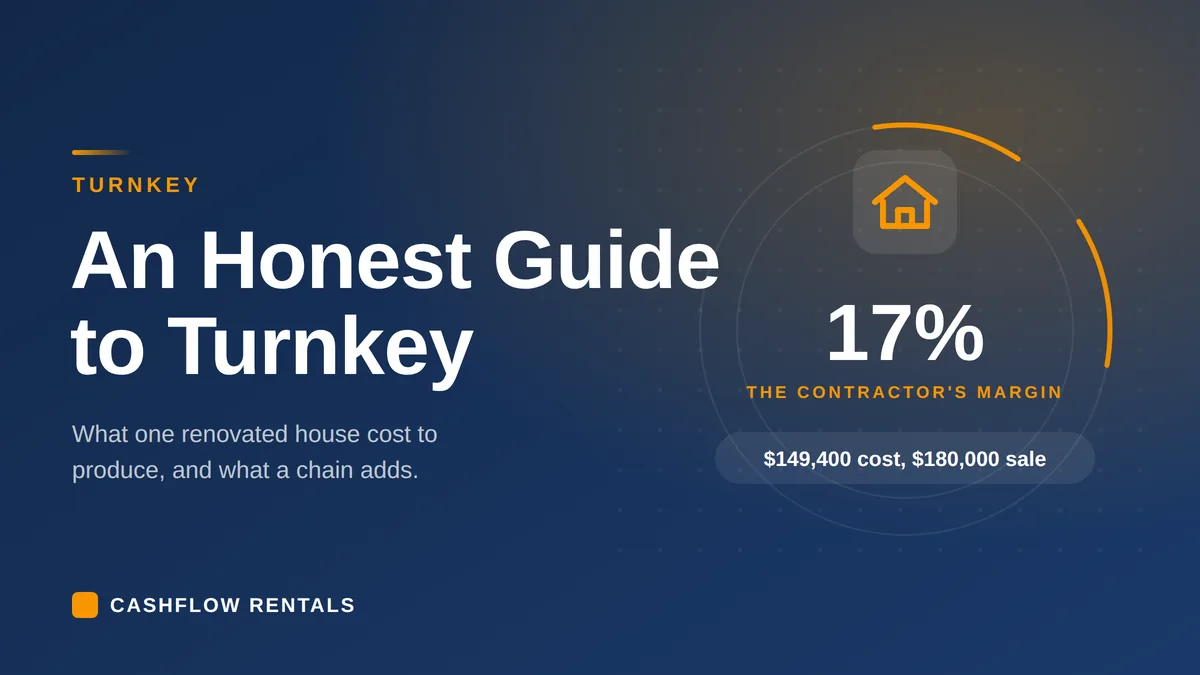
The benchmark is a renovated Midwest single family rental that sold to one of my clients for $180,000. I've set out the build costs from a separate job, line by line, in the honest guide to turnkey investing. Those costs matter here because they show the kind of job a BRRRR buyer takes on.
So this is not one deal audited three ways. The turnkey column is a real purchase. The BRRRR column is a model, built on a separate job's published costs. The direct column stays partly unpriced, because I hold nothing that proves the discount on this house.
I'm paid an advisory fee on the turnkey route, charged to the seller. So the column I earn on is one of the three, and you should weigh everything below accordingly.
What does each route actually mean?
Three different purchases, often described as though they were three levels of effort on the same one.
Turnkey. You buy a finished, usually tenanted house at a retail price, with a manager attached. Somebody else found it, renovated it, let it and appointed the manager.
Buying direct. You buy a house on the open market without a turnkey packager in the middle. It might be finished or it might need light work. You arrange your own inspection, insurance, manager and tenant.
BRRRR. Buy, renovate, rent, refinance, repeat. You buy something cheap and unfinished, pay for the work, let it, then refinance against the improved value to get your capital back out.
The distinction that matters for a foreign buyer isn't effort. It's how much of your money is exposed, for how long, and to what.
What does each one cost in cash?
Here's the same house, three ways.
One $180,000 house, three routes, using the published cost stack | Turnkey | Buying direct | BRRRR |
|---|
| What you pay for the house | $180,000 retail | Market price, without the packager's margin | $50,000, then about $80,000 of work |
| Down payment or project equity | $54,000 at 30% | Similar percentage, lower price | Whatever the bridge lender won't fund |
| Buying costs | $4,842 to $13,554 | Similar | About $2,000, plus refinance costs later |
| Finance and holding during the work | None | None | About $3,900 and $2,500 on this project |
| Cash needed to get started | $64,837 to $73,549 | Lower, by the margin you avoid | Depends entirely on your bridge lender |
| Cash left in once it's let | The same | The same | About $12,400 on these figures |
One convention for the whole article. Every "cash left in" figure is stated before refinance closing costs, which a real deal would add.
Read the last row carefully, because it's the attraction of the BRRRR model.
Build the house for a modeled $138,400. Refinance at 70% of a $180,000 value and the gross loan is $126,000. That leaves about $12,400 the new loan doesn't cover. If both the cost and the value hold up, far less of your money stays in the house.
The buying cost range and the cash figures come from what a non-resident actually pays, measured across four real client deals, and the line items behind them are broken down on three real settlement statements.
And the direct column is genuinely the one I can't fill in.
The saving may be some or all of the packager's margin. But I hold no paper that prices it on this house. What I do hold is the builder's margin on a separate deal, and that is a different number belonging to a different party. So I'd rather leave a gap than invent a discount.
How long until a tenant is paying?
This cost is easy to understate, and on a house with a loan on it, it bites first.
When the rent starts, and who pays until it does | Turnkey | Buying direct | BRRRR |
|---|
| Time to a paying tenant | Potentially immediate if tenanted; otherwise lease-up | Depends on condition and occupancy | Renovation and lease-up before refinance |
| Who carries the mortgage meanwhile | You, briefly or not at all | You | You, on bridge terms |
| Who carries the vacancy risk | You | You | You |
Take a different house in the same market, one I hold every paper for. The builder held it 266 days between buying it and selling it finished. That is one real timeline for a full gut job on a small house, run by a pro, in his own market, with his own trades.
If this is your first one, run from another country, don't plan on beating that. A local pro set it.
Turnkey's honest advantage is here, not in the price. A tenanted one can pay rent at once. A vacant one still has to be let. Either way the building work is done before you own it, and the sequence for buying one you'll never walk into can run in weeks rather than seasons.
What does each route need from you?
Money is the obvious input. It isn't the scarce one.
What each route actually asks of you| What it needs | Turnkey | Buying direct | BRRRR |
|---|
| Cash at the start | Most | Middle | Depends on the lender |
| Your time after buying | About an hour a month in my experience | More, especially early | A lot, for months |
| A contractor you trust | No | Sometimes | Essential |
| A manager you chose | Often introduced with the house | You appoint | You appoint |
| Local market knowledge | Helpful | Important | Essential |
| Tolerance for a bad month | Needed | Needed | Needed most |
The row that decides it for most of my clients is the contractor. A contractor you've never met, in a city you've never visited, on a project you can't inspect, is not a resource. It's an exposure. I've had a manager withhold $50,000 of my money, which I've written up in when your property manager is the biggest risk, and a contractor can go wrong faster and more expensively than that.
If you do have the local team, the case for the middle route gets strong quickly, and how to build an out-of-state rental portfolio is the version of it I'd run.
And whichever route you take, once the house is stabilized the same ownership bills are waiting for you. One turnover cost $9,000 and another $7,000 on two real houses, before the empty weeks, and the roof, the furnace and the water heater come due on their own timetable rather than yours.
Where does each one fail?
Each route has a failure mode I'd worry about most, and knowing which risk you're taking on is a big part of the decision.
One dominant risk per route| Route | The risk I'd watch most |
|---|
| Turnkey | You pay a retail price with several margins in it, on a house you never walked, described by the person selling it |
| Buying direct | You buy badly without enough local knowledge, or the light work turns out not to be light |
| BRRRR | The renovation overruns, or the refinance appraisal lands under your assumption and your capital stays in the house |
Turnkey's pricing risk is unusually visible before you commit. You can independently check the rent, tax, insurance, appraisal, inspection and comparable sales rather than accepting the seller's pro forma. The ten checks you can run without the seller's help cover most of that work, and property tax and insurance are two figures I've repeatedly found worth checking.
BRRRR's valuation risk is different. You can estimate and stress-test the after-repair value in advance, but you can't know what the refinance appraiser will conclude months later.
Which one travels worst across an ocean?
BRRRR, and I say that having done a lot of them when I started out.
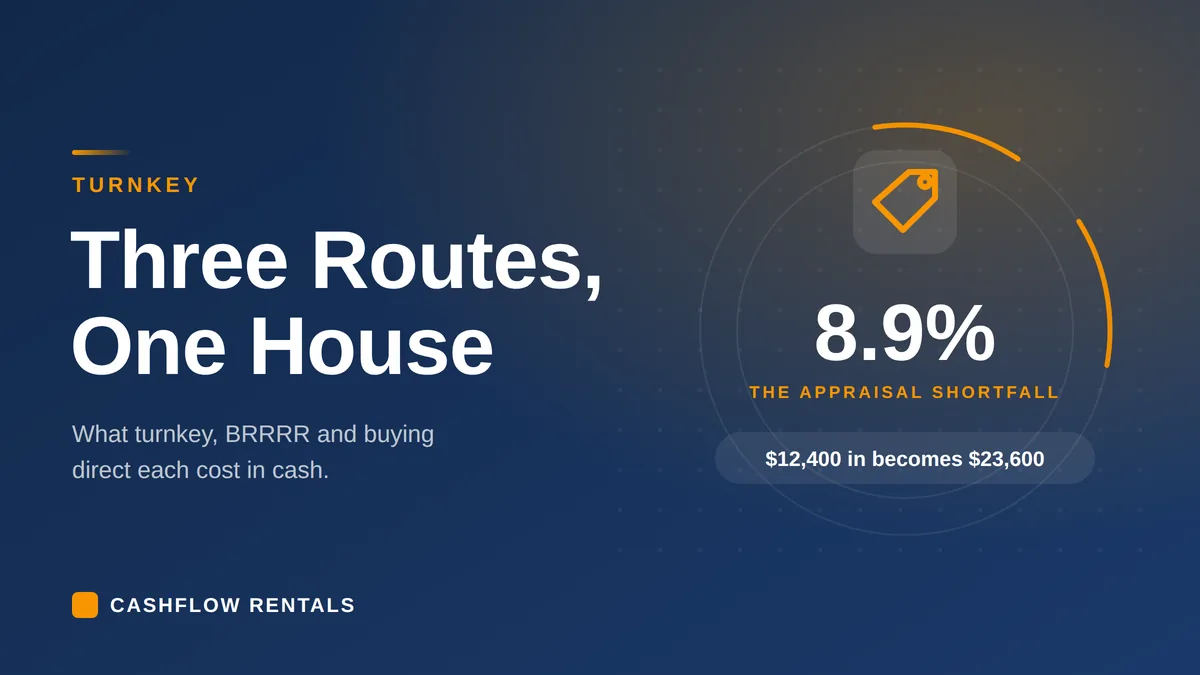
Here's the part that makes it concrete rather than cautious. On a different house I've documented in full, the appraisal came in below the contract price. It was under contract at $174,000, appraised at $163,000, and closed at the appraised value. Against the higher of the two contract figures the same report carries, that's a shortfall of 8.9%.
The buyer was delighted. He paid $11,000 less than he'd agreed.
Now apply that same 8.9% shortfall to a BRRRR on our $180,000 house.
What an 8.9% appraisal shortfall does to a BRRRR on one house | Appraisal lands at $180,000 | Appraisal lands 8.9% lower |
|---|
| Refinance valuation | $180,000 | About $164,000 |
| Cost to produce | $138,400 | $138,400 |
| Refinance at 70% | $126,000 | About $114,800 |
| Modeled project capital left in, before refinance costs | $12,400 | About $23,600 |
So the same appraisal shortfall that reduced the turnkey buyer's purchase price by $11,000 would leave a BRRRR investor with about $11,200 more modeled project capital in the house before refinance costs. Identical event, opposite effect, because one buyer was purchasing at the appraisal and the other would be borrowing against it.
That's why I think BRRRR is the strategy that travels worst. You're managing a contractor you've never met, in a currency you don't earn, on a timetable you can't police. And the exit still rests partly on an appraiser's opinion of value that you don't control, which is a document worth understanding properly before you build a plan on it. The mechanics of the bridge-to-refinance version are in how a DSCR loan compares with hard money.
Some people do it well from abroad. The ones I've seen succeed already knew how to run a renovation before they tried doing it from another continent.
What would I do today?
It depends on which of the three scarce things you actually have, and it isn't usually the money.
If I had cash and no local team and this were my first US purchase from abroad, I'd lean turnkey. You're paying a visible margin to compress a year of relationship-building into a month of paperwork. That's a trade I'd seriously consider. Ronald is the case in point. He's in Ottawa, he had the money and no team, and he wanted the buying done properly rather than done by him.
If I already had a trusted local team and the time to use it, I'd look hard at buying direct. You'll pay less for the house and more in attention. I've seen clients move this way on later purchases once the local relationships are real.
If I had the cash, team and renovation experience, BRRRR could offer the greatest capital efficiency, and the widest range of outcomes. I'd do it in a market I knew, with trades I'd used, and model the refinance at a value below my assumption rather than at it.
And if what appeals is an older house rather than a project, that's a different question again, and often a good instinct. What actually predicts maintenance risk on an older rental is the condition of the components rather than the year built.
Whichever route you take, run it on your own figures rather than anybody's spreadsheet. The rental property cash flow calculator does that in a couple of minutes, and budget for the costs a pro forma leaves out before you compare returns. If you'd rather hand off the finding and the checking, that's the sourcing work I do, and the foreign investor starter kit has the checklists free.
The bottom line
The three routes are not three levels of effort. They're three different bets.
Turnkey bets that a competent operator's margin is cheaper than your own learning curve. On a first purchase from another country, that's a trade I'd make. What you're buying is time and a team, at a price you can see.
BRRRR bets that the renovation cost and refinance valuation land close enough to your assumptions. When they do, the model can leave much less of your capital tied up in the finished house. When they don't, the opposite happens. My documented appraisal example shows why I'd stress-test that exit rather than build the model at the target value.
Buying direct is a route I've seen experienced clients move toward once they've built their own local relationships. It just isn't necessarily where somebody should start.
So don't pick the route by the return in the pitch. Pick it by which of cash, time and local knowledge you genuinely have, and by which failure mode you could absorb. Investing isn't about certainties. It's about shifting the probabilities, and the cheapest way to shift them here is to be honest about which of the three things you're short of.
This article is general information, not legal, tax or financial advice. David Garner is a property investor and is not a lawyer, tax adviser, accountant or investment adviser. Cashflow Rentals is a real estate consultancy, not a real estate broker, and is not a lender or investment adviser. Cashflow Rentals is paid an advisory fee, charged to the renovating contractor, on the turnkey properties it introduces to clients, so one of the three routes compared here is the one it earns on, which should be weighed against everything in this article. The cost stack used for the BRRRR column is one real project's costs as already published, excluding the advisory fee a self-managed investor would not pay, and the renovation figure within it is an estimate rather than a measured cost. The refinance illustrations are arithmetic on stated assumptions, not forecasts, and no lender has quoted on them. Buying cost percentages come from four real client transactions in 2025 and 2026 and are not a market average. Always take advice from a qualified professional before buying.